
Step-by-Step Guide to Launch a White-Label AI Automation Service for Your Agency

How to start an AI automation agency? Begin by selecting a reliable AI platform, defining a fixed-scope pilot, signing a white-label contract that protects your brand, and then delivering the pilot on a tight turnaround. Once the client sees results, you transition to a retainer or larger project while keeping the partnership invisible to the end-user.
Key takeaways
- Choose a cloud AI provider with strong enterprise SLAs and pricing that fits $2-5k pilot budgets.
- Use a white-label contract that includes NDA, non-circumvent, brand-only delivery and clear payment terms.
- Price pilots as fixed-scope, time-boxed projects (e.g., $3,000 for a 3-week chatbot) to de-risk both sides.
- Keep delivery capacity low (1-2 active partners) to maintain reliability and avoid becoming a flaky freelancer.
- Offer a shared status dashboard instead of a full SaaS portal until you have recurring revenue.
- Market the new service through case studies, email sequences and a dedicated landing page that speaks to "we can build it for you under your brand".
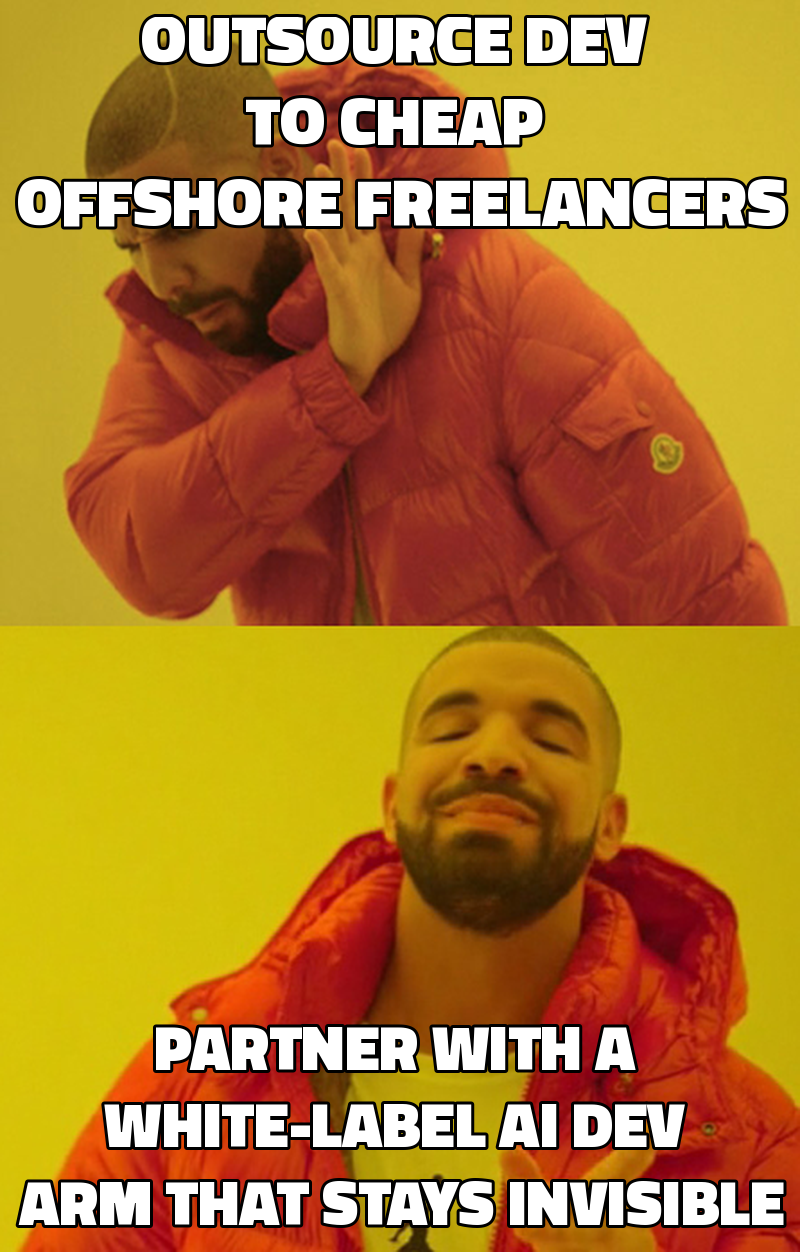
What tech stack should a small agency choose for white-label AI automation?
When you have no in-house developers, the stack must be plug-and-play, have generous free tiers for prototyping and provide clear pricing for production. Below is a comparison of the four most common cloud AI providers used by agencies in 2024.
| Provider | Model focus | Pricing (USD per 1 M tokens) | Integration ease | Enterprise support |
|---|---|---|---|---|
| OpenAI (ChatGPT, GPT-4o) | General purpose, chat, code | $15 (GPT-4o) – $5 (GPT-3.5) | SDKs for Python, Node, REST | Dedicated account manager for Enterprise tier |
| Anthropic (Claude 3) | Safe, instruction-following | $12 (Claude 3 Haiku) – $30 (Sonnet) | Simple HTTP API, Python client | 24/7 Slack support for Business plan |
| Google Vertex AI | Multimodal, structured data | $10 for Gemini Pro | AutoML UI, Terraform modules | SLA-backed response times for Cloud customers |
| Azure OpenAI | Azure ecosystem integration | $13 for GPT-4o | Azure Functions, Logic Apps | Microsoft Enterprise Agreement benefits |
Why OpenAI leads for most agencies: its pricing aligns with the $2-5k pilot range, the documentation is the most extensive, and the ecosystem includes fine-tuning and function calling that reduce custom code. If your agency already uses Microsoft 365, Azure OpenAI may simplify IAM.
Supporting tools
- Zapier or Make for no-code workflow orchestration when the AI output needs to trigger emails, CRM updates or Slack messages.
- Supabase for a low-code PostgreSQL backend that can store user data without managing servers.
- Vercel for instant front-end deployments of React or Next.js UI that calls your AI API.
- GitHub Actions for CI/CD pipelines that run tests on every push, keeping code quality high even when you have a single developer.
How to draft a partner contract that protects brand and margin?
A white-label agreement must balance three goals: keep the agency’s brand front-and-center, guarantee you get a wholesale margin, and limit legal exposure. Below is a checklist of essential clauses with sample language.
| Clause | Purpose | Typical language example |
|---|---|---|
| Non-Disclosure (NDA) | Protect client data and proprietary prompts | "Both parties shall treat all project information as confidential and shall not disclose it to any third party without prior written consent." |
| Non-Circumvent | Prevent the agency from bypassing you for the client | "The Agency agrees not to engage directly with the Client for any services covered by this Agreement without the Provider’s written approval for a period of twelve months." |
| Brand-Only Delivery | Ensure the agency’s name appears on all deliverables | "All final deliverables shall be branded with the Agency’s logo and shall not contain any reference to the Provider, except in internal documentation." |
| Scope & Acceptance | Define what is included in the pilot and how sign-off occurs | "The Provider shall deliver a functional prototype as described in Exhibit A. Acceptance shall occur when the Agency confirms in writing that the prototype meets the acceptance criteria within five business days." |
| Pricing & Payment | Set wholesale rate, margin and invoicing schedule | "The Agency shall pay the Provider a wholesale fee equal to fifty-five percent of the gross client invoice for each project, payable within thirty days of client payment." |
| Liability & Indemnification | Limit risk for both parties | "Each party shall indemnify the other against third-party claims arising from breach of this Agreement, subject to a cap of the total fees paid under this Agreement." |
| Term & Termination | Define partnership length and exit conditions | "Either party may terminate with thirty days’ written notice. Upon termination, all work in progress shall be completed and delivered, and any prepaid fees shall be refunded on a pro-rated basis." |
Practical tip: keep the contract under ten pages. Agencies rarely read long legal documents; a concise, bullet-point style increases the chance they sign quickly.
What pricing model balances risk and profit for pilot projects?
Agencies fear over-promising and under-delivering. A fixed-scope pilot with a clear deliverable removes ambiguity. Use the following pricing framework:
- Discovery & Scoping (Free or low-cost) – Offer a 2-hour paid discovery call ($250) that results in a scoped proposal. This filters serious buyers.
- Pilot Build – Fixed price between $3,000-$5,000 for a 3-week delivery of a minimum viable AI solution (e.g., a chatbot, an email-automation workflow, or a voice-assistant prototype).
- Success Bonus – Optional 10-15 % of the client’s eventual full-project budget if the pilot converts to a larger engagement.
- Retainer – After the pilot, propose a monthly retainer of $1,500-$2,500 for 15-20 hours of ongoing escalation, bug fixes and feature extensions.
Why this works: The pilot price covers your engineering time (≈ $120-$150/hr for a senior AI developer) and leaves a 55-70 % margin as defined in the deal shape. The success bonus incentivizes the agency to upsell without you having to chase new business.
Which operational processes keep delivery reliable at low concurrency?
Your competitive edge is reliability. With only a handful of active partners, you can guarantee turnaround times that offshore freelancers cannot match.
1. Intake Form & Automated Triage
Create a Google Form or Typeform that captures: client name, project description, AI use-case, expected volume, deadline, and budget range. Use Zapier to push the data into a Notion board where each partner sees only their own tickets.
2. Fixed Turnaround Bands
Define a standard delivery window: Simple chatbot – 10 business days, Complex workflow – 21 business days. Publish these bands on the partner portal so agencies set realistic expectations with their clients.
3. Single Point of Contact (SPOC)
Assign one senior developer (you or a lead contractor) as the SPOC for each partner. This person owns the Jira ticket, runs daily stand-ups with the partner’s delivery lead and ensures no hand-off gaps.
4. Quality Gate Checklist
Before any build is shipped, run the following checklist:
- Unit tests pass ≥ 80 % coverage.
- Prompt engineering is documented in a shared Confluence page.
- End-to-end functional test performed in a staging Vercel preview.
- Security scan with OWASP ZAP for any exposed endpoints.
5. Status Dashboard (MVP)
Use a public Notion page or a simple Airtable view that shows: project name, stage (scoping, building, testing, delivered), expected delivery date, and a link to the live preview. Avoid building a custom SaaS dashboard until you have at least three recurring partners.
How to market the new AI automation service to existing clients?
Your agency already has trust relationships; leverage them.
- Case Study Launch – After the first successful pilot, write a one-page case study titled “How X Agency Delivered a 30 % sales lift with a custom AI chatbot built under their brand.” Include metrics: 1,200 monthly active users, 2.3 × reduction in support tickets.
- Email Sequence – Send a three-email series to your client list: (a) problem awareness ("Your competitors are automating lead capture"), (b) solution teaser ("We now offer AI-powered automation under your brand"), (c) call-to-action (free discovery call).
- Landing Page – Build a single-page site on Webflow with sections: Pain points, How it works, Pricing tiers, and a short video demo. Use the keyword “white-label AI automation for agencies” to capture organic traffic.
- Partner Webinar – Host a 30-minute live demo with a current partner (with permission) showing the end-to-end flow from prompt design to Vercel deployment. Record and repurpose the video for YouTube and LinkedIn.
- Referral Incentive – Offer a 5 % commission on the first $10 k of any new partner they refer. This turns satisfied agencies into a sales engine without a dedicated SDR.
Measuring Success
Track the following KPIs for the first 90 days:
- Number of discovery calls booked (target ≥ 8 per month).
- Pilot conversion rate (goal ≥ 50 %).
- Average time from scoping to delivery (stay within defined bands).
- Gross margin per pilot (aim for 55-70 %).
- Retainer uptake after pilot (≥ 30 %).
By focusing on these metrics you can iterate the process quickly and prove the model’s scalability to future partners.
Frequently asked questions
How long does it take to deliver a pilot chatbot?
A typical pilot chatbot that handles FAQ and lead capture can be delivered in ten business days, assuming the agency provides clear prompts and branding assets up front. This timeline includes discovery, prompt engineering, integration with a no-code front-end and a single round of client feedback.
What if the agency’s client wants a custom UI?
You can use a low-code front-end framework like Webflow or Bubble that connects to the AI via REST. The agency supplies the design mock-ups, you implement the API calls, and the final UI is branded with the agency’s logo, keeping the development invisible.
Do I need to hire a full-time developer?
No. Start with a senior freelance AI engineer on a retainer (≈ $150-$200 hr) who can handle the first three pilots. As you add partners, you can transition to a small in-house team or keep a vetted contractor pool.
How do I protect my IP when the agency can see the code?
Deliver the solution as a hosted service (Vercel preview, Supabase backend) and provide the agency with only the URL and API keys. The source code remains in a private GitHub repository accessible only to you.
What if the client asks who built the solution?
Your contract’s Brand-Only Delivery clause obliges the agency to present the work as its own. If the client asks, the agency can simply say “our development partner handled the technical implementation,” which does not breach the agreement.
Can I scale beyond five partners?
Yes, but only after you have documented SOPs, automated the intake workflow and possibly built a lightweight partner portal. Keep the active partner count below ten until you have a dedicated project manager to maintain reliability.
Are there regulatory concerns with AI in marketing?
Depending on geography, GDPR (EU/UK) and CCPA (California) require transparent data handling. Use providers that offer data residency options (e.g., Azure in the EU) and include a data-processing addendum in your contract.
How do I price larger projects after the pilot?
Apply a tiered model: Phase 1 – Discovery ($2k), Phase 2 – Build ($5-$10k per feature set), Phase 3 – Ongoing support (retainer $1.5k-$2k/mo). Quote based on the number of AI calls, custom integrations and UI complexity, always keeping a 55-70 % margin.
AI automation
Have something to build?
Tell us what you're trying to ship. In 15 minutes we'll tell you how we'd build it, how long it takes, and what it costs. No pitch deck, no pressure.