
Step-by-Step Checklist for Safely Onboarding a White-Label Development Partner

How to white label software? 1) Choose a vetted development studio that will build under your brand, stay invisible to the client, and deliver on a fixed-scope pilot; 2) Sign a non-disclosure and non-circumvent agreement, run a paid pilot, then lock in a wholesale rate and retainer for ongoing overflow. 3) Embed the partner in your project pipeline with shared tools, clear SLAs, and a single point of contact.
Key takeaways
- Run a paid, fixed-scope pilot before any long-term commitment.
- Use a wholesale rate contract with clear margin caps (50-70%).
- Require a single accountable liaison from the dev partner.
- Protect your brand with NDA, non-circumvent, and white-label clauses.
- Integrate shared dashboards (Notion, ClickUp) for real-time status visibility.
- Set fixed turnaround windows to avoid “fastest possible” overpromises.
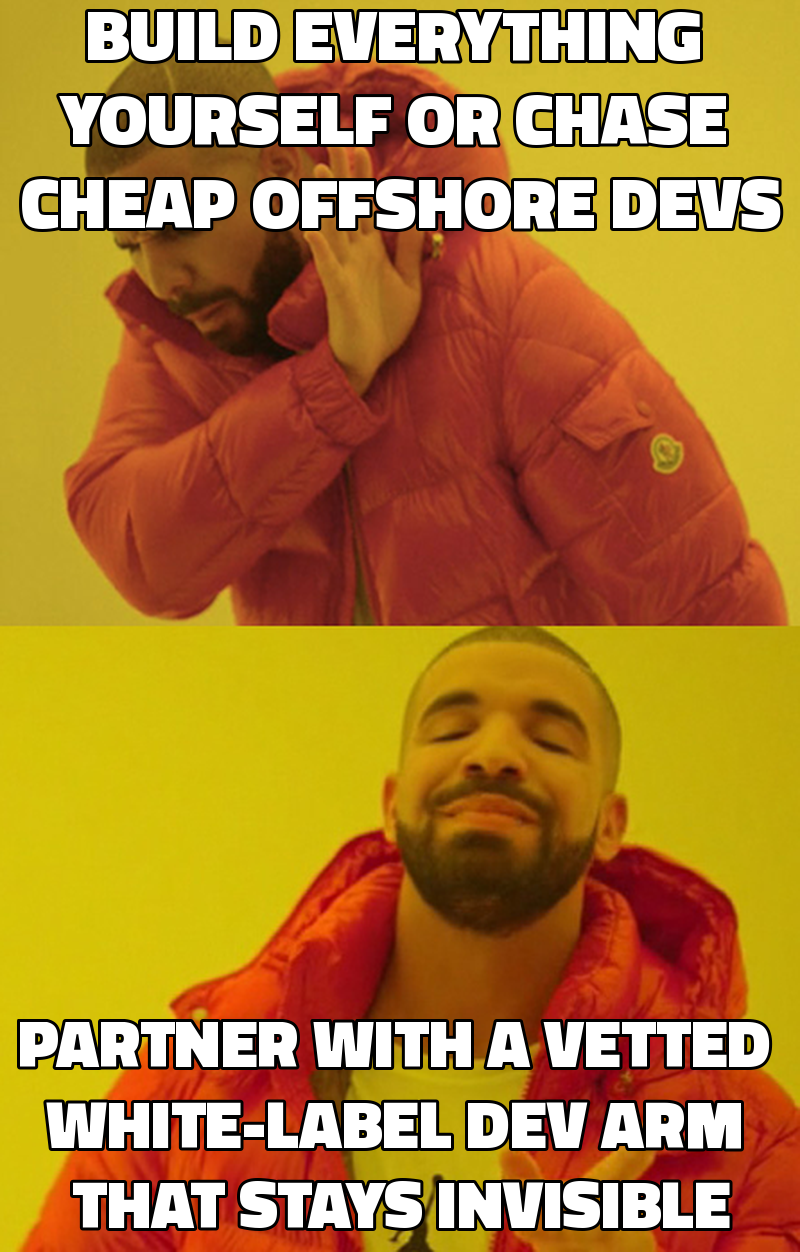
What is white-label development and why agencies need it?
White-label development means a third-party studio builds custom software, AI automation, voice bots, or backend services, but delivers the finished product under the agency’s brand. The agency retains the client relationship, pricing, and margin while the developer stays invisible. For agencies of 5-15 people in the US, UK, or AU, this model solves three core pain points:
- Lost revenue – Agencies turn away requests for custom tools because they lack in-house engineers.
- Brand risk – Clients often fear that the agency is outsourcing; a white-label partner signs NDAs and non-circumvent clauses to keep the agency front-and-center.
- Operational chaos – Freelance or offshore devs ghost projects, miss deadlines, and damage the agency’s reputation.
According to a 2023 Gartner survey, 68% of boutique marketing agencies plan to add development services within two years to improve client retention. The same study notes that agencies that partner with a single vetted dev arm see a 15% increase in average project size.
The biggest risks of a bad white-label partner
| Risk | Impact on agency | How the checklist mitigates it |
|---|---|---|
| Missed deadlines | Lost client trust, revenue churn | Fixed-scope pilot with SLA-backed delivery dates |
| Quality gaps (bugs, UI inconsistency) | Reputation damage, re-work costs | Mandatory QA checklist, shared staging environment |
| Brand exposure (partner’s logo appears) | Client perceives agency as a reseller | NDA + white-label clause, branding guidelines attached |
| Scope creep / hidden fees | Margin erosion | Detailed SOW with capped hours, transparent cost sheet |
| Data security breaches | Legal liability, client loss | GDPR/CCPA compliance clause, encrypted repo access |
Step-by-step onboarding checklist
1. Pre-qualification
- Run the 10-second site test: verify “development” is not listed on the agency’s services page.
- Check trigger signals: recent dev job post, case study showing a platform deliverable, or public statement about needing a partner.
- Confirm headcount (5-15) and geography (US/UK/AU) using LinkedIn or Crunchbase.
2. Legal safeguards
- NDA – standard 2-year confidentiality, signed by both parties.
- Non-circumvent – prohibits the agency from hiring the dev team directly for 12 months.
- White-label addendum – specifies that all deliverables bear the agency’s branding only.
- Service Level Agreement (SLA) – defines response time (24 h), delivery windows (e.g., 2-week turnaround for pilots), and bug-fix windows (5 business days).
- Data protection clause – requires ISO-27001-aligned processes if personal data is handled.
3. Pilot design
- Scope: choose a low-risk, high-visibility feature (e.g., a chatbot prototype or a single-page dashboard).
- Budget: $2,000-$5,000, matching the deal_shape minimum floor of $1,500.
- Timeline: 2-3 weeks from kickoff to demo.
- Success criteria: functional demo, client sign-off, no critical bugs, and documented hand-off.
- Payment: 50% upfront, 50% on acceptance – proves commitment from both sides.
4. Communication & tooling alignment
| Tool | Agency use | Dev partner use | Integration tip |
|---|---|---|---|
| Project manager | ClickUp, Asana, Monday.com | ClickUp (shared workspace) | Create a shared folder with read-only access for the agency’s PM |
| Code repository | GitHub (private org) | GitHub (branch per project) | Add agency’s lead dev as a collaborator with read-only rights |
| Design assets | Figma, Sketch | Figma (shared team) | Use Figma libraries for brand components to keep UI consistent |
| Communication | Slack (agency channel) | Slack (partner channel) | Set up a dedicated #white-label-dev channel for real-time updates |
| Status reporting | Notion dashboard | Notion (view-only) | Build a simple status page with Milestones, Current Sprint, Risks |
5. Technical hand-off standards
- Requirements template – include user stories, acceptance criteria, API contracts, and branding assets.
- Version control policy – feature branches, pull-request reviews by agency’s lead, mandatory CI checks.
- Staging environment – a shared URL with password protection for client demos.
- Documentation – auto-generated Swagger/OpenAPI for APIs, README with deployment steps.
- Post-launch support – 2 weeks of bug-fix coverage included in pilot; optional retainer thereafter.
6. Pricing and margin calculation
- Wholesale rate: agency pays 30-50% of the dev partner’s billable rate (deal_shape 50-70% share).
- Retainer: $1,500-$2,500 per month for 15-20 dev hours, covering escalation and minor tweaks.
- Margin guardrail: ensure each project’s gross margin stays above 40% after dev costs, licensing, and platform fees.
- Invoice flow – agency invoices client at full price, then pays partner a wholesale invoice within 30 days.
7. Ongoing governance
- Quarterly review – KPI dashboard with on-time delivery %, bug-fix turnaround, and margin.
- Escalation path – dedicated account manager at the dev partner, plus a backup senior engineer.
- Capacity caps – limit active partners to 8-10 agencies to keep concurrency low and reliability high.
- Feedback loop – after each project, collect a 5-question NPS survey from the agency’s client (if allowed) to measure satisfaction.
Contract and legal comparison table
| Clause | Standard outsourcing (no-brand) | White-label partnership (our model) |
|---|---|---|
| Branding | Partner’s logo appears on deliverables | Agency’s brand only, white-label addendum |
| Pricing | Cost-plus or hourly rates, no margin control | Wholesale rate + fixed-scope pilot, margin 50-70% |
| Liability | Partner liable for bugs only | Agency retains full liability to client, partner liable to agency per SLA |
| Termination | 30-day notice, no penalty | 60-day notice, repayment of prepaid pilot fees |
| Data security | Basic confidentiality | GDPR/CCPA compliance, encrypted repos, audit rights |
Integrating the partner into your agency workflow
- Kickoff meeting – agency’s Account Director, Delivery Lead, and the dev partner’s Project Lead align on scope, timeline, and branding.
- Shared backlog – use ClickUp to create a “White-Label Dev” list; each item includes a link to the requirement doc and design mockup.
- Sprint cadence – two-week sprints with a demo day; agency invites the client to the demo to keep the relationship front-and-center.
- Quality gate – before any release, the agency’s QA lead runs a checklist: functional test, UI branding audit, performance benchmark (e.g., page load <2 s per Google Lighthouse).
- Client delivery – agency packages the final build in a branded zip or deploys to the client’s hosting, adds a “Built by [Agency]” footer, and sends a post-project report.
Real-world example: RouteMate pilot
- Client need: a SaaS platform for internal workflow automation.
- Pilot scope: MVP with user authentication, task board, and email notifications.
- Timeline: 3 weeks, $4,200 fixed price.
- Outcome: Delivered on day 20, zero critical bugs, agency kept 60% margin, client signed a $12k retainer for quarterly enhancements.
- Key lesson: A small, paid pilot builds trust faster than a “free draft” and protects both parties from scope creep.
Common pitfalls and how the checklist avoids them
| Pitfall | Symptom | Checklist safeguard |
|---|---|---|
| Ghosting after hand-off | No updates for >1 week | SLA response time 24 h, Slack channel dedicated |
| Hidden fees | Invoice spikes after pilot | Detailed SOW with capped hours, transparent cost sheet |
| Brand leakage | Partner’s logo appears in UI | Branding guidelines clause, final UI sign-off by agency |
| Data breach | Client data exposed | GDPR clause, encrypted repo, limited access tokens |
| Scope creep | Project expands without extra budget | Change-order process defined in contract, hourly cap for pilot |
Tools you should already have (or adopt quickly)
- Project management: ClickUp or Asana (shared workspace).
- Design collaboration: Figma with shared libraries.
- Code hosting: GitHub organization with protected branches.
- Communication: Slack channel + weekly 15-minute stand-up.
- Status dashboard: Notion page with embedded ClickUp view.
- Billing: QuickBooks or Xero with custom invoice template showing “Partner services – wholesale rate”.
Final checklist (downloadable one-pager)
- Verify agency size and lack of dev staff.
- Run 10-second site test.
- Confirm trigger signals.
- Sign NDA, non-circumvent, white-label addendum.
- Define pilot scope, budget, timeline.
- Align tools (ClickUp, GitHub, Figma, Slack).
- Set SLA metrics (response, delivery, bug fix).
- Execute pilot, collect client sign-off.
- Review pilot KPI (on-time %, margin, NPS).
- Move to retainer or project-by-project model.
"A pilot is not a test of the market, it is a test of trust between two partners." – internal Synthisia playbook
Frequently asked questions
How do I protect my agency’s brand when using a white-label developer?
The contract must include a white-label addendum that obligates the developer to remove any branding, use only the agency’s color palette and logo, and label all deliverables as the agency’s work. Additionally, run a final UI audit before client hand-off and keep all public-facing assets under the agency’s control.
What is a reasonable pilot budget for a first project?
A pilot should be sized between $2,000 and $5,000, matching the deal_shape minimum floor of $1,500 but providing enough margin to cover the developer’s cost and a small profit. This range aligns with industry data from Forrester that shows 70% of agencies choose pilots in the $2k-$4k band to balance risk and validation.
How many active white-label partners can I manage without hurting reliability?
Synthisia caps active partners at 8-10 agencies to keep concurrency low. With a 15-hour weekly capacity per partner, this ensures each project receives dedicated attention and avoids the flaky-freelancer reputation.
What SLAs should I negotiate with the dev partner?
Key SLAs include: response time within 24 hours, fixed-scope delivery within the agreed sprint (usually 2-3 weeks), critical bug fix within 5 business days, and a 99% uptime guarantee for any hosted staging environment. These numbers are based on a 2022 PwC benchmark for high-touch B2B services.
Can I charge my client a higher price than the wholesale rate?
Yes. The wholesale model expects the agency to keep 50-70% of the client invoice as margin. For example, if the dev partner’s wholesale cost is $3,000, the agency can invoice $5,000-$6,000, covering their expertise, project management, and profit.
How do I handle data privacy when the dev partner accesses client data?
Include a GDPR/CCPA compliance clause, require encrypted data transfer, and limit repository access to read-only where possible. Conduct a brief security audit before the first hand-off and request a SOC 2 Type II report if the partner handles sensitive data.
What if the partner misses a deadline?
The SLA should specify a penalty clause, such as a 5% discount on the overdue milestone. Additionally, maintain a backup resource (a vetted freelance) to step in if the partner consistently under-delivers.
How often should I review the partnership performance?
Conduct a formal review every quarter, measuring on-time delivery %, bug-fix turnaround, client NPS, and margin variance. Use the review to adjust pilot scope, renegotiate rates, or, if needed, replace the partner.
white‑label
Have something to build?
Tell us what you're trying to ship. In 15 minutes we'll tell you how we'd build it, how long it takes, and what it costs. No pitch deck, no pressure.