
Step-by-Step Roadmap to Launch a White-Label AI Automation Service for Small Agencies

How to start an AI automation agency? First, lock in a trusted white-label development partner that can deliver AI, voice and custom backend work under your brand. Next, create a small fixed-scope pilot package that solves a common client problem, price it to cover costs and leave margin, and finally sell it through your existing agency sales channels while keeping the client relationship fully yours.
Key takeaways
- Secure a white-label dev partner with proven AI automation delivery (e.g., Synthisia, RouteMate).
- Start with a $2,000-$5,000 pilot that proves value and builds trust.
- Use a wholesale pricing model: you keep 50-70% of the agency bill.
- Protect your brand with NDA and non-circumvent clauses, but focus on reliability, not price.
- Automate intake, status reporting and billing to stay lean.
Why white-label AI automation fits small agencies
Small marketing, SEO and branding shops often sell strategy, content and paid media but lack the technical depth to build chatbots, workflow automations or voice assistants. According to Gartner, 70% of SMBs will adopt AI automation within the next two years, yet only 20% of agencies currently offer it. This creates a clear revenue gap. By partnering with a specialist dev studio you can fill that gap without hiring a full-time engineer, keep the client relationship intact, and add 15% higher client retention as Forrester reported for agencies that expanded into AI services.
Step 1: Validate the market and your own fit
- Run the 10-second site test: visit the agency website, check the Services page. If "development" is missing but client case studies mention platforms, APIs or automation, you have a fit.
- Confirm the agency size (5-15 people) and geography (US, UK, AU) using LinkedIn company data.
- Ask three discovery questions on a short email or LinkedIn message:
- "Do you ever turn away client requests for chatbots or custom dashboards?"
- "What is the biggest technical hurdle you face today?"
- "Would a fixed-price pilot help you win the deal?" If the answers indicate recurring overflow, move to the next step.
Step 2: Choose the right white-label partner
| Criterion | Minimum Requirement | Ideal Example |
|---|---|---|
| AI expertise | Proven projects with GPT-4, Whisper or custom ML pipelines | Synthisia (RouteMate SaaS) |
| Delivery reliability | 95% on-time rate on last 20 projects | RouteMate team |
| NDA & non-circumvent | Signed standard agreement, no poaching clause | Standard legal template |
| Capacity | 15-20 dev hours per week per partner (capped) | 1-2 senior engineers |
| Pricing transparency | Wholesale rate 50-70% of agency bill | $1,500-$3,500 per $5,000 project |
When evaluating, ask for a recent case study that matches your target client (e.g., a local retailer chatbot). Verify the partner can deliver within a 2-4 week window for a $3k pilot. Avoid partners that promise "fastest possible" without a defined turnaround – it leads to scope creep.
Step 3: Design a pilot product that sells fast
A pilot should be:
- Specific: a single chatbot, an email-to-CRM automation, or a voice-enabled FAQ.
- Bounded: no more than 3 user flows, 1 integration point, and a 2-week delivery guarantee.
- Valuable: solves a pain that the agency’s client has already expressed (e.g., reducing support tickets by 30%).
- Scalable: can be turned into a retainer after the pilot.
Pilot pricing worksheet
| Item | Cost to you (USD) | Suggested agency price (USD) |
|---|---|---|
| Dev hours (15 hrs @ $120/hr) | $1,800 | $3,000 |
| Project management (2 hrs @ $80/hr) | $160 | $500 |
| Overhead & margin | $140 | $500 |
| Total | $2,100 | $4,000 |
The agency keeps $1,900-$2,000 margin (≈50-55%). Offer a Free Scoped Proposal instead of a free build: a 2-page PDF with wireframes, tech stack and timeline, priced at $0 but limited to 4 hours of work.
Step 4: Build the sales and delivery workflow
- Lead capture – add a "Need a custom AI tool?" button to the agency website that routes to a Calendly slot.
- Qualification call – run the three-gate script (Volume, Budget, Live need). Record answers in a shared Google Sheet.
- Proposal generation – use a templated proposal in PandaDoc that pulls client name, pilot scope and delivery dates.
- Project dashboard – start with a simple Notion board shared with the agency. Columns: Backlog, In-Progress, Review, Delivered. Avoid building a full SaaS dashboard until you have at least three paying partners.
- Delivery hand-off – the white-label partner receives a concise brief: user stories, API keys, branding assets. They deliver a zip file and a short video walkthrough.
- Feedback loop – schedule a 30-minute demo with the agency and their client. Capture NPS; use it to upsell a retainer.
Step 5: Price, contract and protect your brand
- Wholesale contract: agency pays you a fixed rate per project (e.g., $2,500 for a $5,000 build). Include a clause that the agency must credit your brand internally if asked.
- Retainer model: after a successful pilot, propose a $1,500/month retainer covering 15-20 dev hours for ongoing tweaks, new automations or bug fixes.
- Legal safeguards: standard NDA, non-circumvent, and a “brand invisibility” clause stating you will not contact the end client directly.
- Margin monitoring: use a simple spreadsheet to track actual dev hours vs forecast. Adjust wholesale rates quarterly based on cost changes.
Step 6: Launch, iterate and scale
- Pilot rollout – target 3 agencies in the first month. Aim for a conversion rate of 40% from pilot to retainer.
- Case study creation – after each successful pilot, co-author a case study with the agency. Publish on both sites, tag the client (with permission), and add to LinkedIn.
- Referral program – give the agency a 5% discount on their next pilot for every new partner they refer.
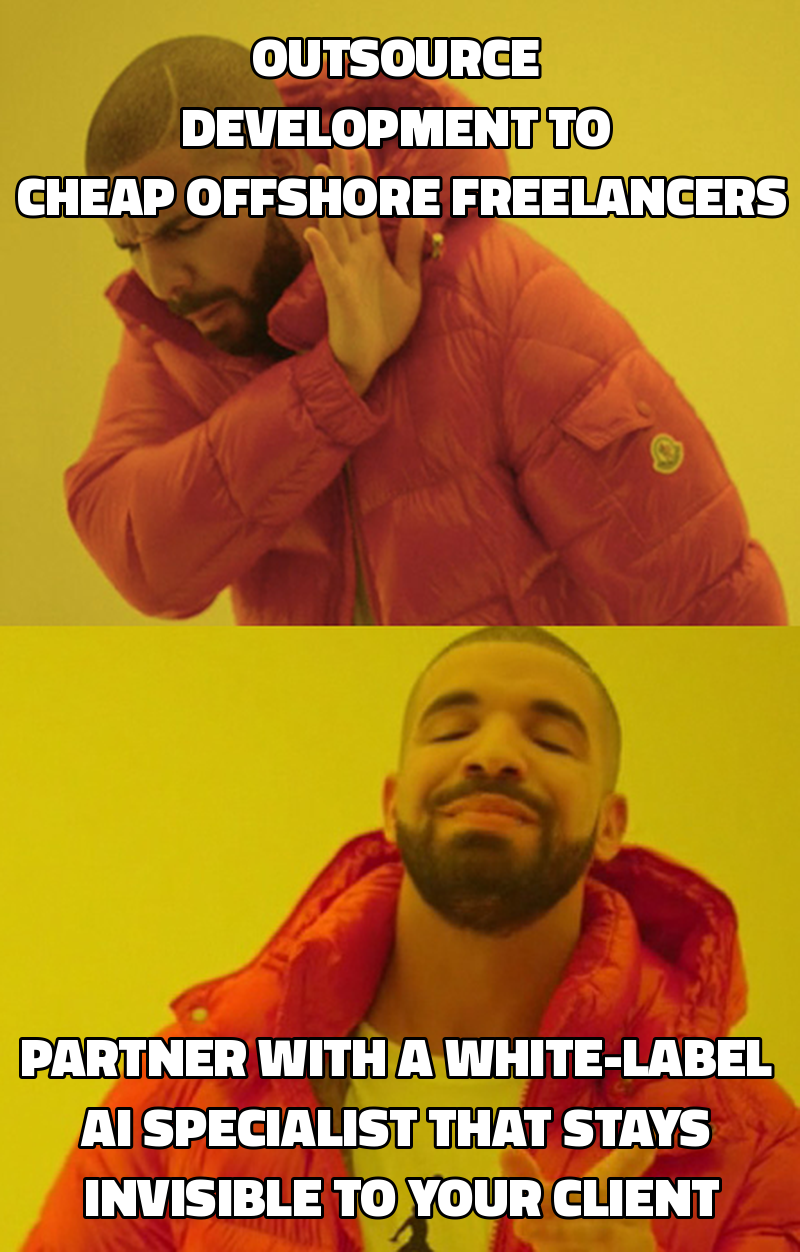
- Capacity cap – limit active partners to 8-10 at any time. This preserves the reliability edge that differentiates you from cheap offshore freelancers.
- Automation of admin – integrate Stripe for invoicing, Zapier for onboarding tasks, and HubSpot for CRM tracking.
- Review quarterly – assess pilot profitability, client satisfaction, and partner performance. Tweak scope limits, turnaround bands, or pricing as needed.
Comparison of partnership models
| Model | Agency control | Your brand exposure | Typical margin | Risk level |
|---|---|---|---|---|
| White-label (this guide) | High – agency sells under its own name | Invisible – NDA protects you | 50-70% of bill | Medium – depends on partner reliability |
| Reseller (you sell directly) | Medium – you handle client communication | Visible – you are the vendor | 30-40% of bill | High – you must manage sales and support |
| Offshore freelancer pool | Low – agency has little oversight | Visible – freelancers may be listed | 20-30% of bill | Very high – turnover and quality issues |
By keeping the white-label model, you leverage the agency’s existing sales engine while you focus on delivery excellence.
Frequently asked questions
How long does it take to launch the first pilot?
Typically 2-4 weeks from the first qualified lead. Week 1 is discovery and scoped proposal, week 2 is development hand-off to the partner, and weeks 3-4 cover build, review and delivery. Setting a fixed turnaround builds credibility and prevents scope creep.
What if the agency already has a dev partner?
Ask what the current partner cannot do. If they lack AI, voice or custom backend expertise, you fill that niche. Position your offering as a specialized overflow layer rather than a replacement.
How do I protect my intellectual property when the partner works under my brand?
Use a standard NDA that covers all project artefacts and a non-circumvent clause that prohibits the partner from contacting the end client directly. Keep branding assets (logos, style guides) in a shared folder with read-only access.
Can I charge a retainer after the pilot?
Yes. Most agencies are willing to pay $1,500-$2,500 per month for 15-20 dev hours of ongoing support, especially after they see a successful pilot that delivered measurable ROI for their client.
What turnaround is realistic for AI chatbot builds?
For a bounded pilot (max 3 intents, one integration) a 10-day delivery window is realistic when the partner allocates 15-20 hours. Larger scopes should be broken into multiple pilots or moved to a retainer.
How do I price the wholesale rate?
Start with a 50% wholesale of the agency’s bill for pilots between $2,000-$5,000. Adjust upward if the partner’s senior engineer rates exceed $120/hr or if you include premium services like custom ML model training.
What tools should the agency use for status reporting?
A shared Notion board or a simple Airtable base works well. Include columns for Scope, Status, Owner, and Delivery Date. Avoid building a custom dashboard until you have at least three paying partners, as the development cost outweighs the benefit early on.
Is this model scalable beyond 10 partners?
Yes, but you must increase partner capacity or add a second trusted white-label studio. Keep the concurrency low per partner to maintain the reliability promise. Once you have a proven repeatable process, you can replicate it with additional partners in other time zones.
AI automation
Have something to build?
Tell us what you're trying to ship. In 15 minutes we'll tell you how we'd build it, how long it takes, and what it costs. No pitch deck, no pressure.