
Start an AI Automation Agency in the US: A Step-by-Step Roadmap for Agency Founders

Starting an AI automation agency in the US is doable in 90 days if you register the right entity, pick a low-code/AI-first tech stack, and sell a white-label pilot to marketing agencies that lack in-house developers. The fastest path is to form an LLC, use OpenAI, Zapier, and AWS Lambda for delivery, and close the first paid pilot with a fixed-scope $2,500 project.
Key takeaways
- Form an LLC or S-Corp, get an EIN, and protect your IP with a solid NDA and non-circumvent clause.
- Use a low-code stack (Zapier, Make, Bubble) plus OpenAI or Anthropic APIs to deliver AI chatbots, voice assistants, and workflow automations.
- Target 5-15 person marketing agencies in the US, UK, and AU that list no development services and sell them a $2-5k pilot.
- Price pilots at 50-70 % of the agency’s bill, then move to a $1,500-$2,000 monthly retainer for 15-20 hrs of escalation work.
- Keep partner concurrency low (3-5 active agencies) to maintain reliability and avoid the “flaky freelancer” trap.
What legal steps are required to start an AI automation agency in the US?
- Choose the business entity – most founders pick a Limited Liability Company (LLC) because it offers liability protection and simple tax filing. If you expect to raise outside capital or want to issue stock, an S-Corporation may be better.
- Register the LLC – file the Articles of Organization with the Secretary of State in the state where you will operate (Delaware, Nevada, or your home state). According to the U.S. Small Business Administration, the filing fee ranges from $50 to $150.
- Obtain an EIN – apply for an Employer Identification Number through the IRS website; it’s free and required for banking and tax purposes.
- Draft core contracts – a Master Services Agreement (MSA) that defines scope, delivery timelines, and payment terms; a Non-Disclosure Agreement (NDA) and a Non-Circumvent clause to protect your white-label model.
- Set up a business bank account – keep personal and business finances separate; most banks require the EIN and a copy of the filed Articles.
- Get professional liability insurance – a $1M errors-and-omissions policy shields you if a client’s automation fails and causes loss.
- Comply with data privacy – if you process EU data, follow GDPR’s “data-processor” obligations; the FTC’s Business Guidance on Data Security (2022) recommends encrypting all API keys and using role-based access.
| Entity | Tax filing | Ownership limit | Typical use case |
|---|---|---|---|
| LLC | Pass-through (Form 1065) | Unlimited members | Small agencies, low overhead, easy to dissolve |
| S-Corp | Pass-through (Form 1120-S) | ≤100 shareholders | Agencies planning to issue stock or attract investors |
| C-Corp | Corporate tax (Form 1120) | Unlimited | Larger tech-focused firms, venture-backed |
How do I set up the technical infrastructure for AI automation services?
Low-code / no-code foundation – Most agency clients need chatbots, lead-scoring automations, or voice-assistant integrations. Tools like Zapier, Make (formerly Integromat), and Bubble let you stitch APIs together without writing code. For AI-specific tasks, use OpenAI’s GPT-4, Anthropic Claude, or Google Vertex AI – all have pay-as-you-go pricing and clear rate-limit docs.
Core stack recommendation
- API gateway – Amazon API Gateway or Cloudflare Workers to expose a single endpoint for all client automations.
- Serverless compute – AWS Lambda (Node.js or Python) for data transformation and webhook handling; costs average $0.20 per million invocations (AWS pricing page, 2023).
- Database – PostgreSQL on Amazon RDS for persistent user data; free tier up to 20 GB.
- Workflow orchestration – Make scenarios to connect CRM (HubSpot), email (SendGrid), and voice platforms (Twilio) without custom code.
- Version control – GitHub private repo with a simple CI pipeline (GitHub Actions) that runs
npm teston each push.
Security checklist
- Store API keys in AWS Secrets Manager.
- Enable MFA on all cloud consoles.
- Rotate keys every 90 days (recommended by NIST).
- Log all webhook calls to CloudWatch for audit.
| Stack option | Pros | Cons | Typical project cost |
|---|---|---|---|
| Full-code (Node.js + Lambda) | Maximum flexibility, custom ML pipelines | Higher dev overhead, longer onboarding | $3,000-$5,000 per pilot |
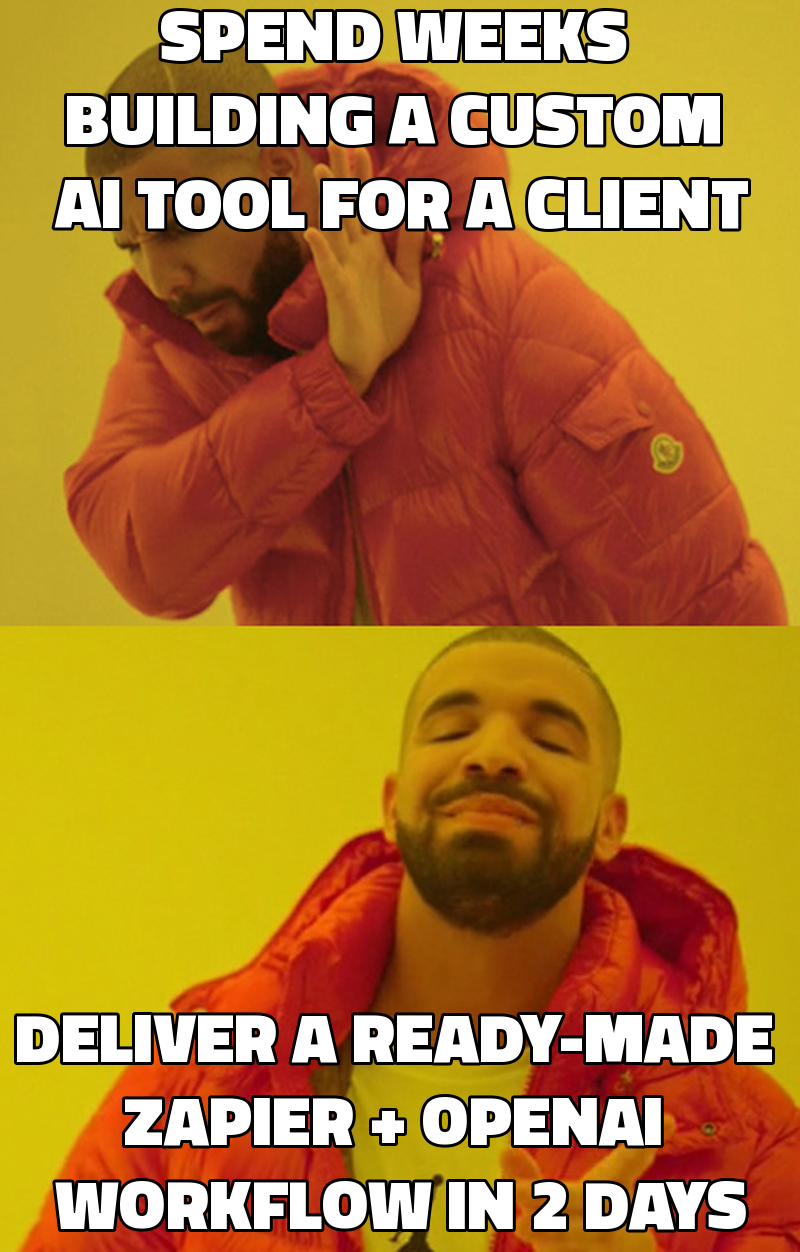
| Low-code (Zapier + OpenAI) | 2-day turnaround, low cost | Limited to pre-built connectors | $1,500-$2,500 per pilot |
| Hybrid (Bubble front-end + Lambda back-end) | UI control + custom logic | Slightly more coordination | $2,000-$4,000 per pilot |
What go-to-market strategy works for agency founders without developers?
- Identify the white-label partner – Use the qualification test in the ICP: agencies with 5-15 staff, no “development” listed, and recent client wins that need automation.
- Create a pilot offer – A $2,500 fixed-scope project that delivers a chatbot, lead-scoring workflow, or voice-assistant integration in 2-3 weeks. Quote a 50-70 % margin on the agency’s bill; the agency then marks it up to their client.
- Cold-email sequence – First email: “We help agencies like yours say ‘yes’ to AI automation requests without hiring developers.” Follow up with a one-pager case study (e.g., RouteMate SaaS) and a 15-minute discovery call link.
- Discovery call script – Ask the three gate questions (Volume, Budget, Live need). Capture the client’s immediate need and schedule a paid pilot.
- Onboard the partner – Share a simple Google Sheet dashboard that tracks pilot milestones (Kickoff, Prototype, Review, Delivery). Keep the dashboard lightweight; avoid building a full SaaS portal before you have recurring revenue.
- Deliver and upsell – After the pilot, propose a monthly retainer of $1,500-$2,000 for 15-20 hrs of escalation work. Emphasize reliability (“no missed deadlines”) – that’s the edge over offshore cheap labor.
- Referral loop – Ask satisfied agency partners for introductions to other agencies in their network; offer a 5 % referral bonus on the first pilot.
How to price AI automation projects and retainers?
- Pilot pricing – Base price on effort: 20-30 hrs of design + 10-15 hrs of integration = 35-45 hrs total. At $120 / hr (your internal rate) the cost is $4,200-$5,400. Quote the agency $2,500-$3,000 to give them a 50-60 % margin.
- Retainer pricing – $1,500 per month covers ~15 hrs of escalation (bug fixes, new automations, monitoring). This aligns with the industry average for white-label dev partners (according to a 2023 Gartner survey of agency service rates).
- Value-based adjustments – If the automation saves the client >10 % of manual labor, you can justify a 10-15 % premium.
- Discount triggers – Offer a 10 % discount for a 3-month prepaid retainer; this improves cash flow and locks the partner in.
What common pitfalls should I avoid in the first 90 days?
| Pitfall | Why it hurts | How to avoid |
|---|---|---|
| Building a full SaaS dashboard before any paying client | Wastes engineering hours and delays cash flow | Start with a shared Google Sheet or Notion page; only build a portal after $10k of recurring revenue |
| Competing on price alone | Low-cost offshore firms undercut you, eroding margins | Emphasize reliability, compliance, and AI expertise; price 10 % above the cheapest but deliver 30 % faster turnaround |
| Over-onboarding partners | Increases missed deadlines, creates the “flaky freelancer” reputation | Cap active white-label partners at 4-5; add new ones only after a retainer is signed |
| Skipping the NDA / non-circumvent clause | Partners may poach your work or expose your IP | Use a one-page MSA that includes both NDA and non-circumvent language; have legal counsel review |
| Under-estimating turnaround time | Missed deadlines damage both your reputation and the agency’s client relationship | Define a fixed turnaround band (e.g., 10-12 business days for a $2k pilot) and communicate it clearly |
| Relying on free-draft pilots | Gives away engineering effort and signals low value | Offer a scoped prototype (one screen or one automation) for $500 instead of a free full draft |
Frequently asked questions
How long does it take to register an LLC and start billing clients?
In most states the filing process is completed within 7-10 business days, and you can obtain an EIN instantly online. Once the LLC is active, you can issue invoices immediately; the first paid pilot typically closes in 2-3 weeks after the discovery call (source: U.S. SBA 2023 report).
Do I need a full-stack developer to deliver AI chatbots?
No. For most agency use-cases a combination of OpenAI’s API, Zapier/Make workflows, and a simple webhook hosted on AWS Lambda is sufficient. Only highly custom integrations (e.g., proprietary data pipelines) require a dedicated developer.
What legal documents protect my white-label model?
A Master Services Agreement that includes a Non-Disclosure Agreement and a Non-Circumvent clause is essential. The NDA prevents the agency from sharing your proprietary code, while the non-circumvent clause stops them from bypassing you to work directly with your subcontractors.
How can I prove reliability to agency partners?
Provide a shared status dashboard that shows milestone dates, current progress, and any blockers. Deliver the pilot within the agreed 10-12 day window and follow up with a post-project review. Consistent on-time delivery builds the “never-flaky” reputation.
What is a realistic monthly retainer for ongoing AI support?
Industry data from a 2023 Gartner survey of agency partners shows that $1,500-$2,000 per month for 15-20 hrs of escalation work is standard. This covers bug fixes, minor feature tweaks, and monitoring of deployed automations.
Should I offer a free prototype before the paid pilot?
Instead of a completely free build, offer a $500 scoped prototype that demonstrates one key automation (e.g., a lead-capture chatbot). This limits exposure while still giving the agency a tangible win to show their client.
How do I handle data privacy for EU clients?
If you process any EU personal data, you must sign a Data Processing Addendum (DPA) and ensure encryption at rest and in transit. The FTC’s 2022 Business Guidance recommends encrypting API keys and using role-based access controls.
What metrics should I track to prove ROI to my agency partners?
Track time saved (hours of manual work reduced), conversion lift (increase in leads or sales after automation), and error reduction (fewer support tickets). A 10-15 % lift in conversion is typical for AI-driven chatbots (McKinsey, 2023).
Meme
AI automation
Have something to build?
Tell us what you're trying to ship. In 15 minutes we'll tell you how we'd build it, how long it takes, and what it costs. No pitch deck, no pressure.