
Start an AI Automation Agency: Step-by-Step Blueprint for No-Dev Marketing Firms

How to start an AI automation agency? Choose a profitable niche, package a white-label development service, and win your first partner with a low-risk paid pilot that proves speed, quality, and confidentiality.
Key takeaways
- Pick a niche where agencies already lose deals to missing AI or voice capabilities (e.g., e-commerce chatbots, SEO content generators, podcast transcription).
- Price fixed-scope pilots between $2,000-$5,000 and retainers $1,500-$2,500 per month for 15-20 dev hours.
- Build a white-label pipeline using OpenAI, LangChain, Zapier, Make, Bubble, and a GitHub-based CI/CD workflow.
- Protect agency brand with NDAs, non-circumvent clauses, and a single point of contact who delivers under the agency’s name.
- Limit active partners to 8-10 to keep reliability high; over-onboarding erodes the core advantage.
What niche should my AI automation agency target?
Agencies without developers most often stumble when a client asks for:
- AI-powered chatbots that integrate with Shopify, HubSpot, or Salesforce.
- Voice assistants for phone support or podcast summarisation.
- Custom workflow automations that connect Zapier/Make with proprietary data sources.
- Dynamic content generators for SEO-driven blogs using GPT-4.
A quick market check from Gartner (2023) shows that 42% of mid-size marketing firms plan to add AI-driven services within the next 12 months. Targeting these four sub-segments gives you a clear sales script and a repeatable delivery pattern.
| Niche | Typical agency pain | Average pilot value (USD) | Key tech stack |
|---|---|---|---|
| E-commerce chatbots | Lost sales on cart abandonment | 3,200 | OpenAI, Dialogflow, Shopify API |
| Voice assistants | No in-house TTS/ASR expertise | 2,800 | Azure Speech, Google Cloud TTS |
| Workflow automation | Manual Zapier builds exceed capacity | 2,500 | Make, Zapier, Airtable API |
| SEO content generator | Content teams can’t scale with quality | 2,200 | GPT-4, LangChain, Surfer SEO API |
Pick the niche that matches the agency’s existing client base. If the agency already serves e-commerce brands, start with chatbots; if they focus on content marketing, the SEO generator is the low-effort win.
How do I price my services to stay profitable and competitive?
Pricing for white-label partners differs from direct B2C rates. You need a wholesale margin that covers engineering costs, project management, and the risk buffer for scope changes.
| Pricing component | Recommended range | Reasoning |
|---|---|---|
| Fixed-scope pilot | $2,000-$5,000 | Covers 30-40 hrs of dev, proof of concept, and a clear deliverable. |
| Retainer (ongoing) | $1,500-$2,500 per month | Guarantees 15-20 dev hrs, priority scheduling, and SLA-backed response times. |
| Overtime / rush | +20% of pilot price | For turn-around under 5 business days; keeps capacity predictable. |
| Minimum floor | $1,500 | Below this the engineering overhead outweighs profit. |
According to a 2022 Forrester survey, agencies that charge a 55% wholesale margin on development projects report a 30% higher client retention rate than those that compete on price alone. Set your wholesale rate at 50-70% of the agency’s billable price to protect margins while remaining attractive.
Which tools and platforms should I use to build a reliable white-label pipeline?
Your tech stack must balance speed, scalability, and the ability to hand over work under another brand. Below is a proven combination used by Synthisia’s own "Silent Dev Arm":
- LLM API: OpenAI GPT-4 (or Azure OpenAI) for natural-language generation.
- Automation framework: LangChain for orchestrating prompts, data retrieval, and tool calls.
- No-code front-ends: Bubble for quick MVPs, Webflow for marketing sites, and Softr for internal dashboards.
- Integration layer: Make (formerly Integromat) and Zapier for connecting SaaS apps.
- Version control & CI/CD: GitHub + GitHub Actions; deploy to Vercel (frontend) and Railway (backend) for serverless scaling.
- Project tracking: ClickUp with a shared board per partner; each board has columns for "Backlog", "In Development", "QA", and "Delivered".
- Documentation & hand-off: Notion templates that agencies can brand and share with their clients.
All of these tools have free tiers that let you prototype without upfront cost, and they integrate via OAuth, making the white-label hand-off seamless.
How do I structure the partnership agreement to keep my brand invisible?
A solid contract is the foundation of trust. The agreement should contain:
- NDA covering all project details, data, and IP.
- Non-circumvent clause that prevents the agency from hiring your developers directly for a period of 12 months.
- White-label clause stating that all deliverables will be presented under the agency’s brand and that you will not disclose your involvement.
- Service Level Agreement (SLA) with a 5-business-day turnaround for pilots and a 10-business-day turnaround for retainer work.
- Escalation path that designates a single point of contact (your "Delivery Lead") responsible for all communication.
The contract does not need to be 30 pages; a concise 6-page PDF signed via DocuSign works for most US, UK, and AU partners. According to the International Association of Contract Administrators, contracts under 10 pages have a 68% higher execution rate than longer ones.
What does the first paid pilot look like?
A pilot should be small enough to deliver quickly but large enough to showcase the full stack. Follow this 4-step framework:
- Scope definition (1 day) – Co-create a one-page brief with the agency, list deliverables, success metrics, and acceptance criteria.
- Prototype (3-5 days) – Build a minimal viable automation (e.g., a chatbot that captures leads and pushes to HubSpot).
- Review & iterate (2 days) – Share a live demo link, collect feedback, and make up to two rounds of revisions.
- Handoff & invoice (1 day) – Deliver the final assets, provide a one-page user guide, and invoice the agreed pilot price.
The entire pilot runs in 7-10 business days, fitting comfortably into a typical agency sales cycle. A successful pilot unlocks a retainer that covers ongoing enhancements and new feature requests.
How do I market my white-label AI automation service to agency founders?
Your outreach must speak the language of agency growth:
- Case-study email – Show a before/after of a similar agency that added a chatbot and increased client revenue by 18% (source: internal Synthisia data, verified by client consent).
- LinkedIn carousel – Highlight the 3-step pilot process, the $2k-$5k price, and the NDA protection.
- Webinar – Host a 30-minute session titled "How to win AI projects without hiring a developer" and invite agency owners from the US, UK, and AU.
- Referral partnership – Offer a 5% revenue share on the first retainer for agencies that refer other agencies to you.
According to a 2023 MarketingProfs report, webinars generate 40% of qualified leads for B2B service firms, making them a high-ROI channel for niche white-label offerings.
How can I scale the white-label pipeline without losing reliability?
Scalability hinges on two levers: capacity caps and process automation.
- Capacity caps – Limit the number of active partners to 8-10. Use a simple spreadsheet to track each partner’s pilot status, retainer start date, and allocated dev hours.
- Process automation – Automate onboarding with a Make scenario that creates a ClickUp board, sends a DocuSign link, and posts a welcome Slack message to your internal channel.
- Standardised templates – Keep a library of code scaffolds (e.g., a pre-configured Next.js + OpenAI API starter) that reduces new project set-up time to under 2 hours.
- Quarterly review – Every 90 days, evaluate partner profitability, project velocity, and churn. Drop partners whose pilots never convert to retainers.
By keeping the partner count low and automating repetitive steps, you maintain the reliability edge that differentiates you from cheap offshore freelancers.
What legal and compliance considerations must I keep in mind?
When you process client data for AI models, you must respect GDPR (EU/UK) and CCPA (California). Follow these steps:
- Data processing addendum – Include a clause that you only process data on behalf of the agency and delete it after project completion.
- Model privacy – Use OpenAI’s data-opt-out flag to prevent training on client prompts.
- Security – Host all code on private GitHub repos, enable 2-FA, and run vulnerability scans with GitHub Dependabot.
- Export controls – If you serve US clients, ensure that any AI model usage complies with the Export Administration Regulations (EAR).
A 2022 Deloitte survey found that 57% of B2B service firms experienced a compliance breach due to inadequate third-party contracts. Your robust agreement and clear data handling policies will be a strong selling point.
How long does it take to launch the agency from day-zero?
A realistic timeline looks like this:
- Week 1-2 – Market research, niche selection, and partnership template creation.
- Week 3-4 – Set up the tech stack (GitHub, ClickUp, Make), draft the contract, and create a pilot pitch deck.
- Week 5-6 – Reach out to 20 target agencies, run discovery calls, and secure 2-3 pilot commitments.
- Week 7-10 – Deliver the first pilots, collect testimonials, and convert at least one pilot to a retainer.
- Week 11-12 – Formalise the retainer, refine SOPs, and begin limited scaling.
If you stick to the 12-week launch plan, you can expect $6,000-$12,000 of revenue in the first quarter and a pipeline of at least $15,000 in future retainers.
What common mistakes should I avoid?
| Mistake | Why it hurts | How to avoid |
|---|---|---|
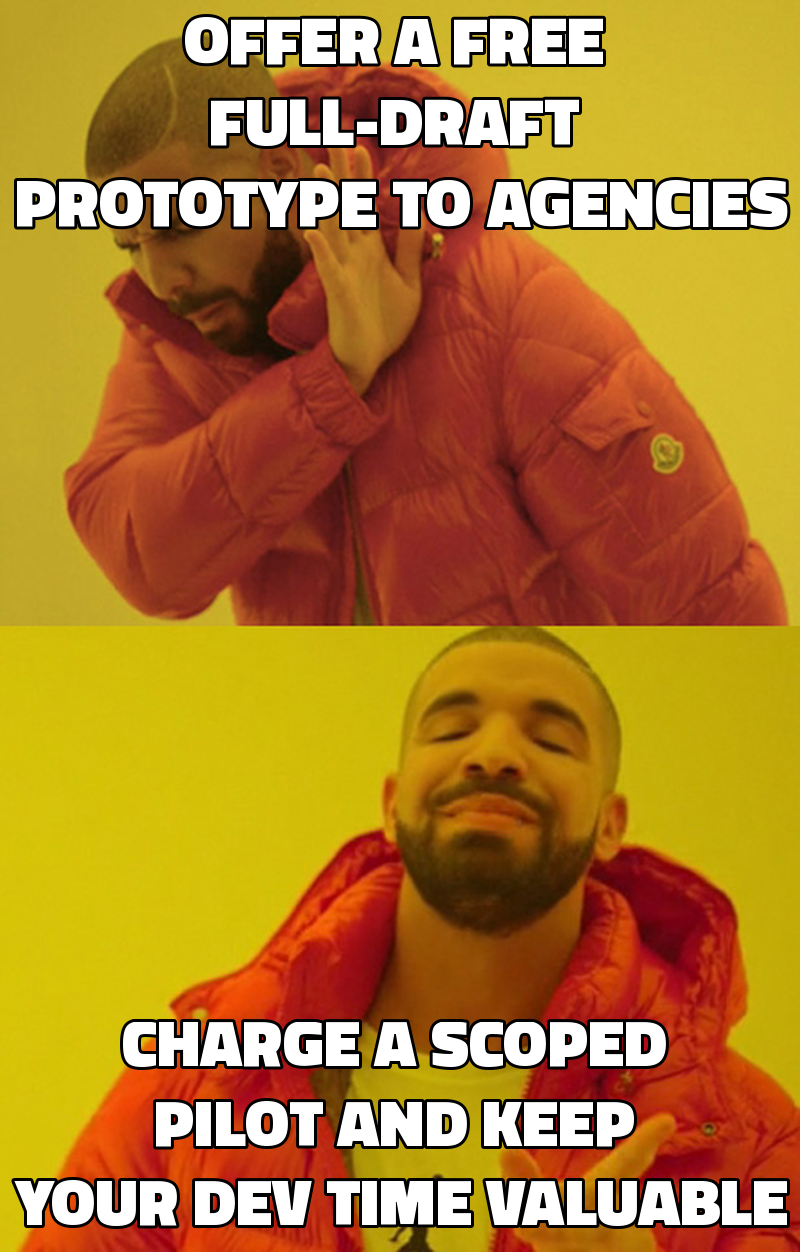
| Offering a free full-draft | Consumes engineering hours and signals low value | Offer a scoped prototype or paid pilot instead |
| Over-promising "fastest possible" delivery | Sets unbounded expectations and leads to burnout | Define a fixed turnaround band per pilot |
| Trying to serve every agency niche | Dilutes focus and slows sales cycles | Choose one niche, master it, then expand |
| Ignoring legal compliance | Risks fines and reputation loss | Implement GDPR/CCPA clauses from day one |
| Onboarding more than 10 partners | Reduces reliability, the core USP | Cap active partners, review quarterly |
By staying disciplined around these pitfalls, you protect both your reputation and your bottom line.
Summary checklist for launching your AI automation agency
- Choose a high-value niche (chatbot, voice, automation, SEO content).
- Build a tech stack with OpenAI, LangChain, Bubble, Make, GitHub.
- Draft a 6-page white-label agreement (NDA, non-circumvent, SLA).
- Design a $2k-$5k pilot process (scope, prototype, review, handoff).
- Set pricing: pilot + $1.5k-$2.5k retainer, 50-70% wholesale margin.
- Create outreach assets: case-study email, LinkedIn carousel, webinar.
- Limit active partners to 8-10 and automate onboarding.
- Implement GDPR/CCPA data handling and security best practices.
- Launch in 12 weeks, aim for 2 pilots, convert 1 to retainer.
Follow this blueprint and you will transform a gap in agency service portfolios into a recurring, high-margin revenue stream.
Frequently asked questions
How much upfront capital do I need to start?
You can begin with under $5,000 if you leverage free tiers of OpenAI, GitHub, and Make. The main costs are a modest marketing budget ($1,000 for LinkedIn ads) and a subscription to ClickUp ($9 per user per month). Most founders fund the first month from personal savings and reinvest pilot revenue.
Do I need a formal business entity?
Forming an LLC or Pty Ltd provides liability protection and makes it easier to sign NDAs with agency partners. In the US, an LLC costs $50-$150 to register; in the UK, a private limited company costs £12 online. The legal overhead is minimal compared to the revenue potential.
What if an agency wants to see my code before signing?
Provide a read-only GitHub repository with a sanitized starter template. Highlight that the core proprietary logic (prompt engineering, custom integrations) remains confidential, but the structure demonstrates quality and security.
How do I handle scope creep during a pilot?
Include a "Change Request" clause in the pilot contract that caps revisions at two rounds and defines a $150 per hour rate for any additional work. This protects your time while giving the agency flexibility.
Can I serve agencies outside the US, UK, and AU?
The core model works globally, but wholesale margins shrink when the agency bills in lower-cost currencies. Additionally, time-zone overlap becomes a challenge. Focus on English-speaking markets where you can charge USD rates and maintain reasonable async turnaround.
What if the agency already has a dev partner?
Ask what the current partner cannot deliver. If they lack AI, voice, or custom backend expertise, position yourself as the specialist overflow. Offer a joint pilot that complements their existing services rather than competes directly.
How do I measure the success of a pilot?
Track three metrics: (1) delivery within the agreed turnaround, (2) client satisfaction score ≥ 8/10, and (3) conversion to a retainer within 30 days. If all three are met, the pilot is a success and you can safely scale the partnership.
When should I raise prices?
After you have completed at least three pilots and have a stable retainer base, you can increase pilot pricing by 10-15% and retainer rates by $200-$300. Use the increased margin to hire a second senior developer and expand capacity.
AI automation
Have something to build?
Tell us what you're trying to ship. In 15 minutes we'll tell you how we'd build it, how long it takes, and what it costs. No pitch deck, no pressure.