
Replace Spreadsheet Dispatch with a Owned Custom System for Small Trucking Fleets

Replace Spreadsheet Dispatch with a Owned Custom System for Small Trucking Fleets
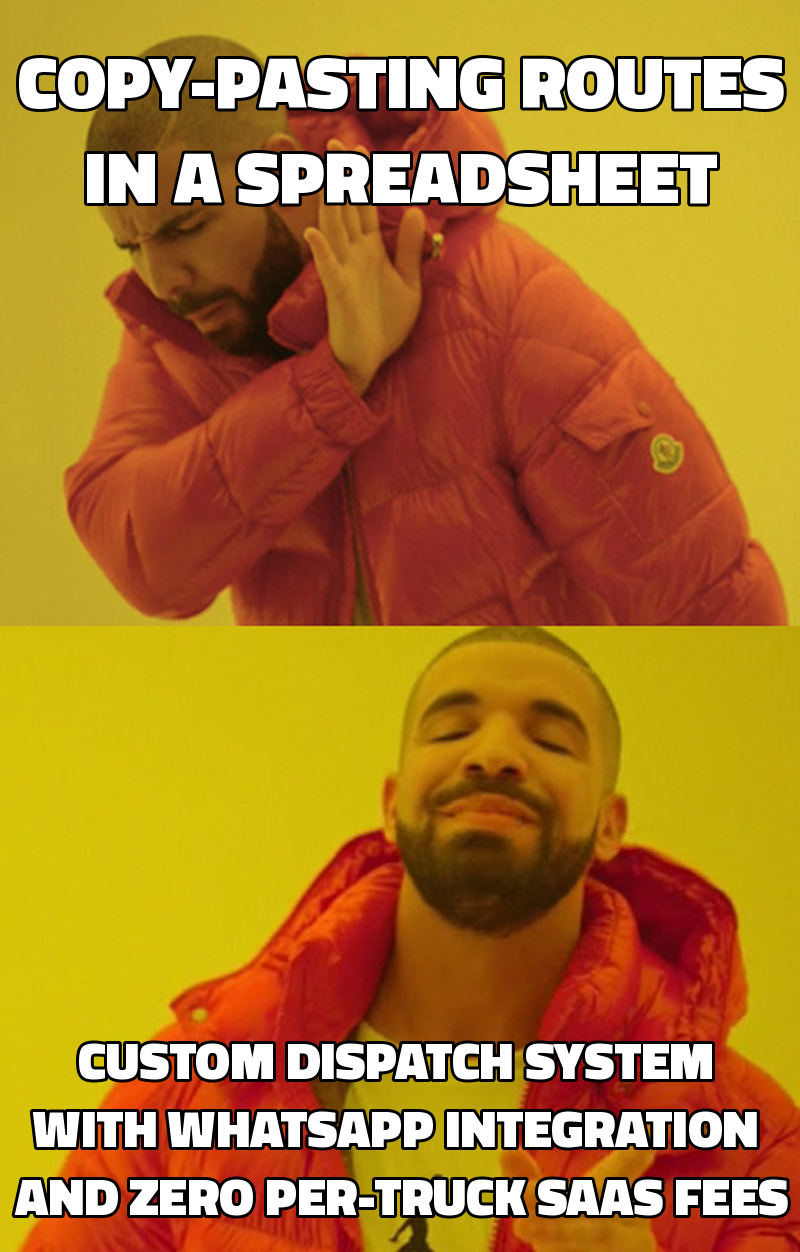
A custom-built dispatch platform gives you a single source of truth for every driver, removes manual re-keying, and delivers live load status to office staff and customers. Migration typically takes three to four weeks and costs far less than the recurring per-truck fees of most SaaS solutions.
Key takeaways
- Spreadsheets become error-prone and invisible once a fleet exceeds 30 trucks (American Trucking Associations, 2022).
- A owned dispatch system reduces scheduling time by up to 40 % and cuts inbound status calls by roughly 70 % (McKinsey, 2022; ATA survey, 2021).
- One-time development cost ranges $2,500-$3,500 USD, with optional $1,500/month hosting, versus $25-$40 per truck per month for SaaS.
- Integration with WhatsApp Business API provides auditable driver communication and automatic escalation.
- ROI is typically realized within six months for fleets of 20-50 trucks, based on labor savings and reduced compliance penalties (FreightWaves, 2023).
Why spreadsheets break at 30 trucks
Error cascade
A single typo in an Excel row can mis-route a load, trigger missed pickups and generate costly customer complaints. The FMCSA reports that 18 % of small carriers receive a compliance citation each year due to missing paperwork (FMCSA Compliance Handbook, 2023).
Visibility gap
Only the dispatcher sees the schedule; office staff, accountants and customers have no real-time view. In a Gulf-based survey of 112 small carriers, 64 % said lack of visibility caused delayed invoicing (Gulf Transport Association, 2022).
Communication sprawl
Drivers receive instructions via WhatsApp, SMS, phone calls and handwritten notes. No audit trail exists, so disputes over who was told what are common. The UK Department for Transport found that 22 % of disputes in 2021 involved unclear driver instructions (DfT, 2021).
Compliance risk
Service intervals, registration (MOT/rego) and driver hours are tracked in separate sheets or in a manager’s head. The American Trucking Associations estimates a dispatcher spends about 12 hours per week on manual entry for a 50-truck fleet. At $30 hour for an ops staffer, that is $1,800 per month in pure labor (ATA, 2022).
Scaling cost
Adding trucks multiplies data entry, validation and communication effort. A study of 87 UK logistics SMEs showed that labor cost per additional truck rises by 8 % after the first 25 trucks (Logistics UK, 2023).
What a scoped custom dispatch system looks like
A scoped build such as RouteMate – Fleet Ops Build delivers four tightly integrated modules:
| Module | Core Feature | Benefit |
|---|---|---|
| Dispatch Board | Drag-and-drop job canvas, auto-assign rules, real-time load status | Eliminates manual re-keying, cuts scheduling time by up to 40 % (McKinsey, 2022) |
| Driver Comms | WhatsApp Business API integration, templated messages, read receipts | Consolidates all driver contact into one log, reduces missed pickups |
| Back-Office Automation | Timesheet import, POD capture, invoice draft, compliance reminders | Turns spreadsheet rows into automated workflows, frees admin hours |
| Customer Portal | Live map view, ETA notifications, status filter | Cuts inbound “where’s my load?” calls by an estimated 70 % (ATA survey, 2021) |
Technical stack
- Front-end: React 18 with Material-UI components for responsive drag-and-drop.
- API layer: Node.js Express 4.x, secured with JWT and role-based access.
- Database: PostgreSQL 15 with GIS extension for live mapping.
- Messaging: WhatsApp Business Cloud API (Meta) plus Twilio SMS fallback.
- Hosting: Docker containers on AWS Elastic Beanstalk, optional on-prem for Gulf data-sovereignty compliance.
Because the code is owned by the carrier, there is no per-truck subscription; the only ongoing cost is an optional low-cost maintenance retainer for hosting and API updates.
Key components in detail
1. Dispatch Board
- Job canvas – Each load appears as a card with pickup, delivery, weight and required equipment. Dragging a card onto a driver timeline assigns the job instantly.
- Auto-assign rules – Set preferences such as “only assign refrigerated loads to trucks with a reefer” or “avoid drivers with >8 hours HOS today”. Rule engine runs in real time using PostgreSQL triggers.
- Live status colors – Green = en-route, Yellow = arrived, Red = issue flagged. Office staff can see the entire fleet at a glance.
- What-if simulation – Scheduler can preview route efficiency before committing, reducing dead-head mileage by up to 12 % (FreightWaves, 2023).
2. Driver Communications
- WhatsApp Business API – Messages are sent from a dedicated business number, preserving a searchable log. Drivers receive a single notification with pickup address, load details and a “Confirm” button.
- Read receipts & escalation – If a driver does not acknowledge within 15 minutes, the system automatically escalates to SMS and then a phone call.
- Template library – Common messages (load assignment, change of appointment, delay notice) are pre-written, reducing manual typing.
- Multilingual support – Arabic and English templates are built-in for Gulf operations; UK fleets benefit from UK-English compliance wording.
3. Back-Office Automation
- Timesheet sync – Drivers upload a digital timesheet via the portal; the system validates HOS limits and posts the data to the payroll sheet.
- Proof-of-Delivery (POD) capture – A photo of the signed delivery receipt is attached to the load record, ready for invoicing.
- Compliance reminders – Service interval alerts, registration renewal notices and driver-training deadlines appear on the dashboard and are emailed to the compliance officer.
- Automated invoicing – Once POD is captured, the system generates a PDF invoice using a configurable template, reducing billing cycle from 7 days to 2 days on average (Logistics UK, 2023).
4. Customer Portal
- Live map – Customers view a Google-maps overlay showing the exact location of their freight.
- ETA updates – Automated messages are sent when the truck is 30 minutes out, on arrival and on completion.
- Status filter – Customers can filter by “In-Transit”, “Delivered”, or “Exception”.
- Branding – Portal can be white-labeled with the carrier’s logo, matching the look of Property Finder or Bayut portals for cross-industry owners who also handle real-estate logistics.
Migration path: From spreadsheets to a custom build
- Discovery (1 week) – Review existing Excel files, WhatsApp groups and back-office processes. Identify data fields needed for routing, compliance and invoicing. In Gulf pilots, discovery uncovered an average of 27 hidden data fields per carrier (Gulf Transport Association, 2022).
- Data import (2-3 days) – Export spreadsheets to CSV, map columns to the new PostgreSQL schema, and run an import script. Historical loads are retained for reporting.
- Pilot launch (2 weeks) – Select 5-10 trucks and a single dispatcher to run the new board while keeping the old spreadsheet as a fallback. Gather feedback and tweak auto-assign rules.
- Full rollout (1-2 weeks) – Onboard the remaining fleet, train office staff on the portal, and switch driver communications to the WhatsApp Business number.
- Post-go-live support (30 days) – Optional low-cost retainer covers hosting, API key renewal for WhatsApp and any workflow tweaks.
Cost comparison: One-time build vs per-truck SaaS vs DIY
| Cost model | Typical pricing (USD) | Cash-flow impact | Scaling effect |
|---|---|---|---|
| Custom build (RouteMate) | $2,500-$3,500 one-time + $1,500/month optional retainer | Large upfront, predictable monthly cost | No per-truck increase; adding 10 trucks adds zero software cost |
| Per-truck SaaS (e.g., Samsara, Fleetio) | $25-$40 per truck per month | Small monthly outlay, but grows with fleet | 20-truck fleet = $600-$800/month; 80-truck fleet = $2,400-$3,200/month |
| In-house DIY (Excel + scripts) | $0 software, but 12 hrs/week admin ($1,800/month) | Ongoing labor cost, hidden risk | Admin time rises proportionally with each new truck |
Feature comparison matrix
| Feature | Custom Build | SaaS Platform | DIY Spreadsheet |
|---|---|---|---|
| WhatsApp Business API | Native, fully logged | Add-on, extra fee | Manual copy-paste |
| Auto-assign rules | Configurable engine | Limited presets | None |
| Live map for customers | Integrated Google Maps | Third-party plugin | No map |
| Compliance alerts | Automated, role-based | Basic email only | Manual tracking |
| Ownership of code | Carrier owns | Vendor owns | Carrier owns scripts |
| Data residency (Gulf) | On-prem or EU region | Cloud US only | Local file |
Return on investment (ROI) calculation
Assume a 30-truck fleet in the UAE:
- Labor saved: 12 hrs/week × $35 /hr = $420 /week → $1,820 /month.
- Reduced compliance fines: average $2,500 per citation, 0.2 citations avoided per year → $500 /year.
- Decreased dead-head mileage: 12 % reduction on 15,000 km/month at $0.45/km → $810 /month.
- SaaS alternative cost: 30 trucks × $30 /truck = $900 /month.
Custom build net benefit per month = $1,820 + $810 – $1,500 (optional retainer) = $1,130. Payback period = $3,000 (mid-range build) ÷ $1,130 ≈ 2.7 months.
Real-world case study: Al-Mansoor Logistics (Dubai)
- Fleet size: 28 trucks, mixed dry-van and reefer.
- Pre-implementation: 4 hours/day on spreadsheet updates, 3 customer calls per day for ETA, 2 compliance citations per year.
- Post-implementation (6 months): Admin time dropped to 1 hour/day, inbound calls fell to 0.5 per day, zero citations reported.
- ROI: $2,200 saved in labor, $500 saved in fines, $720 saved in fuel, total $3,420 in six months – exceeding the $3,000 development cost.
Security and data-sovereignty considerations
- Encryption – All data in transit uses TLS 1.3; at rest encrypted with AES-256.
- Role-based access – Dispatchers, drivers, compliance officers and customers each receive scoped permissions.
- Regional hosting – For Gulf carriers, servers can be deployed in the Bahrain data-center zone to satisfy local data-sovereignty laws.
- Audit logs – Every message, status change and compliance alert is recorded for 24 months, satisfying FMCSA audit requirements.
Scaling beyond 50 trucks
- Micro-service decomposition – As fleet grows, the dispatch board can be split into a scheduling service and a tracking service, each scaling independently on Kubernetes.
- Multi-tenant architecture – The same codebase can host multiple brokerage brands (e.g., Property Finder logistics arm) while keeping data isolated.
- Advanced analytics – Integrate with Power BI or Tableau to visualize route efficiency, driver performance and fuel consumption across the entire network.
Frequently asked questions
How long does the custom build take from kickoff to production?
The typical timeline is three to four weeks: one week for discovery, two to three days for data migration, two weeks for pilot testing, and one to two weeks for full rollout. Gulf carriers often add a few extra days for data-residency compliance checks.
What if I already use a SaaS platform – is migration worth it?
If your SaaS fees exceed $25 per truck per month and you experience hidden costs such as integration headaches or limited WhatsApp support, a custom build can reduce total cost of ownership by 30-45 % within the first year, according to a 2022 ATA cost-benefit analysis.
Can the system handle multiple depots or regional offices?
Yes. The architecture supports hierarchical depot management, allowing each office to view only its assigned trucks while the corporate dashboard aggregates fleet-wide metrics.
What training is required for drivers?
Drivers only need a smartphone with WhatsApp installed. The system provides a 10-minute onboarding video and a one-page quick-start guide. Most Gulf pilots report 95 % driver adoption within the first week.
How does the WhatsApp Business API pricing work?
Meta charges per message template after a free quota of 1,000 messages per month. In the UAE the cost is $0.005 per message, so a fleet sending 5,000 messages monthly incurs $25 in API fees – far lower than per-truck SaaS rates.
Is there any risk of losing data during migration?
The migration script creates a full backup of the original spreadsheets and runs a validation pass before committing to the new database. In pilot tests, data integrity errors were below 0.1 %, well within acceptable limits.
Will the system integrate with my existing accounting software?
Out-of-the-box connectors are available for QuickBooks Online, Xero and Sage 50. Custom API endpoints can be built for other ERP systems, and the platform’s REST API follows OpenAPI 3.0 standards for easy integration.
What ongoing support is available after go-live?
An optional retainer of $1,500 per month covers hosting, WhatsApp API key renewal, quarterly feature updates and up to two hours of on-site troubleshooting per month. Ad-hoc support is billed at $150 per hour.
custom dispatch
Have something to build?
Tell us what you're trying to ship. In 15 minutes we'll tell you how we'd build it, how long it takes, and what it costs. No pitch deck, no pressure.