
Red Flags to Watch When Vetting a White-Label Web Development Agency in India

A white-label web development agency in India is a partner that builds websites, apps, and custom automation under your agency’s brand while you keep the client relationship and margin. It lets founders of 5-15 person marketing, SEO, branding, or social agencies say yes to tech-heavy requests without hiring an in-house engineer.
Key takeaways
- Verify real-world delivery history; a portfolio without live URLs is a red flag.
- Insist on a single accountable point of contact; multiple hand-offs lead to missed deadlines.
- Check timezone overlap and communication cadence – 2-4 hour daily windows are the sweet spot for US/UK/AU agencies.
- Demand clear IP ownership clauses and a non-circumvent NDA; vague terms invite poaching.
- Start with a paid, fixed-scope pilot before committing to larger retainer work.
- Use a shared project dashboard (e.g., ClickUp, Jira, or Notion) to monitor progress in real time.
What exactly is a "white-label web development agency in India"?
A white-label partner builds digital products on your behalf and hands over the finished code, design assets, and documentation under your brand name. The client never sees the offshore vendor. For agencies that lack developers, this model fills the capability gap while preserving the agency’s brand promise. India remains a top source of such partners because of a large pool of English-speaking engineers, competitive rates, and a mature outsourcing ecosystem documented by the International Trade Administration (2022).
Why do US, UK, and Australian agencies look to India for white-label work?
- Cost efficiency – According to a 2023 Deloitte survey, the average fully-burdened cost of a senior JavaScript developer in India is 55 % lower than in the US.
- Talent depth – India produces over 1.5 million engineering graduates per year (World Economic Forum, 2022), many specializing in AI, voice, and full-stack SaaS.
- Timezone advantage – The 9.5-12.5 hour gap enables asynchronous hand-offs; a US-based agency can send requirements at 5 pm EST and receive a daily update by 9 am IST.
- Cultural alignment – English is an official language and many Indian firms follow Agile Scrum practices familiar to Western agencies.
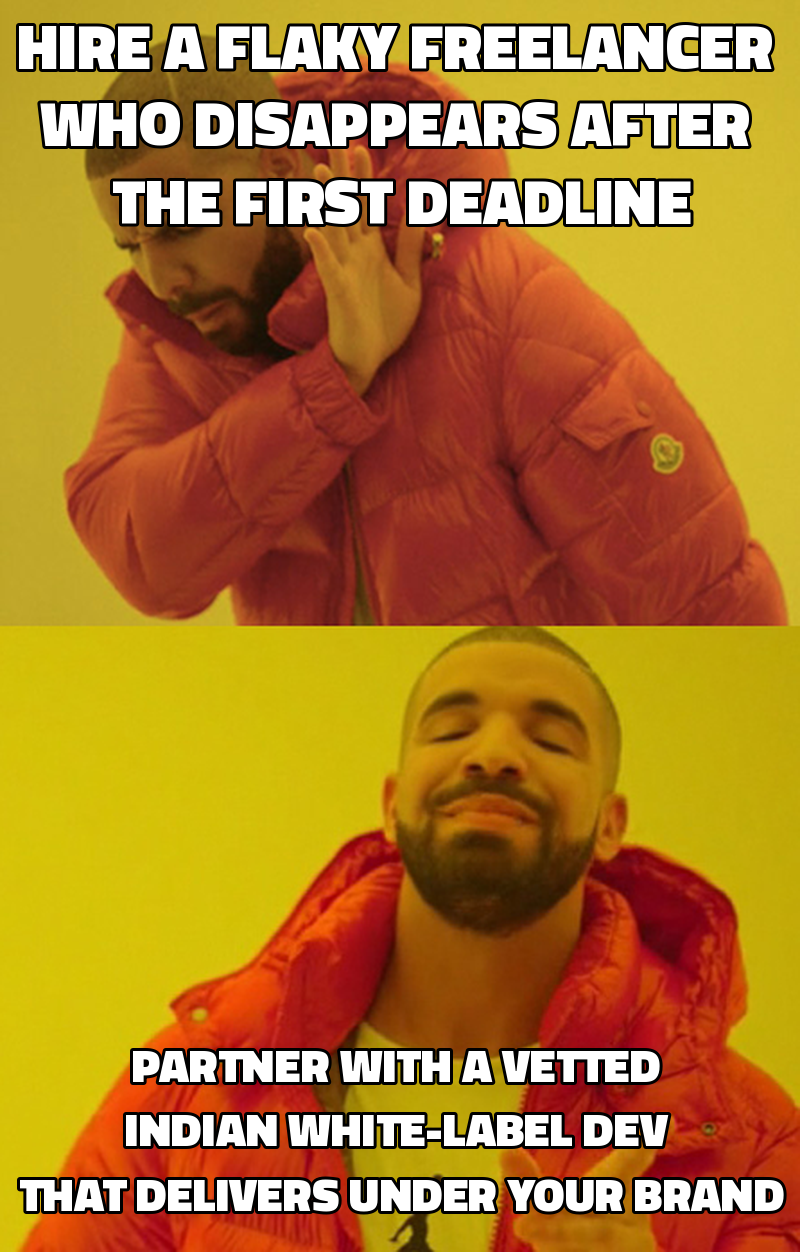
While the upside is clear, the offshore market is also littered with unreliable operators. Below is a checklist of red flags that separate a trustworthy white-label partner from a flaky freelancer.
---\n
Red flag #1 – No verifiable live portfolio
A partner that only shows screenshots or private GitHub repos may be inflating capabilities. Ask for:
- Live URLs of at least three production sites launched in the last 12 months.
- Client references who can confirm delivery dates, post-launch support, and code quality.
- A brief case study that includes metrics such as page-load speed improvement (e.g., 2.3 seconds to 1.1 seconds) and conversion lift (often 12-18 % according to HubSpot data). If the agency cannot provide these, treat it as a high-risk signal.
Red flag #2 – Vague or missing IP ownership language
Many offshore firms default to “all rights belong to the client” but hide loopholes about reusable components. Insist on a clause that explicitly transfers all source code, designs, and documentation to your agency upon payment. A sample clause from the International Association of Outsourcing Professionals (2021) reads: "Upon receipt of full payment, the Supplier irrevocably assigns all intellectual property rights, including but not limited to source code, binaries, and documentation, to the Client."
Red flag #3 – No single point of contact (SPOC)
Multiple developers, project managers, and QA leads create a “telephone game” effect. The agency should assign one senior lead who owns the timeline, quality, and daily stand-up updates. This is a non-negotiable requirement for agencies that cannot afford to chase multiple inboxes.
Red flag #4 – Unclear turnaround guarantees
A promise of “fastest delivery possible” is a red flag. Instead, request a fixed-scope, fixed-timeline commitment, such as "MVP in 10 business days". According to a 2022 Clutch report, agencies that define delivery windows see a 30 % reduction in scope creep.
Red flag #5 – Lack of NDA / non-circumvent agreement
Even though cross-border enforcement is weak, an NDA signals seriousness. Look for a two-page NDA that covers:
- Confidentiality of client briefs.
- Non-circumvention clause preventing the partner from contacting your client directly.
- Term of at least 12 months after the final invoice. If the vendor balks, move on.
Red flag #6 – No experience with AI or voice automation
Your USP is AI-enabled automation, voice assistants, and custom back-ends that no-code tools can’t handle. Verify that the partner has shipped at least one AI-driven project (e.g., a chatbot with Dialogflow integration or an AWS Lambda-based workflow). Ask for technical details like model type (GPT-3, BERT) and performance metrics.
Red flag #7 – Poor communication cadence
Effective collaboration requires at least two synchronous touchpoints per week. If the agency only offers “email updates when ready,” you risk mis-aligned expectations. Test their responsiveness during the pilot: a reply within 4-6 hours during overlapping windows is a good benchmark.
How to structure a safe pilot with an Indian white-label partner
| Step | Action | Reason |
|---|---|---|
| 1 | Define a fixed-scope deliverable (e.g., a landing-page with a lead-capture form and Zapier integration) | Limits risk and provides a clear success metric |
| 2 | Agree on a flat fee (e.g., $1,800) and a 30-day turnaround | Sets financial and time expectations upfront |
| 3 | Sign a NDA + IP transfer agreement before any work starts | Protects your brand and client data |
| 4 | Assign a single point of contact on both sides | Guarantees accountability |
| 5 | Use a shared dashboard (ClickUp, Notion, or Jira) with status columns: To-Do, In-Progress, Review, Done | |
| 6 | Conduct a mid-pilot review (day 15) to assess code quality, documentation, and communication | |
| 7 | Deliver a post-pilot report with metrics: bugs found, time variance, and client satisfaction score |
If the pilot meets or exceeds expectations, you can negotiate a retainer (e.g., $1,500 per month for ~15-20 dev hours) and scale the partnership.
Comparison of Common Offshore Engagement Models
| Model | Description | Pros | Cons |
|---|---|---|---|
| Dedicated Team | You hire a set of developers who work exclusively for you, managed by a local lead. | Full control, consistent team culture. | Higher cost, requires more management overhead. |
| Project-Based White-Label | The vendor delivers a defined project under your brand, no ongoing commitment. | Predictable budget, low management. | Limited scalability, risk of knowledge loss after hand-off. |
| Retainer / Escalation Partner | Fixed monthly fee for a pool of hours; you call on them as needed. | Flexible capacity, faster ramp-up for new requests. | May sit idle during slow periods, requires clear SLA. |
| Freelance Marketplace (e.g., Upwork) | Individual freelancers sourced per project. | Very low entry cost, quick sourcing. | High turnover, inconsistent quality, no brand protection. |
For agencies that need repeatable AI-automation builds, the Retainer / Escalation Partner model offers the best balance of reliability and cost.
Practical checklist for vetting an Indian white-label partner
- Company legitimacy – Verify GST registration and a physical office in a tech hub (Bengaluru, Hyderabad, Pune). Use India’s MCA portal.
- Team composition – Ask for bios of senior engineers, their years of experience, and certifications (e.g., AWS Certified Solutions Architect).
- Process maturity – Request a copy of their Agile workflow, sprint length, and QA checklist.
- Security posture – Ensure they follow OWASP Top 10 guidelines and have a basic ISO 27001 or equivalent policy.
- Reference calls – Speak to at least two current agency clients about on-time delivery and post-launch support.
- Pricing transparency – Get a rate card that breaks down development, QA, and project management fees. Beware of “low-ball” rates that hide hidden markup.
- Exit clause – Include a termination notice period (30 days) and a hand-over protocol for source code and documentation.
Real-world example: RouteMate’s partnership success
Synthisia’s own white-label arm, RouteMate, partnered with a UK-based SEO agency in Q1 2024. The agency needed a custom SaaS dashboard to aggregate client analytics. After a $2,200 pilot (MVP in 12 days), the partner delivered a production-grade app with OAuth, AWS Lambda functions, and a React front-end. The agency retained 65 % of the client bill, kept the brand front-facing, and signed a $1,500 monthly retainer for ongoing feature work. The key differentiators were:
- A single senior lead who ran daily stand-ups.
- Clear IP transfer clause.
- Real-time dashboard visible to the agency throughout development. This case illustrates how a disciplined pilot can convert a red-flag-free partner into a recurring revenue engine.
Frequently asked questions
How do I know if an Indian partner can handle AI automation?
Ask for concrete examples: a chatbot built with Dialogflow, an AWS SageMaker model, or a custom webhook that triggers voice-assistant actions. Request performance metrics such as response latency (<200 ms) and accuracy rates (>85 %). If they can’t provide details, the partner likely lacks the depth you need.
What is a reasonable turnaround time for a white-label MVP?
For a typical SaaS MVP (login, dashboard, API integration) a 2-3 week window is realistic when the scope is fixed and the partner has a dedicated lead. Faster timelines usually mean corners are cut on testing or documentation.
Should I require the partner to sign a non-compete?
A non-compete across all industries is often unenforceable in India. Focus on a non-circumvent clause that prevents the vendor from contacting your client directly. Combine it with a strong IP transfer clause to protect your deliverables.
How much should I budget for a pilot project?
Based on industry data, most agencies allocate $1,500-$3,000 for a 4-6 week pilot that includes design, development, and QA. This range balances risk and gives the partner enough incentive to allocate senior resources.
What tools should we use for shared project visibility?
ClickUp, Notion, and Jira all offer client-facing views. Choose a platform that supports custom status columns, file attachments, and time-tracking. A simple shared board reduces email overload and provides a single source of truth.
How can I protect my agency’s brand if the offshore team makes a mistake?
Include a brand-protection clause that obligates the partner to correct any public-facing error within 48 hours at no extra charge. Also, run a final QA sign-off before the client sees the product.
Is it worth paying a higher rate for a more experienced Indian firm?
Yes. According to a 2022 Gartner survey, agencies that partnered with senior-level engineers saw a 22 % reduction in post-launch bugs and a 15 % faster time-to-market compared with lower-cost junior teams.
Bottom line
Vetting an offshore white-label web development agency in India requires a disciplined, data-driven approach. By demanding verifiable live work, clear IP terms, a single accountable lead, and a fixed-scope pilot, you protect your agency’s brand, margin, and client relationships. When the red flags are cleared, the Indian talent pool can become a strategic advantage, delivering AI-enabled, voice-ready, and custom back-end solutions that keep your agency competitive without the overhead of an in-house dev team.
white‑label
Have something to build?
Tell us what you're trying to ship. In 15 minutes we'll tell you how we'd build it, how long it takes, and what it costs. No pitch deck, no pressure.