
Protecting Your Agency Brand When Working with White-Label Developers

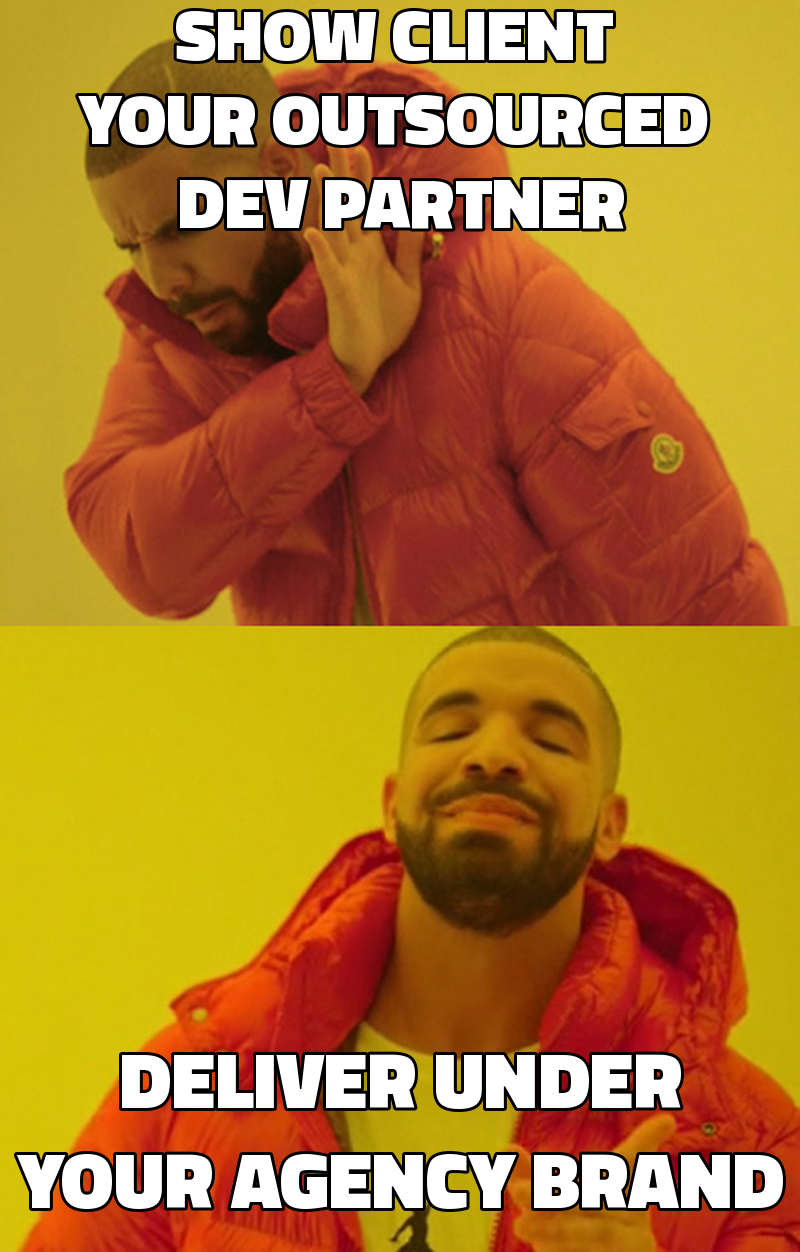
A white-label agency is a development partner that builds software, AI automation, or voice solutions under your agency’s name, while you keep the client relationship and margin. In practice you pay a wholesale rate, the partner delivers the code, and you brand the work as your own.
Key takeaways
- Use a signed NDA and non-circumvent clause before any project starts.
- Provide a shared project dashboard that shows status but hides the partner’s identity.
- Start with a small, fixed-scope pilot to prove reliability and set turnaround expectations.
- Assign a single accountable point of contact (POC) who owns the delivery end-to-end.
- Embed brand assets, style guides, and communication scripts into every hand-off.
- Monitor for poaching signals and enforce penalties in the contract.
What exactly is a white-label developer?
A white-label developer is a third-party engineering team that creates custom builds, web apps, SaaS platforms, AI chatbots, voice assistants, while remaining invisible to the end client. The agency sells the solution as its own service, bills the client at a retail rate, and pays the developer a wholesale fee. This model lets agencies of 5-15 people expand their service catalog without hiring full-time engineers.
According to a 2023 Gartner survey, 42% of boutique marketing agencies use white-label tech partners to fill capability gaps, and 68% of those say the partnership helped them retain high-value clients. The model works best when the agency controls the client-facing narrative and the developer adheres to strict brand-protection clauses.
Why brand protection matters for no-dev agencies
Your agency’s promise to "deliver full-service solutions" is a core differentiator. If a client discovers you outsourced the work, two risks appear:
- Erosion of trust – Clients may feel deceived and look for a partner that can truly do everything in-house.
- Poaching – A visible developer can approach the client directly, offering a lower price because they already know the project details.
A 2022 Forrester study found that 27% of B2B clients who learn about hidden outsourcing terminate the relationship within three months. Protecting your brand therefore directly impacts revenue stability.
Step-by-step framework to keep your brand front-and-center
1. Legal foundations: NDA + non-circumvent
- NDA: Covers project specifications, client data, and any proprietary processes.
- Non-circumvent clause: Prohibits the developer from contacting the client for a defined period (usually 12 months) and includes a liquidated-damage fee equal to 2× the wholesale fee.
- Signature workflow: Use DocuSign or HelloSign for instant execution; store signed copies in a secure, auditable folder (e.g., Google Drive > Contracts > White-Label).
"A solid contract is the first line of defense against brand leakage," says legal partner Cooley.
2. Brand-first onboarding checklist
| Item | Description | Owner |
|---|---|---|
| Brand style guide | Colors, fonts, tone, logo usage | Agency Creative Lead |
| Communication template | Email scripts for status updates, deliverable hand-off, and issue escalation | Agency Account Manager |
| Confidentiality badge | Small visual badge to attach to PDFs showing "Developed by [Agency]" | Agency Ops |
| Project naming convention | Use internal codes that do not reveal the dev partner (e.g., "Project-Aquila") | Agency PM |
3. Single point of contact (POC) model
Assign one senior staff member, often the Head of Delivery or COO, as the Delivery Owner. This person:
- Receives the developer’s technical updates.
- Translates them into client-ready language.
- Owns the final quality check before the client sees anything.
The POC reduces the chance of mixed messages and ensures the agency remains the sole voice.
4. Transparent yet anonymized project dashboard
A lightweight dashboard (e.g., Notion, ClickUp, or a private Airtable view) should show:
- Milestones, due dates, and current status.
- Hours logged (aggregated, not per-engineer).
- Attachments for mockups and deliverables. Do not expose the developer’s name or internal task board. This keeps the client confident you have full control while the developer stays behind the curtain.
5. Fixed-scope pilot before any retainer
Offer a paid pilot that:
- Is scoped to a single feature or a small automation (e.g., a chatbot prototype).
- Has a clear deadline (e.g., 2-3 weeks).
- Includes a success metric (e.g., 80% of test users complete the flow). If the pilot succeeds, move to a larger build and discuss a monthly retainer for ongoing escalation work.
6. Embed brand assets into every deliverable
- Watermarked UI mockups with your agency logo.
- Code comments that reference internal naming conventions, not the developer’s internal repo.
- Final PDF reports that carry the agency’s branding and exclude any third-party logos.
7. Quality gate and acceptance testing
Create a checklist that the Delivery Owner signs off on before any client delivery:
| Quality Item | Pass Criteria |
|---|---|
| Functional testing | All user stories meet acceptance criteria |
| Performance | Page load < 2 seconds on Chrome Lighthouse (mobile) |
| Security | No open ports, OWASP Top 10 compliance |
| Branding | All UI elements match agency style guide |
If any item fails, the developer must remediate at no extra cost before the client sees the work.
8. Monitor for poaching signals
Set up alerts in your CRM (HubSpot or Pipedrive) for:
- New contacts added with the same email domain as the developer.
- Direct inbound emails from the developer’s sales address. When a signal appears, invoke the non-circumvent clause and discuss remediation with your legal counsel.
9. Pricing transparency for the agency
Your wholesale rate should sit between 50-70% of the retail price you charge the client. For a typical $3,000 build, you would pay $1,500-$2,100 to the developer. This margin covers:
- Project management overhead.
- Risk buffer for revisions.
- Profit that funds future partnership scaling.
10. Scale responsibly – cap active partners
Because reliability is your competitive edge, limit the number of concurrent white-label partners to 8-10 agencies. This ensures you can meet SLAs (e.g., 2-week turnaround for a $5k build) without becoming the flaky freelancer you promised to replace.
Comparison: White-label vs In-house vs Freelance
| Model | Cost (USD) per $5k build | Time to market | Brand risk | Scalability |
|---|---|---|---|---|
| White-label | $2,000-$3,000 (wholesale) | 2-3 weeks (fixed) | Low (contractual) | High (partner pool) |
| In-house | $4,500-$6,000 (salary + overhead) | 4-6 weeks (recruit & ramp) | Very low | Medium (capacity limited) |
| Freelance | $1,500-$2,500 (hourly) | 3-5 weeks (variable) | Medium (no NDA) | Low (single point failure) |
Real-world example: RouteMate partnership
Synthisia’s "Silent Dev Arm" helped a UK-based SEO agency launch RouteMate, a full-stack SaaS that automates client reporting. The agency kept the brand on all marketing assets, while Synthisia delivered the backend API, PostgreSQL schema, and React front-end. By using a shared ClickUp dashboard and a single Delivery Owner, the agency reported a 35% increase in upsell revenue within three months, and the developer never contacted the end clients.
Checklist: Brand-Protection Actions for Every White-label Deal
| Action | Done? (✓/✗) |
|---|---|
| Signed NDA & non-circumvent | ✗ |
| Brand style guide uploaded to partner portal | ✗ |
| Shared anonymized dashboard live | ✗ |
| Fixed-scope pilot defined and priced | ✗ |
| Delivery Owner assigned | ✗ |
| Quality gate checklist completed | ✗ |
| Final deliverable watermarked | ✗ |
| Post-delivery client survey scheduled | ✗ |
Common pitfalls and how to avoid them
- Over-promising turnaround – Set a realistic band (e.g., 10-14 business days for a $2k build) and stick to it. Clients value predictability more than speed.
- Giving away the developer’s name – Even a casual "Our partner X built this" can erode the brand narrative. Keep all external communication agency-centric.
- Skipping the pilot – Jumping straight to a large retainer without proof of concept often leads to missed deadlines and strained relationships.
- Relying solely on NDAs – Legal contracts are necessary but not sufficient; operational controls (dashboard, POC, branding) are the real safeguards.
- Under-estimating hidden costs – Factor in project management time (typically 15-20% of dev hours) when negotiating wholesale rates.
How to pitch the partnership to agency leadership
- Start with the pain – "You’re losing $10-15k per month by turning away AI-automation requests."
- Show the ROI – Use the table above to illustrate cost vs in-house hiring.
- Demonstrate brand safety – Walk through the NDA, dashboard, and branding checklist.
- Offer a low-risk pilot – $1,500 for a chatbot prototype that can be delivered in 10 days.
- Close with scalability – Explain the capped partner model ensures you’ll never become a bottleneck.
The future of white-label development for agencies
As AI-generated code and low-code platforms mature, the gap between no-code agencies and custom development narrows. However, agencies will still need deep expertise for:
- Complex integrations (e.g., Salesforce ↔ HubSpot ↔ custom ERP).
- Voice-first experiences (Amazon Alexa, Google Assistant).
- Proprietary data pipelines that require secure back-ends. A reliable white-label partner that protects your brand will remain a strategic asset well into the next decade.
Frequently asked questions
What is the difference between white-label and subcontracting?
White-label means the partner’s work is fully rebranded as yours, and you retain all client-facing rights. Subcontracting often leaves the partner’s name visible and may involve the client dealing directly with both parties.
How can I be sure the developer won’t poach my client?
A robust non-circumvent clause with a liquidated-damage penalty, combined with a shared dashboard that hides the developer’s identity, creates both legal and operational barriers.
Do I need to pay for a pilot if the client later signs a retainer?
Typically the pilot fee is credited toward the first full-scope build. This aligns incentives and shows the client you’re confident in delivery.
What turnaround is realistic for a $5k AI automation project?
For a well-scoped pilot, 10-14 business days is common. Larger builds may extend to 3-4 weeks, but always define a fixed window in the contract.
How many white-label partners should I work with at once?
Limit to 8-10 active agencies. This keeps your capacity high enough to meet SLAs while preventing the "flaky freelancer" reputation.
Can I use a low-code platform instead of a developer?
Low-code can handle simple forms or landing pages, but complex back-ends, custom APIs, and voice integrations still require seasoned engineers. A hybrid approach works: low-code for the front-end, white-label dev for the heavy lifting.
What if the developer misses a deadline?
The contract should include a service-level agreement (SLA) with penalties (e.g., a 5% discount per delayed day). The Delivery Owner can also push internal escalation to keep the client informed.
Protecting your brand while expanding capabilities is not a luxury, it’s a necessity for growth-focused agencies. By following the legal, operational, and communication steps outlined above, you can confidently say yes to every client request, keep the margin, and stay invisible to the competition.
white‑label
Have something to build?
Tell us what you're trying to ship. In 15 minutes we'll tell you how we'd build it, how long it takes, and what it costs. No pitch deck, no pressure.