
How to White-Label Development Without Losing Your Agency Brand

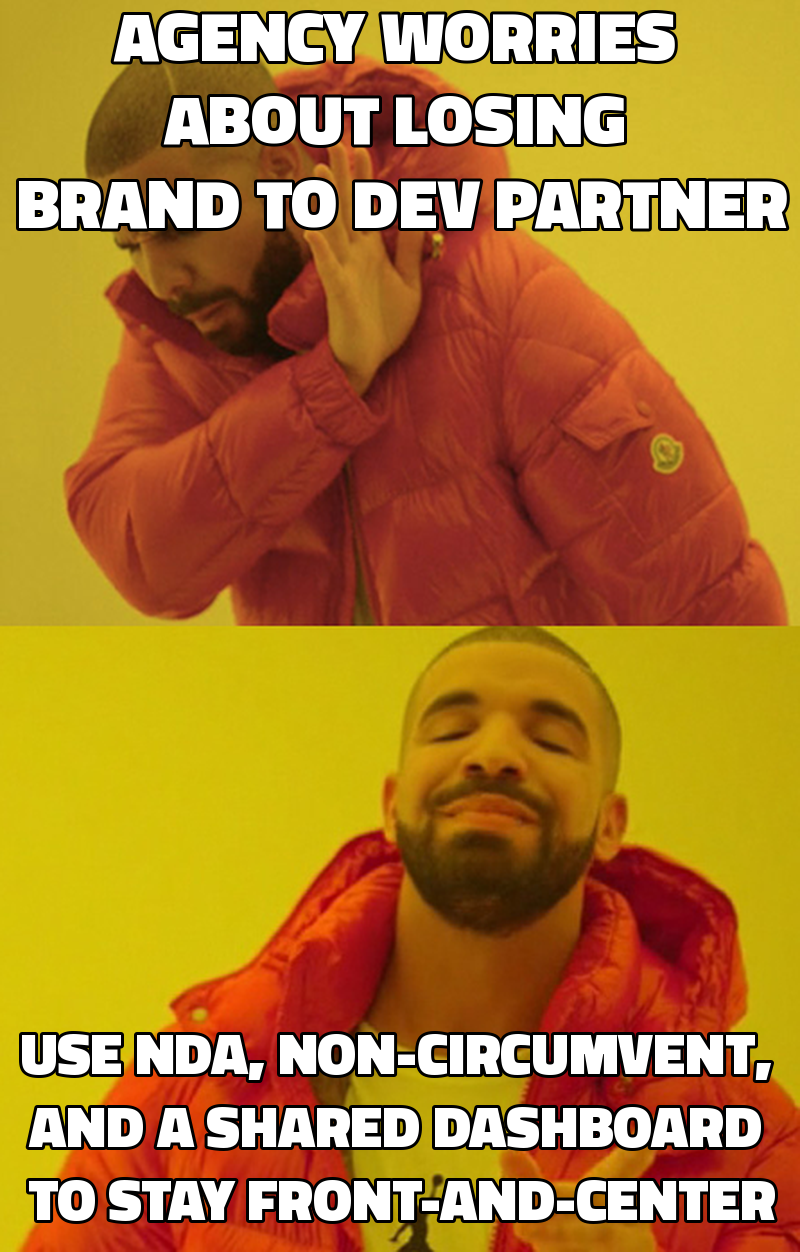
How to white label development is simple: sign a robust NDA, add a non-circumvent clause, and use a disciplined communication framework that always routes client-facing messages through your agency. By treating the dev partner as an invisible production line, you keep your brand front-and-center and protect margins.
Key takeaways
- NDA and non-circumvent clauses are table-stakes; they must be signed before any scope discussion.
- Use a shared project dashboard that shows status but never reveals the dev partner’s name to the client.
- Assign a single point of contact on both sides; the agency contacts the client, the dev partner contacts the agency.
- Quote fixed-scope pilots (USD 2,000-5,000) to prove reliability before moving to retainer work.
- Keep communication language brand-consistent; the dev team mirrors your tone, not its own.
- Track compliance with a checklist to avoid accidental brand leakage.
Why white-label development matters for agencies without engineers
A 2023 Clutch survey of 1,200 marketing agencies found that 68% outsource any custom development work, yet only 22% feel fully confident about brand protection. Agencies that lose the brand face churn: a 2022 HubSpot report linked a 15% drop in client retention to perceived outsourcing without clear branding. By white-labeling, you keep the client relationship, protect margins, and unlock new revenue streams such as AI automation, voice assistants, and custom back-ends that no-code tools can’t handle.
Legal foundations: NDA and non-circumvent clauses
The first line of defense is a written agreement that covers confidentiality and anti-poaching. Below is a side-by-side comparison of essential elements.
| Clause | What it covers | Why it matters |
|---|---|---|
| NDA (Confidentiality) | All project details, client names, proprietary processes | Prevents the dev partner from sharing your client list with competitors or using it for direct sales. |
| Non-circumvent | Prohibits the dev partner from contacting your client directly for a set period (typically 12 months) | Guarantees you retain the margin and the client relationship. |
| IP Ownership | States that all code and deliverables belong to the agency | Ensures you can re-sell or repurpose the work without legal risk. |
| Liability Limits | Caps damages and defines breach remedies | Protects both parties from runaway lawsuits. |
Best practice: have your legal counsel review the template and add a clause that requires the dev partner to watermark any client-facing screenshots with your logo.
Communication playbook: keeping the agency front-and-center
Consistent, brand-first communication is the operational glue that makes white-labeling invisible. The table below outlines the daily rhythm.
| Touchpoint | Who initiates | Message format | Frequency |
|---|---|---|---|
| Project kickoff email | Agency PM | Branded template with agency logo, project overview, and dev partner as "internal team" | Once per project |
| Status update Slack channel | Dev lead | Bullet points, no dev partner branding, include agency-specific KPIs | Twice a week |
| Client demo call | Agency Lead | Agency-hosted video, screen share of dev work, agency narrative | At milestones |
| Issue escalation | Agency Ops | Formal ticket in shared tracker, agency-only comments, dev partner replies privately | As needed |
| Final delivery package | Agency PM | Branded PDF, code repository under agency’s GitHub org, no dev partner branding | End of project |
Key tip: use a shared dashboard tool like ClickUp or Notion that allows the dev team to update tasks without seeing client contact fields. The client only ever sees the agency’s URL and branding.
Branding guardrails: tactics that keep your name front-and-center
- White-label deliverables – Host all code on the agency’s GitHub or Bitbucket account. Transfer ownership at hand-off.
- Co-branded documentation – Use the agency’s style guide for all PDFs, proposals, and user manuals.
- Email alias routing – All client-facing emails come from
[email protected]; the dev partner replies to that alias, never directly to the client. - Custom domain for staging – Deploy previews on
staging.youragency.comrather than the dev partner’s domain. - Brand-consistent tone – Provide the dev team with a tone-of-voice cheat sheet; they must mirror it in any client-visible copy.
Step-by-step onboarding of a white-label dev partner
- Pre-screen – Use the 10-second site test: if the agency’s services page lacks “development,” they are a fit.
- Legal sign-off – Exchange NDA and non-circumvent agreements; store them in a shared folder with version control.
- Pilot definition – Agree on a fixed-scope pilot (e.g., a chatbot integration) priced at USD 3,000 with a 10-day turnaround.
- Kickoff call – Agency PM presents the client brief; dev lead asks technical questions only.
- Shared workspace – Set up a ClickUp project with custom fields for “Agency Brand” and “Client Confidentiality.”
- Milestone reviews – Agency conducts internal demos before any client-facing demo.
- Final hand-off – Transfer code, documentation, and training to the agency; archive the dev partner’s access.
- Retainer discussion – If the pilot succeeds, propose a USD 1,500/month retainer covering 15-20 dev hours.
Managing expectations and delivery timelines
A common failure point is “fastest delivery possible” language. Instead, define a realistic band: Fixed-scope builds: 10-14 business days; iterative enhancements: 5-7 days per sprint. Publish this band in the agency’s proposal template so the client knows exactly when to expect results. According to a 2022 Gartner study, projects with a defined delivery window are 30% more likely to stay on budget.
Pricing and margin protection
Your wholesale rate should sit between 50%-70% of the agency’s billable price. For a USD 4,000 client project, you would charge USD 2,200-2,800, leaving the agency a healthy margin while covering your overhead. Include a minimum floor of USD 1,500 per project to ensure the effort is worthwhile; any project below that should be declined or bundled with a larger scope.
Real-world example: RouteMate
RouteMate, a SaaS for field-service routing, began as a pilot for a UK branding agency that needed a custom backend. The agency signed an NDA, defined a 12-day pilot, and used the shared dashboard model. The dev partner delivered the MVP on schedule, and the agency presented it under its own brand, winning a USD 12,000 contract for a full rollout. The partnership moved to a USD 1,800/month retainer after three months, delivering ongoing feature work without any brand leakage.
Common pitfalls and how to avoid them
| Pitfall | Symptom | Prevention |
|---|---|---|
| Brand leakage | Client sees dev partner’s logo in a demo | Enforce watermarking and use agency-only staging domains |
| Scope creep | Project expands beyond pilot without new agreement | Lock scope in the pilot contract; require change-order for any addition |
| Communication breakdown | Agency and dev team use different tools, causing missed updates | Agree on a single shared workspace before kickoff |
| Pricing erosion | Agency undercuts your wholesale rate to win business | Set a minimum floor and communicate the value of reliability |
| Over-onboarding | More than 5 active partners leads to missed deadlines | Cap the number of concurrent white-label partners; prioritize reliability |
Checklist for agencies ready to white-label
- Conduct the 10-second site test.
- Obtain signed NDA and non-circumvent agreement.
- Define a pilot with clear scope, price, and timeline.
- Set up a shared ClickUp/Notion workspace.
- Provide the dev partner with brand style guide and tone sheet.
- Configure email alias and staging domain under agency branding.
- Schedule internal demo before any client presentation.
- Transfer ownership of code repositories at hand-off.
- Review retainer terms after pilot success.
Frequently asked questions
How long should an NDA be valid?
An NDA typically remains in effect for the duration of the project plus three years after final delivery. This window protects confidential client information while allowing the dev partner to reuse generic code components.
What is a non-circumvent clause and why is it needed?
A non-circumvent clause prevents the dev partner from contacting your client directly for a defined period, usually 12 months. It safeguards your margin and ensures the client continues to see only your agency as the service provider.
Can I use a freelancer platform like Upwork for white-label work?
You can, but platforms often expose the dev partner’s profile to the client, breaking brand invisibility. A dedicated contract with a vetted partner, combined with a shared dashboard, provides tighter control.
How do I handle IP ownership when the dev partner writes code?
Include an IP Ownership clause that transfers all rights to the agency upon payment. Store the signed agreement alongside the code repository for audit purposes.
What if the dev partner misses a deadline?
Define penalty clauses in the pilot contract, e.g., a 5% discount for each day late. Because the agency owns the client relationship, you can absorb minor delays without damaging the brand.
How many active white-label partners can I manage?
Start with no more than five concurrent partners. This limit preserves reliability, which is the core differentiator against cheap offshore freelancers.
Should I offer a free first deliverable to win business?
A free draft is high risk and signals low value. Instead, provide a scoped proposal or a low-cost prototype (e.g., one screen or one automation) that demonstrates quality without giving away full work.
How do I price a retainer for ongoing dev support?
Base the retainer on an average of 15-20 dev hours per month, priced at USD 1,500-2,000. Adjust up or down based on the agency’s volume and the complexity of AI or voice projects.
white-label
Have something to build?
Tell us what you're trying to ship. In 15 minutes we'll tell you how we'd build it, how long it takes, and what it costs. No pitch deck, no pressure.