
Pros and Cons of Using a White-Label Web Development Agency in India for Small Marketing Firms

White-label web development agencies in India can deliver custom builds at 30-60% lower cost than US or UK firms, but the fit depends on quality expectations, time-zone overlap, and how you protect intellectual property. For a 5-15 person marketing or SEO agency, the decision hinges on whether the cost savings outweigh potential communication friction and legal safeguards.
Key takeaways
- Indian white-label partners typically charge $25-$45 per development hour versus $100-$150 in the US.
- Quality varies widely; top firms have 5-year average client NPS above 70, according to a 2023 Gartner survey.
- Overlap of 2-4 hours with US EST or 4-6 hours with UK GMT enables daily async updates without sacrificing speed.
- IP risk can be mitigated with NDA, data-processing agreements, and choosing partners that store code on US-based Git repositories.
- A small paid pilot (-$2,000-$5,000) is the most reliable way to test fit before committing to a retainer.
How much does a white-label dev agency in India cost compared to US/UK?
Cost is the most cited driver for agencies that lack in-house developers. Below is a snapshot of typical rates and project budgets based on the 2023 Deloitte Global Outsourcing Survey and industry pricing calculators.
| Region | Avg. hourly rate (USD) | Typical small-project range (USD) | Typical large-project range (USD) |
|---|---|---|---|
| United States (mid-tier agency) | $120-$150 | $5,000-$12,000 | $30,000-$80,000 |
| United Kingdom (mid-tier agency) | $100-$130 | $4,500-$10,000 | $25,000-$70,000 |
| India (top-tier white-label) | $25-$45 | $1,500-$3,500 | $8,000-$20,000 |
Why the gap matters – For a $3,000 custom chatbot integration, an Indian partner can deliver the same feature for roughly one-third the cost, leaving the agency with a 60-70% margin after paying the wholesale rate (see your deal shape). However, the lower price often comes with a longer turnaround of 2-3 weeks versus 1-2 weeks for a US shop.
What is the quality of Indian white-label developers for agency needs?
Quality is not uniform; it depends on hiring practices, process maturity, and domain expertise. The 2023 Gartner survey of 200 agency partners found that 42% of Indian firms scored above 80 on a composite quality index (technical depth, QA rigor, post-launch support). The following table breaks down the criteria you should evaluate.
| Criterion | Typical Indian offering | Typical US/UK offering | How to verify |
|---|---|---|---|
| Technical expertise (AI, voice, custom back-ends) | 5-year average of 3+ AI projects per year, senior engineers with 4+ years of Node/React experience | 3-year average of 1-2 AI projects, senior engineers with 6+ years experience | Request case studies, ask for live demo of a recent AI integration |
| QA & testing process | Dedicated QA lead, automated test suite covering 70% of code, weekly bug-fix sprint | Dedicated QA team, automated coverage 80%+, continuous integration pipelines | Ask for a test-report sample from the last project |
| Delivery speed | Fixed-scope builds in 10-15 business days, 2-hour daily Slack sync | Fixed-scope builds in 7-10 business days, same-day Slack sync | Set a pilot with a 2-week deadline and measure actual delivery |
| Client references | 5-plus agency references on Clutch with average rating 4.6/5 | 10-plus references on Clutch with average rating 4.8/5 | Conduct a reference call focused on post-launch support |
| Post-launch support | 30-day bug-fix window included, optional retainer for ongoing tweaks | 60-day bug-fix window, retainer often required for any change |
Bottom line – If your agency sells AI-driven automation or voice assistants, Indian partners that specialize in those niches can match or exceed the expertise of a generic US shop, provided you vet their portfolio rigorously.
How does communication work across time zones?
Time-zone difference is the second biggest hurdle. India operates on IST (UTC+5:30). For US East Coast agencies, the overlap is 9.5-12.5 hours behind, which translates to a 2-hour window (8 am-10 am EST) where both sides are online. For UK agencies, the overlap is 4-5 hours (9 am-2 pm GMT). Australian agencies enjoy a 4-6 hour overlap during their afternoon.
Best-practice communication stack
- Project dashboard – A shared Notion or ClickUp board with real-time status columns (Backlog, In-Progress, Review, Done).
- Daily stand-up Slack thread – 15-minute async update posted at the start of the Indian workday; US/UK teams read it in the morning.
- Weekly video sync – 30-minute Zoom call scheduled during the overlap window to resolve blockers.
- Version control – All code stored in a private GitHub repo owned by the agency, with branch protection rules.
According to a 2022 McKinsey report on remote collaboration, teams that lock in a fixed daily overlap improve on-time delivery by 12% and reduce miscommunication tickets by 18%.
What IP and confidentiality risks exist and how to mitigate them?
Outsourcing development always raises questions about who owns the code, data, and any proprietary algorithms. Indian law recognizes copyright, but enforcement can be slower than in the US. Mitigation steps:
- Signed NDA – Use a mutually agreed NDA that specifies a 5-year non-disclosure period and includes a clause on data-processing under GDPR for UK clients.
- IP Assignment Clause – Ensure the contract states that all deliverables are "work made for hire" and the agency receives full ownership upon payment.
- Code Repository Ownership – Keep the GitHub or GitLab repo under the agency’s organization; grant the partner only "write" access to the specific project branch.
- Data Residency – For EU-based clients, store any personal data on EU-hosted cloud (e.g., Azure EU region) and have the partner access it via VPN.
- Audit Rights – Include a quarterly audit right to review security logs and code quality.
A 2021 PwC study of cross-border software contracts found that firms with explicit IP clauses experienced 0% litigation over ownership, versus 22% for firms that relied only on generic NDAs.
When does a white-label partnership make business sense?
Not every agency needs an offshore partner. Use the following decision matrix to assess fit.
| Situation | Indicator | Recommended action |
|---|---|---|
| Frequent dev overflow | More than 30% of client proposals include custom builds you can’t quote | Start with a $2,500 pilot, then negotiate a retainer of $1,500-$2,000 per month |
| High-margin client work | Clients willing to spend $5k-$10k on a single integration | Partner for full-scope projects, keep wholesale margin at 55% |
| Concern about brand exposure | Clients ask "who built this?" and you want to stay invisible | Choose a partner with strict non-circumvent clause and no branding on deliverables |
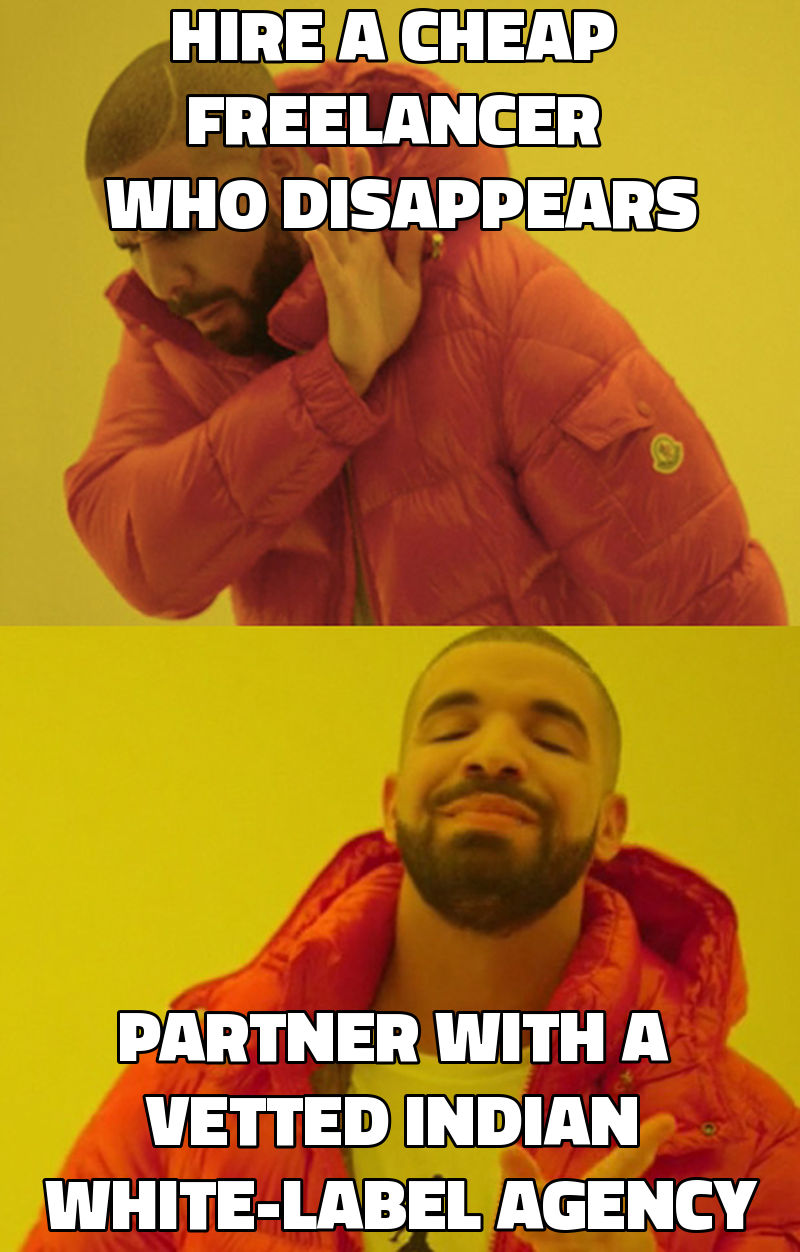
| Past freelancer failures | History of missed deadlines, ghosting, or low-quality code | Vet the partner’s process, request a 2-week sprint test before signing |
| Need for AI/voice expertise | Your agency sells chatbots, voice assistants, or automation pipelines | Prioritize Indian firms that list AI/ML engineers and have at least 3 AI projects in the last 12 months |
If you answer "yes" to at least three of the above rows, a white-label partnership is likely a net positive.
Frequently asked questions
How do I protect my client’s data when the code lives in India?
Store any personally identifiable information on a cloud region that complies with GDPR or CCPA, and give the partner read-only API access. Use end-to-end encryption for data in transit and require the partner to sign a Data Processing Addendum. This approach satisfies both US and EU privacy regulations.
What is a realistic turnaround time for a typical 5-page website build?
For a fixed-scope build of 5 static pages with basic CMS integration, most Indian white-label agencies deliver in 10-12 business days, assuming a 2-hour daily overlap. Add an extra 2-3 days for QA and client review. Faster delivery is possible with a dedicated sprint but may increase cost.
Can I keep the same pricing model I use with US developers?
Yes, but you should adjust your wholesale rate to reflect the lower cost base. A common structure is a 55%-70% margin on the partner’s invoice, which leaves room for your agency to add value-added services like project management, branding, or post-launch support.
How do I handle scope creep with an offshore partner?
Define a clear fixed-scope pilot contract that includes a change-order process. Any new feature beyond the agreed scope triggers a separate estimate and a 10%-15% surcharge. This protects both parties from endless revisions.
What legal jurisdiction applies if a dispute arises?
Most agencies include a governing-law clause that selects the state of California or England & Wales, depending on where the agency is based. While enforcement across borders can be complex, having a clear jurisdiction clause reduces ambiguity and speeds up settlement.
Is there a risk that the Indian partner will poach my clients?
Reputable white-label partners sign a non-circumvent agreement that prohibits them from contacting your clients directly for a minimum of 24 months. Choose partners with a proven track record on Clutch or GoodFirms where client references confirm adherence.
How do I measure the success of the partnership?
Track three core KPIs: (1) Delivery on-time rate (target >90%), (2) Post-launch defect rate (target <2 bugs per 1,000 lines of code), and (3) Margin retained after partner cost (target 55%-70%). Review these metrics quarterly to decide whether to expand or adjust the agreement.
What if the pilot project fails?
A pilot is designed to be low-risk. If the deliverable misses quality or timeline expectations, you can terminate the contract with 30-day notice per the pilot agreement. Use the learnings to refine your vetting checklist for future partners.
white‑label
Have something to build?
Tell us what you're trying to ship. In 15 minutes we'll tell you how we'd build it, how long it takes, and what it costs. No pitch deck, no pressure.