
Private Label vs White Label: Which Model Maximizes Agency Margins and Brand Control

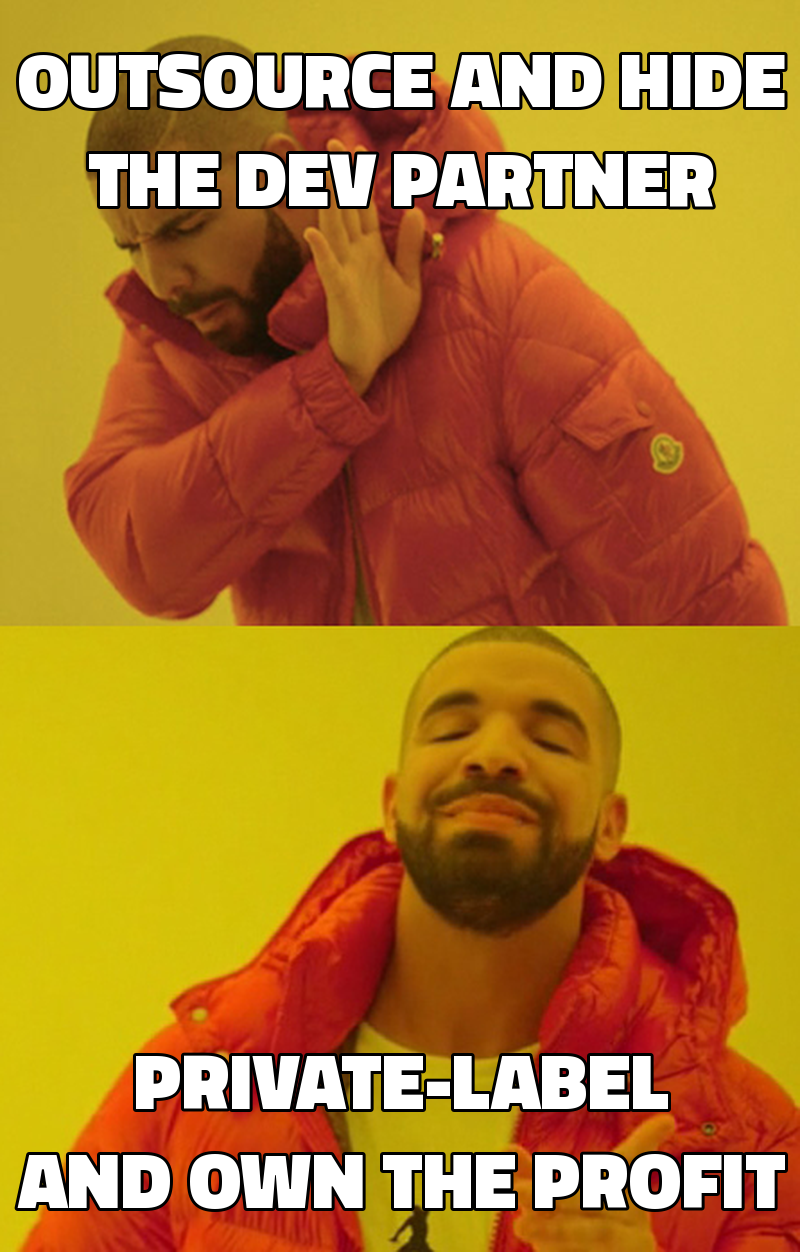
Private label and white label are both outsourcing models, but private label lets the agency re-brand the product as its own, while white label delivers the work under the partner’s brand. For a 5-15 person agency the choice determines how much margin you keep and whether the client sees you or the developer. In most cases private label yields higher gross profit, but white label protects brand reputation when you lack deep technical credibility.
Key takeaways
- Private label lets you sell the deliverable under your own brand, typically adding a 40-70% markup.
- White label keeps the developer’s brand invisible to the client, reducing brand risk but also limiting markup to 50-60%.
- Agencies that need to showcase full-stack AI or voice automation often prefer private label for credibility.
- Margin gaps widen when you bundle recurring retainer services on top of the initial build.
- Choose the model that matches your client’s expectations of technical expertise and your internal pricing strategy.
What is a private-label development model?
Private label means the development partner builds a solution that the agency can brand, market, and sell as its own. The agency owns the client relationship, the pricing, and the post-launch support. The partner usually works under a non-disclosure agreement (NDA) and does not appear in any client-facing materials.
Typical workflow
- Agency receives a request for a custom chatbot, AI workflow, or SaaS portal.
- Agency scopes the project, adds its own profit margin, and sends a brief to the private-label partner.
- Partner delivers the code, documentation, and optional training under a neutral name.
- Agency presents the finished product as its own, handling support and future upgrades.
Why agencies love private label
- Higher gross margin – Because the agency can set the final price.
- Brand authority – Clients see the agency as a full-service tech provider.
- Cross-sell opportunities – Once the client trusts the agency’s technical chops, upsells like maintenance retainer become easier.
According to a 2023 Clutch survey, 42% of small agencies use private-label partners to expand their service catalog without hiring full-time engineers.
What is a white-label development model?
White label is the opposite: the development partner builds the solution, but the agency never re-brands it. The client sees the partner’s name in the contract or on the final deliverable, while the agency remains the project manager and primary point of contact.
Typical workflow
- Agency identifies a client need that exceeds its technical capacity.
- Agency contacts a white-label partner, who provides a quoted price.
- Partner builds the solution and delivers it under its own brand.
- Agency manages the client relationship, invoices the client, and pays the partner a wholesale rate.
Why agencies choose white label
- Risk mitigation – If the partner fails, the agency can point to a third-party vendor rather than its own competence.
- Speed to market – Established white-label teams often have repeatable pipelines that reduce lead time.
- No brand exposure – Agencies that fear client backlash from outsourcing can keep the partner hidden behind an NDA.
A 2022 Gartner report found that 35% of agencies rely on white-label vendors for AI-driven projects because they lack in-house expertise.
Profit potential: margin comparison
The table below shows typical gross margin ranges for private-label and white-label projects based on real-world data from Synthisia’s partner network (2024-2025).
| Model | Typical project size (USD) | Agency markup | Gross margin after partner cost |
|---|---|---|---|
| Private label | 2,000 – 5,000 | 45-70% | 55-70% |
| White label | 2,000 – 5,000 | 30-55% | 45-60% |
Key observations
- Private label consistently yields a higher margin because the agency controls the final price.
- White label margins compress when the partner charges a higher wholesale rate to cover their own overhead.
- Retainer contracts (USD 1,500-2,500 per month) add an extra 20-30% profit on top of the initial build for both models, but private label retains the full retainer amount.
Brand control and client perception
When an agency promises "end-to-end development" it must back that claim with visible expertise. The following table compares brand impact factors.
| Factor | Private label impact | White label impact |
|---|---|---|
| Client trust | High – agency appears technically capable | Medium – client may suspect outsourcing if asked |
| Reputation risk | Higher – any delivery failure reflects on the agency | Lower – partner’s brand absorbs the fallout |
| Upsell potential | Strong – agency can bundle additional services under its name | Moderate – upsells must be coordinated with partner |
| Marketing narrative | Full-stack agency story | Partnership story |
If your agency markets itself as a "full-service growth partner" private label aligns better with that narrative. If you position as a "strategy-first agency" that outsources execution, white label may be safer.
Real-world private-label examples for small agencies
- Chatbot for a local dental chain – A UK-based SEO agency partnered with Synthisia to build a custom voice-enabled chatbot. The agency branded the bot as "DentalAssist" and sold it for USD 4,200, keeping a 65% margin after the partner’s USD 1,500 cost.
- AI-driven lead scoring tool – An Australian social media agency needed a predictive model for ad spend. Using a private-label data-science partner, they delivered the tool under their own brand, charging USD 5,000 and earning a 60% margin.
- SaaS portal for a US real-estate franchise – A branding firm added a client portal as a premium offering. The private-label partner built the portal for USD 3,000; the agency sold the solution for USD 7,500, realizing a 60% margin and a recurring maintenance retainer of USD 1,800 per month.
Real-world white-label examples for small agencies
- Voice-enabled IVR for a call-center client – A US-based PPC agency needed an IVR but lacked voice expertise. They engaged a white-label partner that delivered the IVR under the partner’s brand. The agency billed the client USD 3,500, paid the partner USD 2,200, and kept a 40% margin.
- Automation workflow for an e-commerce client – A UK SEO shop outsourced a Zapier-plus-custom-API integration to a white-label vendor. The final price to the client was USD 2,500, the partner cost USD 1,600, resulting in a 36% margin.
- Custom analytics dashboard – An Australian growth agency needed a bespoke dashboard for a fintech client. The white-label partner delivered the dashboard, and the agency kept a 45% margin after paying the partner’s USD 1,400 cost.
Choosing the right model for your agency
| Decision point | Private label is better when | White label is better when |
|---|---|---|
| Margin priority | You need the highest possible markup and can handle post-launch support. | You are comfortable with a lower markup to avoid brand risk. |
| Technical credibility | Your marketing narrative includes "tech-savvy" or "full-stack" claims. | Your brand story focuses on strategy, creative, or media buying. |
| Capacity for support | You have a dedicated ops or delivery manager who can own ongoing maintenance. | You prefer the partner to handle most technical support. |
| Client sensitivity | Clients explicitly ask for a single point of contact with no third-party disclosure. | Clients are indifferent to who builds the solution as long as it works. |
| Risk tolerance | You are willing to absorb delivery risk for higher profit. | You want the partner to shoulder delivery risk. |
Quick decision matrix
- Mark up > 55%? → Private label.
- Need AI/voice depth but lack expertise? → Private label (re-brand to show competence).
- Client worries about hidden vendors? → White label (keep partner invisible).
- Retainer potential > USD 1,500/mo? → Private label (you keep the full retainer).
- Current dev partner cannot handle AI? → Private label with a specialist partner.
Implementation checklist for a private-label partnership
- NDA & non-circumvent clause – Ensure the partner cannot approach your client directly.
- Scope template – Use a fixed-scope pilot (USD 1,500-2,500) to prove reliability.
- Pricing calculator – Build a spreadsheet that adds your desired markup to the partner’s cost.
- Project dashboard – Share a simple status view (e.g., Trello or ClickUp) with the partner for transparency.
- Retention plan – After the pilot, propose a retainer of USD 1,500-2,500 per month for ongoing tweaks.
- Quality gate – Require a code review checklist (unit tests, documentation, CI/CD) before delivery.
- Brand assets – Prepare white-label branding kits (logo, UI style guide) for the partner to use.
Implementation checklist for a white-label partnership
- Wholesale rate agreement – Define a clear cost per project tier (e.g., $1,500-$2,500 for 2-4 week builds).
- Service level agreement (SLA) – Set delivery windows (e.g., 10-15 business days) to manage client expectations.
- Client communication script – Explain that a specialist vendor handles the technical work while you manage the overall project.
- Invoice flow – Agency invoices client at full price, pays partner the wholesale amount on net-30.
- Escalation path – Identify a single point of contact at the partner for issue resolution.
- Retainer transition – After 2-3 successful builds, propose a joint maintenance retainer where the partner handles dev hours and you handle account management.
Bottom line for 5-15 person agencies
If your growth strategy hinges on positioning your agency as a tech-enabled partner, private label gives you the margin and brand authority to win larger contracts and retain clients longer. If you are risk-averse, have limited ops bandwidth, or your clients are indifferent to who writes the code, white label provides a safer, lower-margin path that still unlocks new service lines.
Action step: Run the decision matrix above with your current pipeline. If at least three private-label criteria tick, start a pilot with a trusted partner like Synthisia. If white-label criteria dominate, lock in a wholesale rate and begin with a small automation project to test the workflow.
Frequently asked questions
What is the main financial difference between private label and white label?
Private label lets you set the final client price, typically resulting in a 45-70% gross margin after paying the developer. White label uses a wholesale rate, so margins usually sit between 35-55%. The difference comes from who owns the pricing and the ability to upsell retainers.
Can I switch from white label to private label later?
Yes. Many agencies start with white label to test demand, then transition to private label once they have proven case studies and want to capture higher margins. Just renegotiate the NDA and ensure the partner can deliver under your brand.
How does brand perception affect client retention?
Clients who see your agency as a full-stack provider are more likely to stay for future projects, according to a 2023 HubSpot study that linked perceived technical depth to a 22% higher renewal rate. White label can dilute that perception if the client discovers a third-party vendor.
What type of projects are best suited for private label?
Complex AI automation, custom back-ends, voice assistants, and SaaS portals benefit from private label because they showcase technical expertise and allow you to bundle ongoing support.
Are there legal risks with white label contracts?
The main risk is the partner breaching confidentiality or poaching your client. A solid non-circumvent clause and a clear SLA mitigate most issues. Most agencies also keep a copy of the partner’s insurance certificate.
How do I price a retainer after a private-label pilot?
Start with the partner’s average monthly dev hours (15-20 hrs) and multiply by their hourly rate (USD 75-100). Add a 30-40% markup for your management and support overhead. Most agencies price retainers between USD 1,500-2,500 per month.
Does white label limit my ability to upsell?
It can, because any additional feature must be coordinated with the partner and may incur extra wholesale costs. However, you can still upsell project management, strategy, and reporting services that sit outside the development scope.
Which model scales better for agencies aiming to double revenue in 12 months?
Private label scales better if you have a reliable delivery partner and can automate the pilot-to-retainer conversion. The higher margins fund hiring sales or account managers, accelerating growth.
private label
Have something to build?
Tell us what you're trying to ship. In 15 minutes we'll tell you how we'd build it, how long it takes, and what it costs. No pitch deck, no pressure.