
White Label vs Private Label: What Agencies Need to Know

White label and private label are not the same; white label means you deliver a product under the agency’s brand, while private label means the product is sold under the partner’s own brand and the agency can re-brand it later. In practice the distinction drives how you protect your brand, allocate profit, and manage legal risk. Choosing the right model lets a 5-15 person agency say yes to AI automation or custom backend requests without hiring a full-time developer.
Key takeaways
- White label keeps the agency’s brand front-and-center, private label lets the provider own the brand.
- Legal contracts differ: NDAs are standard for white label, IP transfer clauses dominate private label.
- Profit margins are typically higher on private label because the agency can mark-up the wholesale rate.
- White label reduces brand dilution risk, private label offers scalability for the provider.
- Match the model to your client-facing promise and the type of work you outsource.
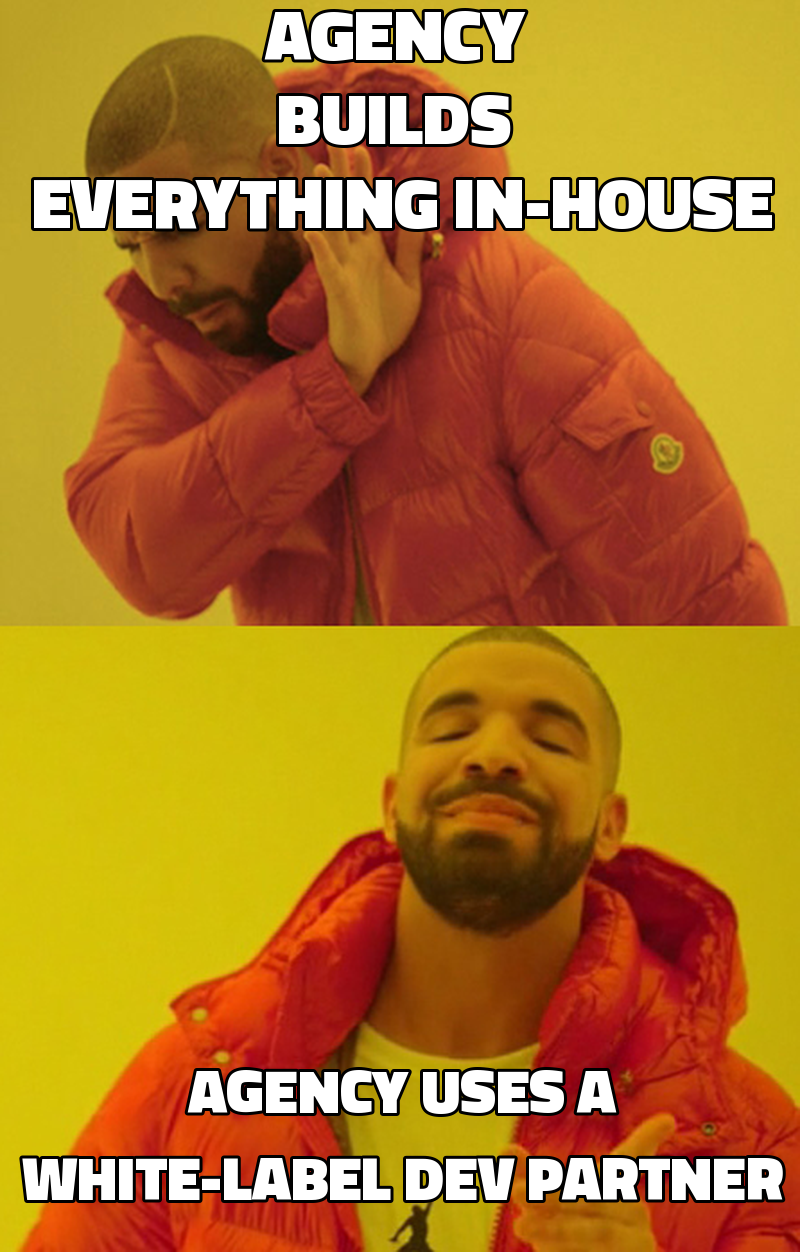
What is white label development for agencies?
White label development is a service where a third-party studio builds a solution that is presented to the client as if the agency created it. The agency retains the client relationship, invoices the client, and the developer works behind the scenes under a non-disclosure agreement (NDA) and a non-circumvent clause. This model is common in the US, UK and AU where agencies sell AI chatbots, voice assistants or custom SaaS tools but lack in-house engineers.
According to the 2023 Clutch Agency Survey, 62% of small marketing agencies outsource at least one development project per quarter, and 41% use a white-label partner for the majority of those projects. The appeal is clear: agencies can expand their service catalog without the overhead of hiring.
What is private label development and how does it differ?
Private label development is a partnership where the provider creates a product that the agency can re-brand and sell as its own, often with a license to modify the branding or UI. Unlike white label, the agency may receive the source code, documentation and the right to customize the solution. The provider typically retains ownership of the underlying platform and may sell the same core product to multiple agencies under different brand skins.
A 2022 Gartner report on B2B SaaS partnerships notes that private-label arrangements generate 15-20% higher average revenue per user (ARPU) for agencies because they can apply their own pricing strategy on top of the wholesale cost.
Branding implications: client perception and agency positioning
| Aspect | White label | Private label |
|---|---|---|
| Brand exposure | Agency name appears on all deliverables, client sees agency as full-service | Agency can choose to expose its own brand or keep the product generic, allowing co-branding options |
| Client trust | Higher because the agency claims ownership of the work | May require extra communication to assure clients the solution is vetted |
| Marketing assets | Agency can showcase case studies as its own work | Agency must obtain permission to use provider’s branding in portfolios |
For agencies that market themselves as “full-stack growth partners,” white label aligns with the promise of end-to-end delivery. Private label works better for agencies that want to build a product line (e.g., a branded chatbot platform) that they can sell to multiple clients under a single brand.
Legal and contract considerations
- NDA and non-circumvent – White label contracts almost always include NDAs that prevent the agency’s client from contacting the developer directly. This protects the provider’s margin.
- IP ownership – Private label agreements usually transfer source code ownership or grant a perpetual license. Agencies must verify that the IP transfer is clean to avoid future infringement claims.
- Liability clauses – Because the agency is the face of the project, white label contracts often shift warranty and support responsibilities to the agency, while private label can allow the provider to retain limited support obligations.
- Compliance – If the solution handles EU personal data, the agency must ensure the provider complies with GDPR. A 2021 PwC study found 48% of small agencies were unaware of their partner’s data-processing agreements, leading to compliance gaps.
Profit and pricing mechanics
| Metric | White label | Private label |
|---|---|---|
| Typical wholesale rate | 50-70% of client invoice | 30-45% of client invoice |
| Margin for agency | 30-50% after overhead | 55-70% after overhead |
| Pricing flexibility | Agency sets final price, often flat-fee per project | Agency can set subscription, tiered pricing or per-seat model |
| Risk exposure | Agency bears support and SLA risk | Provider may retain support, reducing agency risk |
For a $5,000 AI automation build, a white-label partner might charge $2,500 (50% wholesale). The agency invoices $5,000, keeps $2,500 before labor and overhead. In a private-label scenario, the agency might license the core engine for $1,800, then sell a subscription of $150/month to the client, generating recurring revenue that far exceeds the one-time margin.
When to choose white label vs private label
| Situation | Recommended model |
|---|---|
| Agency promises “we build everything in-house” and cannot expose a third-party name | White label – keeps the partner invisible |
| Agency wants to create a branded SaaS product line for multiple clients | Private label – gives ownership of the code |
| Agency needs a single pilot project to test reliability before committing | White label – low commitment, easy to terminate |
| Agency has a steady flow of similar automation requests and wants recurring revenue | Private label – license the engine and scale |
| Agency operates in regulated industries (finance, health) and needs strict data-processing contracts | Private label – negotiate IP and compliance clauses directly |
Real-world comparison table
| Feature | White label | Private label |
|---|---|---|
| Visibility to client | Provider hidden | Provider may be visible or hidden |
| Source code access | No | Yes (full or partial) |
| Customization rights | Limited to UI tweaks | Full customization possible |
| Ongoing support | Agency responsible | Provider may share support load |
| Scalability | Project-by-project | Product-as-a-service model |
Case study snapshot: RouteMate integration
Agency: GrowthCo, a 9-person SEO firm in London. Problem: Clients demanded a custom dashboard to monitor keyword performance, but GrowthCo had no dev capacity. Solution: Synthisia delivered a white-label dashboard under GrowthCo’s brand, completed in 3 weeks for a $4,200 wholesale fee. GrowthCo billed the client $7,500, kept a $3,300 margin, and added “custom analytics” to its service catalog. Outcome: Within six months GrowthCo secured three additional contracts for the same dashboard, generating $22,500 in extra revenue without hiring a developer.
How to structure a partnership agreement
- Define scope and deliverables – Use a fixed-scope pilot (e.g., 2-week prototype) before committing to larger builds.
- Set wholesale rates and margin floors – Align with the deal shape: minimum floor $1,500, 50-70% of client bill.
- Include IP clauses – For private label, specify transfer of source code, documentation and future upgrade rights.
- Add SLA metrics – Response time, bug-fix windows, and delivery timelines (e.g., “fixed-scope build delivered in 10-14 business days”).
- Establish escalation path – Single point of contact on the provider side reduces miscommunication; Synthisia uses a dedicated account manager for each partner.
- Plan for retainer transition – After the pilot, propose a monthly retainer of $1,500 for 15-20 dev hours, covering ongoing tweaks and new feature requests.
Practical steps for agencies ready to decide
- Run the 10-second site test: verify development is not listed on the agency’s services page.
- Review recent client work for hidden dev needs (chatbots, voice, automation).
- Ask the agency’s Head of Delivery: “Which client requests do you currently turn away because you lack dev capacity?”
- Match the answer to the table above: if the request is one-off, start with white label; if it’s a repeatable product, negotiate a private-label license.
- Draft a simple NDA and pilot contract within 48 hours; speed signals reliability.
- Track the pilot in a shared project dashboard (Synthisia’s lightweight view) to demonstrate transparency.
Frequently asked questions
What is the main branding risk of using a white-label partner?
The client may discover the work was outsourced if the agency cannot convincingly present the solution as its own. To mitigate this, agencies should enforce strict NDA terms, use a single point of contact, and ensure the deliverable matches the agency’s visual style and tone.
Can I switch from white label to private label later?
Yes, many providers allow a transition. The agency should negotiate an IP amendment that grants source code access after a set number of projects or a revenue threshold. This flexibility lets agencies start low-risk and scale to product ownership.
How does GDPR affect a white-label development partnership?
When personal data is processed, the agency remains the data controller. The provider must act as a data processor under a GDPR-compliant DPA. Agencies should request the provider’s GDPR certification and include breach-notification clauses in the contract.
What profit margin can I realistically expect?
For white-label projects priced between $2,000-$5,000, agencies typically keep 30-50% after paying the wholesale rate and covering project management overhead. Private-label licensing can push margins to 55-70% because the agency adds recurring subscription fees.
Is a retainer better than per-project billing?
Retainers provide predictable cash flow and prioritize the agency’s work on the provider’s queue. They are ideal when the agency has a steady stream of small automation tweaks. Per-project billing works for occasional large builds.
How do I protect my agency from a partner poaching my clients?
Include a non-circumvent clause that prohibits the provider from contacting the agency’s clients directly for a defined period (usually 12 months). Enforce it with a modest liquidated-damages penalty to deter violations.
Do I need a lawyer to draft these agreements?
While a basic NDA can be templated, it’s wise to have a legal professional review IP transfer and liability clauses, especially for private-label deals that involve source code ownership.
What tools can I use to manage white-label projects?
Simple project boards like ClickUp or Asana work well, but Synthisia offers a shared dashboard that shows real-time status, version control links and delivery timelines without exposing internal code repositories.
white-label
Have something to build?
Tell us what you're trying to ship. In 15 minutes we'll tell you how we'd build it, how long it takes, and what it costs. No pitch deck, no pressure.