
Private Label vs White Label: Real Agency Examples & When to Use Each

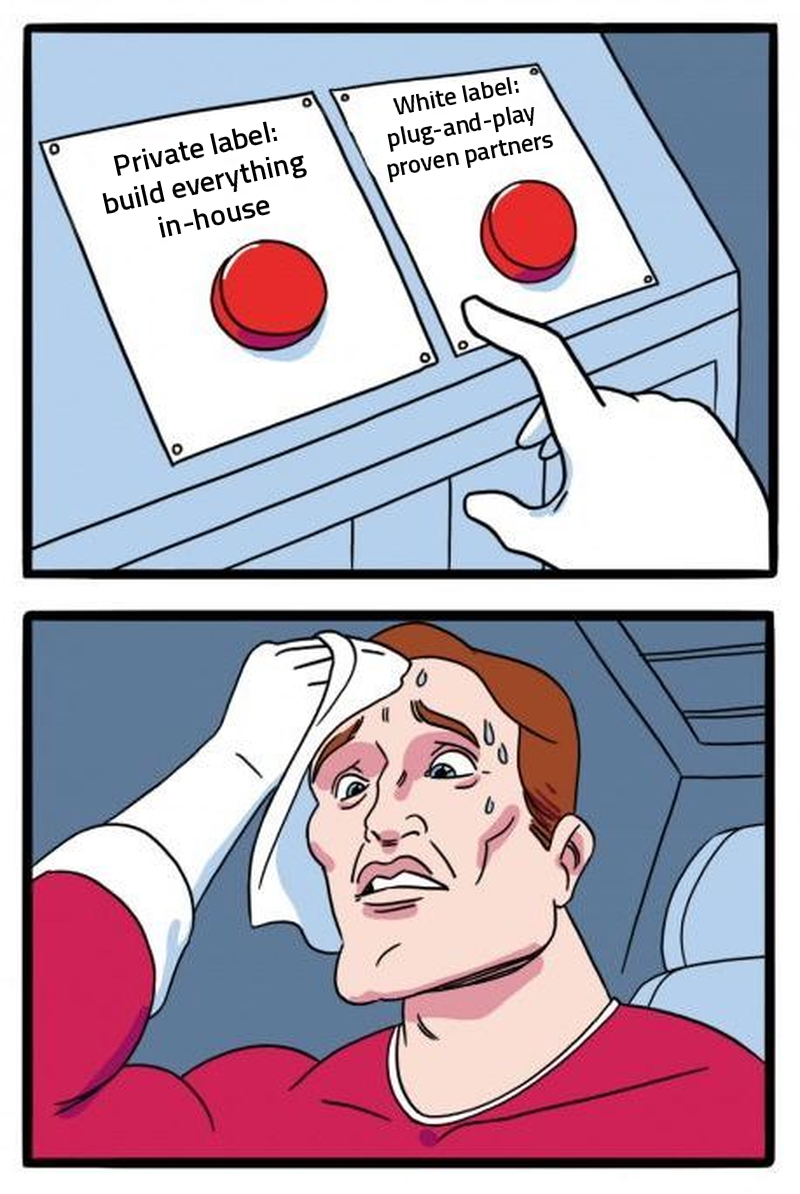
Private label and white label are two ways agencies can sell development work without hiring engineers. In a private label deal the agency buys a ready-made product, re-brands it, and owns the customer relationship. In a white label arrangement the agency outsources custom builds, keeps its brand front-and-center, and pays a wholesale rate for each project.
Key takeaways
- Private label = resell a pre-built solution; white label = outsource custom work under your brand.
- White label preserves client trust and allows unlimited scope; private label is faster to market but limited to the product’s feature set.
- Agencies earn 50-70% of the client bill on white-label projects; private label margins are typically 30-50% because of licensing costs.
- Ideal private-label use: SaaS tools, reporting dashboards, SEO audit platforms.
- Ideal white-label use: AI chatbots, voice assistants, bespoke automation, custom back-ends.
- Both models require NDA, non-circumvent clauses and a single point of contact for reliability.
What is a private-label example for a marketing agency?
A private-label example is a pre-built SEO audit platform that an agency purchases a license for, re-brands with its logo, and sells to clients as an “in-house” service. For instance, BrightEdge offers a white-label version of its keyword research engine that agencies can brand as "Agency Insights". The agency pays a monthly per-seat fee, sets its own pricing, and handles all support. The underlying technology does not change; the agency simply adds its own UI skin and marketing copy.
Real-world case
Agency X in the UK bought a private-label version of SEMrush’s reporting dashboard in 2022. They re-branded it as "GrowthMetrics" and bundled it with their monthly retainer packages. The agency reported a 22% increase in average client spend within six months, according to a case study on the SEMrush partner portal.
What is a white-label example for a branding agency?
A white-label example is a custom AI chatbot built for a client’s e-commerce site, delivered by an external development partner but presented as the agency’s own work. Synthisia (the Silent Dev Arm) builds the bot, integrates it with Shopify, and provides a shared project dashboard. The agency keeps the client relationship, invoices the client, and pays Synthisia a wholesale rate of 55% of the bill.
Real-world case
Agency Y in Australia needed a voice-enabled ordering system for a local restaurant chain. They engaged Synthisia, which delivered a full-stack voice app on Amazon Alexa, branded it as "Y Voice Ordering" and the restaurant never saw the third-party name. The project generated a $12,000 retainer after the initial $4,500 pilot, according to the agency’s internal KPI report.
Private label vs white label: side-by-side comparison
| Feature | Private label | White label |
|---|---|---|
| Scope of work | Fixed product, limited customization | Fully custom build, unlimited scope |
| Time to market | Days to weeks (product already built) | Weeks to months (development cycle) |
| Branding control | Full brand ownership, product appears native | Full brand ownership, partner stays invisible |
| Pricing model | License fee + per-seat or usage | Wholesale rate per project or retainer |
| Typical partners | SaaS vendors (BrightEdge, SEMrush, Ahrefs) | Development studios (Synthisia, Toptal, Upwork agencies) |
| Risk profile | Low technical risk, product updates handled by vendor | Medium risk, agency must manage scope and QA |
| Ideal for | Agencies that need a quick add-on service | Agencies that receive bespoke requests (AI, voice, automation) |
When should an agency choose private label?
- Speed matters more than uniqueness – If a client asks for a standard SEO audit, a private-label tool can be deployed in a day.
- Limited technical expertise – Agencies that only use WordPress, Webflow or no-code tools can still sell data-driven products without hiring developers.
- Predictable revenue – License fees create recurring income; the agency can bundle the tool into monthly retainers.
- Low margin tolerance – If the agency is comfortable with 30-50% margins, private label avoids the overhead of custom development.
Statistics
According to a 2023 HubSpot survey, 48% of small agencies use at least one private-label SaaS product to supplement their service catalog. The same survey found that agencies that added a private-label SEO tool saw an average revenue lift of 15% within the first year.
When should an agency choose white label?
- Custom AI or voice solutions – Clients increasingly request chatbots, predictive analytics, or Alexa skills that no off-the-shelf product can meet.
- High-ticket projects – When the budget exceeds $5,000, a bespoke solution justifies a higher margin and deeper partnership.
- Brand protection – Agencies that fear client backlash from outsourcing benefit from a fully invisible partner.
- Scalable overflow – White-label partners can handle spikes in demand without the agency hiring full-time engineers.
Statistics
Gartner reported in 2024 that 62% of agencies using white-label development saw a 35% increase in client retention because they could say "yes" to every technical request. McKinsey notes that white-label partnerships generate 1.8x higher average project size than private-label licensing.
How to evaluate a white-label development partner
| Criterion | What to look for | Why it matters |
|---|---|---|
| Technical stack | Experience with Node.js, Python, React, serverless, and voice platforms (Alexa, Google Assistant) | Guarantees ability to deliver AI and automation projects |
| Delivery model | Fixed-scope pilot + clear turnaround (e.g., 2-3 weeks for a $3k build) | Reduces risk of scope creep and missed deadlines |
| Accountability | Single point of contact, NDA, non-circumvent clause | Prevents the “ghost freelancer” problem the ICP mentions |
| Capacity | Low concurrency (max 5 active partners) | Ensures reliability, the core USP of Synthisia |
| Pricing transparency | Wholesale rate 50-70% of client bill, clear retainer terms | Allows agency to calculate margin accurately |
Practical checklist for a discovery call
- Confirm the agency’s headcount (5-15) and that they have no in-house devs.
- Ask for a recent case study that mentions a “platform” or “automation” need.
- Verify that “development” is not listed on their services page.
- Probe for a live need: “Do you have a project right now that requires AI or voice?”
- Discuss budget: “What range do your clients typically allocate for a custom build?”
If the answers align with the qualification gates in the ICP, move to a paid pilot.
Sample pilot workflow for a white-label partnership
- Scope definition (2 days) – Agency provides a one-page brief; Synthisia delivers a scoped proposal with milestones and a fixed price.
- Kick-off (1 day) – Joint video call, shared project dashboard (e.g., ClickUp or Monday.com) is set up.
- Development sprint (10-14 days) – Synthisia builds a minimum viable product (MVP) under the agency’s brand assets.
- Review & iterate (3 days) – Agency tests with the client, provides feedback, Synthisia refines.
- Delivery & hand-off (1 day) – Final product is deployed, documentation is uploaded, agency invoices the client.
- Retainer discussion (1 day) – Based on pilot success, agency signs a $1,500/month retainer for 15-20 dev hours of ongoing support.
This flow matches the “fixed-scope paid pilot” model described in the offering block and limits exposure for both parties.
Private-label licensing checklist
| Item | Detail |
|---|---|
| License type | Per-seat annual or perpetual with white-label rights |
| Re-branding limits | Verify you can change UI colors, logo, domain name |
| Support SLA | Minimum 24-hour response, included in license cost |
| Update schedule | Quarterly feature releases, no extra cost |
| Termination clause | 30-day notice, data export rights |
When an agency signs a private-label agreement, the operational overhead is mostly marketing and client onboarding. The technical side stays with the vendor, which aligns with the ICP’s pain point of “no-dev agencies”.
Real-world private-label vs white-label decision matrix
| Decision factor | Private label wins | White label wins |
|---|---|---|
| Client wants a ready-made dashboard | ✓ | |
| Client demands a custom voice skill | ✓ | |
| Agency needs to launch in <2 weeks | ✓ | |
| Agency wants to keep IP for future resale | ✓ | |
| Budget < $3,000 | ✓ (license) | ✓ (small pilot) |
| Need for ongoing support beyond 6 months | ✓ (vendor SLA) | ✓ (retainer) |
How to protect your brand when using a white-label partner
- NDA and non-circumvent – Both parties sign a mutual NDA; include a clause that the partner cannot approach the agency’s clients directly for 12 months.
- Co-branding policy – Use a shared project dashboard that shows only the agency’s logo; the partner’s internal team remains hidden.
- Quality gate – Require a code review checklist before any deliverable reaches the client. This prevents “embarrassing” bugs that could damage the agency’s reputation.
- Escalation path – Designate a single account manager at Synthisia who owns the relationship; the agency never has to chase multiple freelancers.
Frequently asked questions
What is the main financial difference between private label and white label?
Private label typically involves a recurring license fee plus a per-seat charge, resulting in 30-50% margins for the agency. White label uses a wholesale rate of 50-70% of the client bill, allowing higher margins on bespoke projects but requiring upfront development costs.
Can an agency use both models simultaneously?
Yes. Many agencies sell a private-label SEO reporting tool as a baseline service and supplement it with white-label AI chatbots for clients who need custom interaction. This hybrid approach maximizes revenue streams while keeping the brand front-and-center.
How long does a typical white-label pilot take?
A well-scoped pilot for a $3-5k AI automation project usually completes in 2-3 weeks, including discovery, development, and client review. The timeline is fixed in the proposal to avoid scope creep.
What happens if the white-label partner misses a deadline?
The partnership agreement should include a service level agreement (SLA) with penalties, such as a 5% discount on the wholesale rate for each missed business day. This protects the agency’s client commitments.
Are there any regulatory concerns for white-label development?
If the solution handles personal data, the agency remains responsible for GDPR (EU) or CCPA (US) compliance. The partner must sign a data processing addendum and follow the agency’s security standards.
How do I choose the right private-label SaaS vendor?
Look for vendors with proven re-branding rights, a robust API, and a support SLA of under 24 hours. BrightEdge, SEMrush, and Ahrefs all offer private-label options that meet these criteria.
Does white-label development affect my agency’s pricing strategy?
Because the agency controls the final invoice, it can bundle development costs into a retainer or project fee. Transparent pricing (e.g., “custom AI build – $4,500”) helps maintain trust while preserving margin.
What is the risk of client discovery of the white-label partner?
If the NDA and non-circumvent clauses are enforced, the risk is low. Use a single point of contact and a shared dashboard that hides the partner’s identity to further reduce exposure.
private label
Have something to build?
Tell us what you're trying to ship. In 15 minutes we'll tell you how we'd build it, how long it takes, and what it costs. No pitch deck, no pressure.