
Private Label vs White Label: Profit, Branding & Legal Guide for Small Agencies

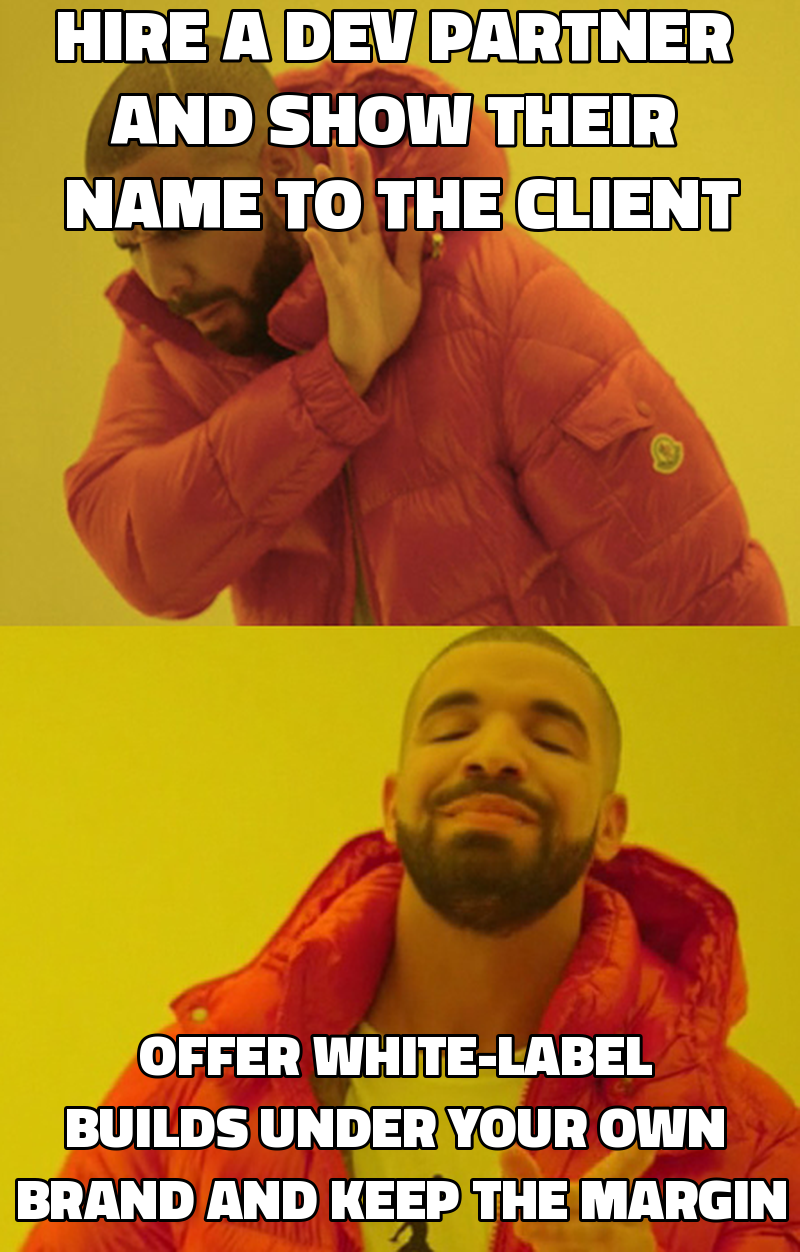
Private label and white label are both ways for an agency to sell development work it does not build in-house, but they differ in who owns the brand and how revenue is split. A private label partnership typically shows the developer’s name on the product and shares revenue 40-60 percent, while a white label deal hides the developer completely, lets the agency keep 50-70 percent of the bill and protects the agency’s brand.
Key takeaways
- White label lets agencies keep the client relationship and markup up to 70 % of the wholesale cost.
- Private label gives the developer a public portfolio and usually caps agency markup at 60 %.
- Branding control is total with white label, partial with private label (developer logo may appear).
- Legal risk is higher for private label because the developer is a co-seller and may be exposed to client lawsuits.
- Choose white label when you need repeat overflow, AI automation or voice projects that your team cannot quote confidently.
What is private label?
Private label is a co-branding model where the development partner’s name appears on the final product or on the contract. The agency sells the solution under its own brand, but the client sees a line-item such as "Developed by Synthisia (private label partner)". This model is common in SaaS reselling, e-commerce platforms and marketing automation tools.
Typical profit structure
- Development cost: $2,000-$5,000 per project (average $3,200 according to a 2023 HubSpot survey of agency partners).
- Agency markup: 40-60 % of the wholesale price.
- Example: A $5,000 chatbot build sold by Agency X with a private label partner at $3,000 cost yields $2,000 agency profit (40 %).
Branding impact
- Agency logo appears on the UI, but a small developer credit is required.
- Client may contact the developer for support, creating a shared reputation risk.
Legal considerations
- Both parties are listed on the contract, so the developer can be sued for defects.
- Intellectual property (IP) is often jointly owned, requiring clear IP assignment clauses.
- GDPR and CCPA compliance responsibilities are split; the agency must ensure the developer’s data handling meets the same standards.
What is white label?
White label is a fully invisible development model. The agency purchases the build at a wholesale rate, re-brands it completely and invoices the client under its own name. The developer never appears on invoices, UI or marketing collateral.
Typical profit structure
- Development cost: $2,000-$5,000 per project (same baseline).
- Agency markup: 50-70 % of the wholesale price.
- Example: A $5,000 voice-assistant project built by Synthisia costs the agency $2,500, leaving a $2,500 profit (50 %).
Branding impact
- Agency retains 100 % of the brand experience.
- No developer credit, so the agency can market the solution as its own proprietary offering.
Legal considerations
- The agency is the sole contract holder; the developer is covered by a non-disclosure and non-circumvent agreement.
- IP is transferred outright to the agency, eliminating joint ownership disputes.
- All compliance (GDPR, CCPA, HIPAA for health-tech) rests on the agency, but the developer must follow the same security standards under the NDA.
Profit margin comparison
| Model | Typical development cost (USD) | Agency markup range | Net agency profit (USD) | IP ownership |
|---|---|---|---|---|
| Private label | $2,000-$5,000 | 40-60 % | $800-$3,000 | Joint or shared |
| White label | $2,000-$5,000 | 50-70 % | $1,000-$3,500 | Agency only |
The table shows that white label can deliver up to $500 more profit per $5,000 project, assuming the same development cost. For agencies that handle 10-12 builds per month, that translates to an extra $5,000-$6,000 in monthly cash flow.
Branding control matrix
| Aspect | Private label | White label |
|---|---|---|
| Client-facing logo | Developer credit required (often small) | Agency logo only |
| Marketing collateral | Must mention partner in case studies | Full agency ownership |
| Upsell potential | Limited – partner may have exclusive rights on certain features | Unlimited – agency can package with other services |
| Reputation risk | Shared – partner failures affect agency brand | Agency sole responsibility – but also sole credit |
Legal risk checklist
- Contractual party – Private label: both agency and developer sign. White label: only agency signs with client.
- Liability clause – Private label requires indemnification from the developer for defects. White label places all liability on the agency, so a solid internal QA process is essential.
- IP assignment – Private label often uses joint-ownership language; white label uses a full transfer clause.
- Data protection – Both models must comply with GDPR (EU) and CCPA (California). Private label adds a data-processing addendum for the developer.
- Non-compete – White label agreements typically include a non-circumvent clause preventing the developer from contacting the agency’s client directly.
Real-world examples
Private label example – Agency Alpha
Agency Alpha, a UK-based branding firm with 8 staff, needed a custom AI-powered SEO audit tool for its enterprise clients. It partnered with Synthisia on a private label basis. The final product displayed "Powered by Synthisia" in the footer. The agency sold the tool for $9,000 per license, paid Synthisia $5,500, and kept $3,500 (≈39 % margin) after support costs. The developer credit helped Agency Alpha win a tech-media award, but a client later sued for a data-leak, and both parties were named in the legal notice, requiring a joint defense.
White label example – Agency Beta
Agency Beta, a US-based growth agency with 12 employees, receives frequent requests for voice-assistant integrations (Amazon Alexa, Google Assistant). It signed a white label agreement with Synthisia. For a $4,800 custom voice bot, Synthisia charged $2,200. Agency Beta billed the client $6,500, kept $4,300 (≈66 % margin), and marketed the bot as "Beta Voice AI" with no third-party branding. Because the contract was solely between Beta and the client, Beta handled all support and retained the full client relationship, leading to a repeat order three months later.
Decision framework for agency founders
- Assess profit goals – If you need the highest possible markup and can absorb full liability, white label is the clear winner.
- Consider brand strategy – If you want to showcase a partnership for credibility (e.g., a well-known dev studio), private label may add trust.
- Evaluate legal capacity – Do you have a legal team that can draft robust indemnity clauses? If not, white label reduces exposure.
- Volume vs. specialty – For occasional high-value projects, private label can provide a portfolio boost. For ongoing overflow (AI automation, voice, custom back-ends), white label yields repeatable margins.
- Compliance readiness – If your agency already has GDPR/CCPA processes, white label is simpler. If you lack those, a private label partner that handles compliance can be a safety net.
How to negotiate the best terms
- Set a floor price – Use the $1,500 minimum floor from Synthisia’s deal shape to avoid projects that erode profit.
- Ask for a capped concurrency – Limit the number of active builds to maintain reliability, a key selling point for agencies.
- Secure IP transfer language – Even in private label, request a clause that grants you exclusive rights to any custom code after the first year.
- Include SLA penalties – For white label, demand a 24-hour bug-fix SLA; for private label, negotiate shared penalties for missed deadlines.
- Leverage pilot projects – Start with a $2,000 paid pilot (as Synthisia recommends) to prove quality before scaling.
Bottom line
White label generally maximizes profit for small agencies because it lets you keep 50-70 % of the wholesale price, gives you full branding control and isolates legal risk behind a solid NDA. Private label can be useful when you need partner credibility or want to co-market a solution, but it caps your markup and adds shared liability. Evaluate your agency’s brand strategy, legal bandwidth and volume expectations to pick the model that aligns with your growth targets.
Frequently asked questions
What is the main financial difference between private label and white label?
White label lets you keep a higher percentage of the invoice, typically 50-70 % versus 40-60 % for private label. The development cost is the same, so the extra markup directly boosts cash flow. Agencies that run ten $5,000 projects a month can see an additional $5,000-$6,000 in profit with white label.
Can I use private label for AI automation projects?
Yes, but you must disclose the developer in the contract and possibly on the UI. Private label can add credibility if the developer is a known AI specialist, but you will share liability for any AI bias or data-privacy issues.
How does GDPR affect white label agreements?
When you white label, you become the data controller, so you must ensure the developer follows GDPR-compliant security practices. Include a data-processing addendum that obligates the developer to delete client data after project completion.
Is a non-disclosure agreement enough protection?
An NDA is table-stakes, but you also need a non-circumvent clause to stop the developer from approaching your client directly. For private label, add indemnification language so the developer covers any third-party claims.
What if the developer misses a deadline?
In white label deals, you can negotiate penalty clauses that credit you a percentage of the wholesale rate for each day late. In private label, penalties are usually shared, so you need a clear SLA that defines who bears the cost.
How do I decide which model fits my agency’s brand?
If your agency markets itself as a full-service tech partner and wants to showcase collaborations, private label works. If you position yourself as the sole owner of proprietary solutions, white label protects that perception and lets you upsell more freely.
Do I need a lawyer to draft these contracts?
While a basic NDA can be templated, profit-driving clauses like IP transfer, indemnification and SLA penalties benefit from legal review. Agencies without in-house counsel often use services like LegalZoom or hire a freelance contract attorney for a few hours.
Can I switch from private label to white label later?
Yes, but you must renegotiate the existing contracts to transfer IP and remove developer branding. Ensure the original agreement includes a termination clause that allows a clean handover without breach.
private label
Have something to build?
Tell us what you're trying to ship. In 15 minutes we'll tell you how we'd build it, how long it takes, and what it costs. No pitch deck, no pressure.