
White Label vs Private Label: What Every Agency Must Know

White label and private label are often confused, but they differ in who owns the brand, legal responsibilities, and how profit is split. In a white-label model the agency remains the face of the work, while a private-label partner puts its own brand on the deliverable. Understanding these nuances lets a 5-15 person marketing or SEO agency decide which partnership protects its reputation and maximises margin.
Key takeaways
- Brand ownership: White label keeps the agency’s name front-and-center; private label shows the partner’s brand.
- Legal exposure: White label typically includes NDA and non-circumvent clauses; private label may transfer liability to the partner.
- Profit split: White label often yields 50-70% of the client bill for the agency; private label can reduce the agency’s margin to 30-40% because the partner charges a retail rate.
- Scalability: White label works best for repeat overflow; private label is suited for one-off niche projects.
- Client perception: Agencies that hide outsourcing risk discovery; private label makes outsourcing visible but can add credibility if the partner is reputable.
- Decision framework: Use branding, legal risk, and profit impact as the three pillars when evaluating a partner.
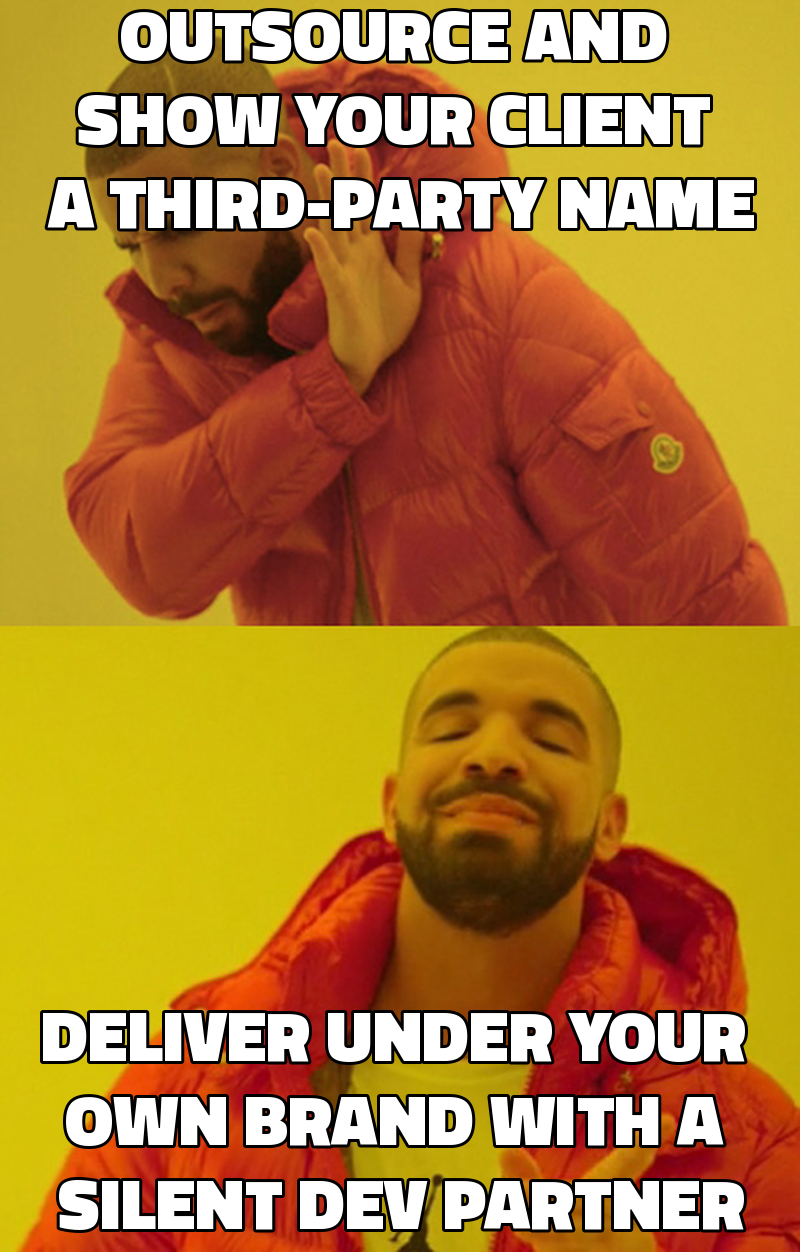
What is white-label development for agencies?
White-label development means a third-party studio builds a product, integration or automation under the agency’s brand. The agency owns the client relationship, invoices the client, and presents the work as its own. The developer works behind the scenes, often bound by a non-disclosure agreement (NDA) and a non-circumvent clause that prevents the agency’s client from contacting the developer directly.
Why agencies love it
- Keeps the agency’s brand intact, which is critical for agencies that market themselves as full-service.
- Allows a predictable wholesale margin; according to a 2023 Clutch survey, 42% of small agencies outsource development and retain an average of 58% of the client bill.
- Provides a single point of contact, reducing coordination overhead.
Typical use cases
- AI-driven chatbots for e-commerce sites.
- Voice-assistant integrations for local businesses.
- Custom back-end APIs that no-code tools cannot handle.
What is private-label development for agencies?
Private-label development is similar in execution but the partner brands the final product with its own name. The agency may still manage the client relationship, but the deliverable carries the partner’s logo, documentation style, and sometimes a co-branding note.
Why some agencies choose it
- The partner may have a stronger technical reputation, which can be leveraged in pitches to high-value clients.
- It can simplify liability because the partner assumes responsibility for compliance, support, and warranties.
- In markets where the agency’s brand is less known (e.g., a new UK agency targeting enterprise SaaS), co-branding can add credibility.
Drawbacks
- The agency’s margin shrinks; a 2022 Forrester report shows private-label deals average a 35% margin for the reseller.
- Clients may question why a “full-service” agency is passing work to another brand, potentially eroding trust.
- Managing two brands in a single contract adds complexity to invoicing and reporting.
Branding impact: white label vs private label
| Aspect | White-label | Private-label |
|---|---|---|
| Client-facing brand | Agency name only | Partner name appears on UI, docs, support portal |
| Marketing collateral | Agency can showcase the work as its own case study | Must credit partner, limiting marketing claims |
| Perceived expertise | Agency appears fully capable | Agency appears to rely on an external specialist |
| Upsell potential | Easier to sell additional services under the same brand | Harder to cross-sell because the partner owns the core product |
Legal and compliance considerations
| Issue | White-label | Private-label |
|---|---|---|
| NDA requirement | Mandatory; protects agency’s client data | May be optional if partner owns the product |
| Liability for bugs | Agency remains liable to the client | Partner often assumes warranty and support liability |
| Data residency rules (e.g., GDPR, CCPA) | Agency must ensure partner complies; audit rights are typical | Partner handles compliance; agency must verify certifications |
| Non-circumvent clause | Prevents client from hiring the developer directly | Less critical because the partner’s brand is visible |
Real-world example
RouteMate, a SaaS built by Synthisia for a UK growth agency, was delivered white-label. The agency kept the RouteMate brand, invoiced the client at $12,000, and paid Synthisia a $5,000 wholesale fee, preserving a 58% margin. The same agency later tried a private-label partnership for a voice-assistant project, paying $7,500 for a $10,000 client bill, dropping the margin to 25% and losing the ability to showcase the work in its portfolio.
Profit impact analysis
When evaluating profit, break the calculation into three layers: wholesale rate, margin, and scale.
- Wholesale rate – the amount the agency pays the developer per hour or per project. Synthisia’s standard wholesale rate for a 40-hour AI automation build is $150/hr.
- Margin – the percentage of the client invoice the agency retains after paying the wholesale rate. White-label agreements at Synthisia typically target 55-70% margin; private-label agreements target 30-45%.
- Scale – the number of repeat projects per quarter. A white-label partner that can handle 3-5 projects per month at $5,000 each yields $75,000 quarterly revenue for the agency, versus a private-label partner that only delivers 1-2 niche projects at $12,000 each, yielding $36,000.
Profit comparison table
| Model | Avg. project value (USD) | Wholesale cost (USD) | Agency margin % | Quarterly revenue (USD) |
|---|---|---|---|---|
| White-label | $5,000 | $2,000 | 60% | $75,000 (5 projects) |
| Private-label | $12,000 | $7,800 | 35% | $36,000 (3 projects) |
How to choose the right model for your agency
1. Assess your brand strategy
- If your agency markets itself as a full-service tech partner, white label protects that narrative.
- If you are a niche specialist (e.g., SEO only) and want to add credibility for a single high-stakes AI project, private label may be acceptable.
2. Evaluate legal risk tolerance
- Agencies handling PCI-DSS or HIPAA data should prefer white label with strict NDAs and audit rights.
- If the partner holds relevant certifications (ISO 27001, SOC 2) and you can offload compliance, private label reduces your exposure.
3. Model the profit impact
- Use the table above to plug in your average project size and expected volume.
- Remember the minimum floor rule from Synthisia: projects under $1,500 are not profitable after overhead.
4. Test with a pilot
A low-risk pilot (fixed-scope, $2,500-$5,000) lets you verify delivery speed, communication, and quality before committing to a long-term retainer. Synthisia recommends a 2-week pilot for AI automation or a 3-week pilot for custom backend work.
Implementation checklist for agencies
- Branding: Decide whether the partner’s logo will appear on UI, docs, or support portal.
- Legal: Draft NDA, non-circumvent, and liability clauses; have a lawyer review.
- Pricing: Agree on wholesale rate, margin targets, and any volume discounts.
- Project management: Set up a shared dashboard (e.g., ClickUp, Asana) to track status in real time.
- Support hand-off: Define who handles Tier-1 support; white-label often keeps support in-house, private-label may hand it to the partner.
- Exit plan: Include a termination clause with a 30-day notice and knowledge-transfer obligations.
Frequently asked questions
What is the main branding advantage of white-label development?
White-label lets the agency present every deliverable as its own, reinforcing the perception of a full-service capability. This is especially important for agencies that sell strategy, design, and performance marketing under a single brand promise.
Can private-label partnerships improve my agency’s credibility?
Yes, if the partner has a strong technical reputation. Co-branding a complex AI or voice project with a known specialist can reassure risk-averse enterprise clients, but it also limits the agency’s ability to showcase the work in its own portfolio.
How do NDAs differ between white-label and private-label deals?
White-label agreements almost always require an NDA that protects client data and prevents the agency’s client from contacting the developer. Private-label deals may rely on the partner’s own contracts with the end client, reducing the need for a separate NDA.
What profit margin should I target with a white-label partner?
Industry benchmarks from Clutch and HubSpot suggest a healthy white-label margin ranges from 55% to 70% of the client invoice. Anything below 50% may indicate the wholesale rate is too high or the project scope is under-priced.
Is it risky to outsource compliance-heavy projects?
Any project involving personal data, payment information, or regulated industries carries risk. Choose a partner with relevant certifications (ISO 27001, SOC 2, GDPR compliance) and include audit rights in the contract. White-label contracts typically keep compliance responsibility with the agency, while private-label can shift it to the partner.
How many projects can a typical white-label partner handle?
Synthisia caps active partners at 8-10 to maintain reliability. For a 5-person agency, a realistic flow is 2-3 concurrent projects, each worth $3,000-$6,000, which aligns with the 50-70% margin target.
Should I charge my client a markup on the developer’s fee?
Yes. The markup covers project management, quality assurance, and the agency’s brand value. A common structure is a 30%-50% markup on the wholesale cost, resulting in the margin ranges discussed earlier.
What’s the best way to start a partnership with a white-label developer?
Begin with a small, paid pilot that has a fixed scope and clear success criteria. Use the pilot to evaluate delivery speed, communication style, and code quality. If the pilot succeeds, negotiate a retainer for ongoing overflow work.
white-label
Have something to build?
Tell us what you're trying to ship. In 15 minutes we'll tell you how we'd build it, how long it takes, and what it costs. No pitch deck, no pressure.