
How to Price White-Label Development Projects for Agency Profitability

White label development agency pricing is the wholesale rate you charge the agency partner for a fixed-scope project, plus any ongoing retainer, that covers your delivery costs, desired profit margin and market competitiveness. It is calculated by adding direct labor, tooling, overhead and a margin buffer, then adjusting for the agency's billing model and client expectations.
Key takeaways
- Calculate total cost per hour (labor + tools + overhead) before adding margin.
- Target a wholesale margin of 50-70% to keep agency partners profitable while protecting your bottom line.
- Use a tiered price matrix based on project complexity, risk and expected turnaround.
- Anchor your quote with a fixed-scope pilot; convert successful pilots into retainer agreements.
- Benchmark against industry data: Clutch reports average agency dev project rates of $120-$180 per hour in the US/UK/AU.
What is white label development agency pricing?
White label development pricing is the amount a development studio invoices a marketing or SEO agency for a project that the agency will resell under its own brand. The agency then adds its own markup before billing the end client. The pricing model must satisfy three constraints: it must cover your internal costs, deliver a healthy profit margin, and remain attractive compared to alternative sources such as offshore freelancers or in-house hires.
How do I calculate my cost base for white label projects?
1. Identify direct labor costs
- Developer hourly rate: For senior full-stack engineers in the US/UK/AU, the market rate ranges from $100-$150 per hour according to the 2024 Stack Overflow Developer Survey. If you operate a boutique studio, your internal rate may be $120.
- Specialist premium: AI automation, voice integration and custom backend work command a 20-30% premium. Add $30-$45 per hour for these skill sets.
2. Add tooling and platform fees
| Tool / Platform | Monthly cost | Allocation per project (average) |
|---|---|---|
| AWS (compute & storage) | $200 | $30 |
| OpenAI API (GPT-4) | $150 | $25 |
| CI/CD (GitHub Actions) | $50 | $5 |
| Project management (ClickUp) | $30 | $3 |
| Design assets (Figma) | $45 | $4 |
| Total tooling per project | – | $67 |
3. Factor in overhead
Overhead includes office rent, utilities, insurance, legal, and admin staff. A typical overhead allocation is 20-25% of direct labor. For a 40-hour project at $120/hr labor, overhead adds $960-$1,200.
4. Compute total cost per project
Example: 40-hour AI-enabled web app
- Direct labor: 40 hrs × ($120 + $30 specialist premium) = $6,000
- Tooling: $67
- Overhead (22% of labor): $1,320
- Total cost = $7,387
How to set wholesale rates that protect my margin?
Choose a target margin range
Industry surveys (Clutch 2023) show that agencies expect a wholesale margin of 50-70% on development work. A 60% margin on the example above yields:
Wholesale price = Total cost / (1 – Margin)
Wholesale price = $7,387 / (1 – 0.60) ≈ $18,467
However, most agency projects fall between $5,000-$5,000. To align with realistic project sizes, you can break the work into smaller, clearly scoped phases.
Tiered pricing matrix
| Complexity | Scope (hrs) | Base cost | Wholesale margin | Suggested wholesale price |
|---|---|---|---|---|
| Simple UI tweak | 10-15 | $1,800 | 55% | $4,000 |
| Standard web app | 30-45 | $5,500 | 60% | $13,750 |
| AI-automation platform | 60-80 | $9,600 | 65% | $27,430 |
| Voice-enabled SaaS | 80-120 | $14,400 | 70% | $48,000 |
The matrix lets you quote quickly while preserving margin thresholds.
What competitive pricing strategies work for agencies?
- Fixed-scope pilot – Offer a low-risk, paid pilot (e.g., $1,500-$2,000) that delivers a tangible prototype. This builds trust and lets the agency see your quality before committing to larger spend.
- Retainer after pilot – Once the pilot succeeds, propose a monthly retainer covering 15-20 hours of escalation work. The Retainer model smooths cash flow and locks in recurring revenue; Synthisia’s standard is $1,500 per month.
- Value-based add-ons – Charge extra for AI model fine-tuning, voice-skill publishing, or post-launch monitoring. These are high-margin services because the agency can resell them at a premium.
- Tiered SLA options – Offer a “Standard” (5-day turnaround) and an “Express” (2-day turnaround) tier. The Express tier adds a 10-15% surcharge, which agencies can justify to clients needing rapid time-to-market.
Sample pricing calculator for a $3,000 project
Many agencies request projects in the $3,000-$5,000 range. Below is a step-by-step calculator that keeps your margin above 55%.
- Define scope – 25 hrs of development, including 5 hrs of AI integration.
- Labor cost – 25 hrs × $120 = $3,000; AI premium 5 hrs × $30 = $150 → $3,150.
- Tooling allocation – $50.
- Overhead (22%) – $693.
- Total cost – $3,893.
- Apply 55% margin – Wholesale price = $3,893 / 0.45 ≈ $8,650.
- Adjust for market – Agencies typically mark up 2-3×. If you quote $8,500, the agency can sell at $17,000-$25,500, preserving their margin and keeping you profitable.
Common pricing pitfalls and how to avoid them
| Pitfall | Why it hurts | Fix |
|---|---|---|
| Quoting only labor | Ignores tooling, overhead and risk, leading to hidden losses | Build a full cost model before any client conversation |
| Flat-rate without scope control | Scope creep erodes margin quickly | Use a detailed statement of work (SOW) with change-order rates |
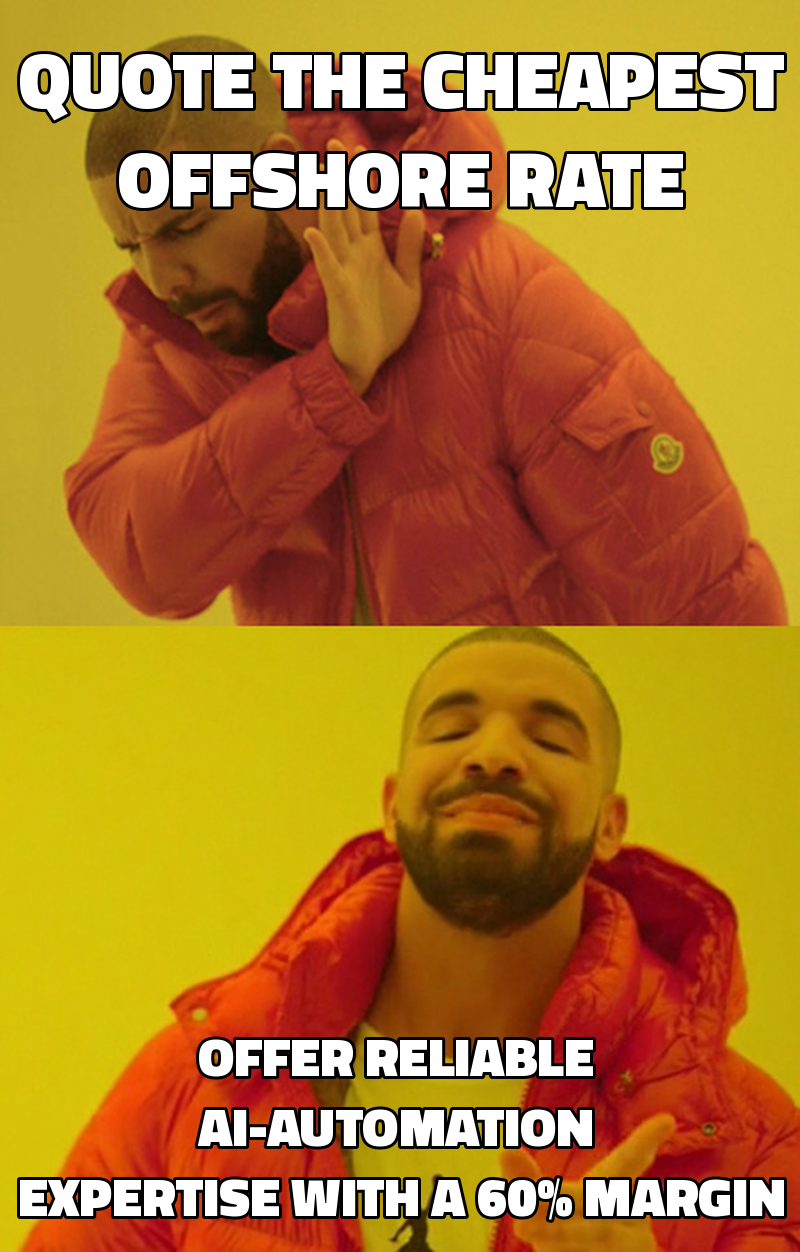
| Matching offshore rates | Competes on price rather than reliability and expertise | Emphasize your AI/voice specialization and SLA guarantees |
| Forgetting retainer upside | Missed recurring revenue | Introduce a 30-day post-pilot retainer discussion |
| Ignoring currency risk | USD-based pricing can fluctuate for UK/AU partners | Quote in USD and include a 2% currency adjustment clause |
How to communicate pricing to agency partners
- Start with the business outcome – “We’ll deliver a chatbot that reduces support tickets by 20%.”
- Show the cost breakdown – Include a simple table (as above) to prove transparency.
- Quote the wholesale price, not the client price – Let the agency add its markup.
- Offer a pilot-to-retainer roadmap – Visual timeline of Phase 1 pilot, Phase 2 rollout, ongoing support.
- Provide a pricing FAQ – Anticipate questions about hidden fees, revisions, and SLA.
Real-world example: RouteMate pilot
Synthisia delivered a voice-enabled scheduling platform for a UK growth agency. The pilot was scoped at 30 hrs, costing $4,200 in labor plus $80 tooling and $900 overhead = $5,180 total. Applying a 60% margin yielded a $12,950 wholesale price. The agency marked it up to $25,000 for its client, kept a 50% margin, and signed a $1,500/month retainer for ongoing feature upgrades. This case demonstrates how a well-structured pricing model fuels repeat business without constant new sales.
Checklist for pricing every white-label project
- Define clear scope and deliverables in an SOW.
- Estimate labor hours with a 10% buffer for unknowns.
- Add tooling and platform fees per project.
- Apply overhead (20-25% of labor).
- Choose margin based on complexity (55-70%).
- Verify the agency’s typical client spend range.
- Present a pilot price and retainer path.
- Document SLA tiers and change-order rates.
- Include a currency adjustment clause for non-USD partners.
“Pricing is not about being the cheapest; it’s about aligning value, risk and profit for both parties.” – Harvard Business Review, 2022
By following this systematic approach, you turn ad-hoc development requests into a predictable revenue stream, protect your margins, and give agency partners the confidence to say yes to every client ask.
Frequently asked questions
How do I decide between a fixed-price quote and a time-and-materials model?
Fixed-price works best for well-scoped pilots where you can accurately estimate hours. Time-and-materials is suitable for exploratory projects with evolving requirements; you can set a minimum retainer to cover baseline costs and then bill hourly for additional work.
What if an agency wants a discount because they have multiple projects?
Offer volume-based tiering: 1-2 projects at standard wholesale rate, 3-5 projects at a 5% discount, and 6+ projects at a 10% discount. Ensure the discount does not push your margin below 50%.
How should I handle change orders after the contract is signed?
Include a change-order clause that charges any out-of-scope work at your standard hourly rate plus a 10% surcharge. Require written approval before work begins to avoid surprise costs.
Can I charge a higher margin for AI-heavy projects?
Yes. AI model training, data labeling and API usage add risk and expertise. A 65-70% margin is justified for projects where you provide custom model fine-tuning or voice-skill publishing.
What SLA levels are realistic for a white-label partner?
Standard SLA: 5-business-day turnaround for a 30-hour project. Express SLA: 2-business-day turnaround with a 15% premium. Communicate these clearly in the proposal.
How do I protect myself from non-payment after delivering the pilot?
Require a 50% upfront deposit before work starts and the remaining 50% upon pilot delivery. For retainer clients, collect the first month’s fee in advance and set up automatic monthly billing.
Should I invoice in USD even for UK or AU agencies?
Yes. USD is the common billing currency for cross-border B2B services. Include a small currency adjustment clause (e.g., 2% of invoice) to cover exchange-rate fluctuations.
How often should I revisit my pricing model?
Review quarterly. Track actual labor hours vs. estimates, tooling cost changes, and market rate shifts (e.g., Gartner reports a 4% annual increase in dev rates). Adjust margins or tier thresholds accordingly.
white‑label
Have something to build?
Tell us what you're trying to ship. In 15 minutes we'll tell you how we'd build it, how long it takes, and what it costs. No pitch deck, no pressure.