
Step-by-Step Pricing Guide for White-Label Development Services

White-label development agencies deliver custom code, AI automation, and integrations under the agency’s brand, allowing marketing, SEO, and branding firms to sell full-stack solutions without hiring engineers. By treating the partner as a wholesale supplier, agencies can set a markup that covers risk, overhead, and profit while remaining attractive to price-sensitive clients.
Key takeaways
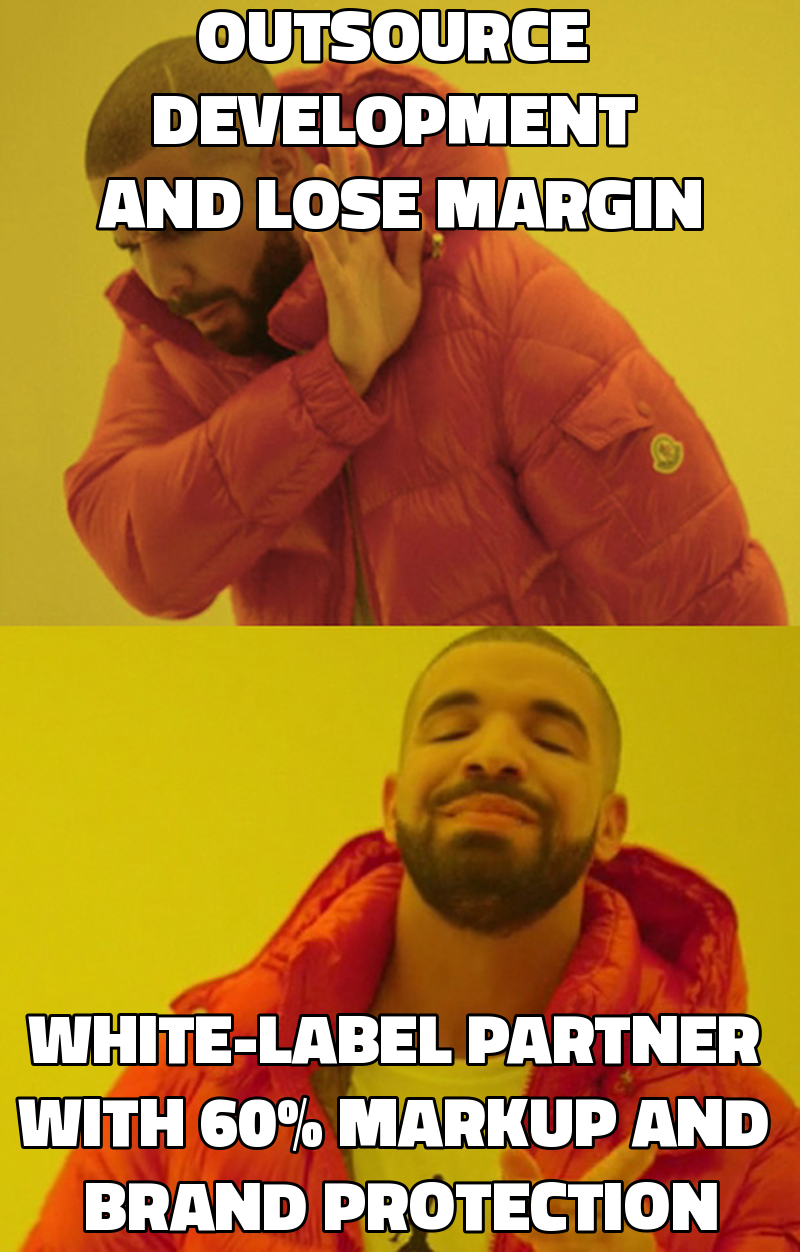
- Treat the dev partner as a wholesale cost and apply a 50-70% markup to protect margin.
- Use a fixed-scope pilot to validate scope, timeline, and price before committing to larger builds.
- Combine per-project pricing with a retainer for ongoing escalation work to smooth cash flow.
- Factor in hidden costs: project management, QA, and revision cycles when calculating your price.
- Benchmark against industry data – Clutch reports 42% of small agencies outsource development, and the median markup is 55%.
How do I calculate a profitable white-label development rate?
Agencies should start with the partner’s wholesale rate, then add layers that reflect their own risk and value. The formula below works for most 5-15 person agencies in the US, UK, and AU:
Base wholesale cost = partner rate per hour (USD) × estimated development hours
Project management buffer = 15% of base cost
Quality assurance buffer = 10% of base cost
Risk & profit markup = 50-70% of (base + buffers)
Final client price = base + buffers + markup
Example – A 30-hour AI chatbot integration at a partner rate of $80/hr:
- Base cost: 30 × $80 = $2,400
- PM buffer (15%): $360
- QA buffer (10%): $240
- Sub-total: $3,000
- Markup (60%): $1,800
- Client price: $4,800
This lands comfortably inside the $5k-$10k range that most SMB clients are willing to spend for a custom automation, according to a 2023 HubSpot survey of agency pricing.
What pricing models work best for white-label partnerships?
Different project types benefit from distinct structures. Below is a comparison of the three most common models.
| Model | When to use | Typical client range | Pros | Cons |
|---|---|---|---|---|
| Fixed-scope pilot | First engagement, high uncertainty | $1,500-$5,000 | Clear expectations, low risk for both parties | Scope creep can erode margin if not tightly defined |
| Tiered fixed price | Repeated similar builds (e.g., landing-page funnels) | $5,000-$15,000 | Scalable, easy to quote | Requires accurate historical data |
| Monthly retainer | Ongoing escalation, support, and small enhancements | $1,500-$3,000 per month | Predictable revenue, strengthens partnership | Must manage capacity to avoid over-commitment |
Choosing the right model: If the agency has never worked with you, start with a pilot. Once trust is proven, move to tiered pricing for repeatable product types and add a retainer for “always-on” support.
How many hours should I allocate for project management and QA?
Even though the dev partner handles coding, the agency remains responsible for client communication, scope definition, and final acceptance. Industry benchmarks suggest:
- Project management: 0.2-0.3 hours per development hour.
- Quality assurance: 0.1-0.15 hours per development hour. These ratios keep the total overhead under 30% of the wholesale cost, which aligns with the profit markup range above.
How do I protect my brand while staying invisible to the client?
A solid NDA and a non-circumvent clause are table-stakes, but the real protection is operational:
- Use a shared project dashboard that shows status without revealing the partner’s name.
- Provide all deliverables under the agency’s branding (logo, style guide, domain).
- Keep a single point of contact – the "Silent Dev Arm" model – so the client never sees multiple engineers.
- Document every hand-off in a formal hand-over sheet; this creates an audit trail if the client asks for source details.
What hidden costs can erode my margin?
Many agencies quote only the dev hours and forget these line items:
- Revision cycles – each round of client feedback typically adds 5-10% of the original development time.
- Third-party licences – AI APIs (OpenAI, Azure Speech) charge per token or per minute; include a buffer of 10% of the dev cost.
- Infrastructure – staging servers, CI/CD pipelines, and monitoring tools can cost $50-$150 per month per project.
- Opportunity cost – time spent chasing the partner for status updates; factor a small “coordination fee” of $100-$200 per project.
By adding these line items to your pricing spreadsheet, you avoid surprise profit dips.
How do I benchmark my markup against the market?
According to a 2022 Deloitte report on agency economics, the median markup for outsourced development sits at 55% across North America and Europe. Agencies that charge less than 45% often struggle with cash-flow, while those above 70% risk losing price-sensitive clients. Use the following table to position yourself:
| Markup % | Typical client reaction | Recommended for |
|---|---|---|
| 45-50 | Seen as a good deal, may attract volume | High-volume, low-complexity pilots |
| 55-60 | Balanced profit and competitiveness | Most SMB automation projects |
| 65-70 | Premium positioning, justified by niche expertise (AI, voice) | Complex, high-value AI or custom backend |
How should I structure the contract to enforce the wholesale rate?
A simple three-section contract works:
- Scope & Deliverables – list each feature, acceptance criteria, and timeline.
- Pricing – state the wholesale cost, your markup, and payment milestones (e.g., 40% upfront, 30% on demo, 30% on launch).
- Protection Clauses – NDA, non-circumvent, and a clause that any change in scope triggers a new estimate at the same markup.
Keep the language clear; agencies often lack legal counsel and will push back on ambiguous terms.
What tools can I use to streamline white-label pricing?
- Quote templates – PandaDoc or Proposify allow you to embed calculations that auto-update when you change hours.
- Project dashboards – Notion or ClickUp with a shared view let the agency monitor progress without exposing the dev partner.
- Time-tracking – Harvest integrates with most dev tools and provides transparent hour logs for the agency to audit.
- API cost calculators – OpenAI’s pricing calculator helps you estimate token usage and embed that cost into your quote.
How do I scale the partnership without becoming a flaky freelancer?
The key is to cap the number of active agency partners. Synthisia recommends a maximum of 12 concurrent white-label relationships, each with a dedicated account manager. This ensures:
- Predictable capacity – you never over-promise delivery speed.
- Higher reliability – agencies can reference your on-time record in their sales pitches.
- Better pricing power – limited supply lets you maintain a healthy markup.
If demand exceeds capacity, prioritize partners with higher retainer commitments or those in your target geographies (US, UK, AU) where currency conversion is minimal.
Frequently asked questions
What is the difference between a white-label dev agency and a freelance subcontractor?
A white-label agency operates under your brand, signs NDAs, and provides a single point of contact. Freelancers often work under their own name, may lack consistent processes, and can disappear mid-project. The agency model reduces risk and protects your client relationship.
How do I handle scope creep without hurting my margin?
Include a clear change-order clause in the contract. Define a “revision budget” (e.g., 10% of the original price) that covers minor tweaks. Anything beyond that triggers a new estimate at the same markup.
Can I charge a higher markup for AI-focused projects?
Yes. AI and voice integrations require specialized talent and higher third-party API costs. A 65-70% markup is justified when you can demonstrate expertise, such as a successful RouteMate deployment.
What if the client wants to see the source code?
Provide the deliverable as a compiled product (e.g., hosted SaaS) and retain the source under a separate licensing agreement with the agency. If the client insists, negotiate a separate source-code licence fee that covers your partner’s cost plus a small profit.
How often should I review my pricing model?
Quarterly reviews work well. Track actual margins, revision cycles, and API cost variance. Adjust the markup or buffers if you consistently exceed or fall short of the target 50-70% range.
Is it worth offering a free pilot?
A free pilot is risky because it gives away engineering hours. Instead, offer a low-cost, time-boxed prototype (e.g., one screen or one automation) for $250-$500. This proves capability while preserving margin.
How do I convince my agency’s leadership to adopt a white-label partner?\nPresent a ROI model: show the incremental revenue from saying “yes” to 3-5 new build requests per month, subtract the wholesale cost, and highlight the net profit after markup. Use the tables above to illustrate the financial upside.
What are the red flags that a potential agency partner is not a good fit?
- They list development as a core service (no gap to fill).
- They already showcase a named dev partner.
- Their team exceeds 20 staff or has an in-house dev team.
- Their recent activity is dormant for over a year.
- They operate out of low-cost offshore locations, which erodes your wholesale margin.
By screening for these signals early, you protect your capacity and maintain a high-quality partner roster.
white‑label
Have something to build?
Tell us what you're trying to ship. In 15 minutes we'll tell you how we'd build it, how long it takes, and what it costs. No pitch deck, no pressure.