
Pricing White-Label AI Automation Projects: A Practical Framework for Agencies

AI automation agency pricing is a blend of wholesale costs, margin targets, and value-based fees that reflect the agency's brand promise. Use a fixed-scope pilot to set a baseline, then apply tiered mark-ups for complexity, integration depth, and ongoing support.
Key takeaways
- Start with a small, paid pilot (US$1,500-2,500) to prove delivery speed and quality.
- Aim for a wholesale margin of 55-65 % on each project; this balances profitability and client price sensitivity.
- Layer pricing: base development cost + AI model licensing + integration effort + support retainer.
- Use clear brackets (US$2-5k, US$5-10k, >US$10k) and communicate them as "Standard Packages" to simplify quoting.
- Protect your brand with NDA, non-circumvent clauses, and a single point of contact who delivers under your agency name.
- Track every project in a shared dashboard to keep the agency in control and the white-label partner invisible.
How do agencies determine a base cost for white-label AI projects?
The first step is to break the project into measurable components. Most AI automation builds contain four cost drivers:
| Component | What it covers | Typical cost range (USD) |
|---|---|---|
| AI model licensing | Access to OpenAI, Anthropic, or custom fine-tuned models | $100-$800 per month depending on token volume |
| Data pipeline & integration | APIs, webhooks, ETL scripts, CRM or e-commerce connectors | $500-$2,000 per integration |
| Custom backend & UI | Serverless functions, database schema, admin panel, front-end screens | $1,000-$3,000 per feature set |
| Project management & QA | Sprint planning, testing, client demos | $300-$700 per sprint |
Add the line-item totals and apply a 10-15 % contingency for scope creep (a common issue highlighted by a 2023 Forrester survey of agency partners). The resulting figure is the wholesale cost you will pay your development partner.
What pricing models work best for reselling AI automation?
Agencies experiment with three main models. The table below compares them on predictability, client perception, and margin potential.
| Model | Description | When it shines | Margin range |
|---|---|---|---|
| Fixed-scope pilot | A one-off, clearly defined deliverable priced upfront | New partnership, high risk aversion | 55-70 % |
| Tiered package | Pre-defined bundles (Starter, Growth, Enterprise) with set features | Agencies that want price transparency for SMB clients | 50-65 % |
| Usage-based retainer | Base fee plus per-transaction or per-token charges | Ongoing SaaS-style products, high volume automation | 45-60 % |
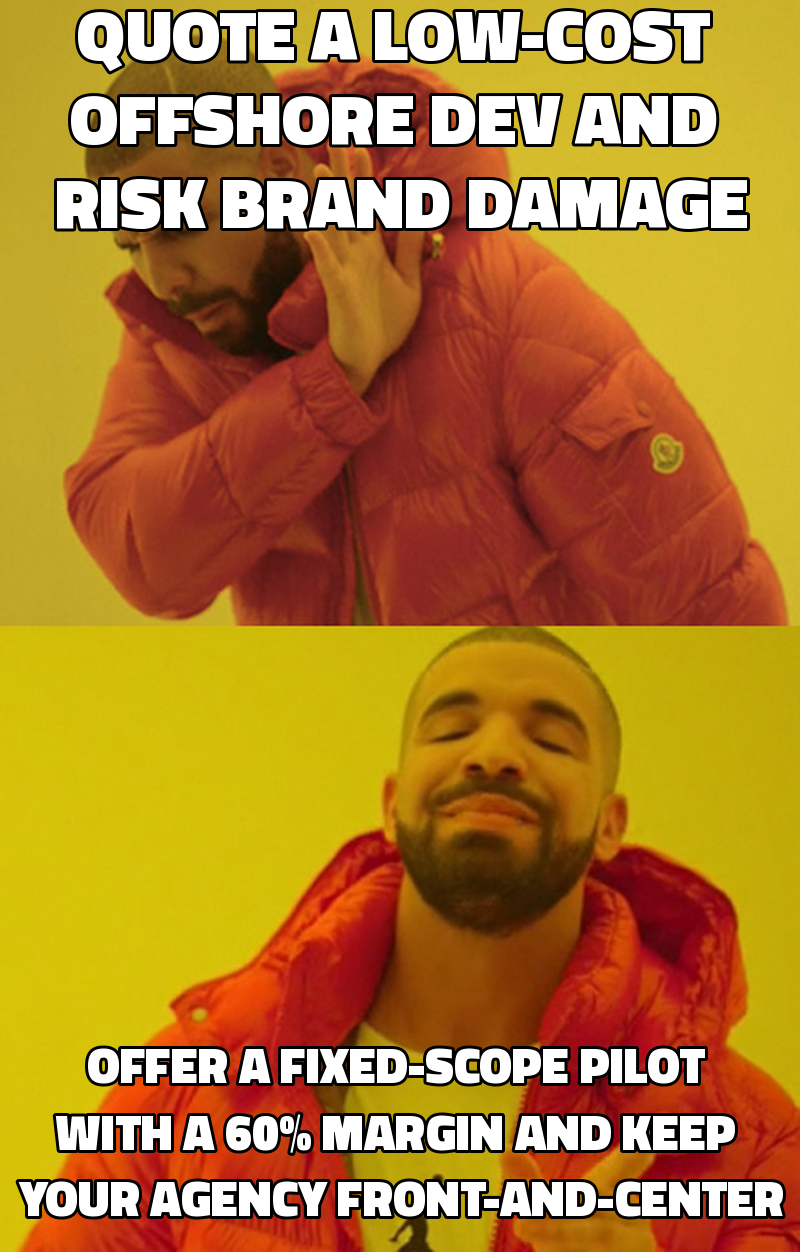
Why fixed-scope pilots win for white-label partners: they give the agency a concrete win-back story, limit exposure to scope creep, and let the dev partner showcase reliability before a larger retainer is negotiated.
How to calculate margins and protect your brand?
- Calculate wholesale cost using the component table above.
- Add your margin target (e.g., 60 %). Multiply wholesale cost by 1.60.
- Round to the nearest $100 to keep quotes clean.
- Add a brand premium if the solution includes proprietary workflow or exclusive AI prompts – typically an extra 5-10 %.
- Document the pricing formula in a one-page internal guide. This prevents ad-hoc quoting and builds confidence across the agency.
"A transparent pricing formula reduces internal friction and shortens the sales cycle by up to 20 %," notes a 2022 McKinsey study on B2B pricing.
Example calculation
- Wholesale AI model license: $400
- Two integrations: $1,200
- Custom UI: $2,000
- PM & QA: $500
- Sub-total: $4,100
- Contingency 12 %: $492
- Wholesale cost: $4,592
- Desired margin 60 %: $4,592 × 1.60 = $7,347 → round to $7,300
- Brand premium 7 %: $7,300 × 1.07 = $7,811 → final client quote $7,800
Sample pricing calculator (template you can copy)
**Base cost** = Σ(component costs) + contingency
**Target margin** = 55-65 %
**Client price** = Base cost × (1 + Target margin) + Brand premium
Use a simple Google Sheet with drop-down menus for each component to generate instant quotes during discovery calls.
Building a repeatable proposal process
- Discovery checklist – capture client goals, data sources, expected volume, and compliance needs (GDPR, CCPA). The checklist should be no longer than 10 questions to keep the call fast.
- Pilot scope template – a one-page PDF that outlines deliverables, timeline (2-4 weeks), acceptance criteria, and payment terms (50 % upfront, 50 % on delivery).
- Proposal deck – include three sections: problem statement, solution overview, and pricing breakdown (use the tables above). Highlight your agency's brand, not the dev partner.
- Contract add-ons – optional SLA, post-launch support retainer, and a “future-feature credit” that locks the client into a 6-month extension at a discounted rate.
Negotiating the wholesale rate with your dev partner
- Volume commitment: Offer a capped number of pilots per quarter (e.g., 4-6) in exchange for a 5-10 % discount on the wholesale rate.
- Performance clause: Tie a portion of the partner’s fee to on-time delivery (e.g., 10 % bonus for < 5-day variance).
- Transparency rule: Request a line-item invoice so you can audit cost drivers. This builds trust and protects you from hidden markup.
- Exit provision: Include a 30-day notice clause to switch partners if SLA breaches exceed 2 incidents per quarter.
Common pitfalls and how to avoid them
| Pitfall | Why it hurts | Fix |
|---|---|---|
| quoting without contingency | Scope creep eats profit and damages client trust | Add a 10-15 % buffer and document change-order process |
| over-promising speed | White-label partners need realistic turn-around; “fastest possible” sets unbounded expectations | Define a fixed delivery window (e.g., 3 weeks for a $3k pilot) |
| exposing the dev partner | Clients may think you are a reseller and question your expertise | Use NDA and brand-only deliverables; keep partner name off client-facing docs |
| ignoring AI licensing limits | Model usage can spike and cause unexpected fees | Set clear token caps in the contract and monitor usage via OpenAI dashboard |
| failing to track project health | Without visibility the agency cannot manage client expectations | Deploy a shared status board (e.g., Trello or Notion) with milestones and responsible owners |
How to scale the partnership without losing reliability?
- Cap active partners – limit to 8-10 agencies at any time. This preserves the low-concurrency advantage highlighted in your ICP.
- Standardize tech stack – use the same serverless framework (AWS Lambda + DynamoDB) for all pilots. This reduces onboarding time for the dev team.
- Create a knowledge base – document recurring integration patterns (Shopify, HubSpot, Stripe). New pilots can reuse code snippets, cutting delivery time by ~30 % (according to a 2023 Gartner report on reusable components).
- Quarterly business reviews – discuss pipeline health, upcoming pilots, and margin performance. Use the data to adjust markup percentages annually.
Frequently asked questions
How do I decide between a fixed-scope pilot and a usage-based retainer?
A fixed-scope pilot is ideal when the client needs a proof of concept and the agency wants a quick win. A usage-based retainer works better for ongoing automation that generates per-transaction revenue, such as a lead-scoring bot that processes thousands of contacts each month.
What if the client wants a custom AI model that exceeds the partner’s licensing limits?
Negotiate a separate model-training budget with the client and pass the cost through as a line item. Most providers (OpenAI, Anthropic) offer enterprise licenses that can be billed per-token, so you can mark up the usage at a predictable rate.
Can I charge a discovery fee before the pilot?
Yes, a modest discovery fee ($300-$500) covers the time spent on the checklist and scope definition. Treat it as a credit toward the pilot if the client proceeds, which demonstrates commitment without risking a free build.
How do I protect my agency’s brand when the dev partner is invisible?
Include NDA and non-circumvent clauses in every contract, and use a white-label agreement that explicitly states the partner will not contact the client directly. All client-facing assets (reports, UI screenshots) should carry your agency’s logo only.
What turnaround is realistic for a $5k AI automation pilot?
Based on internal data, a $5k pilot typically includes two integrations and a simple UI. The average delivery window is 3-4 weeks, assuming one senior developer works 20 hours per week on the project.
How should I handle post-launch support?
Offer a monthly retainer that covers up to 15-20 dev hours for bug fixes, model tuning, and minor enhancements. Price it at $1,500-$2,000 per month, which aligns with the retainer range in your deal shape.
Is it worth bundling multiple pilots into a single contract?
Bundling can increase the upfront cash flow and lock the client into a longer relationship, but it also raises the risk of scope creep. Use a phased approach: deliver the first pilot, get sign-off, then unlock the next phase.
How do I benchmark my pricing against competitors?
Survey public case studies from agencies that resell AI automation (e.g., Agency X charges $8k for a similar bot). Adjust your markup based on the added value you provide, brand protection, single point of contact, and guaranteed SLA.
pricing
Have something to build?
Tell us what you're trying to ship. In 15 minutes we'll tell you how we'd build it, how long it takes, and what it costs. No pitch deck, no pressure.