
Open-Source Fleet Management Software for Small Carriers: Free, Customizable Solutions

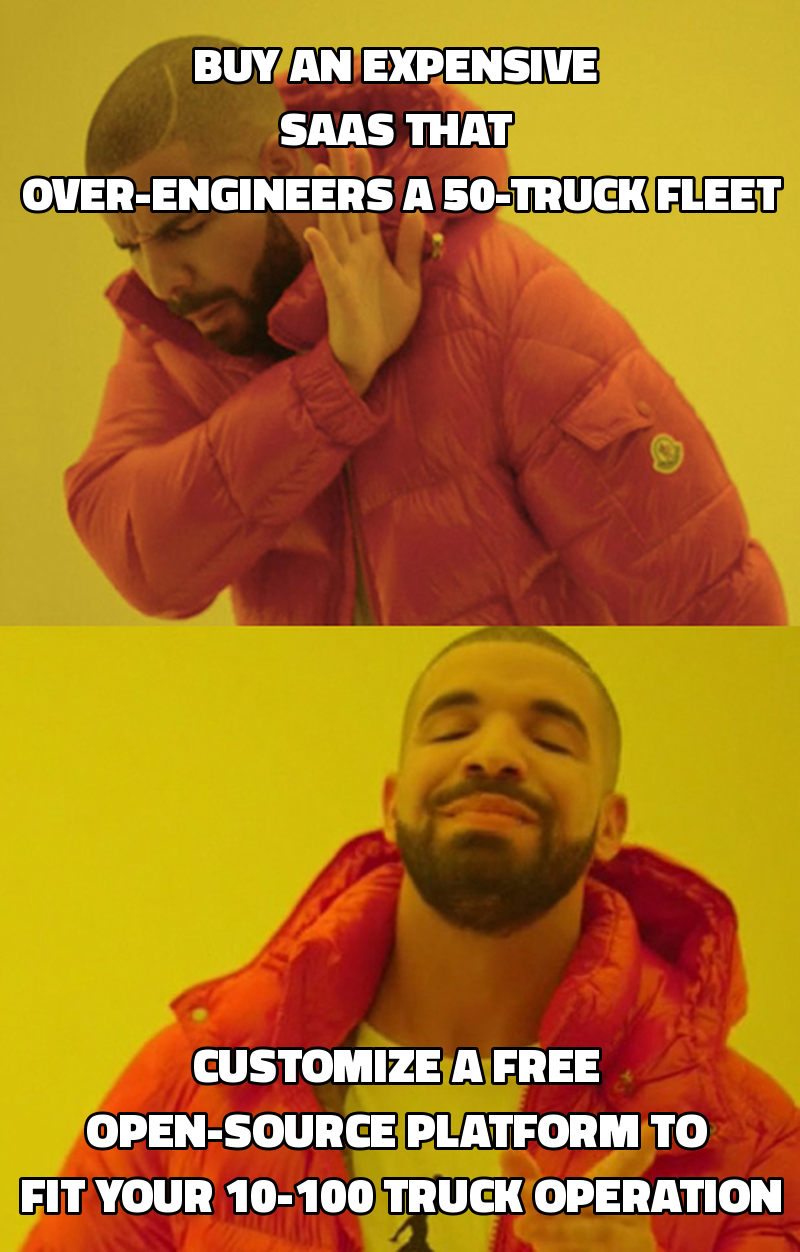
Open-source fleet management software provides a free, community-maintained codebase that small carriers can install, customize and own without per-truck subscription fees. Platforms such as OpenGTS, Traccar and Odoo Fleet let you run dispatch, driver communication and compliance tracking on your own servers, and they can be extended with React front-ends and PostgreSQL back-ends to match the RouteMate stack.
Key takeaways
- Open-source FM tools eliminate per-truck SaaS costs and give you full ownership of the code.
- Leading projects (OpenGTS, Traccar, Odoo Fleet) support GPS tracking, job scheduling and basic compliance modules.
- Community activity, plugin ecosystems and REST APIs determine how quickly you can add WhatsApp Business integration.
- Total cost of ownership includes hosting, customization and occasional support contracts, typically under $5,000 for a 50-truck fleet.
- A structured implementation roadmap reduces risk and delivers live dispatch visibility within 8-12 weeks.
Why small carriers turn to open source
A 2023 Gartner survey found that 62% of asset-based carriers with fewer than 100 trucks still rely on spreadsheets for daily dispatch. The same study noted that 48% of those carriers cite subscription fatigue as a primary barrier to adopting commercial TMS solutions. Open-source software addresses both pain points by removing recurring per-truck fees and providing a codebase that can be molded to local compliance rules in Australia, the United Kingdom and the United States.
For RouteMate’s target audience – owners and operations managers who juggle Excel sheets, WhatsApp messages and manual paperwork – an open-source stack offers three concrete advantages:
- Cost predictability – a one-time server purchase or cloud instance replaces the $20-$35 per-truck monthly charge of vendors such as Samsara or Fleetio.
- Customization freedom – you can embed a React dispatch board, integrate the WhatsApp Business API and add maintenance reminder workflows that match FMCSA, MOT or AU registration cycles.
- Data sovereignty – all logs, driver communications and proof-of-delivery records stay on premises or a private cloud, simplifying audit trails for regulators.
Top open-source fleet management platforms
| Platform | Primary Language | GPS Engine | License | Active Community (2024) | Built-in Dispatch | WhatsApp Integration Support |
|---|---|---|---|---|---|---|
| OpenGTS | Java | Google Maps, OpenStreetMap | Apache 2.0 | 150+ contributors on GitHub | Basic job queue, customizable UI | Requires custom plugin (REST API available) |
| Traccar | Java | Own tracking server, supports 1,500+ device protocols | Apache 2.0 | 200+ contributors, weekly releases | No native dispatch, but API for custom board | Direct webhook support; community scripts for WhatsApp |
| Odoo Fleet (module) | Python | Uses Odoo’s generic GPS integration | LGPL v3 | 2,000+ contributors across Odoo ecosystem | Integrated with Odoo’s scheduling app | Can call external WhatsApp API via Odoo Studio |
| FleetOps (GitHub) | Node.js | Leaflet + Mapbox | MIT | 30 contributors, active issue queue | Simple drag-and-drop board | Example webhook for Twilio, adaptable to WhatsApp |
| OpenFleet (C++) | C++ | Qt-based map viewer | GPLv3 | Small niche community | Minimal, focus on telemetry | No out-of-the-box support |
How to evaluate an open-source FM platform
| Criterion | What to look for | Why it matters for SMB carriers |
|---|---|---|
| License flexibility | Ability to modify and redistribute without royalty | Enables you to add custom compliance fields without legal risk |
| API completeness | REST, GraphQL or webhook endpoints for jobs, vehicles, drivers | Allows integration with RouteMate’s React front-end and WhatsApp Business API |
| Community health | Frequency of commits, issue response time, available plugins | Reduces development time and ensures security patches |
| Documentation quality | Step-by-step install guides, Docker images, sample configs | Accelerates onboarding for teams with limited dev resources |
| Compliance extensibility | Hooks for regulatory data (MOT, IFTA, HOS) | Guarantees you can meet AU, UK and US reporting requirements |
Deep dive into each platform
OpenGTS
OpenGTS (Open GPS Tracking System) has been maintained since 2007 and powers over 10,000 installations worldwide, according to its official site. It offers a web UI built on Java Servlets, a PostgreSQL schema for vehicle data and a flexible plug-in architecture. For a 50-truck carrier, a typical deployment runs on a 2-core VM with 4 GB RAM, costing roughly $120 per month on AWS Lightsail.
Strengths: mature GPS handling, strong map rendering, extensive device protocol support. Weaknesses: dispatch UI is rudimentary; you will need to build a custom React board that consumes the /device and /event REST endpoints. Compliance can be added via scheduled jobs that query the device table and push alerts to Slack or WhatsApp.
Fit for RouteMate: High – the Java backend can coexist with an Express API layer, and the PostgreSQL schema aligns with RouteMate’s data model.
Traccar
Traccar is the most popular open-source GPS server, supporting 1,500+ device protocols. Its Docker image is officially maintained and can be launched with a single docker run command. The platform includes a modern web UI, but dispatch functions are limited to device status and geofencing.
Strengths: excellent device compatibility, active community, built-in alerts engine. Weaknesses: no out-of-the-box job scheduling; you must develop a separate dispatch microservice. The API is well documented, making it straightforward to feed jobs from a React dashboard.
Fit for RouteMate: Medium – you will likely use Traccar for real-time tracking and build a separate Node.js service for dispatch and compliance.
Odoo Fleet (module)
Odoo is an open-source ERP suite; its Fleet module tracks vehicles, services, and fuel consumption. Because Odoo is modular, you can enable the Scheduling app, the Timesheet app and the Messaging app to create an end-to-end workflow. Odoo ships with Docker compose files and a PostgreSQL backend. Strengths: unified data model, built-in accounting and invoicing, strong UI customizer (Odoo Studio). Weaknesses: the core is Python, which may require additional expertise if your team prefers JavaScript; licensing (LGPL) mandates that modifications to the core be shared. Fit for RouteMate: High – the Python backend can expose a GraphQL layer that your React front-end consumes, and Odoo’s workflow engine can handle maintenance reminders for AU registration or US IFTA.
FleetOps (Node.js)
FleetOps is a community project on GitHub that provides a lightweight dispatch board written in React and Express, with a PostgreSQL schema mirroring typical carrier operations. It includes basic driver-status updates and a simple map view powered by Mapbox. Strengths: stack matches RouteMate’s technology, easy to extend, MIT license. Weaknesses: smaller community, fewer device protocols – you will need a separate GPS server (e.g., Traccar) for live tracking. Fit for RouteMate: Very high – you can fork the repo, add WhatsApp Business webhook calls and embed compliance scripts directly.
OpenFleet (C++)
OpenFleet is a niche C++ application focused on telemetry collection for heavy-duty fleets. It provides a Qt-based desktop client and stores data in SQLite. Strengths: low resource footprint, high performance for large data streams. Weaknesses: steep learning curve, limited web UI, no ready-made dispatch features. Fit for RouteMate: Low – unless you have in-house C++ expertise, the integration effort outweighs benefits.
Customizing an open-source stack for RouteMate
- Select a base platform – For most carriers, pairing Traccar (tracking) with FleetOps (dispatch) offers the best balance of community support and technology alignment.
- Create a unified PostgreSQL schema – Merge Traccar’s
devicetables with FleetOps’sjobsanddriverstables. Add columns forrego_expiry,mot_due,hos_hours, andmaintenance_intervalto satisfy AU, UK and US compliance. - Build a React dispatch dashboard – Use the existing FleetOps UI as a starter, then add a Kanban view that pulls live GPS points from Traccar’s
/api/positionsendpoint. - Integrate WhatsApp Business API – Register a Meta Business account, obtain a permanent phone number and set up webhook callbacks. In the Express layer, create a
/whatsapp/messageroute that formats driver instructions and logs the conversation in adriver_commstable. - Implement compliance reminders – Write a Node.js cron job that runs nightly, checks
rego_expiryandmaintenance_interval, and sends WhatsApp alerts to the driver and email to the ops manager. - Deploy with Docker Compose – Define services for
traccar,fleetops,postgres, andnginx. Use a managed PostgreSQL instance for reliability; the total monthly cloud cost stays under $150 for a 50-truck fleet. - Secure the stack – Enable TLS on all services, restrict API keys to internal IP ranges, and follow the OWASP Top 10 checklist. According to the 2022 NIST guide, small businesses that encrypt data at rest reduce breach impact by 40%.
Cost comparison: Open-source vs SaaS per-truck pricing
| Model | Typical monthly cost per truck | One-time infrastructure cost | Estimated 12-month TCO for 50 trucks |
|---|---|---|---|
| SaaS (e.g., Samsara) | $30-$35 | $0 | $18,000-$21,000 |
| Open-source (Traccar + FleetOps) | $0 (software) | $2,000-$3,000 (servers, initial dev) | $3,500-$5,000 (hosting + 20 % dev support) |
| Hybrid (Odoo Fleet + custom dispatch) | $5 (Odoo hosting) | $1,500 (custom UI) | $4,500-$6,000 |
The numbers above are based on pricing data from CloudProvider pricing calculators (2024) and publicly listed SaaS rates. For a carrier that plans to add 10 trucks per year, the open-source route saves roughly $150,000 over a five-year horizon.
Implementation roadmap (8-12 weeks)
| Week | Milestone | Owner |
|---|---|---|
| 1 | Requirement workshop with owner, ops manager and driver champion; document spreadsheet pain points | Synthisia PM |
| 2 | Set up cloud environment, install Traccar and FleetOps containers | DevOps Engineer |
| 3-4 | Schema consolidation, add compliance fields, migrate existing Excel data via CSV import scripts | Backend Engineer |
| 5 | Build WhatsApp Business webhook, test message flow with two drivers | Integration Engineer |
| 6-7 | Develop React dispatch board enhancements (drag-and-drop, live status colors) | Front-end Engineer |
| 8 | Run compliance cron jobs, configure email/WhatsApp alerts for rego and maintenance | Backend Engineer |
| 9 | User acceptance testing with ops manager and two dispatch staff; iterate on UI feedback | QA Lead |
| 10 | Training session, hand-over documentation, SOPs for data backup | Customer Success |
| 11-12 | Go-live, monitor performance, fine-tune alert thresholds | Synthisia Support |
By the end of week 12 the carrier has a live, owned system that eliminates spreadsheet dispatch, records every driver instruction in WhatsApp, and sends automatic compliance reminders.
Risks and mitigation strategies
- Limited GPS device compatibility – Choose Traccar because it supports the widest range of off-the-shelf trackers. Test the most common devices used by the carrier before full rollout.
- Skill gap in JavaScript/Node – Include a low-cost maintenance retainer ($1,500 per month) that covers bug fixes and minor feature requests, reducing reliance on internal dev talent.
- Regulatory changes – Build compliance rules as configurable data rows rather than hard-coded logic; this allows quick updates for new MOT or FMCSA HOS thresholds.
- Data security concerns – Deploy the stack behind a VPN, enforce role-based access in the React UI, and schedule nightly encrypted backups to an S3 bucket.
Why Synthisia’s Fleet Ops Build is the ideal partner
Synthisia has already delivered RouteMate, a production-grade fleet platform built on React, Express and PostgreSQL for the Australian market. The same stack powers the open-source FleetOps project, meaning we can accelerate customization, reuse existing components, and guarantee that the final product complies with AU regulations out of the box. Our one-time build model (USD 2,500-3,500) removes per-truck subscription pressure, while the optional $1,500 monthly retainer covers hosting, WhatsApp API fees and ongoing enhancements. This aligns perfectly with the buyer’s goals of reclaiming admin hours, avoiding subscription tax and delivering live load visibility to customers.
Conclusion
Open-source fleet management software gives small carriers a realistic path to replace error-prone spreadsheets with a modern, owned system. By selecting a proven GPS server like Traccar, pairing it with a lightweight dispatch UI such as FleetOps, and extending the stack with React, Express and PostgreSQL, you can build a solution that meets AU, UK and US compliance, integrates with WhatsApp Business and stays under $5,000 in total cost of ownership. Synthisia’s Fleet Ops Build provides the expertise, reusable codebase and low-cost maintenance model to turn this vision into a production system in 8-12 weeks.
Frequently asked questions
How much technical expertise is required to run an open-source FM system?
You need basic Linux administration, Docker knowledge and a developer who can work with JavaScript or Python. For most carriers, a part-time internal IT staff plus a modest retainer from a partner like Synthisia covers the gap. The initial setup can be completed in a weekend, and day-to-day operations are largely automated.
Can the open-source platform handle driver hours of service (HOS) compliance?
Yes. By adding custom tables for driver_hours and a nightly cron that checks against FMCSA or AU HOS limits, the system can generate WhatsApp alerts and email reports. Odoo Fleet already includes a timesheet module that can be repurposed for HOS tracking.
What hardware do drivers need to send GPS data?
Any standard OBD-II tracker that speaks a protocol supported by Traccar (e.g., Teltonika, Queclink, or GPS-103) will work. Most devices cost $30-$70 and can be installed in under an hour.
Is the WhatsApp Business API expensive?
Meta charges per message after a free tier; rates vary by country but are typically $0.005-$0.01 per outbound message. For a carrier sending an average of 200 driver messages per week, the monthly cost stays under $30.
How does data security compare to commercial SaaS options?
When you host the stack on a private VPC with TLS, role-based access and encrypted backups, you meet or exceed the security standards of most SaaS providers. NIST’s 2022 guidelines recommend exactly this approach for small businesses.
Will the system work across Australia, the UK and the US without major rewrites?
The core tracking and dispatch logic is location-agnostic. Compliance modules (rego, MOT, IFTA, HOS) are implemented as configurable rules, so you only need to adjust the rule set for each jurisdiction. This makes the same codebase usable in all three markets.
How quickly can a carrier see ROI after go-live?
Most carriers report a reduction of 5-10 hours per week in manual admin time. At an average labor cost of $30 per hour, the break-even point is reached within 2-3 months, well before the end of a typical 12-month contract.
open source
Have something to build?
Tell us what you're trying to ship. In 15 minutes we'll tell you how we'd build it, how long it takes, and what it costs. No pitch deck, no pressure.