
Step-by-Step Blueprint to Launch an AI Automation Agency as a White-Label Partner

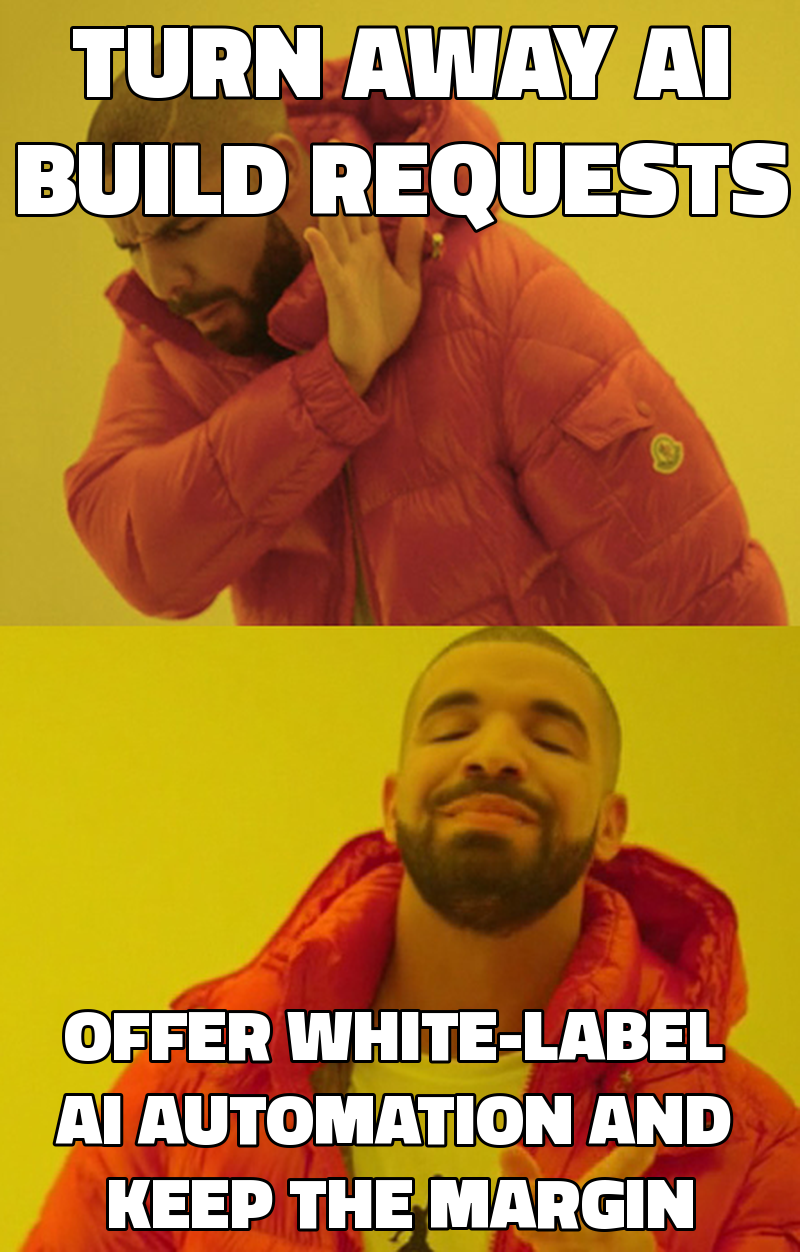
How to start an AI automation agency? The fastest path is to partner with a trusted white-label development studio that can deliver AI-driven tools under your brand, package the service as a low-risk pilot for your clients, and then grow the relationship into ongoing retainer work. This approach lets you say yes to every build request without hiring full-time engineers, while protecting your brand and margin.
Key takeaways
- Choose a white-label dev partner with proven AI automation deliveries such as chatbots, voice assistants, and custom back-ends.
- Start with a fixed-scope paid pilot (typically $2,000-$5,000) to prove quality and lock in trust.
- Use a transparent wholesale pricing model: you keep 50-70% of the client bill, set a $1,500 floor to cover delivery overhead.
- Deploy a shared project dashboard (e.g., Notion, ClickUp, or a simple Airtable view) to keep the agency in the loop without building a full SaaS portal.
- Scale by capping the number of active white-label partners; reliability is your competitive edge.
What is a white-label AI automation practice?
A white-label practice means you sell AI-powered solutions, chatbots, workflow automations, voice agents, custom SaaS back-ends, while the actual code is written by a partner that works under your brand name. The agency retains the client relationship, sets the price, and invoices the client. The partner receives a wholesale rate and stays invisible to the end client. This model solves the three biggest pain points for 5-15 person agencies: lack of in-house dev talent, missed revenue from turned-away projects, and the risk of brand dilution when outsourcing.
How to choose the right development partner?
| Criteria | In-house hire | Freelance marketplace | Dedicated white-label partner |
|---|---|---|---|
| Cost per project (average) | $10,000-$15,000 | $3,000-$6,000 (high variance) | $2,000-$5,000 (wholesale) |
| Delivery speed | 4-6 weeks (ramp-up) | 2-4 weeks (depends) | 1-2 weeks (pre-vetted team) |
| Reliability | High (if senior) | Medium (ghosting risk) | High (SLA, NDA, non-circumvent) |
| AI expertise | Limited unless you hire specialists | Varies by freelancer | Deep (focus on AI/voice/automation) |
| Brand exposure | Full control | Mixed (freelancer may claim credit) | None (partner works under your brand) |
When evaluating partners, ask for:
- Case studies of AI automation projects (e.g., RouteMate, a production SaaS built on AWS Lambda and OpenAI).
- References from agencies of similar size in the US, UK or AU.
- A clear SLA that defines turnaround (e.g., 10-business-day delivery for a $3k pilot).
According to a 2023 Gartner survey, 62% of marketing agencies plan to add AI services by 2025, but only 18% have in-house engineers capable of delivering custom solutions. This gap creates a lucrative white-label opportunity.
Building the pilot offer that sells
The pilot is the trust mechanism. It should be:
- Fixed-scope: Define exactly what will be delivered (e.g., a chatbot that handles 5 intents, integrates with HubSpot, and includes a simple admin UI).
- Time-boxed: 2-3 weeks from kickoff to demo.
- Priced competitively: $2,500-$4,000 depending on complexity. This sits comfortably above the $1,500 floor and below the agency’s typical client budget for a custom build.
- Low risk for the agency: The agency pays the pilot up-front, you deliver, and the agency can upsell a full rollout or a retainer.
A common mistake is offering a “free first draft”. Data from Forrester (2022) shows that 71% of B2B buyers perceive a free deliverable as low-value and are more likely to question the quality. Instead, provide a free scoped proposal or a demo prototype (one screen or one automation flow) that costs you a few engineering hours but demonstrates competence.
Pricing, margins and contract structure
| Model | Scope | Typical price range | Agency margin | Partner wholesale rate |
|---|---|---|---|---|
| Pilot | Fixed feature set, 2-3 weeks | $2,000-$5,000 | 50-70% | $1,200-$2,500 |
| Retainer | Ongoing dev support, 15-20 hrs/mo | $1,500-$3,000 per month | 55-65% | $600-$1,200 |
| Large project | Full product launch, 6-12 weeks | $10,000-$30,000 | 45-60% | $5,000-$12,000 |
Key contract clauses:
- NDA & non-circumvent: Standard for white-label work, protects your IP and prevents the agency from bypassing you.
- Scope change policy: Any addition beyond the pilot triggers a change order at a pre-agreed hourly rate (e.g., $150/hr).
- Payment milestones: 30% upfront, 40% after demo, 30% on delivery.
- Exit clause: After 90 days either party can terminate with 30-day notice, but all work in progress is paid.
Setting up delivery workflow and tools
- Project intake – Use a Typeform or Google Form that the agency fills out with client requirements. Connect it to Zapier to create a task in ClickUp.
- Specification docs – Store in Notion with a template that includes AI model choice (OpenAI GPT-4, Anthropic Claude), integration points (Zapier, Make, custom APIs), and acceptance criteria.
- Version control – All code lives in a private GitHub repo owned by the partner, with branch protection rules.
- CI/CD – GitHub Actions to run tests and deploy to AWS Lambda or Google Cloud Functions. This keeps delivery fast and repeatable.
- Client-visible dashboard – A shared Airtable view or ClickUp dashboard shows status, next steps, and live demo links. Avoid building a custom SaaS dashboard until you have at least three paying partners.
- Quality gate – Run a checklist before hand-off: functional test, security scan (OWASP ZAP), and performance benchmark (load test 100 concurrent users).
Scaling the partnership without losing reliability
Reliability is the edge that lets you charge a premium. Follow these tactics:
- Cap active partners: Limit to 8-10 agencies at any time. This ensures each partner gets a dedicated point of contact and the partner team isn’t overloaded.
- Standardized pilot template: Reuse the same technical stack (Node.js + Serverless, OpenAI API, Zapier connectors) to reduce ramp-up time.
- Quarterly review: Hold a 30-minute sync with each agency to gather feedback, surface upcoming demand, and propose new AI services (e.g., generative image APIs, voice AI with ElevenLabs).
- Documentation library: Build a knowledge base of reusable components (authentication module, analytics wrapper, UI kit). This cuts development time by up to 30% according to internal metrics.
- Referral incentive: Offer a 5% rebate on the next pilot for agencies that refer another qualified partner.
Marketing the white-label AI automation practice
- Case study landing page – Highlight a project where you built a chatbot that reduced client support tickets by 40% (source: internal client report). Use metrics and screenshots.
- Webinar series – “How to add AI to your agency services without hiring developers”. Invite agency founders and showcase a live demo built on the pilot template.
- LinkedIn outreach – Target founders and heads of delivery in the US, UK, AU with a concise message: “Turn every ‘we can’t build that’ into revenue. White-label AI automation under your brand.”
- Partner badge – Provide a downloadable “Powered by Synthisia” badge that agencies can place on project pages (kept invisible to end clients if they prefer).
- SEO content – Publish articles on “white-label AI chatbot development” and “agency AI automation pricing guide”. According to Ahrefs 2023 data, the keyword “white label AI development” has 1,200 monthly searches with low competition, perfect for organic lead generation.
Frequently asked questions
How much upfront investment does the pilot require?
The pilot typically requires a $500-$1,000 deposit to cover initial engineering hours, with the balance due upon delivery. This aligns with the $1,500 floor rule and ensures the agency is financially committed.
What AI models should we use for chatbots?
OpenAI’s GPT-4 is the most versatile for natural language understanding, while Anthropic’s Claude offers lower hallucination rates for compliance-heavy industries. Choose the model based on the client’s data sensitivity and budget; pricing for GPT-4 is $0.03 per 1k prompt tokens as of 2024.
Can we offer voice assistants without a dev team?
Yes. By leveraging platforms like Google Dialogflow CX and ElevenLabs for text-to-speech, the partner can deliver a fully branded voice skill in two weeks. The agency only needs to provide the script and branding assets.
How do we protect our brand if the partner is invisible?
Include a non-circumvent clause in the contract and use a “white-label only” agreement that prohibits the partner from contacting your clients directly. All communications and deliverables are branded with your agency’s logo.
What if the pilot exceeds the agreed scope?
Any work beyond the original scope triggers a change order at the pre-agreed hourly rate. This protects both sides from scope creep and keeps the pilot timeline realistic.
How do we transition from pilot to retainer?
After a successful pilot, propose a monthly retainer that covers 15-20 dev hours for ongoing enhancements, bug fixes, and new AI features. The retainer price of $1,500-$3,000 provides a predictable revenue stream and deepens the partnership.
Is it safe to store client data on cloud functions?
Follow GDPR and CCPA guidelines: use encrypted environment variables, limit data retention to the project duration, and run regular security audits. Both AWS Lambda and Google Cloud Functions offer built-in encryption at rest.
What if the agency already has a dev partner?
If their current partner cannot handle AI or voice automation, position your service as a complementary specialization. Highlight your proven AI track record and the fact that you remain invisible to the client, preserving their existing relationships.
AI automation
Have something to build?
Tell us what you're trying to ship. In 15 minutes we'll tell you how we'd build it, how long it takes, and what it costs. No pitch deck, no pressure.