
Step-by-Step Playbook to Launch a Profitable AI Automation Agency

To start an AI automation agency you first define a white-label service model, pick a core AI stack, and secure a repeatable pilot client. Then you set pricing, build a simple delivery workflow, and market your capability to non-technical agencies that lack developers.
Key takeaways
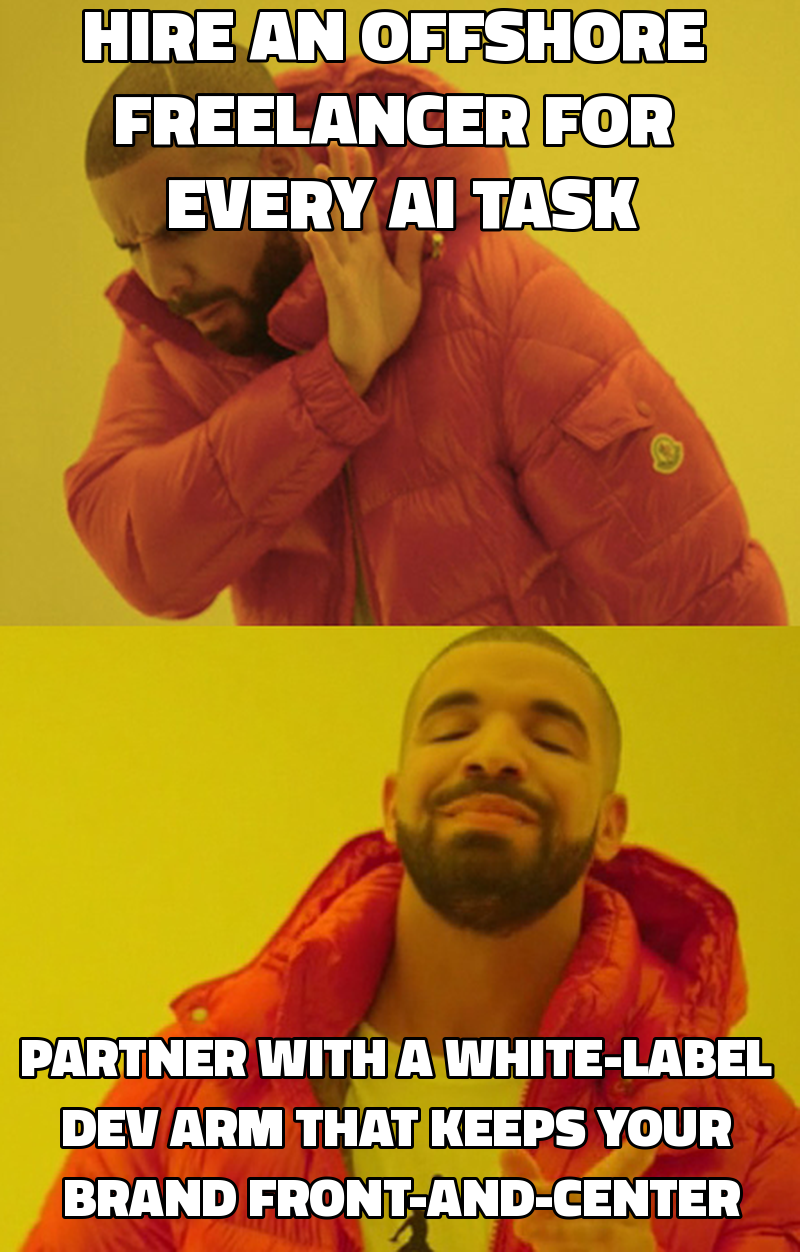
- Define a white-label partnership that lets agencies keep the client brand while you handle all code.
- Choose a proven AI stack (OpenAI, Anthropic, Google Vertex) that matches the agency's typical use cases.
- Launch with a $2,000-$5,000 fixed-scope pilot to prove reliability and unlock retainer work.
- Price using a 50-70% wholesale margin on project fees and a $1,500 monthly retainer for ongoing escalation.
- Use a shared project dashboard (e.g., Notion or ClickUp) to give partners real-time visibility without building a custom SaaS.
- Target founders, CEOs, and heads of delivery at 5-15 person marketing, SEO, branding, or social agencies in the US, UK, and AU.
What is a white-label AI automation agency?
A white-label AI automation agency builds custom AI-driven tools, chatbots, workflow automations, voice assistants, and bespoke back-ends, under the brand of a partner agency. The partner bills the client, you receive a wholesale rate, and the client never sees your name. This model solves the pain point of agencies that lose work because they cannot develop AI solutions in-house, while protecting the agency’s brand and margin.
How do I choose the right AI tools and platforms?
Selecting a stack that balances capability, cost, and ease of integration is critical for a non-technical founder. Below is a comparison of the most common large-language-model (LLM) providers as of 2024.
| Provider | Model Highlights | Pricing (per 1M tokens) | Best Use Cases |
|---|---|---|---|
| OpenAI | GPT-4o, function calling, strong code generation | $15 (prompt) / $30 (completion) | Complex chatbots, code-assist, multi-modal apps |
| Anthropic | Claude 3.5 Sonnet, safety-focused, low hallucination | $12 (prompt) / $24 (completion) | Customer support bots, compliance-sensitive flows |
| Google Vertex AI | PaLM-2, integrated with BigQuery and Dataflow | $10 (prompt) / $20 (completion) | Data-heavy analytics, Google Cloud-centric clients |
| Azure OpenAI | GPT-4 Turbo, enterprise security, regional compliance | $14 (prompt) / $28 (completion) | Enterprises with Azure lock-in, regulated industries |
Why it matters: According to a 2023 McKinsey report, firms that pair the right LLM with a low-code orchestration layer see productivity gains of 30%-40% compared with custom code alone. For agencies serving SMBs, OpenAI’s function-calling and Azure’s compliance options often win the day.
Supporting tools
- Low-code orchestration: Make.com, Zapier, n8n – allow you to stitch LLM calls into client workflows without writing extensive glue code.
- Voice integration: Google Dialogflow CX, Amazon Polly, ElevenLabs – provide TTS and STT for voice assistants.
- Backend as a Service: Supabase, Firebase – give you instant auth, database, and hosting.
- Project tracking: ClickUp, Notion, Monday.com – set up a shared dashboard that the agency can view.
How do I build a fixed-scope pilot that sells itself?
A pilot is a low-risk, high-value proof point. Follow these steps:
- Identify a single automation the agency’s client needs (e.g., lead-capture chatbot on a WordPress site). Keep the scope to one user flow and one integration.
- Write a scoped proposal of 2-3 pages that includes deliverables, timeline (typically 10-12 business days), and a fixed price between $2,000 and $5,000.
- Charge a 30% upfront deposit to cover initial prompt engineering and infrastructure.
- Deliver a working demo (not a full production build) within the agreed timeline. Use a staging sub-domain the agency can share with the client.
- Collect feedback and sign a short retainer for post-pilot enhancements (e.g., $1,500 per month for 15-20 dev hours).
"A well-executed pilot converts 70% of prospects into retainer clients," notes the 2022 State of Agency Partnerships survey by HubSpot.
What pricing models protect margin and appeal to agencies?
Pricing must be simple, transparent, and aligned with agency cash flow. The table below outlines three models that work for white-label partners.
| Model | Structure | Typical Margin | Pros | Cons |
|---|---|---|---|---|
| Fixed-scope project | One-off fee, 10-12 day turnaround | 50-70% wholesale | Predictable for agency, easy to quote | Limited upside if scope creeps |
| Monthly retainer | Fixed $1,500-$3,000 per month for 15-30 hrs | 60-75% wholesale | Ongoing revenue, builds trust | Requires consistent pipeline |
| Revenue-share pilot | Agency pays 30% of the first year’s revenue generated by the AI tool | 40-55% wholesale (depends on tool) | Aligns incentives, lower upfront cost for agency | Complex tracking, slower cash flow |
Key rule: Never compete on price alone. According to a 2023 Deloitte survey, agencies that win on reliability and depth of AI expertise command 2-3× higher margins than those that try to be the cheapest developer.
How do I set up delivery infrastructure without hiring developers?
You can deliver high-quality AI projects with a lean tech stack and a few trusted contractors.
- Core team: Founder (product owner), a part-time AI prompt engineer (contract via Upwork or Toptal), and a senior no-code integrator.
- Version control: Use GitHub with branch protection rules; even low-code workflows can be versioned as JSON.
- CI/CD: Leverage GitHub Actions to run automated tests on prompt changes and API key rotation.
- Hosting: Deploy to Vercel (for front-end) and Supabase (for backend). Both have generous free tiers and simple scaling.
- Documentation: Create a lightweight knowledge base in Notion that includes SOPs for prompt engineering, API key management, and client hand-off.
- Quality gate: Before any delivery, run a checklist: (1) Prompt accuracy test, (2) Integration test, (3) Security review (no hard-coded keys), (4) Client-ready UI review.
How should I approach sales and partnership outreach?
Your target buyers are founders, CEOs, and heads of delivery at agencies with 5-15 staff. Use a multi-channel outreach plan:
- LinkedIn direct messages – reference a recent case study where you built a chatbot for a local retailer and saved 20% of their support cost.
- Email sequence – 3-step cadence: (a) problem-focused intro, (b) pilot offer with ROI numbers, (c) social proof (RouteMate case study).
- Webinar – Host a 30-minute live demo titled “How to add AI chatbots to your client portfolio without hiring a developer”. Promote through agency forums (e.g., AgencyGrowth, GrowthHackers).
- Referral program – Offer a 10% commission on the first $5,000 pilot for agencies that refer another partner.
- Qualification gate – Apply the 10-second site test and the three-gate questionnaire before a discovery call to protect your time.
What are common pitfalls and how do I avoid them?
| Pitfall | Why it hurts | Mitigation |
|---|---|---|
| Over-promising delivery speed | Sets expectations you cannot meet, leading to churn | Define a fixed turnaround band (e.g., 10-12 business days) and stick to it |
| Giving away a free full draft | Consumes engineering hours and devalues your work | Offer a scoped prototype or a paid pilot instead |
| On-boarding too many partners at once | Dilutes reliability, the core USP | |
| Not having an NDA or non-circumvent clause | Risk of partner poaching your work | Use a simple one-page NDA and enforce via trust and performance |
| Ignoring compliance for voice or data | May breach GDPR or CCPA for EU/US clients | |
| Lack of clear pricing tiers | Agencies stall on budget discussions | |
| Neglecting post-pilot support | Missed retainer revenue |
Bottom line: Keep capacity low, deliver on time, and let the pilot convert into a retainer. The Silent Dev Arm model thrives on reliability, not volume.
Frequently asked questions
How much capital do I need to start?
You can launch with under $10,000 by leveraging existing cloud credits (e.g., AWS Activate, Google Cloud for Startups) and contracting on a per-hour basis. The biggest expense is the first pilot’s development time, which you can offset with a 30% deposit from the partner agency.
Do I need to be an AI expert?
No. You need a solid understanding of prompt engineering and the ability to manage contractors. Partner with a prompt engineer on a retainer or use platforms like PromptBase to source proven prompts.
How do I protect my IP when working white-label?
Use a simple NDA that defines ownership of the code and prompts, and include a non-circumvent clause. Most agencies respect these agreements because their brand reputation depends on it.
What legal considerations exist for voice assistants?
If you handle user data, you must comply with GDPR for EU clients and CCPA for California. Use providers that offer data residency options, such as Azure OpenAI in the EU region.
How can I scale after the first few pilots?
Gradually increase the number of active partners to a capped 8-10, hire a second part-time AI engineer, and automate onboarding with a ClickUp template that captures scope, timeline, and pricing.
What metrics should I track to prove ROI to the agency?
Track (a) reduction in client support tickets, (b) increase in lead conversion rate, (c) time saved on manual processes, and (d) revenue generated by the AI tool. Present these in a one-page ROI sheet after the pilot.
Is it better to charge per project or per hour?
Fixed-scope projects are preferred because agencies can quote to their clients without uncertainty. Hourly rates lead to scope creep and lower perceived value.
How do I handle post-launch maintenance?
Include a 2-hour monthly maintenance window in the retainer. For urgent bugs, use a ticketing system (e.g., Freshdesk) with SLA of 24-48 hours.
AI automation
Have something to build?
Tell us what you're trying to ship. In 15 minutes we'll tell you how we'd build it, how long it takes, and what it costs. No pitch deck, no pressure.