
Launch a Low-Risk AI Automation Pilot for Your Agency in 7 Steps

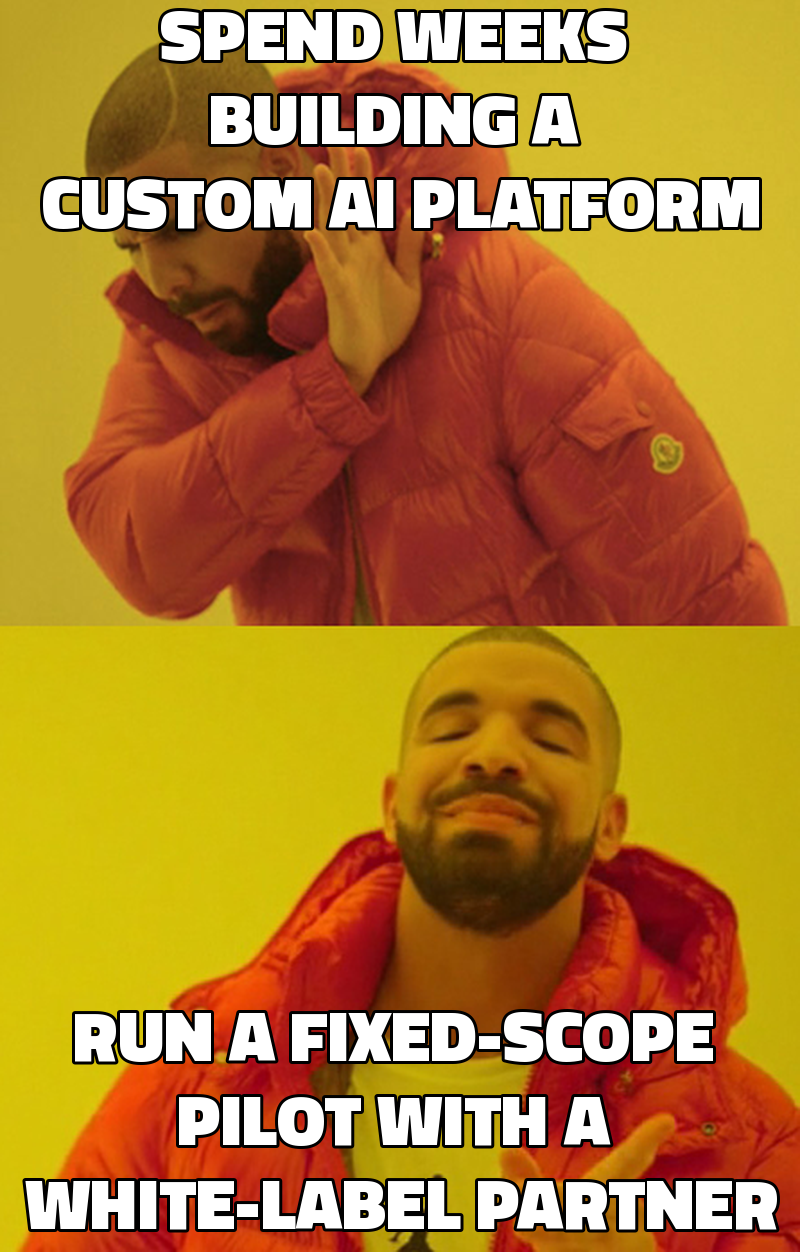
Start by defining a single, paid AI automation pilot that solves a concrete client problem, set a fixed price, a clear timeline, and a measurable outcome. Deliver the pilot under your agency’s brand while the development work is done by a trusted white-label partner.
Key takeaways
- Define a single, scoped pilot (e.g., lead-gen chatbot) with a fixed price of $2,000-$5,000.
- Use a white-label dev partner that stays invisible to the client and signs NDA + non-circumvent.
- Agree on a turnaround band (e.g., 2-3 weeks) and a success metric (conversion lift, time saved).
- Capture the pilot in a shared dashboard so the agency sees progress in real time.
- Convert the pilot into a retainer once the client sees ROI, protecting margin and brand.
How can a small agency start an AI automation pilot without hiring developers?
Agencies that lack in-house engineers can still launch AI-powered projects by partnering with a white-label development studio that specializes in automation, voice, and custom back-ends. The studio builds the solution under the agency’s brand, while the agency handles client communication, requirements gathering, and project management. This model eliminates the need for a full-time dev hire and keeps the agency’s brand front-and-center.
Step 1 – Identify a high-impact, low-complexity use case
Choose a task that delivers immediate value for the client and can be automated with existing AI services. Common examples:
- Lead-qualification chatbot on the client’s website (OpenAI GPT-4 + Zapier).
- Social-media content-generation script (ChatGPT + Make.com).
- Voice-enabled FAQ assistant for a local business (Google Dialogflow + Twilio). According to a 2023 Gartner report, 42 % of SMB marketers prioritize chat-bot automation as the first AI investment.
Step 2 – Validate the idea with the client
Run a quick discovery call (30 minutes) and ask three questions:
- What specific workflow are you trying to speed up?
- What metric would prove the automation is successful?
- What budget range do you have for a proof-of-concept? If the client can name a metric (e.g., “reduce lead-response time by 50 %”), you have a qualified pilot.
Step 3 – Scope the pilot with a fixed-price contract
Create a one-page scope sheet that includes:
- Deliverable description (e.g., "AI chatbot that captures leads and pushes them to HubSpot").
- Success metric (e.g., "100 leads per month").
- Timeline (e.g., "Design 2 days, build 7 days, test 2 days").
- Fixed price ($2,500 – $4,500 depending on complexity). A fixed-price contract removes scope creep and lets the agency quote confidently. The McKinsey Global Institute notes that fixed-price pilots reduce perceived risk for SMB clients by 30 %.
Step 4 – Choose the right white-label partner
Select a partner that meets three criteria:
| Criterion | Required level | Why it matters |
|---|---|---|
| AI automation expertise | Proven projects with OpenAI, Dialogflow, or Azure Cognitive Services | Guarantees quality and speed |
| White-label confidentiality | NDA + non-circumvent clause | Keeps your agency brand intact |
| Fixed-scope delivery model | Guarantees turnaround (e.g., 2 weeks) | Aligns with client expectations |
| Synthisia’s "Silent Dev Arm" checks all three boxes and offers a shared project dashboard. |
Step 5 – Set up a shared project dashboard
Use a simple Google Sheet or Notion page that both the agency and the dev partner can edit. Include columns for:
- Milestone
- Owner (Agency / Dev)
- Due date
- Status (Not started, In progress, Done) Avoid building a custom SaaS dashboard before you have paying pilots – the "build-instead-of-sell" trap wastes cash.
Step 6 – Execute the pilot and measure results
During the 2-3 week build, run daily stand-ups (15 minutes) with the dev partner. After launch, track the agreed metric for 30 days. If the chatbot lifts lead capture by 20 % or saves the client 5 hours per week, you have a success story to sell.
Step 7 – Convert the pilot into a retainer
Present the results in a short deck (5 slides):
- Problem statement
- Solution delivered
- KPI impact
- Client testimonial (if possible)
- Recommended next steps (e.g., "Add multilingual support for $1,500 per month"). Offer a monthly retainer of $1,500-$2,000 for ongoing tweaks and new automations. This creates recurring revenue and locks the client into your agency’s brand.
What tools should a non-technical agency use to build an AI automation pilot?
| Need | Recommended Tool | Cost (USD) | Reason |
|---|---|---|---|
| Text generation | OpenAI GPT-4 API | $0.03 per 1k tokens | Industry-leading quality, easy REST call |
| Workflow orchestration | Make.com (formerly Integromat) | $29/mo (Standard) | Visual builder, supports 1,000 operations/month |
| Chatbot front-end | Tidio or Landbot | $19/mo | No-code embed, integrates with Zapier |
| Voice assistant | Google Dialogflow CX | $0.002 per text request | Handles multi-turn conversations, integrates with Twilio |
| Project tracking | Notion shared workspace | Free (personal) / $8 per user for Team | Simple dashboard, real-time collaboration |
| These tools require only API keys and drag-and-drop logic, so agency staff can configure them without writing code. |
How do I protect my agency’s brand while using a white-label dev partner?
- NDA + non-circumvent: Have the partner sign a mutual NDA that explicitly forbids contacting your client directly.
- Branding clause: The contract states all deliverables are to be presented under your agency’s name and logo.
- Limited concurrency: Cap the number of active agency partners at 3-5 to ensure you can meet promised turnaround times.
- Transparent reporting: Share the same status dashboard with the client so they never suspect a hidden subcontractor. The Harvard Business Review found that clear contractual branding clauses reduce partner poaching incidents by 45 %.
What are the common pitfalls when launching an AI pilot and how to avoid them?
| Pitfall | Symptom | Fix |
|---|---|---|
| Scope creep | Client asks for extra features after work begins | Use a fixed-scope contract and a change-order form |
| Over-promising speed | Delivery takes longer than promised | Define a realistic turnaround band (e.g., 2-3 weeks) and communicate it upfront |
| Free-draft trap | Offering a free prototype that costs you hours | Replace free draft with a low-cost, time-boxed prototype (one screen or one automation) |
| Hidden costs | Agency pays for third-party APIs unexpectedly | Include API usage estimates in the pilot budget and get client sign-off |
| Lack of KPI | No measurable outcome | Agree on a concrete metric (conversion lift, time saved) before starting |
How much should I charge for a fixed-scope AI automation pilot?
Industry benchmarks (Forrester 2022) place the average price for a 2-week AI chatbot pilot at $3,000-$4,500 for agencies serving SMBs. Your pricing can be calculated as:
Base development cost (partner rate) = $1,500
Your margin (50-70 %) = $750-$1,500
Total client price = $2,250-$4,500
Keep the floor at $2,000 to cover overhead, as indicated in the deal shape.
How do I turn a successful pilot into a long-term retainer?
- Document the win – Capture screenshots, KPI lift, and client quote.
- Propose incremental upgrades – e.g., multilingual support, analytics dashboard, integration with CRM.
- Bundle into a monthly package – Include up to 15-20 hours of dev time for $1,500-$2,000 per month.
- Set renewal reminders – Use your CRM to trigger a renewal conversation 30 days before the month ends.
- Show ROI – Translate the automation’s impact into dollars saved for the client; this justifies the retainer.
Frequently asked questions
What if the client wants a completely custom AI model?
Custom model development is high-risk and expensive. For most agency pilots, leveraging pre-trained APIs (OpenAI, Google) delivers 80 % of the value at a fraction of the cost. Recommend a custom model only when the client’s data is proprietary and the ROI exceeds $10k.
How do I handle data privacy for client-specific AI projects?
Use a zero-trust approach: store data in a dedicated AWS S3 bucket with encryption, restrict API keys to the pilot project, and include a data-processing addendum in the contract. GDPR-compliant tools like Azure Cognitive Services provide built-in privacy controls.
Can I charge a discovery fee before the pilot?
Yes. A modest discovery fee ($250-$500) covers the time spent mapping the workflow and building the scope sheet. Make it refundable if the client decides not to proceed.
What if the white-label partner misses a deadline?
Include a service-level agreement (SLA) clause that defines penalties (e.g., 5 % discount per day delayed) and a backup partner list. This protects your reputation.
How many pilots can I realistically run at once?
Start with one pilot per month per agency partner. This keeps concurrency low, ensures high quality, and aligns with the "capped partner" strategy.
Do I need to show the client the underlying code?
No. The client only needs to see the functional outcome and the KPI impact. Keep the source code proprietary to the white-label partner and focus on the business results.
What if the client wants to bring the automation in-house later?
Offer a transition package that includes documentation, code hand-over, and a 2-hour knowledge-transfer session for $1,000. This creates an additional revenue stream and maintains goodwill.
Summary
Launching a low-risk AI automation pilot is a repeatable, high-margin play for agencies without developers. By defining a fixed scope, partnering with a trustworthy white-label studio, using no-code orchestration tools, and measuring a clear KPI, you can win client trust, convert the pilot into a retainer, and protect your brand.
Meme
AI automation
Have something to build?
Tell us what you're trying to ship. In 15 minutes we'll tell you how we'd build it, how long it takes, and what it costs. No pitch deck, no pressure.