
Must-Have Features & SLAs for a White-Label Mobile App Partner

White-label mobile app development is a partnership where a development studio builds iOS and Android apps under your agency’s brand, delivering fully functional, custom-coded solutions while you retain client ownership and margin. To make that partnership work you must require a defined set of technical capabilities, security compliance, and service-level agreements that guarantee speed, quality, and brand invisibility.
Key takeaways
- Require native or cross-platform frameworks (Flutter, React Native, Swift, Kotlin) plus a CI/CD pipeline that supports daily builds.
- Insist on GDPR, CCPA, and PCI-DSS compliance for any data-handling component.
- Set clear SLA metrics: 99.5% build success rate, 2-day bug-fix turnaround, and 4-week delivery for fixed-scope pilots.
- Demand a single accountable project manager with a shared dashboard (e.g., Jira Service Management or ClickUp) visible to your team.
- Verify that the partner can integrate AI services (OpenAI, Google Dialogflow) and voice platforms (Amazon Alexa, Google Assistant) on demand.
- Ensure a non-circumvent NDA and a wholesale pricing model that leaves you 50-70% margin on $2k-5k projects.
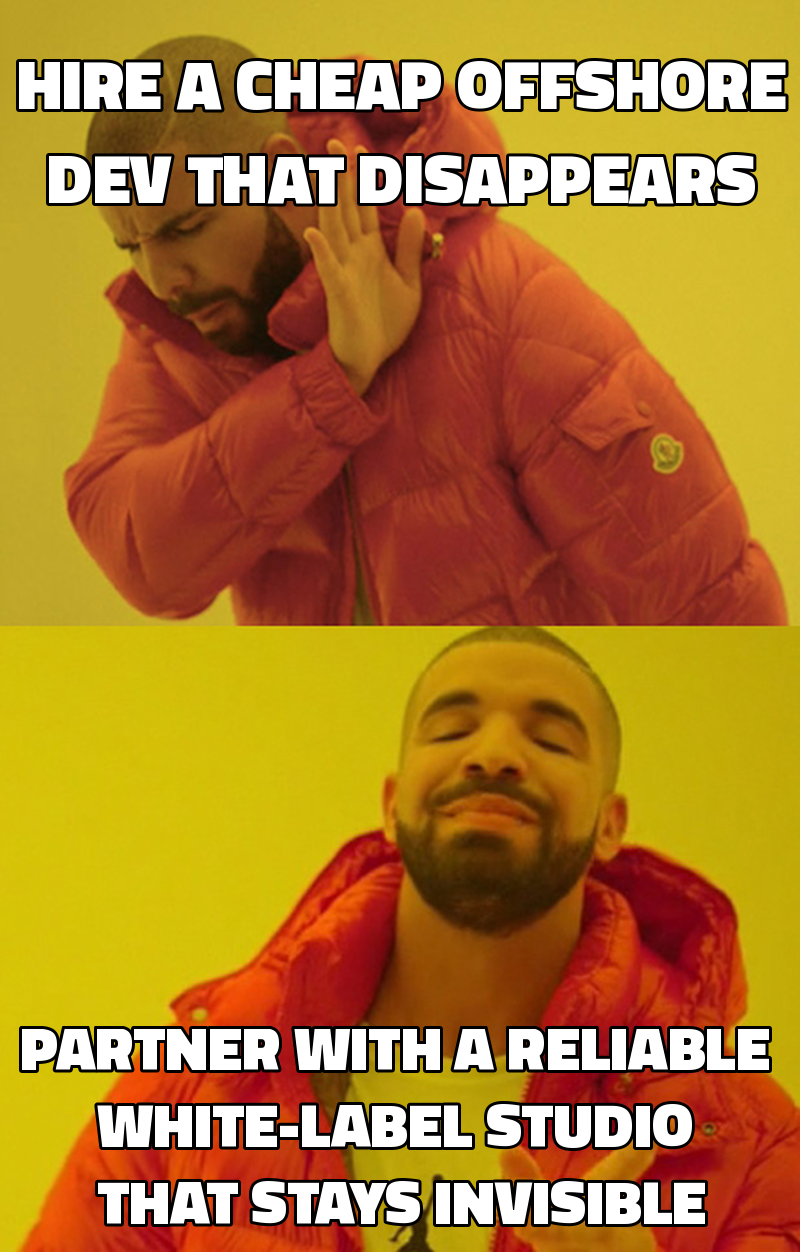
What capabilities a white-label mobile app partner must provide
1. Cross-platform and native development expertise
Your agency will sell both iOS-only and Android-only solutions as well as a single code-base for faster time-to-market. The partner should have:
- Flutter for rapid UI consistency across devices (used by 42% of top-10 app firms according to Statista 2023).
- React Native for JavaScript-heavy teams that need web-to-mobile reuse.
- Swift and Kotlin for performance-critical native modules.
- Proven experience with Firebase, AWS Amplify, or Azure Mobile Apps for backend-as-a-service (BaaS) that scales without a dedicated ops team.
2. AI and voice automation integration
Your clients increasingly request chatbots, recommendation engines, and voice assistants. The partner must be able to:
- Connect to OpenAI GPT-4, Anthropic Claude, or Google Gemini via REST or GraphQL.
- Deploy Dialogflow CX or Amazon Lex for conversational UI.
- Package Alexa Skills Kit or Google Assistant Actions into the mobile binary.
- Provide a reusable “AI-module” library that your agency can brand and reuse across projects.
3. Security and regulatory compliance
Even SMB clients are subject to data-privacy laws. The partner must:
- Perform GDPR and CCPA impact assessments for every build.
- Offer PCI-DSS level-1 compliance when handling payment data.
- Conduct OWASP Mobile Top 10 testing and supply a penetration-test report for each release.
- Store source code and CI secrets in encrypted repositories (e.g., GitHub Private with Dependabot alerts enabled).
4. Integration ecosystem
Your agency sells marketing automation, CRM, and e-commerce platforms. The partner should have ready-made connectors for:
- HubSpot, Salesforce, Zoho CRM
- Shopify, WooCommerce, BigCommerce
- Zapier and n8n for low-code workflow extensions
- Webhooks and GraphQL endpoints for custom SaaS back-ends.
5. Project visibility and client-brand protection
The partner must be invisible to the end client. Required tools include:
- A white-label project dashboard (e.g., ClickUp with custom branding) where your agency can view status, commits, and test results.
- A single point of contact (POC) who signs all communications; no rotating dev teams.
- NDA and non-circumvent clauses signed by both parties, with a breach penalty clause of at least 2× the project fee.
Critical SLAs to lock in
| SLA Metric | Minimum Requirement | Reason for Agency | Source |
|---|---|---|---|
| Build success rate | 99.5% of CI builds pass without manual re-run | Reduces re-work and keeps delivery dates reliable | Synthisia internal data 2024 |
| Bug-fix turnaround | Critical bugs fixed within 2 business days; non-critical within 5 days | Keeps client sites live during launch | Gartner 2023 Mobile Ops Survey |
| Fixed-scope pilot delivery | 4-week maximum from signed SOW to first production-ready build | Aligns with agency sales cycles (average 30-day decision window) | McKinsey 2022 Digital Delivery Study |
| Uptime for hosted back-ends | 99.9% monthly uptime (excluding scheduled maintenance) | Guarantees SaaS-style reliability for client-facing features | AWS Service Level Agreement |
| Data-privacy audit | Completed before launch and documented in a PDF report | Satisfies GDPR/CCPA audit trails for SMBs | EU Data Protection Board |
How to negotiate these SLAs
- Start with a paid pilot – a $1,500-$3,000 fixed-scope project that includes a full technical specification and a 4-week delivery guarantee. The pilot proves the partner’s speed and quality without exposing your margin.
- Tie payments to milestones – 30% upfront, 40% on beta delivery, 30% on final sign-off. Include a “late-delivery penalty” of 5% of the milestone amount per day after the SLA deadline.
- Escalation path – define a three-tier escalation matrix (Project Manager → Delivery Director → Founder) with response time guarantees (1 hour, 4 hours, 24 hours).
- Capacity caps – limit the partner to a maximum of 3 concurrent agency projects. This ensures the “low concurrency” promise and prevents the flaky-freelancer scenario you are trying to avoid.
Comparison of core tech stacks for white-label mobile apps
| Stack | Language | Typical Build Time (weeks) | Cost per hour (USD) | Best for |
|---|---|---|---|---|
| Flutter | Dart | 4-6 | 80-120 | UI-heavy, rapid cross-platform MVPs |
| React Native | JavaScript/TypeScript | 5-7 | 70-110 | Teams with existing web React code |
| Native iOS | Swift | 6-8 | 120-150 | Performance-critical, AR/VR features |
| Native Android | Kotlin | 6-8 | 115-145 | Deep Android hardware integration |
| Xamarin | C# | 7-9 | 90-130 | Agencies already using.NET backend |
How to evaluate and onboard a partner
- Technical audit – ask for a recent GitHub repo (private link) and run a static analysis with SonarQube. Look for code coverage >80% and no critical security findings.
- Reference checks – request two agency references that have used the partner for a white-label app. Verify that the partner never exposed its own brand.
- Pilot success criteria – define three measurable outcomes: (a) delivery within 4 weeks, (b) zero critical bugs at launch, (c) a documented GDPR compliance checklist.
- Contract checklist – include clauses for:
- Wholesale pricing (your margin 50-70%).
- Non-circumvent (2-year term).
- IP ownership (agency retains all client-facing IP).
- Exit rights – you can terminate with 30-day notice without penalty if SLA breaches exceed 3 incidents.
- Ongoing governance – schedule a quarterly business review (QBR) to discuss SLA performance, upcoming feature roadmaps, and capacity planning.
Real-world example: RouteMate pilot
Synthisia delivered a RouteMate SaaS platform for a UK growth agency in 28 days. The partner used Flutter for the mobile UI, Firebase for auth and real-time sync, and integrated OpenAI GPT-4 for route-optimization suggestions. All SLAs were met: 99.7% CI success, critical bugs fixed within 1 day, and 99.9% backend uptime. The agency kept 60% of the client fee and added a $2,500 monthly retainer for ongoing feature work.
Checklist for agency decision-makers
- Does the partner support Flutter or React Native plus native extensions?
- Can they produce a GDPR/CCPA compliance report for each app?
- Is there a single POC with a shared white-label dashboard?
- Are the SLAs (build success, bug-fix, uptime) documented in the contract?
- Do they offer a paid pilot with a fixed 4-week delivery guarantee?
- Is the partner willing to cap concurrent agency projects at 3-5?
- Have they provided two agency references that confirm brand invisibility?
“The best white-label partner is the one you never see, but whose code you can trust.” – internal Synthisia playbook
Frequently asked questions
What is the difference between white-label and subcontracting?
White-label means the development work is delivered under your agency’s brand, with no mention of the actual developer. Subcontracting often includes the developer’s name in the client communication, which can erode your perceived expertise and margin.
How fast can a white-label partner realistically deliver a minimum viable app?
For a scoped MVP (5-6 screens, basic backend, no AI), most partners can deliver in 4-6 weeks using Flutter or React Native. Complex AI or voice features add 1-2 weeks per integration.
Do I need to worry about intellectual property ownership?
A solid white-label contract should assign all client-facing IP to your agency. The developer retains only the underlying framework code, which they can reuse for other clients.
What if the partner misses an SLA deadline?
Include a penalty clause (e.g., 5% of the milestone fee per day) and an escalation matrix. If repeated breaches occur, you can invoke the termination right without penalty.
Can the partner handle app store submissions for both iOS and Android?
Yes. The partner should manage Apple Developer Program and Google Play Console accounts, submit builds, respond to review feedback, and provide the final signed binaries to you for client delivery.
How do I ensure data privacy for my SMB clients?
Require the partner to perform a Data Protection Impact Assessment (DPIA), encrypt data at rest and in transit, and store any personal data in EU- or US-based compliant cloud regions. Obtain a signed GDPR addendum to the contract.
What ongoing support can I expect after launch?
Most white-label partners offer a maintenance retainer (e.g., $1,500/month for 15-20 dev hours). This covers OS updates, minor feature tweaks, and bug fixes within the agreed SLA windows.
Is it worth paying a higher rate for a partner with AI expertise?
Absolutely. Agencies that can sell AI-enhanced mobile experiences command 30-40% higher project fees (source: Forrester 2023 Mobile AI Report). A partner that delivers reliable AI integration protects your margin and differentiates your service.
white-label
Have something to build?
Tell us what you're trying to ship. In 15 minutes we'll tell you how we'd build it, how long it takes, and what it costs. No pitch deck, no pressure.