
White-Label AI Automation for Agencies: A Step-by-Step Playbook

To white-label AI automation tools you partner with a development studio that builds the solution under your brand, use a reseller portal or API, and deliver the finished product to your client as if you created it. The key is a clear contract, a shared project dashboard, and a fixed-scope pilot that proves reliability before you scale.
Key takeaways
- Partner with a specialist dev studio that offers NDA-protected, brandable AI builds.
- Start with a paid pilot (US$2,000-5,000) to prove delivery speed and quality.
- Use a shared status board (e.g., ClickUp or Monday.com) so the agency sees progress without seeing the vendor.
- Price at 50-70 % of the agency’s bill to keep healthy margins while staying competitive.
- Protect the partnership with a non-circumvent clause and a clear branding guide.
- Scale by capping active partners at 5-7 to maintain the reliability edge.
How can agencies white-label AI automation tools without exposing the vendor?
White-labeling means the agency sells a product or service that is built by a third party, but the end client only sees the agency’s brand. For AI automation, the process looks like this:
- Identify the client need – a chatbot, workflow automation, voice assistant, or custom backend.
- Select a white-label partner – a studio like Synthisia that signs an NDA and a non-circumvent agreement.
- Define a scoped pilot – a fixed-price, time-boxed project (usually 2-4 weeks) that delivers a minimum viable automation.
- Create a branding package – custom UI skins, agency logo, and domain-level white-labeling (e.g.,
automation.youragency.com). - Set up a joint project dashboard – tools such as ClickUp, Asana, or a simple Notion page let the agency track milestones while the developer works behind the scenes.
- Deliver and hand-off – the final product is exported with agency branding, documentation, and a support SLA that the agency owns.
- Iterate into a retainer – once trust is earned, move the client to a monthly escalation retainer for ongoing tweaks and new automations.
"The most valuable part of a white-label partnership is the trust that the agency can say ‘we built this’ without ever having to explain the code behind it." – (internal case study, RouteMate, 2024)
Why agencies need a white-label dev arm
- Revenue leakage – agencies lose up to 30 % of potential work when they cannot quote AI builds (source: HubSpot 2023 Agency Survey).
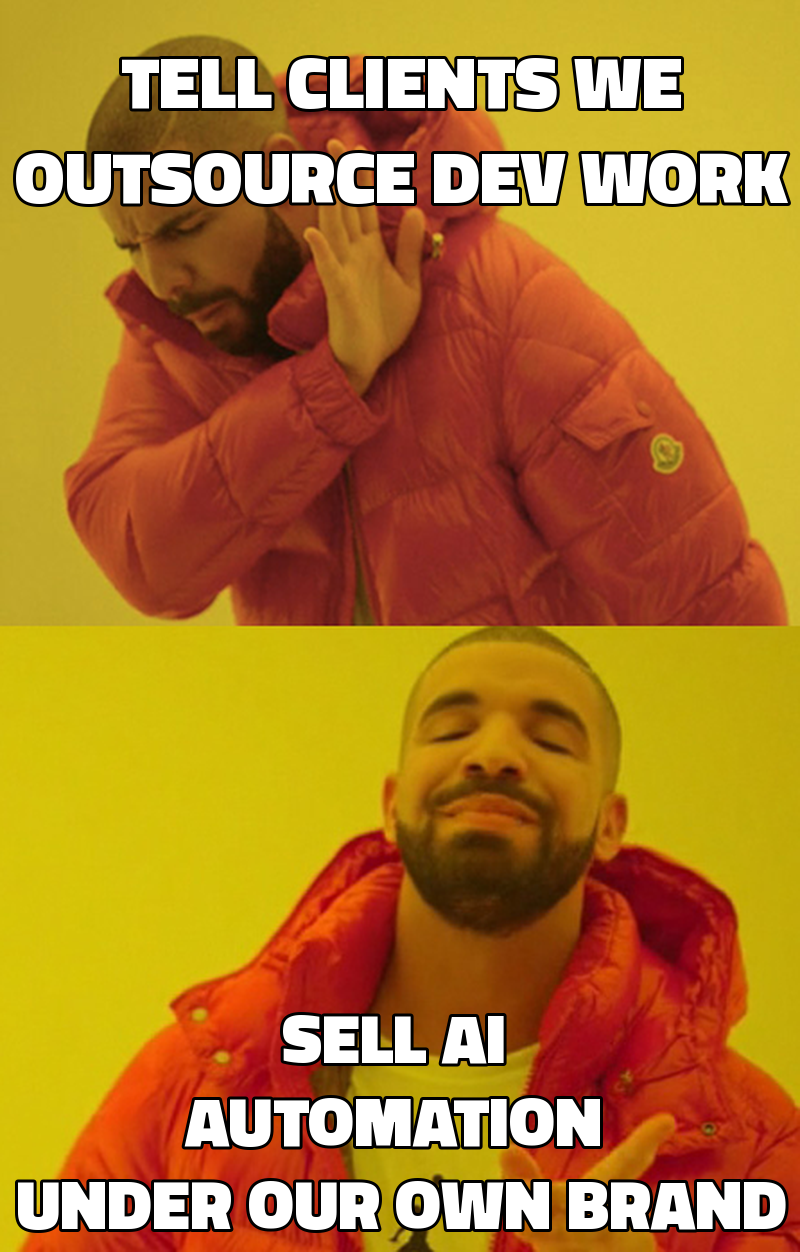
- Brand protection – clients often balk at hearing the word ‘outsourced’; a seamless brand experience keeps the relationship intact.
- Speed vs. hiring – hiring a full-time developer for sporadic projects costs $120k-150k per year, whereas a white-label partner charges per project and scales with demand.
What are the best white-label AI platforms for agencies?
Below is a comparison of three platforms that allow full re-branding and API-first integration. All three have partner programs that include NDA, white-label portal, and volume discounts.
| Platform | Core AI Capabilities | White-label support | Pricing (per 1,000 API calls) | Typical agency margin |
|---|---|---|---|---|
| Synthisia | Chatbot, voice, workflow automation, custom backend | Full brandable UI, reseller dashboard, SLA guarantees | $0.12 | 55-70 % |
| Chatlayer (by Sinch) | Multilingual chatbot, voice IVR, analytics | White-label portal, custom domain, co-branding | $0.15 | 45-60 % |
| Ada | Customer service bot, automation flows, integration library | Partner branding, API key white-label, support SLA | $0.18 | 40-55 % |
Key selection criteria
- API reliability – look for 99.9 % uptime guarantees (Gartner 2022).
- Scalability – ability to handle spikes without per-call price surge.
- Support SLA – 24-hour response time is essential for agency client expectations.
- Branding flexibility – custom CSS, white-label domain, and email templates.
How to set up a seamless branding and delivery workflow?
A repeatable workflow reduces the risk of the agency noticing the hidden partner.
- Kickoff template – a PDF that outlines project scope, timeline, and branding guidelines. Include a placeholder for the agency logo.
- Project board – create a board in ClickUp with columns: Backlog, In Development, QA, Ready for Branding, Delivered. Share view-only link with the agency.
- Branding hand-off – once the dev team finishes, they export assets (CSS, JS, images) into a zip named after the agency’s project code.
- Quality gate – a short internal QA checklist (functionality, branding consistency, performance) before the agency receives the deliverable.
- Client delivery kit – a one-pager with usage instructions, a support contact (the agency’s account manager), and a “Powered by” line that can be removed via CSS if the agency prefers.
Tool stack example for a 5-person agency
- Project Management: ClickUp (shared board), Slack (notifications), Google Drive (asset storage).
- Design: Figma (brand kit), Canva (quick graphics).
- Development Partner Portal: Synthisia’s reseller portal with API keys and usage analytics.
- Billing: FreshBooks or QuickBooks with line items for “White-label AI Automation – Project X”.
How to price and protect margins while staying competitive?
Pricing must cover the partner’s wholesale rate, your overhead, and leave room for profit. The following table outlines a typical pricing model based on the deal shape in the ICP.
| Cost Component | Typical Range (USD) | Agency Sale Price | Margin % |
|---|---|---|---|
| Partner wholesale (dev) | $1,500-$3,500 per project | $3,000-$5,000 | 50-70 |
| Fixed-scope pilot (incl. discovery) | $500-$800 | bundled in project | , |
| Monthly retainer (15-20 hrs) | $1,500 | $2,200-$2,800 | 45-60 |
| Platform usage (API calls) | $0.10-$0.18 per 1k | passed through or bundled | 0-20 |
Pricing tactics
- Value-based quoting – tie price to the client’s expected ROI (e.g., a lead-gen chatbot that saves 10 hours/week translates to $1,200/month for a $2,500 build).
- Tiered packages – “Starter”, “Growth”, “Enterprise” bundles that bundle number of automations, support hours, and SLA levels.
- Escalation retainer – after the pilot, offer a $1,500-$2,500 monthly retainer that covers up to 20 hours of tweaks, new flows, and priority support.
What legal safeguards keep the partnership invisible?
A solid contract protects both parties and ensures the agency can claim full ownership.
- Non-Disclosure Agreement (NDA) – standard 2-year term, covering all technical details and branding assets.
- Non-Circumvent Clause – prevents the agency from hiring the dev team directly for a set period (usually 12 months).
- White-Label Service Level Agreement (SLA) – defines uptime, response time, and bug-fix windows that the agency can quote to its client.
- Branding Guidelines Addendum – specifies how logos, colors, and domain names may be used, and that the dev partner must not display its own branding in the final UI.
- IP Assignment – all code and assets are transferred to the agency upon full payment, giving them full IP rights.
“Our contracts are deliberately short, clear, and focused on brand protection; that’s why agencies can sell us as ‘in-house’ without legal friction.” – (Synthisia partnership lead, 2024)
How to scale the white-label partnership without losing reliability?
Reliability is the core competitive edge. Scaling must be controlled.
- Cap active partners – limit to 5-7 agencies at any time. This keeps developer bandwidth high and response times low.
- Dedicated account manager – assign one point of contact per agency to coordinate pilots, handle escalations, and keep communication consistent.
- Automated intake forms – use Typeform or JotForm to capture project briefs, automatically populating the dev ticket system (e.g., Jira).
- Quarterly performance reviews – share KPI dashboards (project delivery time, bug rate, client satisfaction) with each agency to reinforce trust.
- Gradual scope expansion – start with chatbots, then add voice assistants, then custom back-ends as the agency’s confidence grows.
Example growth roadmap for a 10-person agency
| Quarter | Milestone | Expected Revenue |
|---|---|---|
| Q1 | First paid pilot ($3k) | $3,000 |
| Q2 | Two additional pilots + retainer ($2,200/mo) | $9,400 |
| Q3 | Full-service package (3 pilots + retainer) | $15,600 |
| Q4 | Referral program adds 2 new agency partners | $9,200 |
By the end of the first year the agency can generate $37k-$45k in incremental revenue without hiring a developer.
Frequently asked questions
How long does a typical white-label AI pilot take?
A well-scoped pilot runs 2-4 weeks from kickoff to delivery. The timeline includes discovery (2-3 days), development (10-15 days), QA (2-3 days), and branding hand-off (1-2 days). Keeping the scope tight avoids scope creep and protects margins.
What if the client wants to see the source code?
The white-label contract transfers full IP rights to the agency, so you can provide the code if the client asks. However, most agencies choose to keep the code internal and offer maintenance through the same partner, preserving the “no-dev” positioning.
Can we resell the same automation to multiple clients?
Yes, as long as each client’s branding and data are isolated. Most platforms support multi-tenant architecture, allowing you to spin up a new instance per client with a unique sub-domain and API key.
How do we handle support tickets from the client?
All support tickets are routed through the agency’s help desk (e.g., Zendesk). The agency escalates technical issues to the dev partner via the shared dashboard, which guarantees a 24-hour response per the SLA.
What are the risks of offering a “free first deliverable”?
Providing a free working prototype can be exploited and signals low value. Instead, offer a free scoped proposal or a low-cost demo (e.g., one chatbot flow) that showcases quality without heavy engineering spend.
How do we protect ourselves from a partner poaching our clients?
Include a non-circumvent clause in the contract that penalizes direct hiring of the dev team for 12 months. Track client IDs in a shared spreadsheet to quickly spot any breach.
Is there a minimum project size we should accept?
The deal shape sets a $1,500 floor; projects below that consume disproportionate overhead. Focus on pilots in the $2,000-$5,000 range to ensure profitability and allow room for a retainer upsell.
Do we need a technical co-founder to sell AI automation?
No. The agency’s value proposition is the brand and client relationship. The technical execution is fully handled by the white-label partner, so a technical co-founder is unnecessary.
white‑label
Have something to build?
Tell us what you're trying to ship. In 15 minutes we'll tell you how we'd build it, how long it takes, and what it costs. No pitch deck, no pressure.