
How to White-Label AI Automation Software for Agency Clients

How to white-label AI automation software is a three-step process: pick a flexible AI platform, wrap it in your brand assets, and deliver it through a reliable partner who stays invisible to the client. By following a proven workflow you can say yes to every build request, protect your agency brand, and keep a healthy margin without hiring a full-time developer.
Key takeaways
- Choose an AI platform with robust API, multi-region hosting and compliance certifications (GDPR, CCPA).
- Use a white-label partner that signs NDA, non-circumvent and offers a single point of contact.
- Rebrand UI, documentation and support channels to match your agency’s voice.
- Set fixed-scope pilot pricing (US$2,000-5,000) to earn trust before a retainer.
- Track projects on a shared dashboard to keep clients informed and protect margins.
- Avoid free-draft giveaways; offer a scoped prototype instead.
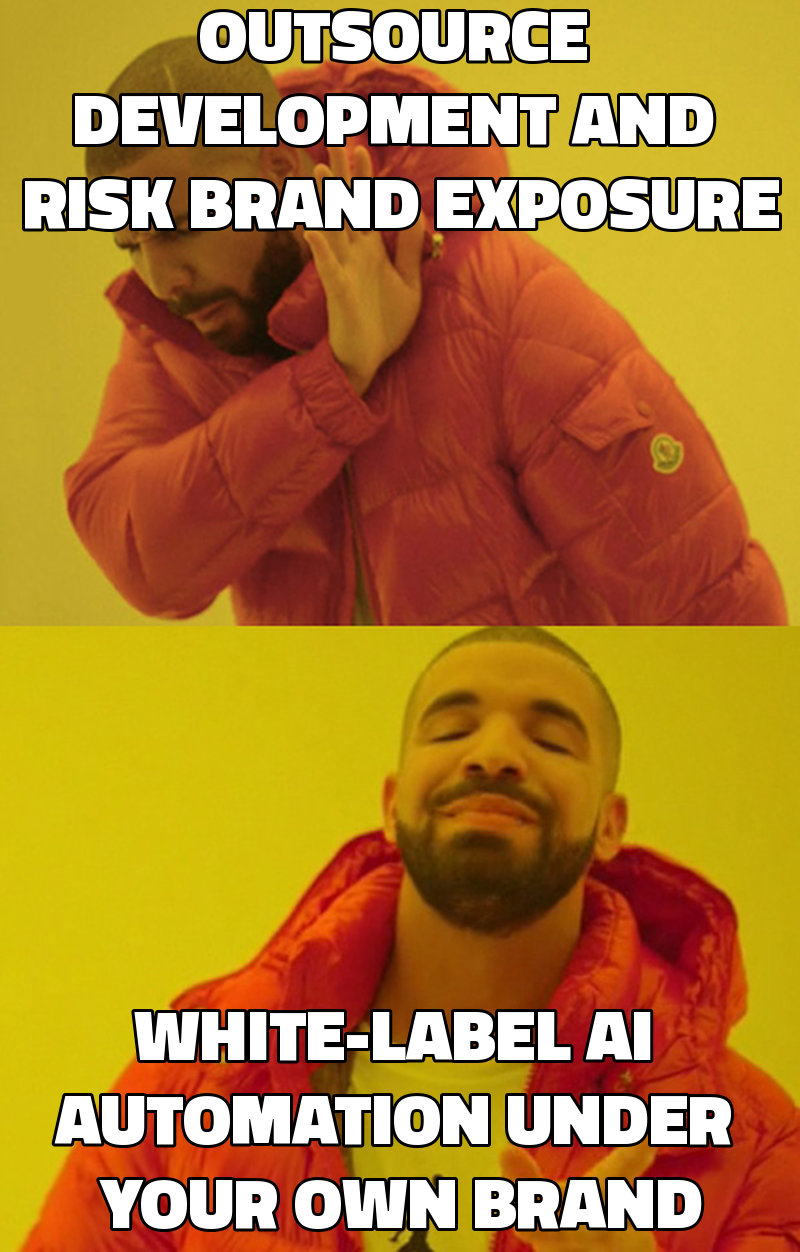
What is white-label AI automation software?
White-label AI automation software is a ready-made solution, chatbots, workflow bots, voice assistants or custom back-ends, that you rebrand and sell as if it were built in-house. The underlying code remains the property of the development partner, but every client-facing element (logo, URL, help docs, support email) carries your agency’s identity. This model lets agencies expand service catalogs without the overhead of hiring engineers, while preserving the perception of a full-service shop.
Why agencies need a white-label dev partner
Small marketing, SEO and branding agencies (5-15 people) often lack the technical bandwidth to deliver AI-driven projects. According to a 2023 Gartner survey, 68% of agencies plan to add AI services within two years, yet only 22% have in-house developers. The gap creates three pain points:
- Lost revenue when you turn away build requests.
- Client churn when they find a competitor that can deliver the missing feature.
- Reputation risk when outsourcing is exposed. A white-label partner solves all three by staying behind the scenes, delivering on time, and letting you keep the client relationship front-and-center.
Step-by-step process to white-label an AI tool
| Step | Action | Tool/Resource | Outcome |
|---|---|---|---|
| 1 | Identify client need | Client brief, discovery call | Clear problem statement |
| 2 | Select AI platform | OpenAI GPT-4, Anthropic Claude, Google Vertex AI, Azure OpenAI, or Cohere | Platform that meets latency, compliance, and cost criteria |
| 3 | Define scope & pilot price | Spreadsheet, pricing calculator | Fixed-scope contract (US$2,000-5,000) |
| 4 | Sign legal agreements | NDA, non-circumvent, white-label SLA | Protection for IP and brand |
| 5 | Brand the UI & docs | Figma, Storybook, custom CSS, brand guide | Agency-branded front-end and help center |
| 6 | Set up shared project dashboard | ClickUp, Notion, or custom portal (start simple) | Real-time visibility for agency and partner |
| 7 | Deliver pilot, collect feedback | Video call, feedback form (Typeform) | Validation and upsell opportunity |
| 8 | Transition to retainer or larger build | Retainer contract, quarterly review | Ongoing revenue stream |
1. Identify the client need
Start every white-label engagement with a discovery call that surfaces the exact workflow the client wants to automate. Use a structured questionnaire (e.g., “What trigger initiates the process? What data sources are involved? What is the desired outcome?”). Capture the answers in a Google Sheet so you can map them to platform capabilities.
2. Select the right AI platform
Pick a platform that aligns with three criteria:
- API flexibility – ability to chain prompts, call external APIs, and handle streaming responses.
- Compliance – ISO-27001, SOC-2, GDPR, CCPA certifications are a must for US/UK/AU SMB clients.
- Pricing transparency – predictable per-token or per-call cost to keep margins stable. For example, OpenAI’s GPT-4 API offers a pay-as-you-go model with an enterprise tier that includes dedicated capacity and data-privacy guarantees (source: OpenAI pricing page, 2024). If you need voice, Twilio Autopilot or Google Dialogflow provide SSML support and telephony integration.
3. Define scope and pilot price
Agencies should never start with an open-ended estimate. Break the project into discrete deliverables (e.g., “Create a lead-capture chatbot with three intents and CRM integration”). Assign a token-budget estimate and a development-hour estimate (e.g., 20 hours). Multiply by your wholesale rate (US$75-100 per hour) to arrive at a pilot price between US$2,000 and US$5,000. This range matches the typical budget for SMB automation projects, according to a 2023 Forrester report on SMB tech spend.
4. Sign legal agreements
A solid white-label relationship rests on three contracts:
- Non-Disclosure Agreement (NDA) – protects proprietary prompts and data handling logic.
- Non-Circumvent Agreement – prevents the agency from bypassing you to hire the developers directly.
- White-Label Service Level Agreement (SLA) – defines response times, uptime guarantees (e.g., 99.5% monthly uptime), and support escalation paths. All three should be signed before any code is shared.
5. Brand the UI and documentation
Replace every visual and textual cue with agency branding:
- Logo and color palette – update Figma components and CSS variables.
- Domain and SSL – host the front-end on a sub-domain like
automation.youragency.com. - Help center – write FAQs in the agency’s tone, host on Zendesk or Freshdesk under the agency’s brand.
- Support email – route tickets through a shared inbox (
[email protected]) that your partner can access via a delegated mailbox.
6. Set up a shared project dashboard
Avoid the “build-instead-of-sell” trap by delivering a lightweight status board from day one. Use ClickUp’s public view or a Notion page that lists:
- Project milestones
- Current sprint tasks
- Live demo link
- Upcoming billing dates This transparency builds trust and lets the agency showcase progress to the client without revealing the partner.
7. Deliver the pilot and collect feedback
After the agreed-upon turnaround (typically 2-3 weeks for a US$3,000 pilot), schedule a demo call. Record the session, capture notes in a Typeform feedback survey, and score the pilot on:
- Functionality (0-10)
- User experience (0-10)
- Alignment with brand voice (0-10) If the average score is 8 or higher, propose a larger build or a monthly retainer.
8. Transition to a retainer or larger build
Most agencies find that a retainer of US$1,500-2,500 per month (covering 15-20 dev hours) provides a predictable overflow capacity. Structure the retainer with a quarterly review clause so you can adjust hours based on seasonal demand.
Comparison of white-label models
| Model | Agency involvement | Partner visibility | Typical margin |
|---|---|---|---|
| Full white-label | Agency handles sales, branding, client communication | Partner stays invisible, signs NDA | 50-70% of client bill |
| Co-brand | Agency and partner share branding on UI | Partner name appears in footer or “powered by” | 40-55% |
| Reseller | Agency sells partner’s product as-is, no rebranding | Partner listed as vendor | 30-45% |
Choosing the right AI platform to rebrand
| Platform | Strength | Weakness | Ideal use case |
|---|---|---|---|
| OpenAI GPT-4 | Strong language generation, large ecosystem | Higher token cost for large contexts | Conversational bots, content generation |
| Anthropic Claude | Safer output, better refusal handling | Smaller community, fewer integrations | Customer support agents with compliance focus |
| Google Vertex AI | Integrated with GCP data pipelines, strong MLOps | Complex pricing tiers | Enterprise-grade analytics bots |
| Azure OpenAI | Seamless Azure AD security, regional data residency | Limited to Azure regions | Finance or healthcare bots requiring Azure compliance |
| Twilio Autopilot | Built-in telephony, SMS, voice | Limited to voice flows | Call-center assistants |
When rebranding, pick the platform that already meets the client’s data residency requirement (e.g., EU data must stay in EU-region clouds). This eliminates the need for additional legal hoops.
Legal and branding checklist for white-labeling
- NDA signed – both parties, includes prompt data.
- Non-circumvent clause – 12-month term, 5% penalty.
- White-label SLA – 99.5% uptime, 24-hour critical bug response.
- Brand guide – logo files, color hex, typography.
- Domain ownership – agency registers sub-domain, points CNAME to partner hosting.
- Compliance audit – confirm GDPR, CCPA, and local privacy law adherence.
- Support escalation matrix – Tier-1 handled by agency, Tier-2 by partner.
- IP ownership statement – agency owns the front-end code, partner retains core AI model IP.
Pricing and margin calculations for agencies
- Calculate partner cost – wholesale rate US$75 per hour × estimated hours (e.g., 20 hrs = US$1,500).
- Add agency overhead – project management, branding, support (10% of partner cost ≈ US$150).
- Set client price – partner cost + overhead + desired margin (e.g., 50% margin → US$3,150).
- Apply tiered pricing – for repeat clients, offer a 5% discount but keep margin above 45%.
- Retainer model – flat US$1,500 per month covers 15 hrs; any overflow billed at US$100 per hour.
Example: A client needs a lead-capture chatbot (20 hrs). Partner cost US$1,500, agency overhead US$150, total US$1,650. Charging US$3,300 yields a 50% margin, well within the 50-70% range defined in the deal shape.
Onboarding the partner and managing projects
- Kick-off call – introduce agency account manager, partner lead, and client stakeholder.
- Shared repository – use a private GitHub repo with branch protection; agency can view but not push.
- Status updates – weekly 15-minute stand-up recorded in Loom, linked in the dashboard.
- Quality gate – before each release, run automated tests (Jest for Node, PyTest for Python) and a UI sanity check.
- Client demo – deliver a clickable prototype in Figma or a live URL with agency branding.
- Post-launch support – 30-day bug-fix window covered by the pilot price; thereafter, switch to retainer support.
Common pitfalls and how to avoid them
| Pitfall | Why it hurts | Prevention |
|---|---|---|
| Offering a free full draft | Consumes partner hours, signals low value | Offer a scoped prototype (one screen or one automation) instead |
| Over-promising turnaround | Sets unbounded expectations, leads to missed deadlines | Define a fixed delivery band (e.g., 10-12 business days for a US$3,000 pilot) |
| Ignoring compliance | Risks fines, client loss, reputation damage | Run a compliance checklist for GDPR/CCPA before any data processing |
| Using generic branding | Dilutes agency’s premium positioning | Apply agency brand guide to every UI element and documentation |
| Not capping partner load | Turns you into a flaky freelancer | Limit active white-label partners to 5-7, as per the deal shape |
Case study: RouteMate white-label success
Client: A UK-based SEO agency with 9 staff members, no developers. Need: An automated reporting dashboard that pulls Google Search Console data, formats it, and emails weekly PDFs. Solution: Synthisia built a custom Python backend on AWS Lambda, integrated with OpenAI for natural-language insights, and white-labeled the UI under the agency’s brand. The pilot cost US$3,200, delivered in 11 days. After a 9-month retainer (US$1,800/month) the agency now offers the service to 12 of its SMB clients, generating an additional US$45,000 ARR while keeping the development partner invisible.
"The biggest win was keeping our brand front-and-center while we could finally say ‘yes’ to every client request," says the agency’s Managing Director.
Frequently asked questions
How long does a white-label AI pilot usually take?
A typical pilot for a chatbot or automation workflow runs 10-14 business days from sign-off to live demo. The timeline includes discovery (2 days), platform setup (3 days), branding (2 days), development (5-7 days) and QA (1 day). Keeping the scope tight and using a pre-approved AI platform helps meet this window consistently.
Can I use no-code tools for white-label projects?
No-code platforms like Bubble or Make.com are great for proof-of-concepts, but they often hit a ceiling when you need custom integrations, advanced prompting, or compliance guarantees. For agency clients that expect enterprise-grade security, a code-first platform (OpenAI, Azure OpenAI) paired with a white-label partner is the safer route.
What if the client discovers the partner behind the scenes?
A solid NDA and non-circumvent agreement protect you legally, but the real safeguard is delivering a seamless brand experience. Use agency-specific URLs, email addresses, and support tickets. When the client contacts support, they see only the agency’s branding, reinforcing the perception of ownership.
How do I set the right price for a white-label solution?
Start with the partner’s wholesale cost, add 10-15% for project management and branding, then apply a margin of 50-70% based on the client’s budget tier. For SMBs, a US$2,500-5,000 range for a pilot is typical; larger enterprises can bear US$10,000-20,000 for more complex automations.
Do I need to host the AI model myself?
Most agencies benefit from the partner’s managed hosting (AWS, GCP, Azure) because it includes auto-scaling, security patches, and compliance certifications. Hosting yourself adds operational overhead and may breach data-residency requirements for EU or Australian clients.
What support level should I promise to my clients?
Offer a 30-day bug-fix window included in the pilot price, then transition to a retainer for ongoing enhancements and SLA-based support (e.g., 24-hour critical issue response). Clear support tiers prevent scope creep and keep margins healthy.
How can I measure the ROI of white-label automation services?
Track three metrics: (1) incremental revenue from new services, (2) margin per project, and (3) client retention rate. A 2022 McKinsey study found agencies that added AI services saw a 12% increase in average client lifetime value within 12 months.
Is it safe to share client data with the white-label partner?
Yes, as long as the partner signs a Data Processing Addendum (DPA) that mirrors GDPR and CCPA obligations. Verify that the partner’s cloud provider has ISO-27001 and SOC-2 certifications, and encrypt data in transit and at rest.
white‑label
Have something to build?
Tell us what you're trying to ship. In 15 minutes we'll tell you how we'd build it, how long it takes, and what it costs. No pitch deck, no pressure.