
How to Vet a US White-Label Development Agency for Your Marketing Firm

A white-label development agency in the USA is a third-party studio that builds custom software, AI automation, or voice solutions under your brand name while you keep the client relationship. It lets a 5-15 person marketing agency say yes to complex builds without hiring an in-house engineer, and it protects your brand by staying invisible to the client.
Key takeaways
- Verify the partner’s US base, timezone overlap (US-UK-AU), and no-code ceiling.
- Insist on a paid pilot with fixed scope before any long-term retainer.
- Check for a single accountable point of contact and documented NDA/NCA.
- Evaluate technical depth in AI, automation, and voice against your client demand.
- Use a checklist of red-flags (in-house devs, offshore pricing, dormant sites) to disqualify quickly.
- Track performance with a shared project dashboard and SLA metrics.
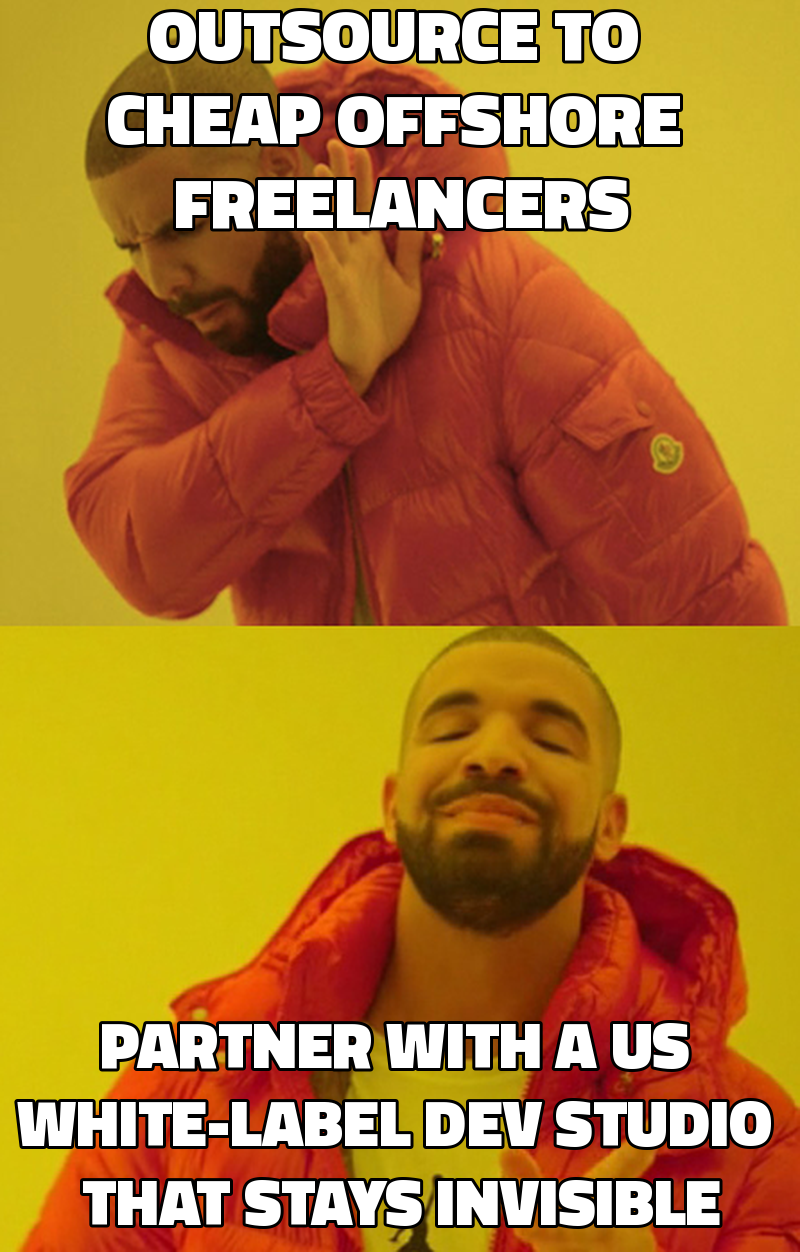
What is a white-label development agency in the USA?
A white-label dev agency provides end-to-end software delivery, frontend, backend, integrations, cloud hosting, while the hiring agency brands the work as its own. In the United States the model is common for marketing firms that lack engineers but need to deliver custom SaaS tools, chatbots, or voice assistants. The partner signs an NDA and a non-circumvent agreement, bills you at a wholesale rate, and you invoice your client at a markup. According to a 2023 Gartner report, 42% of mid-size agencies use white-label tech partners to expand service portfolios without increasing headcount.
Why small marketing agencies need a US white-label dev partner
| Pain point | Impact on agency | How a US white-label partner solves it |
|---|---|---|
| Lost revenue from unfulfilled build requests | Turns away $10-30k projects per quarter | Provides a ready-made dev capacity that can be billed at 50-70% margin |
| Brand risk when clients discover outsourcing | Client churn, reputation hit | Partner stays invisible, signed NDA/NCA protects brand |
| Inability to quote timelines confidently | Missed sales, under-pricing | Fixed-scope pilot gives concrete timeline and cost data |
| High cost of hiring a full-time engineer | Cash-flow strain, under-utilisation | Pay-as-you-go pilot and retainer model keeps overhead low |
A US-based partner also aligns with your billing currency (USD) and offers reasonable timezone overlap for real-time feedback. The Australian overlap is a bonus for agencies with AU clients, as demonstrated by RouteMate’s successful rollout.
How to spot a reliable white-label development agency
Below is a practical 12-point checklist that you can run in under five minutes before a discovery call.
1. Confirm US legal entity and address
- Look for a.com domain with a US-based contact page.
- Verify the company registration on the Secretary of State website (e.g., Delaware, California).
- Check that the listed phone number has a US area code.
2. Evaluate portfolio relevance
- Review case studies for AI automation, voice assistants, or custom back-ends.
- Ensure the projects are for SMB clients, not enterprise-only.
- Note the tech stack: Node.js, Python, React, AWS, Dialogflow, or similar.
3. Check for a single point of contact (SPOC)
- The website should list a Delivery Lead or Account Manager.
- A SPOC reduces hand-off risk and mirrors the "RouteMate" model.
4. Verify NDA/NCA readiness
- Ask for a template NDA before the pilot.
- Ensure a non-circumvent clause protects you from being bypassed.
5. Assess technical depth in AI/automation
- Ask for examples of GPT-4 integration, Zapier-style workflow automation, or custom voice bots.
- According to Forrester (2022), agencies that can embed generative AI see a 30% uplift in project value.
6. Look for transparent pricing and SLA
- Fixed-price pilot range should be $2,000-$5,000.
- SLA should define turnaround (e.g., 2-3 weeks for a scoped build) and bug-fix window.
7. Test responsiveness
- Send a brief inquiry and measure first-reply time.
- A response within 24-48 hours signals operational discipline.
8. Verify no-in-house dev claim
- If the site lists "Our developers" or a tech team, they may not have a gap to fill.
- This is a disqualifier per your ICP.
9. Check for active social proof
- LinkedIn updates, blog posts, or client testimonials within the last 90 days.
- A dormant site (no activity >12 months) is a red flag.
10. Confirm US-based pricing model
- Avoid partners that quote rates in INR or PHP; they break the wholesale margin.
11. Review contract flexibility
- Ability to start with a paid pilot and later transition to a retainer.
- Minimum floor of $1,500 per project aligns with your deal shape.
12. Ask for a demo dashboard
- A simple shared status view (e.g., Trello, ClickUp) is sufficient.
- Do not demand a custom SaaS dashboard before you have paying partners.
Red-flags vs Green-flags table
| Indicator | Red-flag (disqualify) | Green-flag (qualify) |
|---|---|---|
| Service list includes "development" | Gap already covered, no need for you | No dev services listed, clear gap |
| Listed partner "built by XYZ" | Already has a white-label partner | No partner logos, open to new relationships |
| Team size >20 with dev department | In-house capacity, low margin | 5-15 staff, no engineers |
| Pricing shown in low-cost offshore currency | Likely offshore subcontracting, margin squeeze | USD pricing, transparent wholesale rate |
| No recent case studies or social activity | Dormant, risk of missed deadlines | Active blog, recent client wins |
| Offshore base (India, Philippines) | No wholesale margin, time-zone clash | US/UK/AU base, reasonable overlap |
Conducting the qualification call: the three-gate framework
Gate 1 – Volume
Ask: "How many client projects do you run simultaneously, and how often does a project need custom development you can’t handle in-house?" Look for recurring dev requests (at least 2-3 per month). A steady flow justifies a retainer.
Gate 2 – Budget
Ask: "What budget range do your clients allocate for a custom build or automation?" If they regularly spend $5k-$20k, a $2k-$5k pilot is a non-issue. Agencies that quote <$1k for dev work are likely price-driven and may pressure you on margins.
Gate 3 – Live need now
Ask: "Do you have a project right now that needs AI, voice, or a custom backend you can’t deliver?" A concrete near-term need moves the conversation from theory to a paid pilot.
Scoring
- Pass all three → qualified, move to pilot proposal.
- Pass two → nurture, revisit in 30-60 days.
- Pass one or none → drop.
Designing the pilot: low-risk, high-trust
- Scope definition – Limit to one core feature (e.g., a chatbot integration or a data-sync API). Document deliverables, acceptance criteria, and timeline.
- Fixed price – Quote $2,500-$4,000 based on effort estimate (2-3 weeks).
- Milestone payment – 50% upfront, 50% on delivery; aligns incentives.
- SLA – 5-day bug-fix window post-delivery.
- Dashboard access – Share a ClickUp board with status columns (Backlog, In-Progress, Review, Done).
- Feedback loop – 30-minute demo call at the end of each sprint.
If the pilot meets quality, timeline, and communication expectations, propose a retainer of $1,500-$2,000 per month for 15-20 dev hours, matching your deal shape.
Legal safeguards: NDA, NCA, and IP ownership
- NDA protects any pre-pilot ideas you share.
- Non-circumvent agreement (NCA) prevents the partner from approaching your client directly.
- IP assignment – Ensure the contract states that all code and assets become your agency’s IP upon payment.
- Jurisdiction – Choose California or New York law for enforceability.
While enforcement across borders can be tricky, these documents act as strong deterrents and are standard practice per the International Association of Contract Administrators (IACA, 2021).
Pricing model sanity check
Your wholesale margin target is 50-70% of the agency’s bill. For a $4,000 project, your cost should be $1,200-$2,000. The minimum floor of $1,500 ensures you cover overhead (project management, QA, and the 5-hour buffer for unexpected scope). Retainer pricing at $1,500 per month for 15-20 hours translates to $75-$100 per hour, a competitive rate for senior US engineers while preserving margin.
Managing the partnership for long-term success
- Capacity caps – Limit active partners to 8-10 to maintain reliability.
- Quarterly health checks – Review SLA adherence, bug-fix turnaround, and client satisfaction scores.
- Co-branding guidelines – Provide a brand kit for the partner to use in deliverables (logo placement, tone of voice).
- Escalation path – Define a direct line to the Delivery Lead for any issue that threatens a client deadline.
- Continuous learning – Schedule a bi-annual tech showcase where the partner demonstrates new AI or voice capabilities.
By treating the white-label partner as an extension of your own team, you protect the agency’s reputation while unlocking higher-margin services.
Frequently asked questions
How do I know if a white-label dev agency is truly US-based?
Check the company’s registration on the state Secretary of State website, verify a US phone number, and look for a physical address in the United States. A quick WHOIS lookup can also confirm the domain’s registration location. If any of these are missing, ask for a proof of incorporation before proceeding.
What’s the difference between a white-label dev partner and a freelancer?
A white-label partner works under a formal contract, provides a single point of contact, and signs NDAs/NCAs to keep your brand invisible. Freelancers typically operate on a per-project basis, may juggle multiple clients, and lack the structured SLA and brand protection you need for agency-level reliability.
How many pilot projects should I run before committing to a retainer?
Most agencies find that one well-scoped pilot (2-3 weeks) is enough to evaluate communication, quality, and turnaround. If the pilot exceeds expectations, propose a retainer in the next call. Running a second pilot is only necessary if the first project had ambiguous scope or unexpected challenges.
What SLA metrics matter most for a white-label partnership?
Key metrics include: delivery within the agreed timeframe (±2 days), bug-fix turnaround (≤5 days), uptime of hosted solutions (≥99.5% monthly), and a Net Promoter Score (NPS) of ≥70 from your internal team. Track these in a shared dashboard for transparency.
Can I use the same white-label partner for both AI automation and voice apps?
Yes, provided the partner demonstrates expertise in both areas. Look for case studies that show integration of GPT-4 or other LLMs with voice platforms like Amazon Alexa or Google Assistant. A partner that can handle both reduces coordination overhead.
How do I protect my agency’s brand when the partner delivers the work?
Include branding guidelines in the contract, require the partner to remove any internal watermarks, and use a shared project dashboard that shows only status, not internal branding. The partner should deliver final assets (code, design files) ready for you to re-brand before client hand-off.
What if the partner misses a deadline?
Your SLA should specify penalties, such as a 5% discount on the invoice for each day beyond the agreed delivery window. Escalation paths and a dedicated Delivery Lead help resolve issues quickly before they affect your client.
Is it worth paying a higher rate for a US partner versus offshore?
While offshore rates can be lower, US partners provide timezone overlap, cultural alignment, and higher reliability, critical for agency reputation. According to a 2022 Clutch survey, 68% of agencies that switched to US-based white-label partners reported a reduction in missed deadlines and client churn.
By following this checklist, running a disciplined pilot, and enforcing clear legal and performance standards, you can confidently add a US white-label development agency to your service stack. The result is more won projects, protected brand equity, and a scalable revenue stream without the overhead of hiring full-time engineers.
white‑label
Have something to build?
Tell us what you're trying to ship. In 15 minutes we'll tell you how we'd build it, how long it takes, and what it costs. No pitch deck, no pressure.