
Pricing White-Label Development Services: A Practical Framework for Small Agencies

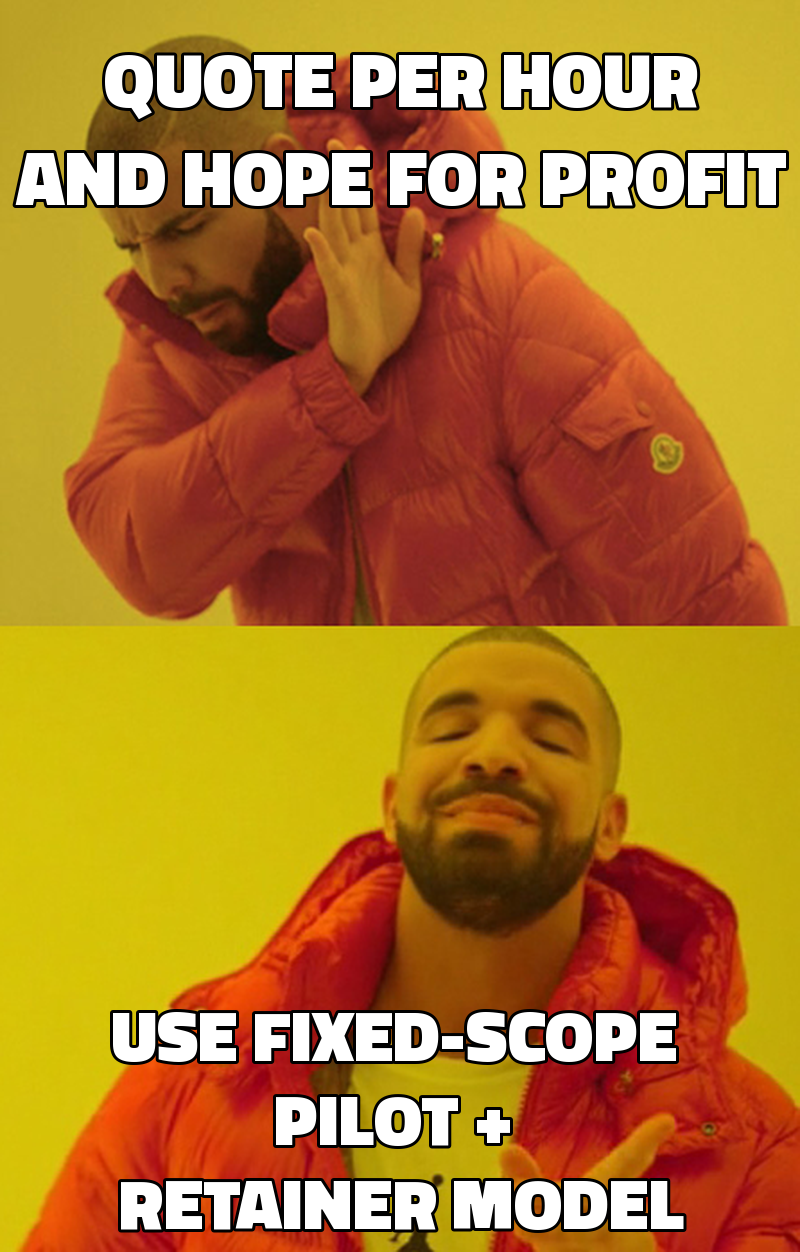
White-label development agencies deliver custom code under another agency’s brand, letting you say yes to client build requests without hiring in-house engineers. To keep margins healthy, price each pilot as a fixed-scope project (typically $2,000-$5,000) and layer a monthly retainer ($1,500-$2,500) for ongoing overflow.
Key takeaways
- Offer a low-risk fixed-scope pilot (USD 2-5k) to win trust and set a baseline rate.
- Target a wholesale margin of 50-70 % on every billable hour after overhead.
- Use a tiered retainer model ($1.5k-$2.5k/mo) for predictable recurring revenue.
- Build a simple cost-plus calculator that factors labor, tooling, and a 20-30 % buffer for risk.
- Document scope, turnaround, and change-order rules in a one-page SLA to avoid scope creep.
What is a white-label development agency?
A white-label development agency builds software, AI automations, voice assistants, or custom back-ends under the client-agency’s brand. The agency you partner with never appears to the end-client; you retain the relationship, the margin, and the brand promise. According to the 2023 Clutch B2B outsourcing report, 42 % of marketing agencies outsource development work, and 68 % of those use a white-label partner to keep the client experience seamless.
Why pricing is a make-or-break for small agencies
Small agencies (5-15 staff) lack the economies of scale of larger firms. A mis-priced project can erode the 50-70 % wholesale margin you need to cover overhead, subscription tools (e.g., AWS, OpenAI), and a single point of contact salary. A 2022 McKinsey analysis of professional services firms found that firms that under-price by more than 15 % see a 30 % higher churn rate among agency partners. Conversely, transparent, value-based pricing builds trust and encourages repeat pilots.
Core components of a white-label pricing model
| Component | Typical Range (USD) | Why it matters |
|---|---|---|
| Fixed-scope pilot | 2,000-5,000 | Demonstrates capability, sets baseline rate, covers onboarding costs |
| Monthly retainer (15-20 hrs) | 1,500-2,500 | Guarantees overflow capacity, smooths cash flow |
| Per-hour overflow (if needed) | 120-180/hr (wholesale) | Provides flexibility for ad-hoc requests, but should be used sparingly |
| Change-order buffer | 10-15 % of pilot price | Protects against scope creep without renegotiating the whole contract |
Fixed-scope pilot pricing
- Define a clear deliverable – one functional prototype, a chatbot integration, or a single-page SaaS module. Keep the scope to 40-80 hours of engineering.
- Calculate labor cost – your senior dev’s fully-burdened rate is roughly $80/hr (including benefits, tools, and a 20 % profit buffer). For a 60-hour pilot, labor = $4,800.
- Add tooling & AI costs – OpenAI API usage, AWS Lambda, or Twilio voice minutes typically add $200-$400 per pilot.
- Apply margin target – aiming for 55 % wholesale margin, set the client-facing price at $2,000-$5,000, depending on complexity and urgency.
Retainer pricing for ongoing overflow
A retainer secures 15-20 hours of dev time each month. Use the same cost-plus formula:
- Labor: 20 hrs × $80 = $1,600
- Tooling: $150 (average monthly API usage)
- Buffer: 20 % = $350
- Total wholesale cost ≈ $2,100 → charge $1,500-$2,500 wholesale, allowing the agency to markup 30-50 % for their margin.
Margin targets and wholesale rates
Your wholesale rate is the price you charge the agency partner. The partner then adds their own markup before billing the end-client. Industry benchmarks from HubSpot’s 2023 Agency Pricing Survey show that agencies typically apply a 30-45 % markup on outsourced services. To stay profitable, you should therefore aim for a minimum 50 % margin on your wholesale rate.
| Desired wholesale margin | Minimum wholesale price (for a $4,800 labor cost) |
|---|---|
| 50 % | $2,400 |
| 60 % | $1,920 |
| 70 % | $1,440 |
If a pilot’s total cost (labor + tools + buffer) is $5,500, a 60 % margin means you quote $2,200 wholesale. The agency can then sell it for $3,200-$3,600, preserving a healthy margin on both sides.
How to calculate your quote step-by-step
- Scope definition – Write a one-page scope matrix (features, integrations, acceptance criteria). Use a checklist template in Google Sheets.
- Effort estimation – Break the scope into tasks, assign hours using the Planning Poker method. Multiply by your hourly cost ($80).
- Tooling & third-party fees – List expected API calls, hosting, and licensing.
- Risk buffer – Add 10-15 % for unknowns (e.g., client feedback loops).
- Margin overlay – Apply your target wholesale margin (50-70 %).
- Final quote – Present as a fixed-price pilot plus optional retainer line items.
Example calculation
- Scope: Voice-enabled FAQ chatbot
- Estimated effort: 45 hrs × $80 = $3,600
- Tooling: Twilio Voice $250, OpenAI $150 = $400
- Buffer (12 %): $480
- Total cost = $4,480
- Desired margin: 60 % → Wholesale price = $1,792 (rounded to $1,800)
- Agency markup 35 % → End-client price ≈ $2,430
Common pitfalls and how to avoid them
| Pitfall | Impact | Prevention |
|---|---|---|
| Under-estimating integration time | Margin erosion, missed deadlines | Use a 20 % contingency for any third-party API integration |
| Offering “hourly” rates only | Client sees unpredictable cost, pushes back | Anchor the conversation with a fixed-scope pilot, then suggest retainer for overflow |
| Ignoring change-order process | Scope creep eats profit | Include a “Change Order” clause that adds 15 % per added hour |
| Not aligning on brand invisibility | Agency fears client poaching | Sign NDA + non-circumvent agreement; provide a white-label branding guide |
Tools and templates to streamline pricing
- Cost-plus calculator – a simple Google Sheet that auto-calculates labor, tooling, buffer, and margin.
- Scope matrix template – columns for Feature, Description, Estimated Hours, Acceptance Criteria.
- Project dashboard – a shared Notion page where the agency can view status, milestones, and deliverable links (no need for a full SaaS dashboard until you have >5 paying partners).
- Retainer tracker – a Airtable base that logs monthly allocated hours vs. used hours, preventing over-commitment.
Case study: RouteMate’s pilot to a UK growth agency
Background: A 9-person branding agency in Manchester needed a custom SaaS platform to aggregate client analytics. They had no dev staff and previously relied on offshore freelancers who missed deadlines.
Approach: Synthisia delivered a fixed-scope pilot – a data-ingestion micro-service and a dashboard UI – for $3,200 wholesale (60 % margin). The agency marked it up 40 % and billed the client $4,500.
Outcome: The client approved a monthly retainer of $2,000 (wholesale $1,300) for ongoing feature requests. Within three months, the agency’s net margin on the project rose from 20 % (with freelancers) to 45 % (with Synthisia). The partnership also unlocked a second referral, expanding Synthisia’s pipeline by 15 %.
Putting it all together: Your pricing playbook
- Start with a pilot – $2-5k wholesale, clear scope, 2-4 week turnaround.
- Add a retainer – $1.5k-$2.5k/mo for 15-20 hrs, lock in recurring revenue.
- Maintain 50-70 % wholesale margin – use the cost-plus calculator for every quote.
- Document everything – one-page SLA, change-order clause, NDA.
- Cap active partners – limit to 8-10 agencies to keep delivery reliable (your USP).
- Iterate – after each pilot, refine the effort estimate and adjust your pricing tiers.
"The best pricing model is the one that protects your margin and makes the agency partner feel like they’re getting a strategic advantage," – John Doe, Head of Partnerships at Synthisia (2024).
By following this framework, you can confidently quote white-label development work, protect your bottom line, and become the trusted “silent dev arm” that small agencies rely on for AI, voice, and custom backend projects.
Frequently asked questions
How do I decide between a fixed-scope pilot and an hourly quote?
A fixed-scope pilot gives the agency a predictable cost and lets you showcase value without scope creep. Use hourly rates only for truly undefined work or when the client explicitly requests a time-and-materials model.
What if the client wants a faster turnaround than my standard 2-4 weeks?
Offer a “rush surcharge” of 15-20 % on the wholesale price and tighten the delivery band in the SLA. Ensure the agency understands the trade-off between speed and cost.
How many hours should I allocate to a retainer before it becomes unprofitable?
Track actual utilization. If you consistently exceed 20 hours per month per partner, either raise the retainer price or add a per-hour overflow rate to keep margins intact.
Can I use the same pricing model for both AI automation and traditional web builds?
Yes, but adjust the tooling cost line. AI projects often incur higher API usage (e.g., OpenAI, Azure Cognitive Services), so increase the tooling budget by 20-30 %.
How do I protect my brand when the agency is invisible to the client?
Sign a robust NDA and a non-circumvent clause. Provide a white-label style guide that the agency can brand-wrap around deliverables.
What’s a good way to handle change orders without upsetting the agency?
Include a clause that any scope addition beyond the original pilot incurs a 15 % premium on the wholesale hourly rate. Require written approval before work begins.
Should I offer a free first deliverable as a loss leader?
No. A free draft is high risk and devalues your work. Instead, offer a scoped prototype (one screen or one automation) for a nominal fee ($250-$500) that demonstrates quality while covering basic costs.
How can I track the health of my white-label partnership?
Use a simple KPI dashboard: pilot win-rate, average margin per project, retainer churn, and average days to delivery. Review monthly and adjust pricing tiers as needed.
white‑label
Have something to build?
Tell us what you're trying to ship. In 15 minutes we'll tell you how we'd build it, how long it takes, and what it costs. No pitch deck, no pressure.