
How to Pitch White-Label Development Services to Agency Clients

White-label development is when you sell development work under your agency’s brand while a partner builds it for you. It lets you say yes to client requests for custom AI automation, voice bots or SaaS tools without hiring a full-time engineer. The key is to present it as a seamless extension of your own team, not as a third-party hand-off.
Key takeaways
- Position white-label dev as a brand-protected capability that fills the AI and custom-backend gap.
- Use a low-risk paid pilot (fixed scope, $2k-$5k) to earn trust before proposing a retainer.
- Highlight your single point of contact, NDA and non-circumvent terms as safety nets.
- Quote a wholesale margin of 50-70% and keep concurrency low to guarantee reliability.
- Leverage the "Silent Dev Arm" story (RouteMate SaaS) as proof of delivery.
- Follow a three-gate qualification: volume, budget and live need.
What is white-label development and why agencies need it
Agencies of 5-15 people often sell strategy, branding, SEO and paid media, but they lack the technical depth to deliver AI-driven automation, voice assistants or custom back-ends. A 2023 McKinsey survey found that 48% of mid-size agencies outsource more than half of their development work because hiring in-house engineers raises fixed costs by 30-40%.
When you partner with a specialist like Synthisia you keep the client relationship, keep the margin and avoid the hiring risk. The partner works under your brand, signs NDAs and non-circumvent agreements, and provides a single accountable delivery manager. The result is a reliable overflow pipe that turns lost opportunities into recurring revenue.
Positioning the service to your clients
| Positioning angle | What the client hears | Why it matters to the agency |
|---|---|---|
| "Full-service tech partner" | "We can design, build and maintain your custom AI workflow without adding a new vendor" | Eliminates the perception of a hand-off, protects the agency’s brand. |
| "Speed + expertise" | "Our team delivers a production-ready prototype in 10 business days" | Meets the client’s time-to-value demand, justifies premium pricing. |
| "Risk-free pilot" | "Start with a $3,000 scoped build, no long-term commitment" | Reduces the client’s financial risk, gives the agency a low-cost entry point. |
Use the agency’s own language from their website. If they market themselves as a "growth partner", frame the dev service as "growth-engine tech". If they focus on "brand experience", talk about "interactive brand-centric tools".
Sales script you can use step by step
1. Warm-up (30 seconds) – “I noticed you recently launched a new e-commerce site for XYZ. Are you seeing any requests for custom checkout automation or voice-enabled search?”
2. Diagnose the gap (1 minute) – Ask the three qualification gates:
- Volume: “How many of your clients need a custom tool each quarter?”
- Budget: “What budget range do they allocate for a bespoke automation project?”
- Live need: “Do you have a project right now that you can’t deliver in-house?”
3. Reveal the solution (45 seconds) – “We act as your silent dev arm. You keep the brand on the deliverable, we handle the code, and you retain 60% of the bill. Our last partner launched a voice-assistant for a retail client and kept 70% margin.
4. Pitch the pilot (30 seconds) – “Let’s start with a fixed-scope pilot: a chatbot that captures leads and pushes them to your CRM for $3,200, delivered in 12 days. If it meets your KPI, we can move to a monthly retainer for ongoing tweaks.”
5. Close the next step (15 seconds) – “Can I send over a scoped proposal and NDA by end of day? We’ll schedule a 15-minute walkthrough tomorrow.”
Stick to the script, pause for the prospect’s answers, and mirror their terminology. Confidence comes from the concrete pilot numbers.
Pricing and contract levers
| Component | Typical range | Rationale |
|---|---|---|
| Fixed-scope pilot | $2,000-$5,000 | Covers discovery, design and a working MVP. Keeps risk low for both sides. |
| Wholesale margin | 50-70% of agency bill | Allows agency to quote $4,000-$8,000 while you receive $2,000-$5,600. |
| Minimum floor | $1,500 per project | Below this the delivery overhead erodes profitability. |
| Monthly retainer | $1,500-$2,500 for 15-20 hrs | Provides predictable capacity for escalation work. |
| SLA turnaround | 10-14 business days for pilot, 5-7 days for minor tweaks | Sets clear expectations, avoids “fastest possible” ambiguity. |
Contract checklist
- NDA covering source code and client data.
- Non-circumvent clause preventing the agency from hiring your dev team directly.
- Scope definition matrix (features, revisions, acceptance criteria).
- Milestone payment schedule (30% start, 40% demo, 30% delivery).
- Exit clause after 3 months of no pilot conversion.
Objection handling cheat sheet
| Objection | Response pattern |
|---|---|
| “We don’t want a third party visible to the client.” | Emphasize the NDA, brand-only deliverables, and the success story of RouteMate where the client never saw the dev partner. |
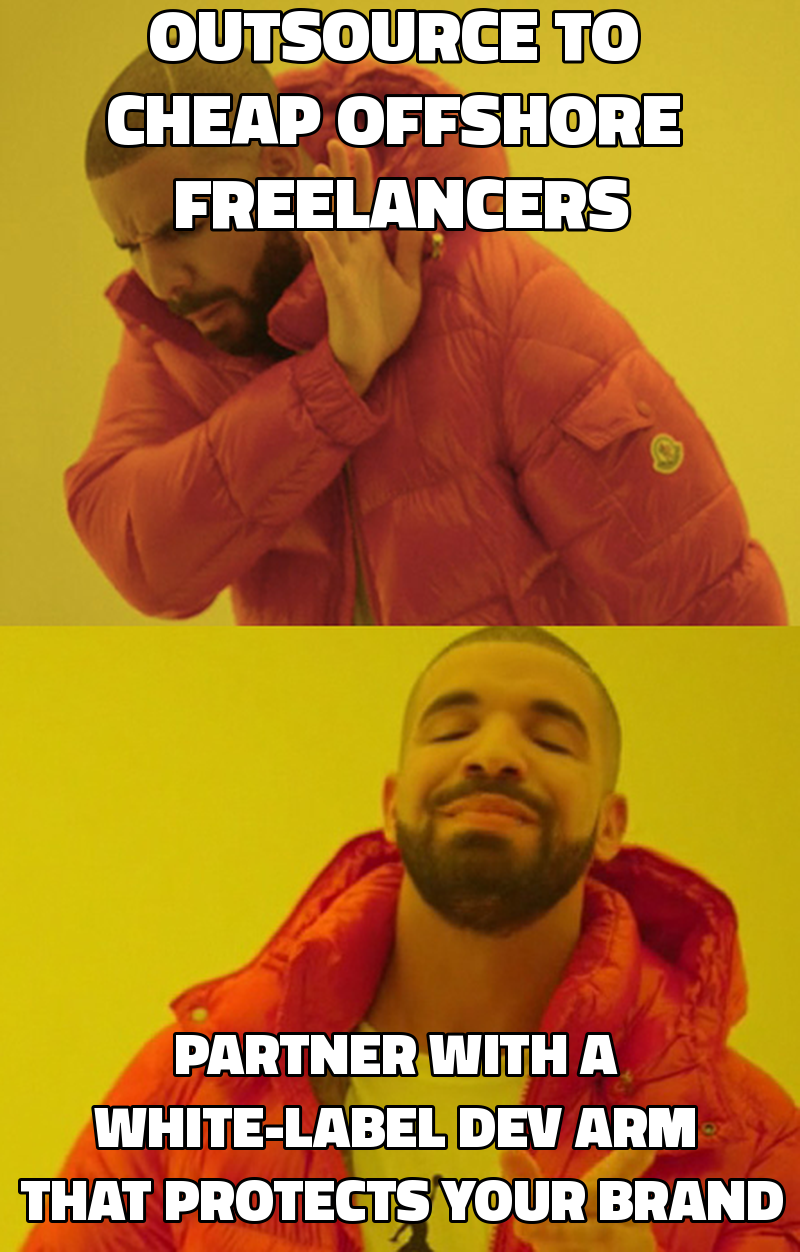
| “Your price seems high compared to offshore freelancers.” | Point out the reliability premium, 0-bug SLA, and the hidden cost of missed deadlines (average $12k per incident per Gartner). |
| “We already have a dev partner.” | Ask what they can’t do – AI, voice, custom back-end – and position yourself as the specialist complement. |
| “We fear losing control of the code.” | Offer a shared GitHub repo with read-only access for the agency, and a hand-off document at project close. |
Implementation checklist for the agency
- Identify the gap – Run the 10-second site test on every prospect.
- Qualify – Apply the three-gate questionnaire before a discovery call.
- Send pilot brief – Include scope, timeline, price, and NDA.
- Kick-off meeting – Introduce the single point of contact (your Synthisia Delivery Lead).
- Project dashboard – Use a shared Notion or ClickUp view; do not build a custom SaaS dashboard until you have 3 paying pilots.
- Delivery – Follow the defined SLA, provide daily status updates, and request client feedback at the demo.
- Close & upsell – Review KPI results, propose a retainer, and lock in the wholesale margin.
Real-world case study: RouteMate
RouteMate is a SaaS platform that automates route planning for logistics firms. The agency pitched the idea, but lacked the backend expertise. Synthisia built the full stack in 8 weeks, delivered under the agency’s brand, and the agency kept a 65% margin on a $12k contract. The client never knew a third party was involved, and the agency secured a 12-month support retainer worth $1,800 per month.
Frequently asked questions
How do I protect my brand when using a white-label partner?
Your contract includes an NDA and a non-circumvent clause. All deliverables are white-labeled, and the partner uses your logo on the final UI. You retain full ownership of the source code, and the client only sees your agency name.
What if the pilot project exceeds the agreed scope?
The pilot scope is locked in a written statement of work. Any additional features trigger a change order with a pre-agreed hourly rate. This prevents scope creep and keeps the pilot profitable.
Can I offer a free first deliverable as a teaser?
A free draft is high risk because it gives away engineering time. Instead, offer a free scoped proposal or a 2-hour prototype that demonstrates the concept. The prospect pays for the pilot if they move forward.
How fast can a pilot be delivered?
Our standard SLA is 10-14 business days for a $2k-$5k pilot. This balances speed with quality and aligns with most agency sales cycles.
What if the agency already has a dev partner?
Ask what capabilities are missing – AI, voice, complex integrations. Position yourself as the specialist that fills those gaps, not as a replacement.
How do I calculate the wholesale margin?
Take the agency’s quoted price to the client, subtract your agreed wholesale rate, and ensure the remainder falls between 50-70%. For example, a $6,000 client bill minus a $3,500 wholesale cost yields a 42% margin; you would negotiate a higher wholesale rate or increase the client price.
Is there a minimum project size I should accept?
Yes. Projects under $1,500 rarely cover the overhead of project management and QA. Use the $1,500 floor rule to keep the partnership sustainable.
How do I scale the partnership without losing reliability?
Cap the number of active agency partners to 8-10 at any time. This keeps concurrency low, ensures each partner gets dedicated capacity, and maintains the reliability promise that differentiates you from offshore freelancers.
Prepared by Synthisia, the silent dev arm for growth-focused agencies.
white-label
Have something to build?
Tell us what you're trying to ship. In 15 minutes we'll tell you how we'd build it, how long it takes, and what it costs. No pitch deck, no pressure.