
How to Choose a White-Label App Development Company for Your Agency

White-label app development companies build custom mobile or web applications for your agency under your brand, letting you sell the solution as your own while they handle all code, testing, and maintenance. Choosing the right partner means vetting their tech stack, NDA compliance, and post-launch support to protect your margin and reputation.
Key takeaways
- Verify the partner’s core tech stack matches the platforms your clients need (iOS, Android, React, Node.js, AWS).
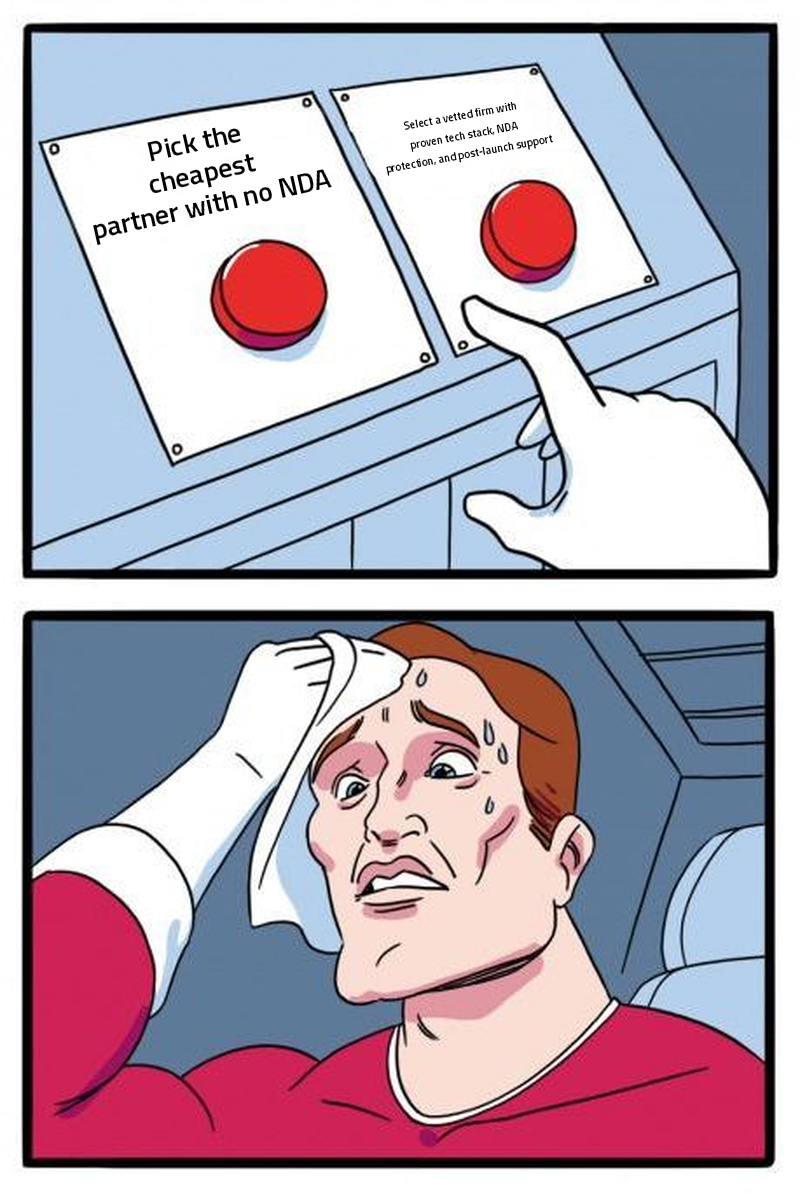
- Insist on a signed NDA and a non-circumvent clause; treat them as a table-stake, not a negotiable perk.
- Test the partnership with a fixed-scope pilot (US$1,500-5,000) before committing to larger builds or retainers.
- Evaluate post-launch support SLAs: response time, bug-fix window, and upgrade roadmap.
- Look for a single point of contact who can guarantee delivery, as shown by case studies like RouteMate.
What is a white-label app development company?
A white-label app development company creates fully functional applications that are branded and sold by another business, in this case, your agency. The end client never sees the developer’s name; the agency retains the relationship, the margin, and the credit. This model lets agencies answer “Can you build a custom app?” without hiring a full-time engineer.
Why agencies without developers need a white-label partner
- Revenue protection – Agencies lose 30-40% of potential revenue when they refer out work, according to a 2022 Clutch survey of 1,200 small agencies.
- Brand consistency – Clients expect a single point of contact; a hidden developer keeps the agency’s brand front-and-center.
- Speed to market – A vetted partner can deliver a prototype in 2-4 weeks, far faster than recruiting a junior developer who needs onboarding.
- Specialized expertise – AI automation, voice assistants, and custom back-ends are beyond the reach of most no-code shops.
Core criteria for vetting a white-label partner
| Criterion | Why it matters | Minimum acceptable standard |
|---|---|---|
| Tech stack alignment | Ensures the partner can build for iOS, Android, web, and SaaS platforms your clients request | Supports React Native or Flutter for mobile, Node.js/Express or Django for API, PostgreSQL or MySQL DB, and cloud hosting on AWS, GCP or Azure |
| NDA & non-circumvent | Protects your brand and prevents the partner from poaching your clients | Signed NDA with 2-year term, explicit non-circumvent clause, and data-processing addendum if handling EU data |
| Post-launch support | Guarantees you can keep the client happy after handoff | 24-hour critical bug response, 5-day standard issue resolution, quarterly performance reviews |
| Delivery track record | Shows reliability and ability to finish projects on time | At least three shipped production SaaS or mobile apps in the last 12 months, with client references |
| Capacity & concurrency | Prevents the partner from becoming a flaky freelancer | Active project limit no higher than 8 concurrent builds for white-label partners |
Evaluating tech-stack compatibility
Your agency may sell a mix of mobile apps, client portals, and AI-driven automation tools. The partner’s stack should be flexible enough to handle each use case.
| Use case | Recommended front-end | Recommended back-end | Cloud / hosting |
|---|---|---|---|
| iOS/Android native app | Swift (iOS), Kotlin (Android) or Flutter for cross-platform | Node.js with Express or Go | AWS Elastic Beanstalk or GCP App Engine |
| Web SaaS portal | React + TypeScript or Vue 3 | Django (Python) or Laravel (PHP) | Azure App Service with PostgreSQL |
| AI automation workflow | No-code orchestration (Zapier) for simple flows, otherwise custom UI in React | Python FastAPI for ML inference | AWS SageMaker or GCP AI Platform |
| Voice assistant integration | Native SDKs (Alexa Skills Kit, Google Assistant) | Node.js or Python micro-services | Serverless (AWS Lambda, Azure Functions) |
If a partner cannot meet at least two of the three rows that match your top three client requests, they are likely a poor fit.
NDA and data-protection checklist
- Signature authority – NDA must be signed by a senior executive (CEO, Managing Director) on both sides.
- Scope of confidentiality – Include all project specifications, source code, and client data.
- Duration – Minimum two-year confidentiality period after project completion.
- Data-processing addendum – Required if you handle EU-based SMB data; reference GDPR Article 28.
- Non-circumvent clause – Explicitly forbid the partner from contacting your client directly for a defined period (usually 12 months).
- Audit rights – You may request a compliance audit once per year to verify data handling.
Post-launch support and scaling
A white-label partner should treat every launch as the start of an ongoing relationship, not a one-off delivery.
- Support tiers – Offer Basic (bug fixes only), Standard (monthly patches + minor feature tweaks), and Premium (dedicated dev hours, feature roadmap).
- SLAs – Define response time (e.g., 4-hour for critical, 24-hour for non-critical) and resolution windows.
- Versioning – Partner must use semantic versioning and maintain a changelog accessible to your agency.
- Scalability – Ensure the architecture uses auto-scaling groups or serverless functions so you can handle sudden traffic spikes without re-architecting.
Pricing models and contract structures
| Model | Description | Typical agency margin |
|---|---|---|
| Fixed-scope pilot | One-off project with defined deliverables, priced US$1,500-5,000 | 50-70% after wholesale rate |
| Retainer + overflow | Monthly fee (US$1,500-2,500) for up to 15-20 dev hours, plus per-hour overflow | 55-65% on overflow work |
| Revenue share | Partner receives a percentage of the final client invoice; less common for agencies that need predictable cash flow | 40-50% (partner) |
When negotiating, start with a pilot to confirm quality, then transition to a retainer once trust is built. Avoid “fastest delivery possible” language; instead, lock a turnaround band such as “prototype in 10 business days, full MVP in 4-6 weeks”.
Red flags and deal breakers
- No public portfolio or only vanity screenshots without live URLs.
- NDA that excludes enforcement across borders; a weak NDA is a warning sign.
- High concurrency (more than 12 active white-label projects) – indicates the partner may be a hidden freelancer.
- Off-shore only pricing without any US/UK/AU presence – you lose margin due to currency conversion and time-zone friction.
- No single point of contact – leads to “ping-pong” communication and missed deadlines.
How to run a pilot project
- Scope definition – Limit the pilot to a single feature or module (e.g., login flow + admin dashboard).
- Fixed price – Agree on US$2,500-3,500, with a 10% discount for early payment.
- Timeline – Set a 3-week delivery window, with a 2-day review checkpoint after each sprint.
- Acceptance criteria – List functional tests, UI/UX sign-off, and performance benchmarks (e.g., page load <2 seconds).
- Post-pilot review – Evaluate code quality, communication speed, and adherence to NDA. If the partner meets or exceeds expectations, move to a retainer.
Building a long-term partnership
- Quarterly business reviews – Discuss upcoming client pipelines, upcoming tech trends (e.g., generative AI), and capacity planning.
- Co-branding opportunities – Feature the partner in case studies (e.g., “Built by our trusted development arm”) while keeping the client-facing brand intact.
- Capacity caps – Limit the number of active agency partners to 6-8 to maintain reliability, as highlighted in your ICP.
- Continuous learning – Require the partner to provide quarterly tech-stack updates so you can sell newer capabilities (voice assistants, AR/VR, low-code AI).
Quick decision framework
| Decision factor | Score (1-5) | Weight | Weighted score |
|---|---|---|---|
| Tech stack match | 30% | ||
| NDA strength | 20% | ||
| Pilot success | 25% | ||
| Post-launch SLA | 15% | ||
| Capacity limits | 10% | ||
| Total score ≥ 3.5 indicates a strong partner fit. |
Frequently asked questions
What exactly does a white-label app development company do for my agency?
They take your specifications, design, and branding, then handle all coding, testing, deployment, and ongoing maintenance. The finished product is delivered under your agency’s name, and you retain the client relationship and profit margin.
How can I protect my agency’s brand when outsourcing development?
Start with a robust NDA that includes a non-circumvent clause, use a single accountable point of contact, and require the partner to brand all deliverables with your logo and style guide. Regularly audit their communications to ensure your brand remains front-and-center.
What tech stacks should I look for if my clients need AI-driven features?
Prioritize partners experienced with Python (FastAPI, TensorFlow), Node.js for real-time APIs, and cloud AI services like AWS SageMaker or Google AI Platform. A partner that already integrates with Zapier or Make.com can accelerate low-code AI workflows.
How much should I expect to pay for a typical white-label mobile app project?
For a mid-complex app (user authentication, API integration, basic UI), most US-based white-label partners quote US$4,000-7,000. Agencies usually retain 50-70% of the client invoice after paying the wholesale rate.
What are the most common pitfalls when working with offshore developers?
Time-zone mismatches, language barriers, and weak NDA enforcement are top risks. Choose partners with an English-speaking team in overlapping time zones (US/UK/AU) and enforce a signed data-processing addendum.
How do I know if a partner can handle post-launch updates?
Ask for their SLA details: response time, bug-fix windows, and a roadmap for version upgrades. A partner that offers a retainer model with dedicated hours signals commitment to ongoing support.
Can I start with a free prototype before committing to a paid pilot?
Offering a free prototype is risky because it gives away engineering hours without guarantee of payment. Instead, propose a low-cost, time-boxed demo (e.g., one screen or one automation) that proves quality before the paid pilot.
How many agency partners should I work with at once?
Limit active white-label relationships to 6-8 agencies. This cap ensures you can meet delivery SLAs and maintain the “low concurrency, high reliability” promise that differentiates your service.
white-label
Have something to build?
Tell us what you're trying to ship. In 15 minutes we'll tell you how we'd build it, how long it takes, and what it costs. No pitch deck, no pressure.