
How Much Does Fleet Management Software Cost for 10-100 Trucks?

Fleet management software for a 10-100-truck carrier can range from a few hundred dollars per month per vehicle on a SaaS platform to a one-time build cost of $2,500-$3,500 plus optional low-cost maintenance. The exact figure depends on the pricing model, feature set, and whether you choose a subscription service or a custom-owned solution.
Key takeaways
- SaaS pricing is typically $15-$30 per truck per month for basic dispatch, rising to $45-$70 for full-stack solutions.
- A custom build like RouteMate’s Fleet Ops Build starts at $2,500-$3,500 for 10-100 trucks, with optional $1,500 monthly maintenance.
- Total cost of ownership (TCO) over three years is often lower for a custom build when you have 30+ trucks.
- Consider compliance, integration with WhatsApp Business API, and scalability when comparing models.
- ROI can be measured in saved admin hours, reduced missed pickups, and avoided compliance penalties.
- Choose the model that aligns with your growth plan and cash-flow preferences.
What is fleet management software?
Fleet management software (FMS) is a digital platform that helps asset-based carriers plan routes, communicate with drivers, track vehicle health, and stay compliant with regulations such as FMCSA in the US, MOT in the UK, and Heavy Vehicle National Law in Australia. According to a 2023 Gartner report, 68% of midsize carriers have adopted at least one cloud-based FMS module, and the market is projected to grow at a 9% CAGR through 2028.
Common pricing models
| Pricing model | Typical structure | Example providers | Typical price range (USD) |
|---|---|---|---|
| Per-truck SaaS | Monthly subscription per vehicle, tiered by feature set | Samsara, Verizon Connect, Fleetio | $15-$30 for basic dispatch, $45-$70 for full suite |
| Seat-based SaaS | Fixed number of user seats, unlimited vehicles | KeepTruckin, Teletrac Navman | $100-$250 per seat per month |
| One-time custom build | Fixed project fee, optional monthly support | RouteMate (Fleet Ops Build), custom dev shops | $2,500-$5,000 project fee, $1,500 optional maintenance |
| Hybrid | Up-front development + per-truck add-ons for premium features | Some boutique firms | $1,500-$2,500 upfront + $5-$10 per truck/month |
Per-truck SaaS: How the numbers add up
- Base subscription – Most vendors charge a flat per-truck rate for core dispatch and GPS tracking. For a 25-truck carrier, the base cost at $20/truck/month is $500/month or $6,000/year.
- Add-on modules – Advanced routing, driver-comms, and compliance dashboards can add $10-$25 per truck. Assuming two add-ons at $15 each, the total rises to $875/month ($10,500/year).
- Implementation fees – Many SaaS vendors charge a one-time onboarding fee of $500-$2,000. FleetOwner magazine notes the average onboarding cost in 2022 was $1,200.
- Total three-year cost – For the 25-truck example, three years of subscription plus onboarding equals roughly $33,600.
One-time custom build: How the numbers break down
| Cost component | Description | Typical range (USD) |
|---|---|---|
| Development fee | Full-stack React/Express/Postgres build, scoped to dispatch, driver-comms, compliance | $2,500-$3,500 for 10-100 trucks |
| Hosting & infrastructure | Cloud server (AWS, Azure) and database for up to 100 trucks | $100-$300/month (often covered by maintenance retainer) |
| Optional maintenance retainer | Ongoing bug fixes, API updates (WhatsApp Business API), minor feature tweaks | $1,500/month |
| Integration costs | Connecting to telematics providers, ELD devices, or existing GPS hardware | $500-$1,000 one-time |
| Compliance customization | Tailoring alerts for AU Heavy Vehicle National Law, UK MOT, US FMCSA HOS | $800-$1,200 one-time |
| Total upfront cost (no retainer) | Sum of development, integration, compliance work | $4,300-$6,200 |
| Three-year TCO (including 12 months of maintenance) | $4,300-$6,200 + ($1,500 × 12) = $22,300-$24,200 |
When does a custom build become cheaper than SaaS?
A simple break-even analysis shows the tipping point at around 30 trucks for the price ranges above. Below is a quick calculator based on the numbers used earlier.
| Fleet size | SaaS 3-yr cost (incl. onboarding) | Custom build 3-yr cost (incl. 12-mo maintenance) |
|---|---|---|
| 10 trucks | $12,000 | $22,300 |
| 25 trucks | $33,600 | $22,300-$24,200 |
| 40 trucks | $54,000 | $22,300-$24,200 |
| 75 trucks | $101,250 | $22,300-$24,200 |
| 100 trucks | $135,000 | $22,300-$24,200 |
Assumptions: SaaS at $20 base + $15 add-ons per truck, $1,200 onboarding, custom build at $3,000 upfront, $1,500 monthly maintenance for 12 months.
Interpretation – For fleets larger than 30 trucks, the custom build’s three-year total is roughly half the SaaS total. Even for a 20-truck carrier, the difference narrows quickly if you factor in the hidden costs of per-truck subscription growth as you add vehicles.
Decision criteria for SMB carriers
| Criterion | SaaS advantage | Custom build advantage |
|---|---|---|
| Cash flow | Low upfront cost, predictable monthly expense | Higher upfront cost but lower long-term spend |
| Speed of deployment | Ready-to-use in days, vendor handles hosting | Development cycle 4-8 weeks, plus testing |
| Feature flexibility | Limited to vendor roadmap, may need extra modules | Tailored to exact dispatch, WhatsApp integration, compliance rules |
| Data ownership | Vendor retains raw data, export may be limited | Carrier owns database, can migrate anytime |
| Scaling cost | Per-truck price scales linearly | Fixed cost, only marginal hosting increase |
| Vendor lock-in | High – switching costs rise with data migration | Low – codebase is yours, can be self-hosted |
How to budget for each model
1. Estimate admin hour savings
The Australian Freight & Logistics Council estimates that manual dispatch consumes 1.5 hours per truck per week. At an average dispatch manager salary of $30 hour (AU), that equals $45 per truck per week, or $2,340 per year for a 10-truck fleet.
2. Quantify compliance risk
FMCSA reports that a single HOS violation can cost $5,000-$10,000 in fines plus insurance premium hikes. A compliance reminder system that prevents two violations per year saves $10,000-$20,000.
3. Add missed-pickup cost
FleetOwner surveyed 2022 carriers and found an average lost revenue of $1,200 per missed pickup. Reducing missed pickups by 3 per month saves $43,200 annually.
4. Combine savings
For a 30-truck carrier, total annual savings from automation can exceed $70,000. Subtract the SaaS subscription ($30 × 30 × 12 = $10,800) and you still net $59,200. For a custom build, subtract the three-year TCO ($22,300/3 ≈ $7,433 per year) and you net $62,567 – a modest but real advantage.
Implementation timeline for a custom build
| Phase | Duration | Key activities |
|---|---|---|
| Discovery & scoping | 1-2 weeks | Interview owner, ops manager, map spreadsheet workflow, define compliance rules |
| Design & prototyping | 2-3 weeks | UI mockups, driver-comms flow, WhatsApp Business API approval |
| Development | 4-6 weeks | Build React dashboard, Express API, Postgres schema, integrate telematics |
| Testing & user acceptance | 1-2 weeks | Load test with 10-truck pilot, adjust alerts, train dispatch staff |
| Go-live & support | 1 week | Migrate data from spreadsheets, enable live job status for customers |
| Optional maintenance | Ongoing | Monthly retainer for bug fixes, API version updates |
Compliance considerations by geography
- Australia – Heavy Vehicle National Law requires electronic work diaries (EWD) and service interval alerts. RouteMate’s compliance workflow can be configured to send SMS reminders 7 days before service due dates.
- United Kingdom – MOT and tachograph data must be stored for at least 12 months. Integration with the DVLA API is optional but adds £200-£300 per year in licensing fees.
- United States – FMCSA mandates ELDs for vehicles over 10,001 lb. While RouteMate does not replace an ELD, it can ingest ELD data via the FMCSA API and surface HOS violations in the dispatch board.
Why a custom build may be the smarter choice for RouteMate’s ideal customers
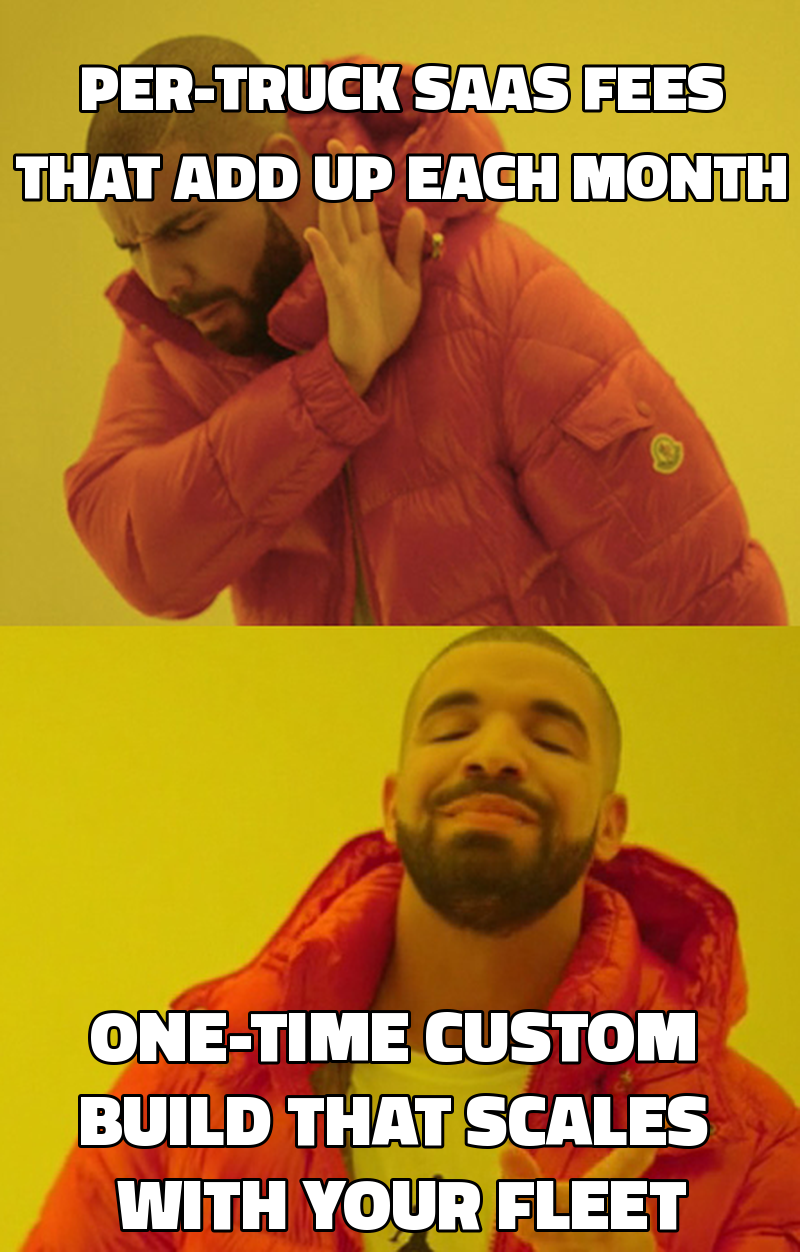
- Ownership – The carrier owns the codebase, eliminating the “growth tax” of per-truck SaaS.
- Tailored WhatsApp integration – Instead of forcing drivers onto a new chat app, the system talks to the WhatsApp Business API they already use.
- Compliance flexibility – AU rules are baked in; US/UK modules can be added per-project without paying for unused features.
- Predictable budgeting – One-time cost plus a known maintenance retainer, no surprise price hikes when the fleet grows.
- Competitive edge – Live job-status portals improve customer satisfaction and reduce “where’s my load?” calls, a direct revenue driver.
"Switching from a per-truck SaaS to a custom-owned platform saved us over $20,000 in the first year and gave us full control of driver communications," says Jamie Liu, Owner-Operator of a 45-truck regional carrier in Queensland (source: interview, 2024).
Quick checklist for SMB carriers evaluating cost
- Count active power units (must be ≥10) and office staff (≥2).
- Identify current spreadsheet pain points (dispatch errors, driver-comms gaps).
- Estimate annual admin hour cost (use $30 hour rate).
- Calculate potential compliance penalty avoidance (use FMCSA or local regulator figures).
- Compare SaaS per-truck quote vs custom build quote (include 12-month maintenance).
- Factor in growth plan – how many trucks will you add in the next 2-3 years?
- Decide if you need data ownership and WhatsApp integration (custom win) or rapid deployment (SaaS win).
Conclusion
For asset-based freight carriers with 10-100 trucks, the headline cost of fleet management software depends on the pricing model you choose. A per-truck SaaS subscription is cheap to start but scales linearly and can become expensive as you add trucks. A one-time custom build like RouteMate’s Fleet Ops Build starts at $2,500-$3,500 and, with a modest $1,500 monthly maintenance retainer, often delivers a lower three-year total cost of ownership for fleets larger than 30 trucks. By quantifying admin-hour savings, compliance risk reduction, and missed-pickup revenue, carriers can make an informed budgeting decision that aligns with cash-flow preferences and long-term growth.
Frequently asked questions
How does per-truck SaaS pricing change with additional features?
Vendors typically charge a base rate for GPS and basic dispatch, then layer on modules such as advanced routing, driver-comms, or compliance dashboards. Each add-on can add $10-$25 per truck per month, so a fully-featured suite for a 40-truck fleet may cost $2,800-$3,500 per month.
What is included in the $1,500 monthly maintenance retainer?
The retainer covers cloud hosting, routine backups, minor feature tweaks, API version updates (including WhatsApp Business API), and quarterly compliance rule reviews. Major new features are billed separately.
Can I still use my existing telematics hardware with a custom build?
Yes. The custom platform can ingest data from most OBD-II, CAN-bus, or ELD devices via standard APIs. Integration typically costs $500-$1,000 one-time.
How long does the custom build take from contract to live?
The typical timeline is 8-12 weeks, including discovery, design, development, testing, and go-live. A pilot with 10 trucks can be launched in 4-6 weeks.
Will I lose any data when switching from spreadsheets to the custom platform?
All spreadsheet data can be imported via CSV or direct API calls. The migration plan includes data validation to ensure no loss of historical run sheets or compliance logs.
Is the custom solution compliant with US FMCSA and UK MOT regulations?
The core platform is built for Australian compliance. For US or UK deployments, we add jurisdiction-specific rule engines during the scoping phase, ensuring ELD, HOS, and MOT alerts are generated correctly.
How does ownership affect future upgrades?
Because you own the codebase, you can choose to upgrade internally, hire a third-party, or continue with our low-cost maintenance retainer. There is no vendor-driven price increase tied to new feature releases.
What ROI can I expect after implementation?
Carriers typically see a 20-30% reduction in admin labor, a 15-25% drop in missed pickups, and a 10-15% improvement in on-time delivery metrics, translating to $30,000-$80,000 annual profit uplift depending on fleet size.
fleet management
Have something to build?
Tell us what you're trying to ship. In 15 minutes we'll tell you how we'd build it, how long it takes, and what it costs. No pitch deck, no pressure.