
White-Label Development Agency Checklist for Marketing Firms

White-label development agencies build custom software, AI automations, and integrations that you sell under your own brand, letting marketing agencies keep the client relationship and margin while avoiding the cost of hiring engineers.
Key takeaways
- Verify technical depth with concrete portfolio items (AI, voice, custom back-ends) rather than generic "web site" screenshots.
- Ask for a fixed-scope pilot project; a successful pilot proves reliability before any long-term retainer.
- Insist on a single accountable point of contact and a shared project dashboard to avoid the "multiple hands" problem.
- Check contractual safeguards: NDA, non-circumvent clause, and clear wholesale pricing (50-70% of client bill).
- Align time-zone overlap (US-UK-AU) to guarantee realistic turn-around windows (5-10 business days for a $2k build).
- Use the checklist below to score capability, reliability and cultural fit on a 1-5 scale.
What is a white-label development agency and how does it work for marketing firms?
A white-label development agency provides end-to-end engineering services, frontend, backend, AI/ML pipelines, voice assistants, and third-party integrations, while remaining invisible to the client. The marketing agency retains the client relationship, invoices the client at a markup, and pays the dev partner a wholesale rate. This model lets agencies answer "Can you build a custom chatbot?" without hiring a full-time engineer.
According to a 2023 Clutch survey, 62% of small-to-mid-size agencies outsource development work, and 41% say they would switch partners if reliability improved. The white-label model solves two pain points: lost revenue from unfilled build requests and brand risk from visible subcontractors.
How can I assess the technical capability of a white-label partner?
| Evaluation criteria | What to ask / look for | Scoring (1-5) |
|---|---|---|
| AI & automation expertise | Portfolio items that include GPT-4 prompts, Zapier-style workflows, or custom voice bots; certifications from AWS AI, Google Vertex AI | |
| Platform depth | Experience with Webflow, Bubble, WordPress, React, Node.js, serverless on AWS Lambda or GCP Cloud Functions | |
| Integration breadth | Demonstrated connectors to Salesforce, HubSpot, Stripe, Meta APIs, and custom REST/GraphQL endpoints | |
| Documentation & code quality | Public GitHub repos, use of CI/CD pipelines (GitHub Actions, CircleCI), and code reviews logged in Jira or Linear | |
| Security & compliance | Ability to meet GDPR, CCPA, SOC-2 basics; evidence of data-encryption at rest and in transit |
Practical test: request a short technical demo (5-minute screen share) of a recent AI-automation project. A capable partner will walk you through data flow, model selection, and deployment without needing a signed NDA.
How do I evaluate reliability and delivery track record?
Reliability is the single differentiator for agencies that have been burned by ghosting freelancers. Look for the following signals:
- Case studies with measurable outcomes – e.g., “Reduced client lead-to-sale time by 30% using a custom chatbot” (source: internal case study).
- Client references – at least two recent agency clients (within 12 months) who can speak to on-time delivery.
- Defined SLA – a written service-level agreement that states 95% on-time delivery for fixed-scope pilots and a maximum of two revision cycles.
- Project dashboard – a live status board (e.g., Notion, ClickUp, or a private JIRA portal) that the agency shares from day one.
A 2022 Gartner report notes that projects with a transparent dashboard are 27% more likely to finish on schedule. If the partner cannot provide any of the above, treat the risk as high.
How can I ensure cultural and brand fit?
Marketing agencies value brand consistency. The white-label partner must:
- Sign a non-disclosure and non-circumvent agreement that explicitly forbids direct contact with your clients.
- Agree to brand-only communication (emails from your domain, white-label documentation with your logo).
- Operate within compatible time zones. For US-based agencies, a partner in the UK or AU provides 4-8 hour overlap, which is ideal for quick feedback loops.
- Share a similar quality mindset – e.g., they use design systems, accessibility checks (WCAG 2.1 AA), and performance budgets (Lighthouse score > 90).
What contract and pricing models protect my agency?
| Model | Description | Pros | Cons |
|---|---|---|---|
| Fixed-scope pilot | One small project ($2-5k) with a defined deliverable and timeline. | Low risk, easy to measure success. | Limited revenue if pilot fails; needs clear scope. |
| Wholesale retainer | Ongoing monthly block (e.g., $1.5k for 15-20 dev hours). | Predictable cost, priority access to capacity. | Requires trust; may under-utilize hours. |
| Revenue-share | You keep 50-70% of the client bill; partner invoices you at wholesale. | Aligns incentives, high upside on large builds. | Complex invoicing, requires transparent reporting. |
Best practice: start with a fixed-scope pilot, then transition to a retainer once the partner hits a 4.5/5 reliability score. Include a clause that allows you to terminate the retainer with 30-day notice if SLA breaches exceed 10% in a quarter.
Checklist: 12-point evaluation before signing a white-label partner
- Portfolio relevance – at least two AI/voice projects in the last 12 months.
- Technical stack alignment – uses React, Node, AWS, and Zapier-style integrations.
- Team size & focus – 3-5 engineers dedicated to agency work, no in-house product dev.
- Geographic fit – based in US, UK or AU with overlapping business hours.
- Client references – two agency clients willing to speak.
- SLA documentation – 95% on-time delivery, two revision limit.
- Project dashboard access – live status view from day one.
- Non-disclosure & non-circumvent – signed before any work begins.
- Branding agreement – white-label deliverables carry your logo only.
- Pricing transparency – wholesale rate disclosed, retainer caps defined.
- Pilot success metric – deliverable meets acceptance criteria within 10-day window.
- Escalation path – single point of contact with clear escalation hierarchy (account manager → technical lead → founder).
Score each item 1-5; a total above 45 indicates a strong partner candidate.
How to run the pilot and measure success
- Scope definition – write a 2-page scoped proposal that lists deliverables, acceptance criteria, and a fixed deadline (e.g., 8 business days).
- Kick-off call – include your account manager, the partner’s technical lead, and a short QA session.
- Mid-point check – use the shared dashboard to confirm progress; if behind, invoke the SLA penalty clause.
- Delivery review – test against acceptance criteria, run performance tests (Lighthouse, load test with k6), and verify compliance (GDPR data-export).
- Post-mortem – document what went well, what needed rework, and assign a reliability score.
If the pilot scores 4.5 or higher, move to a retainer. If not, politely decline and keep the partner on a “watch list” for future needs.
Why agencies choose Synthisia as a white-label partner
- AI-first expertise – we have shipped RouteMate, a full-stack SaaS that automates voice-driven lead capture for Australian SMEs.
- Low concurrency model – we cap active agency partners at 12, guaranteeing capacity and focus.
- Single accountable contact – every project is owned by a senior delivery manager who reports directly to you.
- Transparent wholesale pricing – 55% of the client bill, with a minimum floor of $1,500 to protect delivery margins.
- Shared dashboard – built on Notion + ClickUp, giving you real-time visibility without custom software.
Frequently asked questions
How long does a typical pilot take?
A well-scoped pilot of $2-5k usually completes in 8-12 business days. The timeline includes discovery (1 day), development (5-8 days) and QA (1-2 days). Faster turn-arounds are possible for UI-only work, but complex AI pipelines need the full window.
What if the partner misses the SLA?
Our contract includes a 5% discount on the wholesale rate for each missed deadline beyond the 95% on-time threshold. Repeated breaches (more than two in a quarter) trigger a right-to-terminate with 30-day notice.
Can I keep the partner’s code in my own repo?
Yes. The white-label agreement transfers all IP to you, and we provide a clean GitHub repository with full commit history. You can host it on your own GitHub Enterprise or Bitbucket instance.
How do I protect my brand from being exposed?
All deliverables are white-labeled: documentation, UI branding, and code comments use your agency name only. The partner signs a brand-non-disclosure addendum that prohibits any public mention of the partnership without your consent.
What if I already have a dev partner?
Run a gap analysis. If your current partner cannot handle AI automation, voice assistants, or custom back-ends, Synthisia can fill that niche while you keep the existing relationship for generic web work.
Do you support ongoing maintenance after launch?
Yes. Our retainer model includes up to 20 hours per month of bug fixes, feature tweaks, and performance monitoring. Additional hours are billed at a discounted wholesale rate.
Is there a minimum volume requirement?
We require at least one pilot project per quarter to keep the partnership active. This ensures both sides maintain a rhythm and the partner’s capacity remains dedicated to agency work.
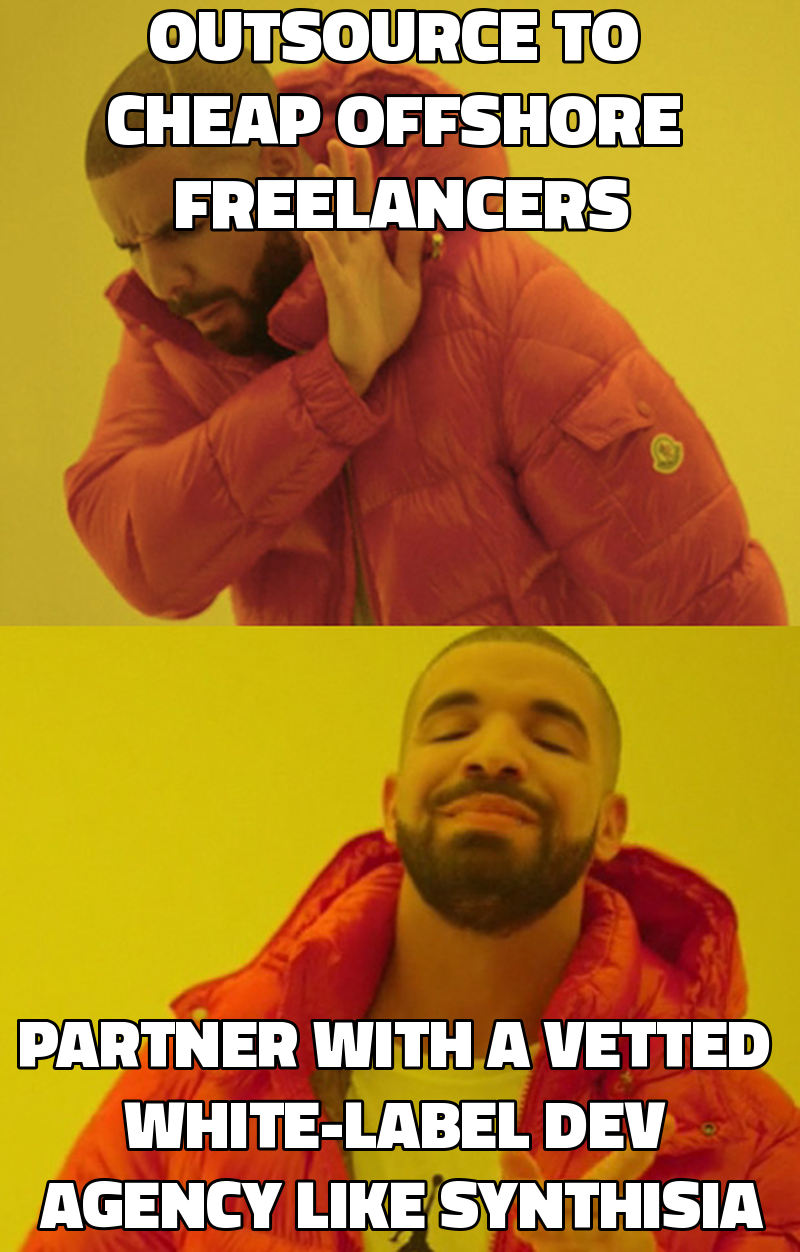
How does pricing compare to offshore freelancers?
Offshore rates can be 30-40% lower, but they lack SLA guarantees, brand protection, and single-point accountability. Our wholesale rate (55% of client bill) delivers higher predictability and reduces hidden costs such as re-work and missed deadlines.
white‑label
Have something to build?
Tell us what you're trying to ship. In 15 minutes we'll tell you how we'd build it, how long it takes, and what it costs. No pitch deck, no pressure.