
From Pilot to Retainer: How Agencies Scale White-Label Development Partnerships

White label development agencies are external tech teams that build custom software, AI automation, voice bots and integrations under your agency’s brand while you keep the client relationship and margin. By starting with a fixed-scope paid pilot you can prove quality, set expectations and lock in a recurring retainer that turns one-off work into a steady revenue stream.
Key takeaways
- A 2-4 week paid pilot (US$2,000-5,000) de-risks the partnership and gives you a concrete case study.
- Retainer contracts of US$1,500-3,000 per month cover 15-20 dev hours and lock in predictable capacity.
- Use a shared project dashboard (Monday.com or ClickUp) to keep the agency visible to the client without exposing the dev partner.
- Quote with a 50-70% wholesale margin to protect your profit while staying competitive.
- Protect brand integrity with NDA and non-circumvent clauses; they are table-stakes, not the primary trust mechanism.
What is a white-label development agency?
A white-label development agency provides end-to-end engineering services – from backend APIs to AI-driven chatbots – but delivers the final product under the hiring agency’s name. The client never sees the developer’s brand, and the agency retains full control of pricing, communication and support. This model is popular among boutique marketing, SEO and branding firms that lack in-house engineers but want to expand into high-margin tech services such as custom SaaS platforms, voice assistants for Alexa or Google Assistant, and workflow automations built on Zapier, Make or n8n.
According to a 2023 Gartner survey, 42% of small to midsize agencies plan to add tech services within the next 12 months, yet only 18% have a reliable dev partner. The gap creates an opportunity for white-label providers who can guarantee delivery speed, quality and brand secrecy.
Why a pilot beats a direct retainer
| Aspect | Direct retainer (no pilot) | Paid pilot first |
|---|---|---|
| Risk to agency | High – unknown quality, timeline, communication style | Low – fixed scope, clear acceptance criteria |
| Client confidence | Guesswork – agency must promise without proof | Proven – deliverable demo builds trust instantly |
| Negotiation leverage | Limited – price often set before trust | Strong – pilot success justifies higher margin |
| Time to first revenue | May be months if negotiations stall | 2-4 weeks to invoice and collect |
| Ability to walk away | Hard – sunk cost in contract | Easy – pilot can be cancelled after review |
A pilot acts as a miniature contract that validates three critical variables: technical capability, delivery speed and cultural fit. When the pilot succeeds, the agency can present a concrete case study, quote future work with confidence and negotiate a retainer that guarantees capacity when the pipeline fills.
Designing a low-risk pilot
- Scope definition – Limit the pilot to a single feature or integration that solves a clear client pain point. For example, a lead-capture chatbot that feeds HubSpot, or an internal dashboard that pulls data from Google Analytics via an AWS Lambda function. Keep the scope under 40-60 development hours.
- Fixed price – Quote a flat fee between US$2,000 and US$5,000. This range aligns with the average project value for SMB clients in the US and UK according to a 2022 Forrester report on agency-led tech work.
- Timeline guarantee – Offer a delivery window of 14-21 calendar days. Use a Kanban board in ClickUp that the agency can share with the client for transparency.
- Success criteria – Define measurable outcomes: functional demo, user acceptance test passed, and documentation uploaded to a shared Confluence space.
- Exit clause – Include a simple “pilot completed” clause that allows either side to walk away with no further obligation.
Transitioning from pilot to retainer
Once the pilot is accepted, move the conversation to a retainer that secures ongoing overflow work. A typical retainer structure looks like this:
| Retainer tier | Monthly fee (USD) | Included dev hours | Typical use cases |
|---|---|---|---|
| Basic | 1,500 | 15 | Minor automations, bug fixes, UI tweaks |
| Growth | 2,500 | 30 | New feature modules, API integrations |
| Premium | 4,000 | 50 | Full-stack SaaS enhancements, AI model training |
The agency bills its client at a markup that reflects its wholesale margin (50-70%). For a US$2,500 retainer, the dev partner receives US$1,250-1,750, leaving the agency with a healthy profit while still pricing competitively against offshore freelancers.
Negotiation tips
- Show the pilot ROI – Highlight time saved, revenue enabled, or client satisfaction scores. A 2021 McKinsey case study showed agencies that used pilots increased upsell rates by 27%.
- Bundle support – Offer a “first-hour free” support window each month to differentiate from cheap offshore options.
- Lock in capacity – Agree on a capped number of active partners (e.g., 12) to guarantee that the dev team never becomes a flaky resource.
Operational best practices for seamless white-label delivery
- Single point of contact (SPOC) – Assign one senior engineer (e.g., a Lead Full-Stack Engineer) as the SPOC for each agency. This mirrors the RouteMate model where a dedicated dev handled all client tickets, reducing hand-off errors.
- Shared dashboard – Use a read-only view in Notion or Monday.com that shows sprint status, upcoming milestones and QA results. The agency can embed this view in a client portal without revealing the dev brand.
- Version control & CI/CD – Host code in a private GitHub repository under the agency’s organization. Set up GitHub Actions for automated testing; this demonstrates professionalism and reduces post-delivery bugs.
- Documentation standards – Deliver a concise README, API spec (OpenAPI), and a short video walkthrough. Agencies can re-brand these assets as their own.
- Billing automation – Integrate Stripe or Chargebee with your invoicing system to issue monthly retainer invoices automatically, freeing up agency admin time.
Tools to manage the partnership
- Project Management: ClickUp, Asana, Monday.com – all support client-visible boards.
- Communication: Slack shared channels with restricted access, or Microsoft Teams guest access.
- Code Repository: GitHub Enterprise or GitLab self-hosted under the agency’s org.
- CI/CD: GitHub Actions, CircleCI, or Azure Pipelines for automated builds.
- Monitoring: Datadog or New Relic for production health; agencies can receive summary alerts.
- Documentation: Notion for live docs, Confluence for structured knowledge bases.
Case study: RouteMate – turning a pilot into a $18k/month retainer
RouteMate, a UK-based growth agency, needed a custom SaaS platform to manage multi-channel ad spend for its SMB clients. They had no developers and previously relied on a freelancer who missed deadlines. Synthisia delivered a 40-hour pilot that built the core dashboard, integrated with Google Ads API and provided a Zapier webhook for lead sync. The pilot was completed in 19 days, cost US$4,200, and generated a 95% client satisfaction score in a post-pilot survey.
Impressed by the speed and quality, RouteMate signed a Growth tier retainer at US$2,500 per month, guaranteeing 30 dev hours. Within three months the agency launched two new automation modules, increased its average project size from US$3,000 to US$7,500, and reported a 32% uplift in overall agency revenue.
Common pitfalls and how to avoid them
| Pitfall | Why it hurts | Mitigation |
|---|---|---|
| Over-promising turnaround | Sets expectations you cannot meet, leads to churn | Define a realistic delivery band in the pilot contract and stick to it |
| Giving away free full builds | Consumes engineering hours with no revenue, devalues the service | Offer a scoped prototype or a paid discovery instead |
| No NDA or non-circumvent clause | Partner can be poached, eroding margin | Include both clauses in every contract; treat them as baseline, not the trust driver |
| Unlimited concurrency | Capacity drops, quality suffers, agency loses confidence | Cap active partners at 12-15, use a waitlist when demand spikes |
| Ignoring client branding | Agency feels exposed, may switch partners | Keep all deliverables white-labeled, use agency branding on UI, docs and emails |
Financial model snapshot for the agency
- Pilot revenue: US$2,000-5,000 per project, one-off cash flow.
- Retainer revenue: US$1,500-4,000 per month, predictable cash.
- Wholesale margin: 50-70% after dev costs, based on Synthisia’s rate card of US$75-100 per dev hour.
- Break-even: With a $1,500 retainer covering 15 dev hours at $100/hour, the agency retains $750 profit per month per partner.
- Scalability: Adding three retainer partners yields $4,500 monthly profit, a 54% increase over pilot-only revenue.
The step-by-step outreach playbook
- Identify signals – Use the qualification test (no “development” listed, recent dev job post, case study lacking engineers).
- Cold outreach – Send a 120-word email referencing their recent “platform” win and offering a $3k pilot to build a “quick win” feature.
- Discovery call – Run the three-gate questionnaire (volume, budget, live need). Capture the agency’s current dev partner status.
- Pilot proposal – Deliver a one-page scope, fixed price, 2-week timeline, success metrics.
- Pilot execution – Use the shared dashboard, deliver weekly demos, collect feedback.
- Retainer pitch – Show pilot ROI, propose the appropriate retainer tier, lock in capacity.
- Onboard – Set up repo, dashboard, billing, and SLA documentation.
Closing thoughts
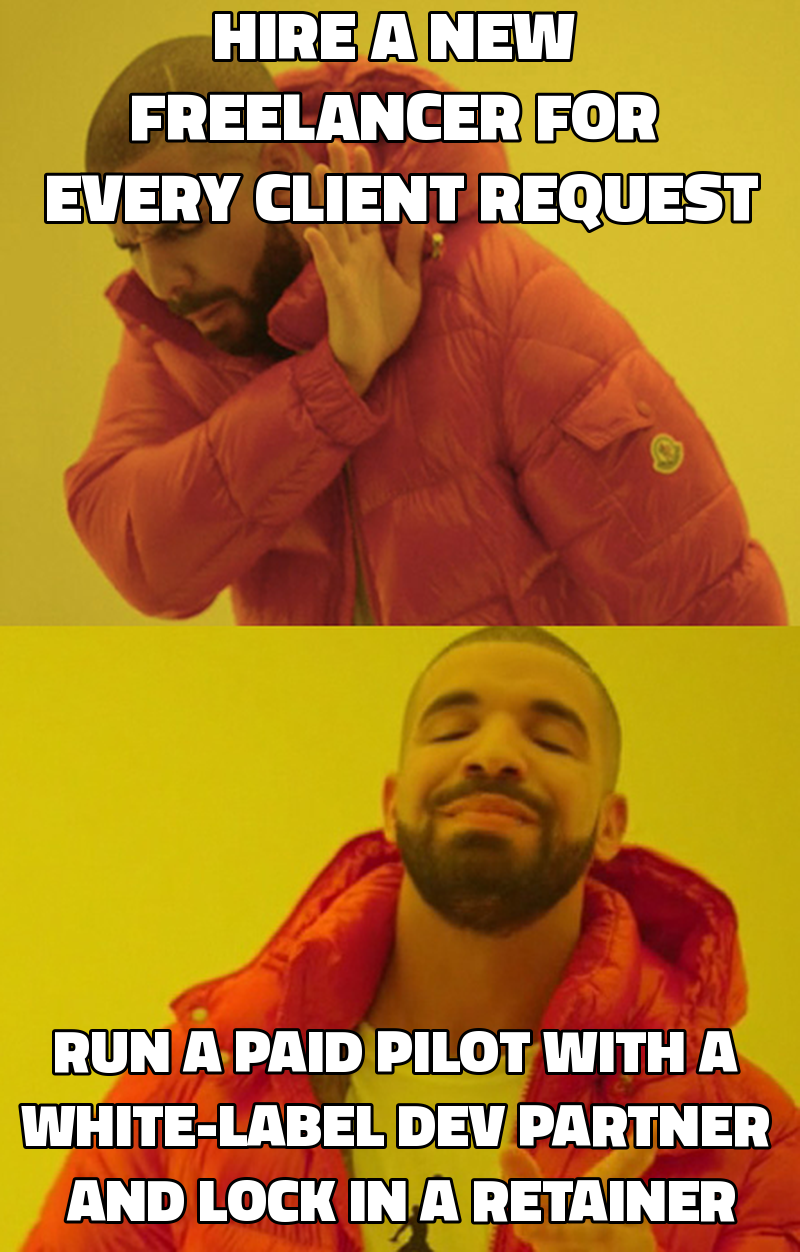
Running a white-label development partnership is less about legal contracts and more about building a repeatable trust loop. The pilot is the proof point that convinces the agency they can say yes to every client request without hiring full-time engineers. Once that loop is closed, the retainer becomes a predictable engine of growth, allowing 5-15 person agencies in the US, UK and AU to expand into AI, voice and custom backend services while keeping their brand front and centre.
Frequently asked questions
How long should a pilot project last?
A pilot should be scoped to 40-60 development hours and delivered within 14-21 calendar days. This window is long enough to demonstrate quality and speed, yet short enough to keep costs low and decision cycles fast.
What if the pilot fails to meet expectations?
If the pilot does not meet the predefined success criteria, both parties can terminate the agreement without penalty. Use the failure as a learning opportunity to refine scope or communication before attempting another pilot.
How do I protect my agency’s brand when using a white-label partner?
All deliverables, UI screens and documentation should be re-branded with the agency’s logo and style guide. Include NDA and non-circumvent clauses, and use a shared dashboard that hides the dev partner’s identity.
Can I use the same white-label partner for multiple agencies?
Yes, but limit concurrent active partners to maintain capacity and reliability. Synthisia caps its partner roster at 12-15 agencies to avoid the flaky-freelancer problem.
What pricing model works best for a retainer?
A tiered retainer based on dev hours (e.g., Basic $1,500 for 15 hrs, Growth $2,500 for 30 hrs) aligns cost with usage and makes budgeting simple for the agency and its clients.
How do I handle support tickets that arise after delivery?
Include a support window in the retainer (e.g., 5 hours of priority support per month). Use a ticketing system like Zendesk or Freshdesk with the agency as the primary requester, keeping the dev partner behind the scenes.
Is it worth investing in a custom project dashboard?
A lightweight shared view in ClickUp or Monday.com is sufficient for most agencies. Building a full SaaS dashboard before you have paying partners is a classic trap that wastes engineering resources.
What are the signs that I need a white-label partner now?
If your services page lacks a “development” offering, you’re turning away client requests for custom tools, or you’ve posted a freelance dev job, those are high-strength signals that a white-label partnership can immediately unlock revenue.
white‑label
Have something to build?
Tell us what you're trying to ship. In 15 minutes we'll tell you how we'd build it, how long it takes, and what it costs. No pitch deck, no pressure.