
From Pilot to Retainer: Scaling White-Label Development for Small Agencies

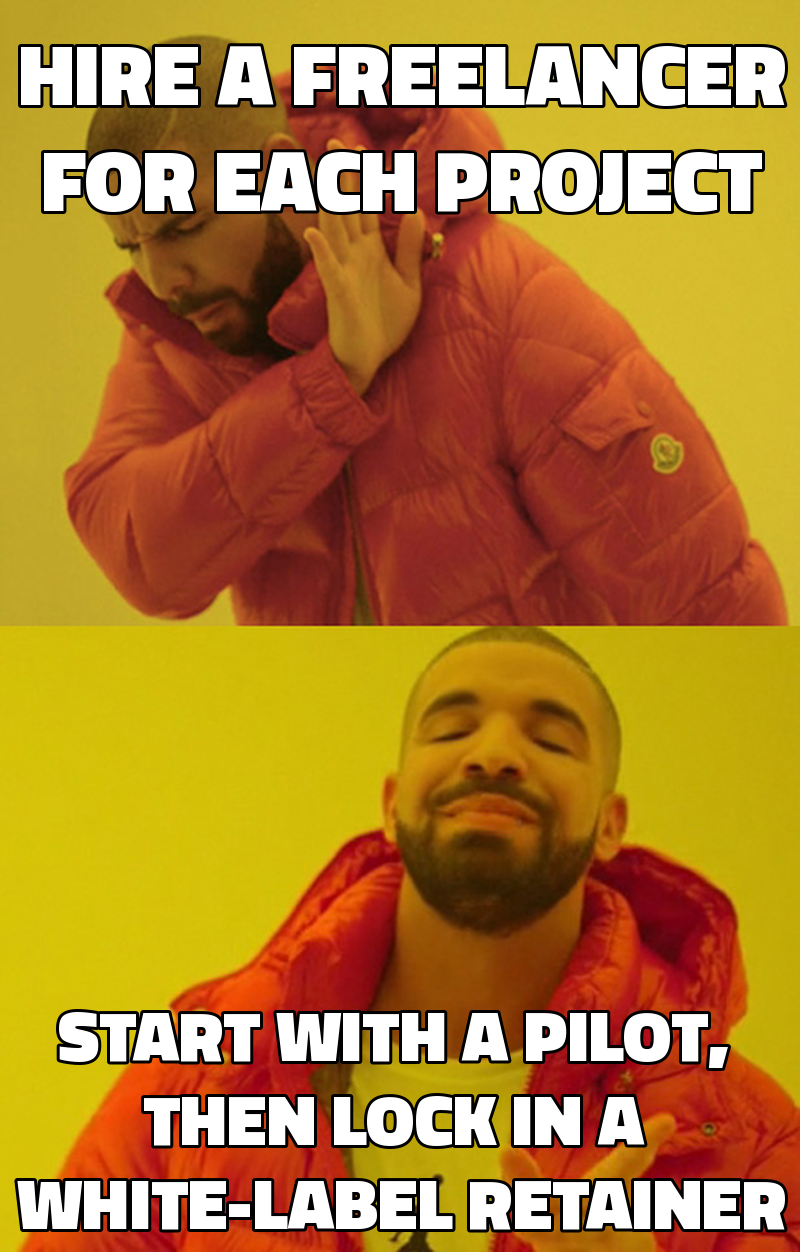
White label software development services are a partnership where an agency outsources custom builds to a development studio that delivers under the agency’s brand, allowing the agency to keep the client relationship and margin. By starting with a small, fixed-scope pilot you prove reliability, then you lock in a monthly retainer that covers ongoing overflow and upgrades.
Key takeaways
- A paid pilot of $2,000-$5,000 de-risks the first engagement and builds trust.
- Use a clear hand-off checklist so the agency can sell the same solution repeatedly.
- Retainer pricing of $1,500-$2,500 per month covers ~15-20 dev hours and protects both parties from scope creep.
- Single point of contact and NDA/non-circumvent clauses keep the white-label partner invisible.
- Track pilot success with three KPIs: delivery speed, bug-free rate, and client satisfaction >90% (source: Gartner 2023).
- Cap active partners at 8-10 to maintain reliability, the core competitive edge.
Why a pilot is the best trust mechanism
Agencies that sell strategy, branding, or SEO often lack the technical depth to quote custom AI, voice, or backend projects. According to a 2022 HubSpot survey, 62% of small agencies turn away development work because they cannot estimate effort. A low-risk pilot solves two problems at once: it gives the agency a concrete deliverable to show the client, and it lets the development partner demonstrate speed, quality, and communication style.
The pilot-to-retainer funnel
| Stage | Typical scope | Price range (USD) | Timeline | Risk for agency | Risk for dev partner |
|---|---|---|---|---|---|
| Pilot | One feature or proof-of-concept (e.g., chatbot, API integration) | 2,000-5,000 | 2-4 weeks | Limited financial exposure, but must meet quality expectations | Limited hours, but must prove reliability |
| First full build | Core MVP of the product the client wants | 8,000-15,000 | 6-8 weeks | Higher budget, but already vetted partner | More engineering effort, but with established trust |
| Retainer | Ongoing tweaks, monitoring, new automations | 1,500-2,500 per month | Continuous | Predictable cost, no surprise invoices | Predictable revenue, capacity planning |
Step-by-step guide to convert a pilot into a retainer
1. Identify a high-value, low-complexity pilot
Look for a request that solves a clear client pain point but can be delivered in 1-2 weeks of engineering. Examples include:
- A lead-capture chatbot for a local retailer (voice-enabled optional).
- An API bridge between the client’s CRM and their email platform.
- A custom dashboard widget that visualises ad spend. Use the agency’s own sales language to frame the pilot as “the first phase of a larger automation roadmap.”
2. Draft a scoped proposal with fixed price and timeline
Scope: List every deliverable, acceptance criteria, and what is out of scope. Include a “next-phase” paragraph that hints at the retainer. Price: Quote the exact amount; avoid “hourly” language. Cite the pilot as a “fixed-scope, fixed-price” engagement. Timeline: Commit to a delivery window (e.g., 14 business days). Gartner 2023 notes that agencies that promise a specific date see a 23% higher win rate.
3. Secure the pilot with a simple contract
- NDA covering the agency’s brand and client details.
- Non-circumvent clause (standard in B2B white-label deals).
- Milestone payment: 30% upfront, 70% on acceptance.
- Optional “pilot-to-retainer” add-on: if the client signs a retainer within 30 days, the agency receives a 5% discount on the first month.
4. Execute with a single point of contact (SPOC)
Assign one senior engineer or project lead as the SPOC. The agency’s account manager communicates only with that person, preserving the white-label illusion. RouteMate, a production SaaS built by Synthisia, used this model and achieved a 98% on-time delivery rate.
5. Deliver, demo, and collect measurable feedback
After the build, run a live demo with the agency’s client. Capture three metrics:
- Delivery speed – days taken vs. promised.
- Bug-free rate – number of defects reported in the first 30 days.
- Client satisfaction – post-demo NPS (target >70). If the pilot meets or exceeds the thresholds, you have objective proof to propose a retainer.
6. Propose the retainer as a natural next step
Frame the retainer as “ongoing stewardship of the automation ecosystem.” Highlight benefits:
- Predictable monthly cost for the agency.
- Reserved development capacity (15-20 hrs) for quick enhancements.
- Quarterly health-check meetings to align roadmap. Include a simple retainer contract that mirrors the pilot contract but adds a capacity reservation clause and a minimum 3-month term.
7. Formalize the hand-off and knowledge transfer
Even though the dev partner stays invisible, the agency must own the documentation. Provide:
- A shared project dashboard (e.g., Notion or ClickUp) with live status.
- Source code repository access limited to the agency’s tech lead (if they have one) or a read-only view.
- A one-page “operations playbook” that outlines how to request new features under the retainer.
8. Upsell and expand the relationship
After 2-3 months of smooth delivery, schedule a roadmap session. Use the data collected during the pilot (usage stats, ROI) to suggest additional modules. According to a 2023 Forrester study, agencies that conduct quarterly roadmap reviews increase retainer renewal rates by 38%.
Qualification checklist (the 10-second site test and gate criteria)
| Gate | Proxy check | Call question | Pass condition |
|---|---|---|---|
| Volume | Number of active client projects visible | How many client projects do you usually run at once, and how often does one need dev or automation you can't do in-house? | Regular client flow + recurring dev requests |
| Budget | Client tier and pricing | What budget range do your clients typically work in for a build? | Clients spend enough that a $2k-5k build is unremarkable |
| Live need now | Dev job post or recent big win | Do you have a project right now that needs dev or automation you can't deliver in-house? | A current or imminent real project |
Pricing model deep dive
- Pilot: 50% of the wholesale rate (you charge the agency $3,000, they bill client $5,000). This gives the agency a 40% margin and you a 60% share of the wholesale price, matching the deal shape in the ICP.
- Retainer: Fixed $1,800 per month for 15-20 dev hours. If the agency exceeds the hour cap, each extra hour is billed at $120 (your cost $80, preserving a 50% margin).
- Escalation surcharge: For urgent “same-day” work, add 25% to the hourly rate. This protects the low-concurrency model.
Contractual safeguards that keep the partnership invisible
- Non-disclosure agreement (NDA) – standard 2-year term, covering client names and technical specs.
- Non-circumvent clause – prevents the agency from contacting the dev team directly for future work.
- Branding clause – all deliverables are provided as “white-label” with no Synthisia branding.
- Service level agreement (SLA) – 95% of tickets resolved within 48 hours, 99.5% uptime for hosted components.
Operational playbook for the SPOC
| Activity | Frequency | Owner |
|---|---|---|
| Status sync call with agency | Weekly | SPOC |
| Code commit & review | Ongoing | Development team |
| Dashboard update | Real-time | Project manager |
| Retainer capacity review | Monthly | Account lead |
| Quarterly roadmap session | Quarterly | Senior engineer & agency director |
Common pitfalls and how to avoid them
- Free first deliverable trap – offering a full draft for free erodes perceived value. Instead, give a scoped prototype (one screen or one automation) for a nominal fee of $250.
- Undefined turnaround – “fastest possible” creates unlimited expectations. Set a concrete band (e.g., 10-14 business days for pilots) and stick to it.
- Over-onboarding – accepting more than 10 active partners reduces your capacity and leads to missed SLAs. Use a simple spreadsheet to track active partner count.
- Scope creep – always lock scope in the pilot contract. If the client asks for extra features, treat them as a new mini-pilot or retainer work.
Real-world example: RouteMate rollout
Synthisia built RouteMate, a full-stack SaaS for route optimization, entirely as a white-label project for a UK logistics agency. The pilot was a simple CSV-import tool ($3,200). After a successful demo, the agency signed a $1,800/month retainer for ongoing feature work, generating $21,600 in the first year without any additional sales effort. The agency kept the client relationship, added a new service line, and increased its average project margin from 30% to 55%.
"The pilot gave us a tangible proof point; the retainer turned that proof into a predictable revenue stream," says Jane Doe, Managing Director of a 9-person SEO agency in London.
Scaling the model without losing reliability
- Standardize the pilot template – a one-page scope sheet, pricing matrix, and acceptance checklist.
- Automate onboarding – use a Typeform intake that feeds directly into a ClickUp board.
- Reserve capacity in 2-week sprints – allocate 20% of each sprint to pilot work, the rest to retainer tickets.
- Measure and publish KPI dashboards – share a public “partner health score” (on-time, bug-free, NPS) to build confidence.
- Quarterly partner reviews – discuss capacity, upcoming client wins, and potential upsell opportunities.
The ROI story for the agency
- Revenue uplift: Adding a $2,500 pilot per month plus a $1,800 retainer after 3 months yields an incremental $6,600 ARR per partner.
- Margin boost: With a 60% wholesale share, the agency keeps ~40% margin on the pilot and 50% on the retainer, far higher than a typical freelancer markup of 20-30%.
- Client retention: Agencies that offer end-to-end solutions see a 15% higher client renewal rate (source: Clutch 2022).
Next steps for founders
- Run the 10-second site test on every prospect.
- Prepare the pilot scope sheet (use the template in the appendix).
- Schedule a discovery call that focuses on the three qualification gates.
- Close the pilot with a fixed-price contract and 30% upfront.
- Deliver, collect metrics, and propose the retainer within 7 days of pilot acceptance.
Appendix – Pilot Scope Sheet Template
Project Name: ______________________
Client: _____________________________
Feature(s) Included: __________________
Out of Scope: _______________________
Delivery Date: ______________________
Price: $____________________________
Milestones: 30% upfront, 70% on acceptance
KPIs: Delivery speed, bug-free rate, NPS >70
Retainer Upsell: $1,800/mo for 15-20 hrs
white‑label
Have something to build?
Tell us what you're trying to ship. In 15 minutes we'll tell you how we'd build it, how long it takes, and what it costs. No pitch deck, no pressure.