
Freight Dispatch Software: Automation for Growing Fleets (2026)

The best freight dispatch solution for US carriers with 10-100 trucks isn’t a single product; it’s the option that matches your fleet’s size, compliance needs and budget while giving you control over data and workflows.
Key takeaways
- Identify the regulatory gaps you must fill (FMCSA safety, HOS, DOT registration) before looking at any tool.
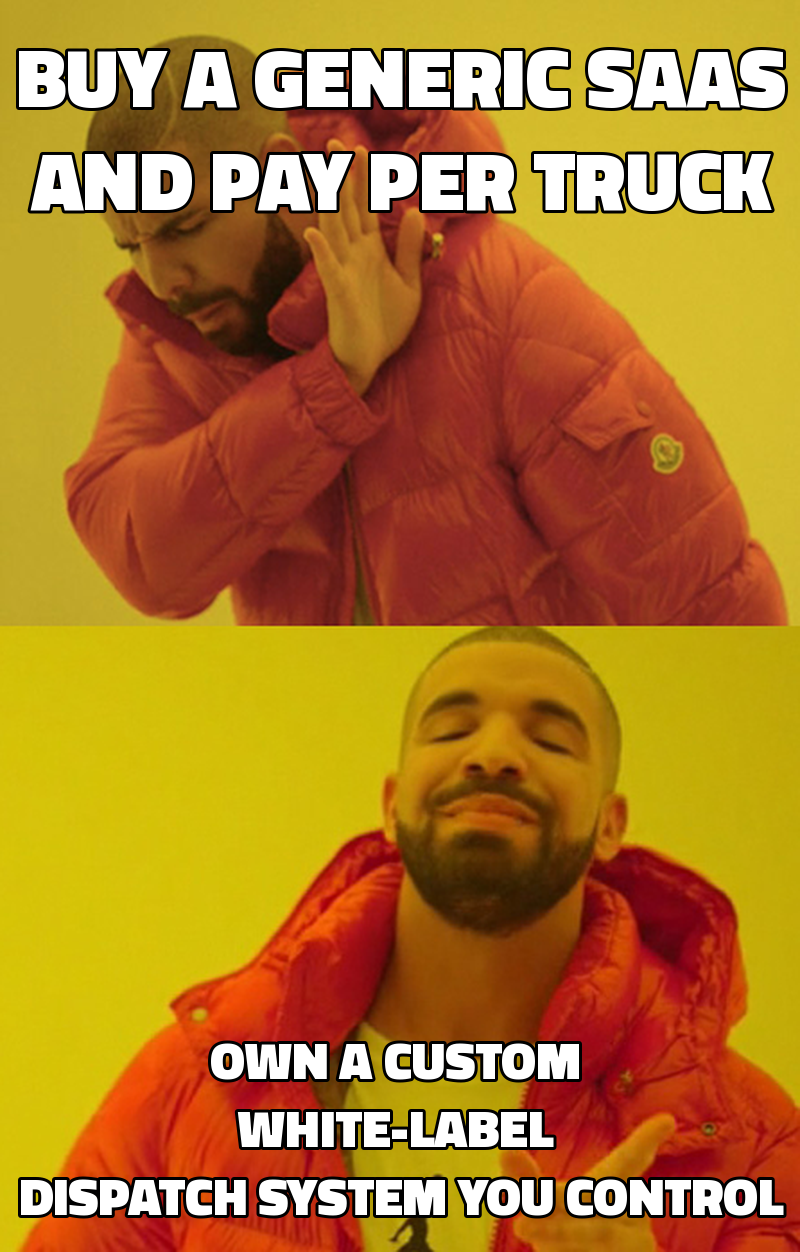
- Off-the-shelf SaaS offers speed but can become expensive per-truck as you grow.
- Local agencies bring industry knowledge but may lock you into recurring fees and limited data ownership.
- Freelancers can build a quick prototype but often lack long-term support and security guarantees.
- A custom or white-label build gives you full ownership, tailored compliance automation and the ability to integrate existing communication channels like WhatsApp.
- Remote partners that operate in the US can meet data-residency requirements if they host on US-based cloud regions.
How to compare your options
| Option type | Typical cost model | Scalability | Compliance fit | Data residency | Customization depth |
|---|---|---|---|---|---|
| Off-the-shelf SaaS | Subscription per truck or per driver | High (cloud native) | Vendor updates to FMCSA rules, but may lag behind local nuances | Hosted in US data centers (most major vendors) | Limited to preset modules and APIs |
| Local agency | Project fee + ongoing support retainer | Medium (depends on agency resources) | Agency often knows US trucking regs, can tailor workflows | Usually US-based, but verify hosting details | Moderate – agency can add integrations but stays within their platform |
| Freelancer | Fixed project price or hourly rate | Low to medium (depends on code quality) | Compliance is only as good as the freelancer’s knowledge | Freelancer may use generic cloud; ask for US region | |
| Custom / white-label build (e.g., Synthisia) | One-time build fee + optional low-cost maintenance | High – you own the code and can scale on your terms | Built to match FMCSA, DOT, state-level rules from day one | You choose US cloud provider (AWS, Azure, GCP) | Full – every screen, workflow and integration is yours |
Off-the-shelf SaaS platforms
Most carriers start with a cloud SaaS product because it promises instant deployment. Popular categories include telematics suites (e.g., Samsara, Verizon Connect) and dedicated dispatch portals. They typically charge a per-truck or per-driver monthly fee, which can be attractive for a fleet of ten trucks but quickly becomes a growth tax as you add more units. These tools usually include GPS tracking, driver-scorecards and basic compliance alerts. However, they often force you to work within a generic UI, limit integration with tools you already use (WhatsApp Business API, accounting software) and store data in a multi-tenant environment where you have limited control over backups and export formats. For a fleet that still relies on spreadsheets, the learning curve can be steep and the visibility gains modest.
Local agencies and consulting firms
In the United States there are a handful of agencies that specialize in trucking software. They market themselves as “industry-focused” and can quickly configure a dispatch board that mirrors your spreadsheet layout. The advantage is that they understand FMCSA reporting requirements and can set up automated reminders for vehicle inspections, registration renewals and driver hours of service. Their pricing is usually a project fee plus a monthly support retainer. While this reduces the upfront risk, you remain dependent on the agency for any new feature, bug fix or security patch. Data ownership is also a gray area; many agencies host the solution on their own servers, so you need to confirm that the hosting location complies with US data-residency expectations.
Freelancers and boutique developers
Hiring a freelance developer or a small boutique team can produce a lightweight dispatch dashboard tailored to your exact spreadsheet columns. This route is often the cheapest way to get a custom UI up and running quickly. The downside is the lack of guaranteed long-term support. If the freelancer moves on, you may be left with undocumented code, security vulnerabilities and no clear path for scaling. Compliance automation is especially risky – a single missed update to FMCSA HOS rules can expose your fleet to fines. If you go this route, insist on a detailed hand-off, source code escrow and a clear SLA for future updates.
When a custom / white-label build is the right call (Synthisia)
Ideal scenario – You have outgrown the per-truck pricing of SaaS tools, need deep integration with WhatsApp Business API, and want a single system that owns your dispatch board, driver communications, compliance alerts and back-office paperwork. You also want to keep all data on US servers and retain full control over future enhancements.
What Synthisia offers – A scoped, one-time build that delivers a dashboard built on the same stack that powered RouteMate for the Australian market, now adapted for US regulations. The solution includes:
- Real-time dispatch board that replaces spreadsheet rows with drag-and-drop job cards.
- Automated driver-comms that log every WhatsApp message, reducing disputes.
- Compliance workflows for DOT registration, service intervals and HOS tracking.
- Customer portal for live load status, cutting down “where’s my load?” calls.
- Ownership of the source code and the option to host on any US-based cloud provider you choose.
Why consider it – You avoid the recurring per-truck fees that can double your software spend as you add trucks. You get a system that grows with you, not a vendor that forces you into higher tiers. Because the build is done remotely, you can still work with a US-based team that follows local data-privacy laws and can sign a Nondisclosure Agreement that protects your operational secrets.
Next steps – If the description resonates, schedule a short discovery call with Synthisia to map your current spreadsheet workflow, compliance gaps and integration points. We’ll provide a fixed-price proposal and outline a maintenance retainer that keeps the system secure and up-to-date with FMCSA rule changes.
Frequently asked questions
How much does a custom dispatch build typically cost in the US?
Pricing varies by scope, but for a fleet of 10-100 trucks a full-stack build (React front-end, Express API, Postgres database) usually ranges from $30,000 to $60,000 as a one-time fee. Ongoing maintenance retainer is optional and often starts around $500 per month for security patches and minor enhancements.
Can a remote development partner legally work with US carriers?
Yes. Remote partners can sign a US-based contract, adhere to FMCSA data-handling guidelines and host the solution on US-region cloud services. Most reputable firms are familiar with cross-border work and can provide the necessary certifications.
Is it better to buy a SaaS tool or build my own?
If you have fewer than 15 trucks and need basic GPS tracking, a SaaS subscription may be cheaper short-term. However, once you approach 30-40 trucks, per-truck fees can outpace the cost of a custom build, especially when you need deep integration and full data ownership.
Will a custom build integrate with my existing accounting software?
Custom builds can use APIs to push invoices, payment status and fuel receipts directly into QuickBooks, Xero or any ERP you use. The integration is part of the scoped development, so you avoid manual re-keying of data each week.
How does a custom solution handle FMCSA compliance updates?
The codebase can be designed with a compliance module that pulls rule changes from FMCSA’s public feeds. Synthisia offers an optional quarterly review to ensure the system reflects the latest safety and HOS regulations.
What about data security and backups?
When you host on AWS US-East (or any US region), you can enable encrypted EBS volumes, automated snapshots and multi-AZ redundancy. Ownership of the code means you control backup schedules and can export the entire database at any time.
Do I need an IT team to maintain a custom system?
Not necessarily. The optional low-cost maintenance retainer covers routine updates, security patches and minor feature requests, allowing you to focus on operations while the partner handles the technical side.
How long does it take to go from spreadsheet to a live dashboard?
A typical scoped project for a 10-truck fleet takes 8-12 weeks from requirements gathering to user acceptance testing. Larger fleets may add a few weeks for additional routing optimization and compliance workflow complexity.
freight dispatch
Have something to build?
Tell us what you're trying to ship. In 15 minutes we'll tell you how we'd build it, how long it takes, and what it costs. No pitch deck, no pressure.