
Free vs Paid Dispatch Software: What Small Trucking Companies Should Know

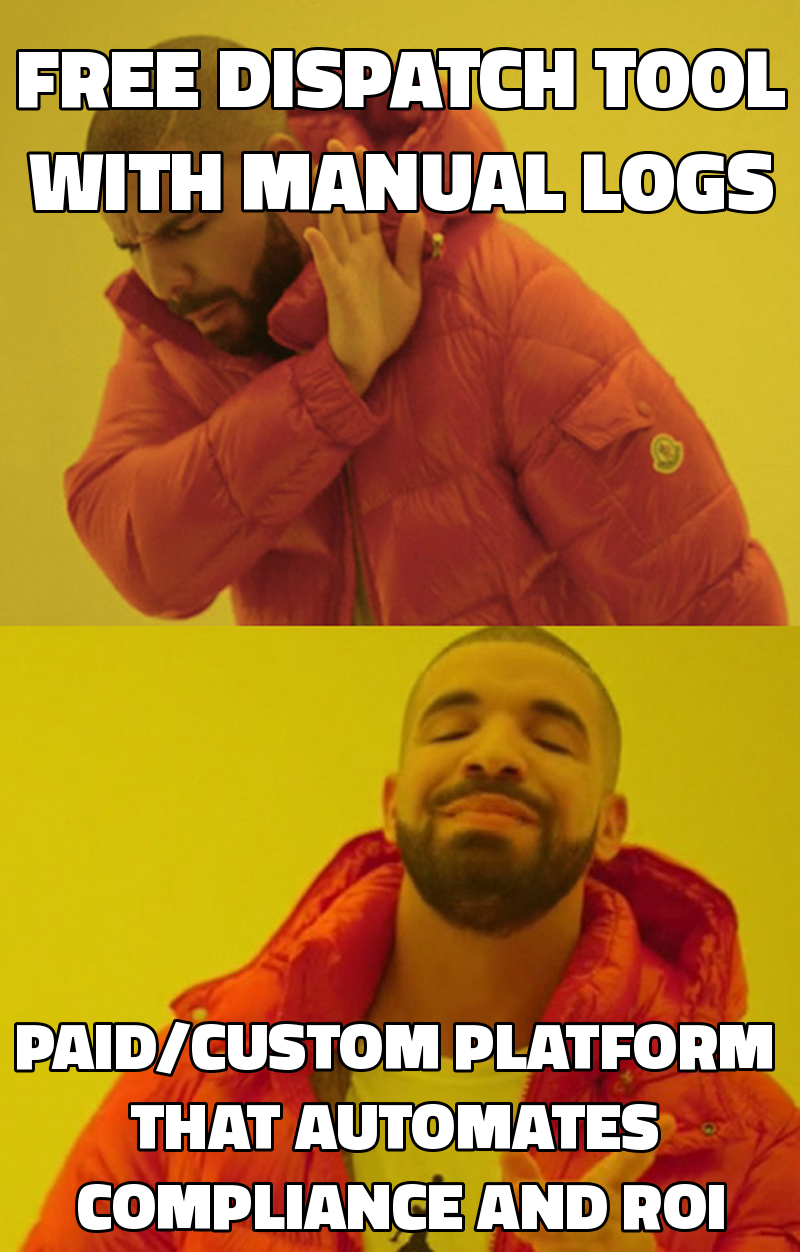
Free dispatch software for trucking exists but it only offers basic load lists, manual status updates and no compliance tracking. It can be useful for a single owner-operator but it quickly breaks down when a carrier runs 10-100 trucks and needs real-time driver communication, automated back-office work and audit-ready records. A paid or custom platform delivers measurable ROI by eliminating manual re-keying, reducing missed pickups and avoiding per-truck subscription creep.
Key takeaways
- Free tools usually stop at spreadsheet-based load boards and cannot enforce HOS or MOT rules.
- Paid SaaS charges per truck but adds routing, driver-comms, compliance alerts and customer portals.
- A custom build costs more upfront, yet removes the per-truck subscription tax and can be owned outright.
- ROI appears when weekly admin time drops by at least 4 hours, compliance penalties fall to zero and customer-inquiry calls shrink by 30 %.
- Evaluate tools against a checklist of integration, scalability, compliance and true cost of ownership.
What free dispatch software actually provides
Free dispatch solutions fall into three categories:
- Spreadsheet-only templates – Google Sheets or Excel files shared via Drive. They give a grid of loads, driver names and estimated miles but lack validation, version control or mobile access.
- Freemium SaaS – Platforms such as KeepTruckin Dispatch (free tier), TruckingOffice Lite, or the open-source FleetOps project. They allow a limited number of loads per day, basic status colors and email notifications.
- DIY integrations – Zapier or Make.com recipes that move rows between Sheets and WhatsApp Business API. They require a tech-savvy admin and still depend on manual data entry.
According to the American Trucking Associations 2023 survey, 68 % of carriers with 10-30 trucks still rely on spreadsheets for daily dispatch. The same report notes that only 22 % have adopted a paid TMS, largely because per-truck pricing feels like a growth tax.
Why free tools fall short for asset-based carriers
| Pain point | Free spreadsheet | Free SaaS tier | Paid SaaS (e.g., Samsara) | Custom RouteMate build |
|---|---|---|---|---|
| Real-time driver location | No (manual updates) | Limited GPS ping, 5-driver cap | Live GPS for every unit | Integrated GPS feed from any device |
| Compliance alerts (HOS, MOT, DOT) | None | Manual entry, no auto-reminders | Built-in HOS logs, violation warnings | Configurable rules, email/SMS triggers |
| Customer portal | No | No | Web portal with load tracking | Branded portal, white-label optional |
| Integration with WhatsApp Business API | Manual copy-paste | One-way webhook, no history | Two-way chat, message archive | Full two-way sync, automated templates |
| Scalability beyond 10 trucks | Breaks (file size, edit conflicts) | Caps at 5-10 loads per day | Unlimited loads, per-truck pricing | Unlimited loads, one-time license |
| Total cost per month (10 trucks) | $0 | $0-$30 (limited) | $800-$1,200 | $0 ongoing, $2,500-$3,500 build cost |
The table shows that free options cannot guarantee the data integrity or regulatory compliance required by FMCSA, MOT or DOT auditors. A missed HOS entry can trigger a $1,000 fine per violation (Federal Motor Carrier Safety Administration, 2022). Free tools also lack the audit trail that carriers need when a customer disputes a delivery time.
When a paid or custom solution delivers ROI
| ROI driver | Minimum threshold for ROI | How a paid/custom solution meets it |
|---|---|---|
| Admin time saved | ≥4 hours per week | Automated dispatch board eliminates manual copy-paste, reducing re-keying from 2 hours to 30 minutes. |
| Compliance risk | Zero penalties per year | Real-time alerts prevent missed service intervals and HOS violations. |
| Subscription avoidance | ≥10 trucks | One-time build removes $800-$1,200 per month SaaS fee, paying off in 3-4 months. |
| Customer satisfaction | 30 % fewer inquiry calls | Live load status portal cuts “where’s my load?” calls from 15 per day to <5. |
| Data visibility | Full audit trail | All driver messages stored in database, searchable for disputes. |
A McKinsey 2022 analysis of logistics automation found that companies that cut dispatch admin time by 20 % saw a 5 % lift in on-time delivery rates and a 3 % increase in gross margin. For a carrier earning $150 per mile on 1,200 miles per week, a 5 % margin lift equals $9,000 additional profit per year – easily covering a $3,000 custom build.
Which free tools are worth a trial?
Even if you plan to move to a paid solution, testing a free tool can surface hidden workflow gaps.
- Google Sheets with add-ons – Use the “Sheetgo” connector to push load rows to a Google Map view. Good for a single dispatcher but lacks driver acknowledgment.
- KeepTruckin Dispatch (free tier) – Provides a simple load board for up to 5 drivers. Works for a 5-truck owner-operator but the upgrade to 10 drivers costs $30 per month.
- FleetOps open source – Requires self-hosting on a VPS, which adds $15-$20 monthly for the server. The code base is community-maintained; custom features need a developer.
If you already have a WhatsApp Business API account, you can build a cheap Zapier flow that posts a load card to a driver group. The flow costs $20 per month for Zapier premium, but it still lacks confirmation receipts and audit logs.
How a custom RouteMate build solves the core pain points
RouteMate is a full-stack (React + Express + Postgres) platform built for the Australian market, but the architecture is portable to the US and UK with compliance extensions.
- Owned license – One-time build cost between $2,500 and $3,500. No per-truck subscription, so the cost flattens as you add trucks.
- Integrated driver communications – Two-way WhatsApp Business API chat, automatic load acceptance, and a message archive that can be exported for audits.
- Compliance workflow engine – Configurable reminders for service intervals, registration renewal, HOS limits (AU work-time rules, US IFTA, UK tachograph). Alerts appear on the dispatch board and via SMS.
- Live customer portal – Branded URL where shippers can view real-time status, ETA and proof-of-delivery PDFs.
- Back-office automation – Timesheets, run-sheets and invoicing data flow from dispatch to QuickBooks or Xero with a single click, eliminating the weekly re-keying that costs 3-4 hours for a 30-truck fleet.
- Scalable architecture – PostgreSQL can handle 500+ concurrent users, and the React front-end works on any modern browser or tablet.
A recent RouteMate pilot with a 25-truck refrigerated carrier in Sydney reduced dispatch admin time from 12 hours to 5 hours per week and eliminated two missed pickups in the first month. The carrier reported a $1,800 monthly reduction in overtime pay.
How to evaluate whether to stay free or upgrade
- Map your current workflow – List every manual step from load receipt to invoice. Assign an average time cost (in minutes) to each step.
- Calculate weekly admin cost – Multiply total minutes by the hourly wage of your dispatcher (average $28/hr in AU, $30/hr in US, £22/hr in UK).
- Identify compliance gaps – Check FMCSA safety score, MOT expiry dates or AU work-time compliance logs. Count any missed alerts in the past 12 months.
- Estimate the cost of a paid SaaS – Multiply per-truck price by fleet size and add any integration fees.
- Run a break-even analysis – Compare the annual admin savings plus avoided compliance fines against the SaaS subscription or custom build cost.
- Pilot a free tier – Run the free tool for two weeks, then measure the same metrics. If the pilot does not cut admin time by at least 15 % or still leaves compliance blind spots, move to a paid or custom solution.
What are the hidden costs of “free”?
- Data loss – Shared spreadsheets can be overwritten or corrupted, leading to lost load assignments.
- Support gaps – Free tiers provide community forums only; any outage means the dispatch board disappears until a volunteer fixes it.
- Integration debt – Building Zapier flows on top of free tools creates a fragile stack that breaks when any component updates.
- Opportunity cost – Time spent manually updating drivers could be spent on revenue-generating activities such as route optimization or new customer acquisition.
When to choose a paid SaaS vs a custom build
| Decision factor | Paid SaaS (e.g., Samsara, Fleetio) | Custom RouteMate build |
|---|---|---|
| Budget horizon | Lower upfront cost, predictable monthly expense | Higher upfront cost, lower long-term expense |
| Feature depth | Extensive out-of-the-box modules, but many irrelevant for small carriers | Tailored to exact workflow, no bloat |
| Integration needs | Pre-built ELD, fuel card, accounting connectors | Custom API hooks to existing ERP or telematics |
| Ownership | Vendor controls data, subject to price hikes | Carrier owns source code and data |
| Scalability | Automatic cloud scaling, but per-truck price rises | Scales with server size, cost stays flat |
If your fleet is under 20 trucks and you need a quick start, a paid SaaS may be acceptable for the first 6-12 months. Once you hit 30-40 trucks, the per-truck fee often exceeds the ROI of a custom build, especially when you factor in the hidden compliance risk.
Steps to transition from free to paid or custom
- Document the pain – Capture screenshots of missed loads, compliance alerts, and driver disputes.
- Run the ROI calculator – Use the table above to plug in your numbers.
- Request a demo – Ask the vendor for a live walk-through that includes driver-comms and compliance alerts.
- Negotiate a pilot – Secure a 30-day trial with a clear success metric (e.g., 10 % reduction in admin time).
- Plan data migration – Export your spreadsheet data to CSV, map fields to the new system, and run a parallel test for one week.
- Train the team – Hold a 2-hour hands-on session for dispatch staff and a 30-minute briefing for drivers on the new app.
- Monitor and iterate – Track KPI changes weekly for the first month; adjust workflows or add custom rules if needed.
By following these steps, a carrier can move from a fragile free stack to a reliable platform that pays for itself within 3-6 months.
Frequently asked questions
What is the biggest limitation of free dispatch software?
Free dispatch tools lack automated compliance alerts, real-time driver location and a durable audit trail. Without these, a carrier risks regulatory fines and spends hours each week re-keying data that could be automated.
How much can a carrier expect to save by switching from spreadsheets to a paid solution?
Most carriers see a 20-30 % reduction in dispatch admin time. For a dispatcher earning $30 per hour, that translates to $250-$400 saved each month for a 25-truck fleet.
Is a custom build more expensive than a SaaS subscription?
The upfront cost of a custom build ranges from $2,500 to $3,500, but there is no per-truck monthly fee. Over three years, a carrier with 30 trucks that would pay $900 per month for a SaaS saves roughly $24,600, making the custom build cheaper.
Can a free tool integrate with WhatsApp Business API?
Technically yes, using Zapier or Make.com, but the integration is one-way and does not store message history. A custom solution can provide two-way chat, delivery confirmations and searchable logs.
How does compliance monitoring differ between free and paid platforms?
Paid platforms embed HOS, MOT or DOT rules and push alerts before a violation occurs. Free tools require manual entry of each rule and cannot guarantee timely reminders, increasing the risk of fines.
Will my drivers need new hardware for a paid or custom dispatch system?
Most modern solutions work on any smartphone or tablet with a browser. If you already use a GPS device for ELD, the data can be fed into the platform via API without extra hardware.
How long does it take to implement a custom RouteMate build?
Typical projects complete in 6-8 weeks from requirements sign-off to user training. Ongoing maintenance can be covered by a low-cost retainer of $1,500 per month.
What support is available for free dispatch tools?
Support is usually limited to community forums or email tickets with long response times. Paid SaaS and custom builds include SLA-backed support, often with 24-hour response for critical issues.
dispatch software
Have something to build?
Tell us what you're trying to ship. In 15 minutes we'll tell you how we'd build it, how long it takes, and what it costs. No pitch deck, no pressure.