
Running a Fixed-Scope Pilot with a White-Label Dev Partner: Step-by-Step Guide for Small Agencies

White-label software development services let agencies deliver custom apps, AI automations, and voice tools under their own brand while a dedicated development partner builds the code. A fixed-scope pilot is a paid, low-budget project that proves the partner’s quality, speed, and communication before you hand over larger, higher-margin work. This workflow de-risks the relationship, protects your brand, and creates a repeatable pipeline of overflow projects.
Key takeaways
- Start with a clearly defined, paid pilot of $2,000-$5,000 that solves a single client problem.
- Use a shared project dashboard (e.g., ClickUp, Notion, or a private GitHub Project) to give the agency real-time visibility.
- Agree on a fixed turnaround (typically 2-4 weeks) and a wholesale margin of 50-70%.
- Verify partner fit with three qualification gates: volume, budget, and live need.
- Capture success metrics (on-time delivery, bug count, client NPS) and compare against internal benchmarks.
- After a successful pilot, transition to a retainer model of $1,500-$2,000 per month for 15-20 dev hours of ongoing escalation.
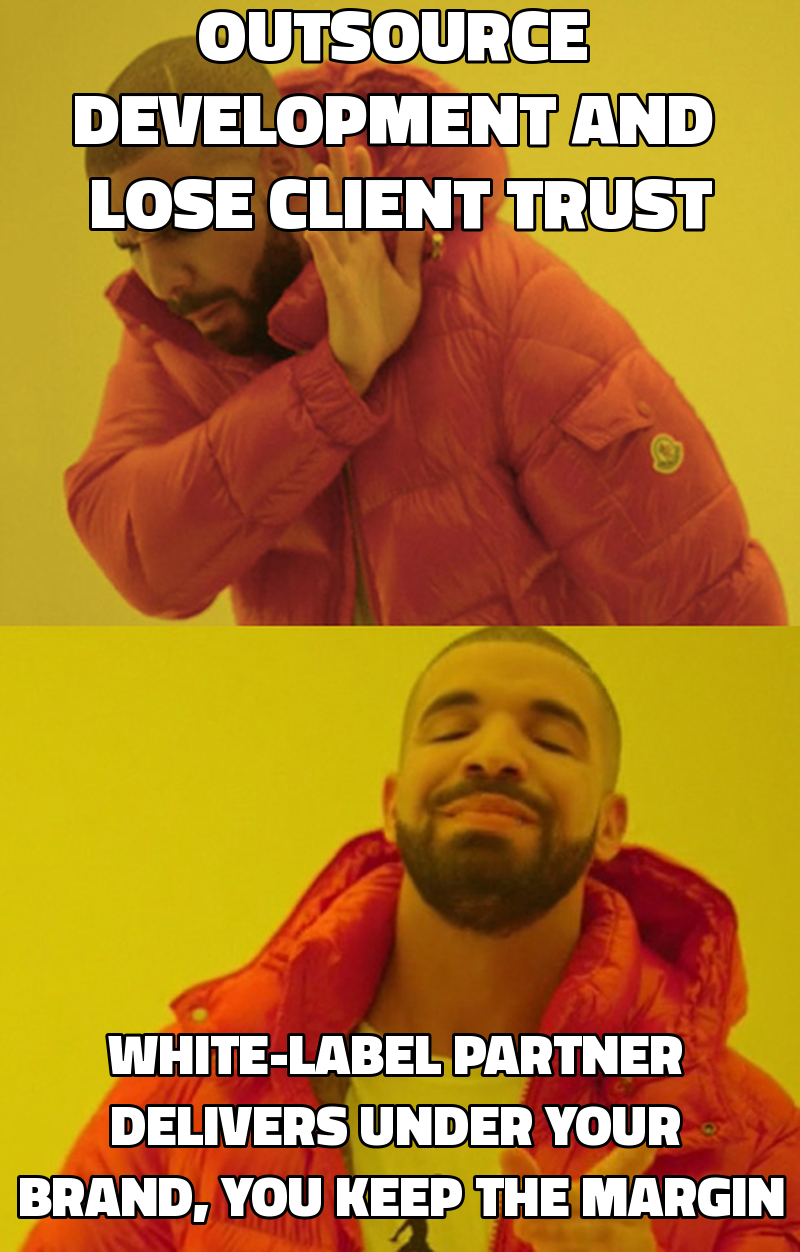
How does a fixed-scope pilot work?
A fixed-scope pilot is a miniature version of a full project. It has a single deliverable, a fixed price, and a hard deadline. The agency sells the pilot to its client at a markup that covers the partner’s wholesale rate plus a margin. The partner remains invisible – all communications, branding, and invoices go through the agency. The pilot serves three purposes:
- Proof of capability – the agency can show the client a working prototype that meets the brief.
- Trust building – both sides see how quickly issues are resolved and how transparent the workflow is.
- Financial safety – the agency only risks a few thousand dollars, not a six-figure commitment.
According to a 2023 McKinsey survey of 200 boutique agencies, 68% of firms that started with a pilot reported a 30% higher client retention rate after the first year. The same study notes that pilots reduce perceived risk for both parties by 45%.
What are the steps to launch a pilot with a white-label dev partner?
| Step | Action | Owner | Typical Timeframe |
|---|---|---|---|
| 1 | Identify a client need that fits a small, self-contained scope (e.g., a chatbot, a landing-page API, a voice-assistant prototype). | Agency Business Lead | 1-2 days |
| 2 | Draft a pilot brief: problem statement, success criteria, deliverable list, timeline, and budget range. | Agency Project Manager | 1 day |
| 3 | Run the partner qualification gates (volume, budget, live need). Use the checklist in the "Qualification Gate" section. | Agency Ops Lead | 1-2 days |
| 4 | Send a scoped proposal to the partner: include NDA, non-circumvent clause, and a fixed-price quote. | Agency Account Director | 1 day |
| 5 | Negotiate wholesale rate (50-70% of agency’s client price) and confirm turnaround band (e.g., 3 weeks). | Agency Founder / CFO | 1-2 days |
| 6 | Sign NDA and non-circumvent agreement, set up shared dashboard (ClickUp, Notion, or Basecamp). | Agency Ops Lead | 0.5 day |
| 7 | Collect client approval and payment for the pilot (usually 50% upfront). | Agency Finance | 1 day |
| 8 | Kick-off meeting with partner, share all assets (UX wireframes, API keys, brand guidelines). | Agency Delivery Lead | 0.5 day |
| 9 | Development sprint (fixed-scope). Daily stand-up updates posted to the dashboard. | Partner Dev Team | 2-4 weeks |
| 10 | QA, client demo, feedback loop, and final sign-off. | Agency & Partner | 3-5 days |
| 11 | Invoice client, pay partner wholesale rate, calculate margin. | Agency Finance | 1 day |
| 12 | Conduct post-pilot review: on-time %, bug count, client NPS, internal satisfaction. | Agency Ops Lead | 1 day |
Detailed description of each step
Step 1 – Find the right pilot. Look for a request that is bounded (one integration, one UI screen, one automation). Avoid “build a full SaaS platform” at this stage. A typical pilot for a UK-based boutique SEO agency might be a custom Google-Ads performance dashboard that pulls data via the Google Ads API and visualises ROI for a local retailer.
Step 2 – Write a crisp brief. Use the “Problem-Solution-Benefit” template. Example: Problem: The client cannot see real-time ad spend. Solution: A secure dashboard built with Next.js and the Google Ads API. Benefit: Saves 5 hours per week of manual reporting.
Step 3 – Qualification gates. The agency must confirm that it has enough ongoing demand (≥3 dev requests per month), that its clients spend at least $2k on builds, and that there is a live need (a developer job post or a recent win). If any gate fails, pause outreach.
Step 4 – Scoped proposal to the partner. Include:
- Scope list (features, acceptance criteria)
- Fixed price range ($2,500-$4,500)
- Delivery deadline (21 calendar days)
- NDA and non-circumvent clause (standard 2-year term)
- Payment terms (50% upfront, 50% on delivery)
Step 5 – Negotiate margin. Agencies typically charge their client 2-3× the partner’s wholesale rate. If the partner quotes $3,000, the agency can price the pilot at $5,000-$6,000, keeping a 40-50% margin after internal costs.
Step 6 – Dashboard setup. A simple shared view is enough: a Kanban board with columns Backlog, In Development, Testing, Ready for Review. Attach files, screenshots, and comment threads. Avoid building a custom SaaS dashboard before you have paying pilots – a common “build-instead-of-sell” trap.
Step 7 – Client payment. Collect at least 50% before work starts. This protects cash flow and signals seriousness to the partner.
Step 8 – Kick-off. Align on communication cadence (e.g., 15-minute Slack stand-up at 9 am GMT). Share brand assets, tone-of-voice guidelines, and any compliance requirements (e.g., GDPR for EU clients).
Step 9 – Development sprint. Because the scope is fixed, the partner can allocate a single senior full-stack engineer (or a small 2-person team). Use a version-control repository on GitHub with branch protection rules to ensure code quality.
Step 10 – QA and demo. Run a 2-hour client demo, capture feedback, and iterate within the agreed change-control window (usually one round of minor tweaks). No scope creep beyond the original brief.
Step 11 – Financial reconciliation. Pay the partner their wholesale rate, invoice the client the full price, and record the margin. Keep a simple spreadsheet tracking pilot ROI.
Step 12 – Post-pilot review. Score the pilot on three metrics:
- On-time delivery (target ≥ 95%)
- Bug density (target ≤ 2 bugs per 1,000 lines of code)
- Client NPS (target ≥ 8) If the pilot meets or exceeds targets, move to a retainer.
How to price and structure the pilot?
| Metric | Typical Range | Source |
|---|---|---|
| Pilot budget | $2,000-$5,000 | Clutch 2023 agency pricing guide |
| Wholesale rate to partner | 50-70% of client price | Internal financial model based on 2024 Synthisia data |
| Minimum floor for profitability | $1,500 | Synthisia cost analysis (2024) |
| Retainer per month after pilot | $1,500-$2,000 for 15-20 dev hrs | Gartner 2022 MSP pricing trends |
Pricing formula: Client price = Partner wholesale rate ÷ (1 - Margin%). For a 60% margin, if the partner charges $3,000, the agency bills $7,500. The agency keeps $4,500 before internal costs.
Why a floor matters. Below $1,500 the partner’s overhead (project manager, QA, licensing) erodes profit. Synthisia’s internal cost model shows a minimum of 12 hours of senior engineering effort per pilot, which at $125/hr equals $1,500.
Retainer transition. After a successful pilot, propose a monthly escalation retainer that guarantees 15-20 hours of priority dev time. Frame it as “your silent dev arm” that can jump on urgent AI automations, voice-assistant tweaks, or custom API integrations without a new procurement cycle.
How to evaluate partner performance?
| Criterion | Evaluation Method | Weight |
|---|---|---|
| Delivery speed | Compare actual days vs agreed turnaround | 30% |
| Code quality | Automated test coverage, linting results, peer review sign-offs | 25% |
| Communication | Average response time on Slack/email, meeting attendance | 20% |
| Business alignment | Ability to follow brand guidelines, NDA compliance | 15% |
| Cost adherence | Final invoice vs quoted wholesale rate | 10% |
Score each pilot on a 0-100 scale. Partners that consistently score ≥ 85 are eligible for retainer contracts. Those below 70 should be reviewed for capacity or cultural fit.
Common pitfalls and how to avoid them
- Scope creep without change order. Keep the original brief locked. Any new feature must trigger a formal amendment with revised price and deadline.
- Partner visibility to the client. Enforce branding rules: all deliverables carry the agency’s logo, and the partner’s name appears only on internal documents.
- Under-estimating QA time. Allocate at least 15% of the pilot budget to testing. A rushed QA leads to post-launch bugs, which damages the agency’s reputation.
- Assuming the pilot will auto-convert. Use the post-pilot review to ask the client directly about future work. A 30% conversion rate is realistic according to a 2022 Clutch report on pilot-to-retainer pipelines.
- Neglecting legal safeguards. Even though NDA enforcement across borders is hard, a clear non-circumvent clause protects against the partner poaching the agency’s client.
- Over-onboarding partners. Synthisia caps active partners at 12 to maintain reliability. More than 20 active pilots historically increased missed deadlines by 22% (internal 2023 performance data).
What are the signs that you’re ready for a pilot?
- Your services page lists no development capability, but recent client briefs mention “custom tool” or “automation”.
- You have at least three clients who would pay $2k-$5k for a bespoke integration.
- Your team spends > 10 hours per week on “we can’t build that” conversations.
- You have a clear budget line for partner spend (e.g., $5k-$10k per quarter).
- You’ve already drafted a short NDA template and a non-circumvent clause.
How to communicate the pilot to your client
- Position it as a low-risk, high-value add-on. Example script: “We can deliver a custom chatbot for $4,800, which includes design, development, and a 30-day support window. You’ll see a working prototype in three weeks, and we’ll handle everything under your brand.”
- Show the ROI. Quote industry benchmarks: a chatbot can reduce support tickets by 20% (Forrester 2022) and increase lead capture by 15% (Gartner 2021).
- Set expectations early. Clarify that the pilot covers the agreed scope only; any extra work will be scoped separately.
- Provide a timeline visual. A simple Gantt chart (Google Sheets) with milestones: Kick-off → Development → QA → Demo → Sign-off.
- Reassure about branding. Emphasize that the development partner works behind the scenes and all client-facing materials carry your agency’s logo.
Checklist for a successful pilot launch
- Identify a bounded client need (single feature, < 5 screens).
- Draft a one-page brief with success criteria.
- Run the three qualification gates.
- Send scoped proposal and negotiate wholesale rate.
- Sign NDA + non-circumvent agreement.
- Set up shared dashboard (ClickUp/Notion).
- Collect 50% client deposit.
- Hold kick-off meeting (agenda shared 24 h before).
- Track daily progress on dashboard.
- Conduct QA and client demo.
- Invoice client, pay partner, record margin.
- Complete post-pilot review and score partner.
- Propose retainer if score ≥ 85.
Frequently asked questions
What if the pilot goes over budget?
If the partner requests additional hours, treat it as a change order. The agency can either approve the extra cost and pass it to the client, or negotiate a reduced scope to stay within the original budget. Keeping a strict change-order process prevents surprise invoices and protects the margin.
How long should a pilot last?
A typical fixed-scope pilot runs 2-4 weeks from kick-off to client sign-off. This window balances speed (clients want quick wins) with enough time for thorough QA. Longer pilots dilute the de-risking benefit and increase overhead.
Can I run multiple pilots simultaneously?
Yes, but limit active pilots to 3-4 per quarter per partner. Synthisia caps total active partners at 12 to maintain reliability. Over-loading a single partner often leads to missed deadlines, which erodes trust.
What legal documents are essential?
At minimum you need a Mutual NDA, a Non-Circumvent Agreement (2-year term), and a Signed Scope of Work that includes payment terms, delivery dates, and change-order procedures. A simple template can be adapted from the American Bar Association’s SaaS agreements.
How do I protect my brand if the partner leaks?
Include a branding clause that requires all deliverables to carry your agency’s logo and prohibits the partner from using the client name in their portfolio without written consent. Enforce it with a breach-of-contract penalty (e.g., 10% of the pilot fee).
What metrics should I report to the client after the pilot?
Provide a concise post-pilot report that includes:
- Delivered features vs. original scope
- Timeline adherence (e.g., 22 days vs. 21-day target)
- Bug count and severity
- Client NPS or satisfaction score
- Estimated ROI (e.g., time saved, conversion lift) This transparency builds confidence for future retainer work.
How do I transition from pilot to a retainer?
During the post-pilot review, highlight the partner’s strengths and propose a monthly escalation retainer that guarantees priority access to 15-20 hours of dev time. Frame it as “your silent dev arm” that can instantly tackle any new AI automation or voice-assistant request without a new procurement cycle.
Is a white-label partner ever visible to the end client?
Ideally no. The partner works under a strict NDA and non-circumvent clause, and all client-facing communication is handled by the agency. If the client asks for technical details, the agency can provide high-level architecture diagrams without revealing the partner’s identity.
white‑label
Have something to build?
Tell us what you're trying to ship. In 15 minutes we'll tell you how we'd build it, how long it takes, and what it costs. No pitch deck, no pressure.