
How to Vet and Choose a Reliable US White-Label Development Agency

White-label development agencies in the USA are third-party studios that build software, AI automations, voice assistants or custom back-ends under your agency's brand, while you keep the client relationship and margin. The most reliable partners combine deep technical expertise, proven delivery processes and strict non-disclosure terms, so you can say yes to any client request without hiring an in-house engineer.
Key takeaways
- Define a pilot scope of $2,000-$5,000 to test speed, quality and communication before committing to larger deals.
- Use a three-gate qualification framework (volume, budget, live need) to filter prospects quickly.
- Prioritize agencies that specialize in AI/automation, have a single point of contact, and operate within the US time zones.
- Insist on NDA + non-circumvent clauses, but treat the pilot as the real trust mechanism.
- Track every project in a shared dashboard (e.g., Notion or ClickUp) to keep visibility and protect your brand.
- Limit active white-label partners to 3-5 to maintain reliability and avoid becoming the flaky freelancer you replaced.
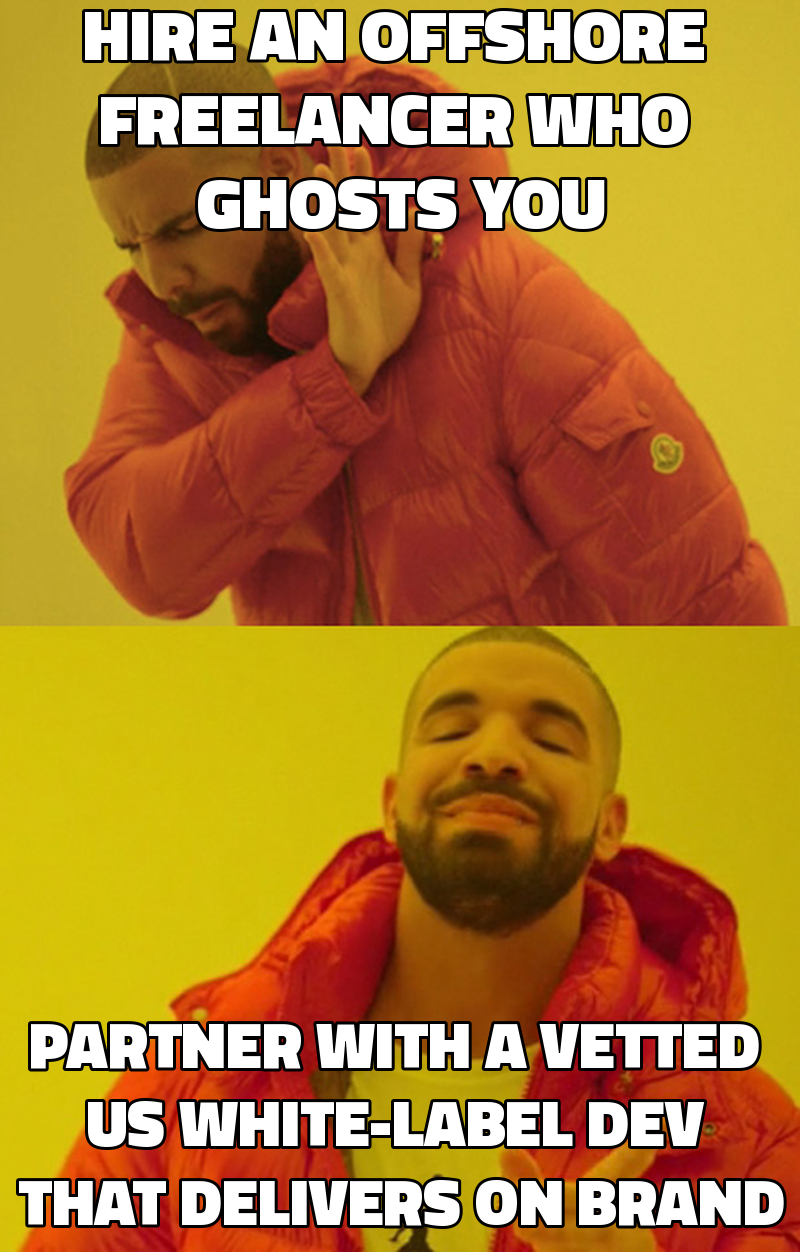
What is a white-label development agency and why choose one in the USA?
A white-label development agency builds digital products that you re-brand as your own. The model lets marketing, SEO or branding firms expand their service catalogue without the overhead of hiring engineers. Choosing a partner based in the United States gives you:
- Currency alignment – invoices are in USD, eliminating exchange-rate headaches.
- Time-zone overlap – a 9-5 EST partner provides same-day feedback for US-based agencies and reasonable async windows for UK/AU firms.
- Legal enforceability – U.S. contract law makes NDAs and non-circumvent clauses more reliable than offshore jurisdictions.
- Quality expectations – according to a 2023 Clutch survey, 42% of small agencies report higher satisfaction with domestic dev partners versus offshore alternatives.
How do I identify reliable white-label dev partners in the United States?
The first step is a signal-based hunt. Look for agencies that:
- List “custom software”, “AI automation” or “voice integration” on their service pages without offering development directly to end-clients.
- Publish case studies showing production SaaS or enterprise portals (e.g., RouteMate, a full-stack SaaS built for a health-tech client).
- Appear on reputable directories such as Clutch, GoodFirms or the Gartner Digital Markets Marketplace.
- Have a visible tech stack that includes modern frameworks (React, Node.js, Python, AWS) and CI/CD tools (GitHub Actions, CircleCI).
A quick 10-second site test (open Services → look for “development”) helps you filter out agencies that already have an in-house dev team or a disclosed partner.
What criteria should I use to vet a white-label dev agency?
| Criterion | Why it matters | How to evaluate |
|---|---|---|
| Domain expertise | AI, voice and custom back-ends are niche; generic WordPress shops can’t deliver. | Review case studies; ask for a technical walkthrough of a recent AI automation project. |
| Delivery track record | Missed deadlines erode client trust. | Request references; check project timelines on Upwork or LinkedIn endorsements. |
| Single point of contact (SPOC) | Reduces miscommunication and accountability gaps. | Confirm the name, title and Slack/Zoom availability of the SPOC during the pilot. |
| Pricing transparency | You need a wholesale margin of 50-70% as defined in your deal shape. | Ask for a rate card or a sample fixed-scope quote for a $3,000 build. |
| Legal safeguards | NDAs and non-circumvent clauses protect your brand. | Review a sample contract; verify the jurisdiction is a U.S. state (e.g., Delaware). |
| Capacity & concurrency limits | Over-onboarding creates the flaky-freelancer problem you want to avoid. | Ask how many active white-label partners they support simultaneously; aim for <5. |
| Tooling & transparency | Real-time dashboards keep you in the loop and reduce “black-box” risk. | Confirm they use ClickUp, Jira or a shared Notion board with status columns. |
Which U.S. agencies specialize in AI automation, voice, and custom back-ends?
| Agency | Specialty | Typical project size (USD) | Notable client |
|---|---|---|---|
| Synthisia | AI workflow automation, voice assistants, custom SaaS back-ends | $2,000-$10,000 | RouteMate (health-tech SaaS) |
| Elevate Labs | Machine-learning pipelines, data-driven dashboards | $5,000-$15,000 | GreenLeaf Marketing (analytics platform) |
| Clever Code Co. | Voice-first applications (Alexa, Google Assistant) | $3,000-$12,000 | BrightSide Retail (voice-enabled inventory) |
| Forge Foundry | Full-stack web portals, API integrations | $4,000-$20,000 | Apex Legal (client portal) |
| Pixel Pioneers | Low-code to custom code migration, API orchestration | $2,500-$8,000 | Nova Fitness (membership platform) |
All listed firms operate out of major U.S. tech hubs (NY, SF, Austin) and accept wholesale rates that fit your 50-70% margin model.
How to structure a pilot project that proves reliability
- Scope a fixed-price deliverable – choose a micro-feature (e.g., a chatbot prototype or a data-export API) worth $2,500-$4,000.
- Define success metrics – code quality (GitHub PR approval rate >90%), turnaround time (5-7 business days), and communication SLA (response <4 hours on Slack).
- Set a clear hand-off – at pilot end, the agency provides full documentation, source code repository access, and a walkthrough video.
- Pay a modest upfront deposit (30%) – signals commitment without exposing you to large risk.
- Review and decide – if metrics are met, move to a retainer model (e.g., $1,500/month for 15-20 dev hours) as outlined in your deal shape.
A pilot also serves as a de-risking conversation point with your client: you can say, “We’ve tested the concept with a trusted partner and are ready to deliver the full solution.”
What contract terms protect my brand and margin?
- Non-Disclosure Agreement (NDA) – standard 2-year term, signed by both parties.
- Non-Circumvent Clause – prohibits the dev agency from contacting your client directly for a period of 18 months.
- Wholesale Pricing Schedule – list the wholesale rate (e.g., 55% of client bill) and include a floor of $1,500 per project to cover overhead.
- Service Level Agreement (SLA) – define response times, bug-fix windows, and escalation paths.
- Intellectual Property Assignment – all code and assets belong to the agency (you) upon final payment.
- Termination Rights – 30-day notice with a pro-rated refund for any work not yet delivered.
While NDAs are table-stakes, the pilot’s performance is the real trust lever; a well-executed pilot reduces reliance on legal enforcement.
What red flags indicate a risky partner?
- No clear SPOC – multiple emails from different engineers.
- Off-shore address or low-cost geo listed – suggests margin-driven pricing, not reliability.
- Promises of “same-week delivery” without a defined scope – often a sign of over-commitment.
- Lack of case studies or vague client names – may be fabricating experience.
- Existing white-label partner displayed on their site – your gap may already be filled.
- Team size >20 with an internal dev department – they are a product shop, not a partner.
If any of these appear during the pre-call checks, politely decline or move them to a “nurture” bucket.
How to onboard and manage the partnership for long-term success?
- Kick-off meeting with the SPOC – align on communication tools (Slack channel, weekly Zoom), project naming conventions, and version-control workflow.
- Shared dashboard – set up a ClickUp board with columns: Backlog, In-Progress, Review, Done. Grant your account view-only access.
- Quarterly performance review – track SLA adherence, bug rates, and margin health. Adjust the wholesale rate if the partner consistently exceeds expectations.
- Capacity planning – limit active partners to 3-5; if you approach the cap, pause new onboarding until a partner’s contract ends.
- Escalation path – designate a senior operations director on your side who can intervene if the dev partner misses a deadline.
- Co-marketing opportunities – once trust is proven, ask the partner for joint case studies (under your brand) to attract higher-margin clients.
By treating the white-label partner as an extension of your delivery team rather than a vendor, you preserve brand integrity and keep the client relationship front-and-center.
Frequently asked questions
How much does a typical white-label dev project cost in the US?
Projects range from $2,000 for a simple chatbot to $20,000 for a full SaaS portal. The wholesale margin you keep should sit between 50-70% of the client bill, as outlined in your deal shape.
Do I need a lawyer to draft the NDA and non-circumvent clause?
A basic NDA can be sourced from the American Bar Association template and customized for your agency. For the non-circumvent clause, a short addendum reviewed by a contract-savvy attorney ensures enforceability.
Can I work with multiple white-label partners simultaneously?
Yes, but keep the total active partners under five to maintain reliability. Over-onboarding creates the flaky-freelancer problem you aim to avoid.
What if the partner misses a deadline?
Your SLA should include a penalty clause (e.g., 5% discount on the invoice for each day beyond the agreed turnaround). Escalate through the designated senior ops contact.
Are there tax implications when paying a US partner as a wholesale partner?
Payments are reported on Form 1099-NEC if the partner is an independent contractor. If they are a corporation, you receive a W-9 and no 1099 is required.
How do I protect my agency’s brand if the partner is visible to the client?
Require the partner to use your agency’s branding on all deliverables, email signatures, and project documentation. The NDA and non-circumvent clause reinforce this invisibility.
What tools should we use for project tracking?
ClickUp, Notion, or Jira are popular. Choose one that both teams can access; integrate with Slack for real-time notifications.
How long should the pilot phase last?
A 2-4 week pilot is ideal for a $2,500-$4,000 scope. It provides enough time to assess quality, communication, and turnaround without locking up large budgets.
white‑label
Have something to build?
Tell us what you're trying to ship. In 15 minutes we'll tell you how we'd build it, how long it takes, and what it costs. No pitch deck, no pressure.