
How to Choose a Reliable White-Label Web Development Partner in India for US Agencies

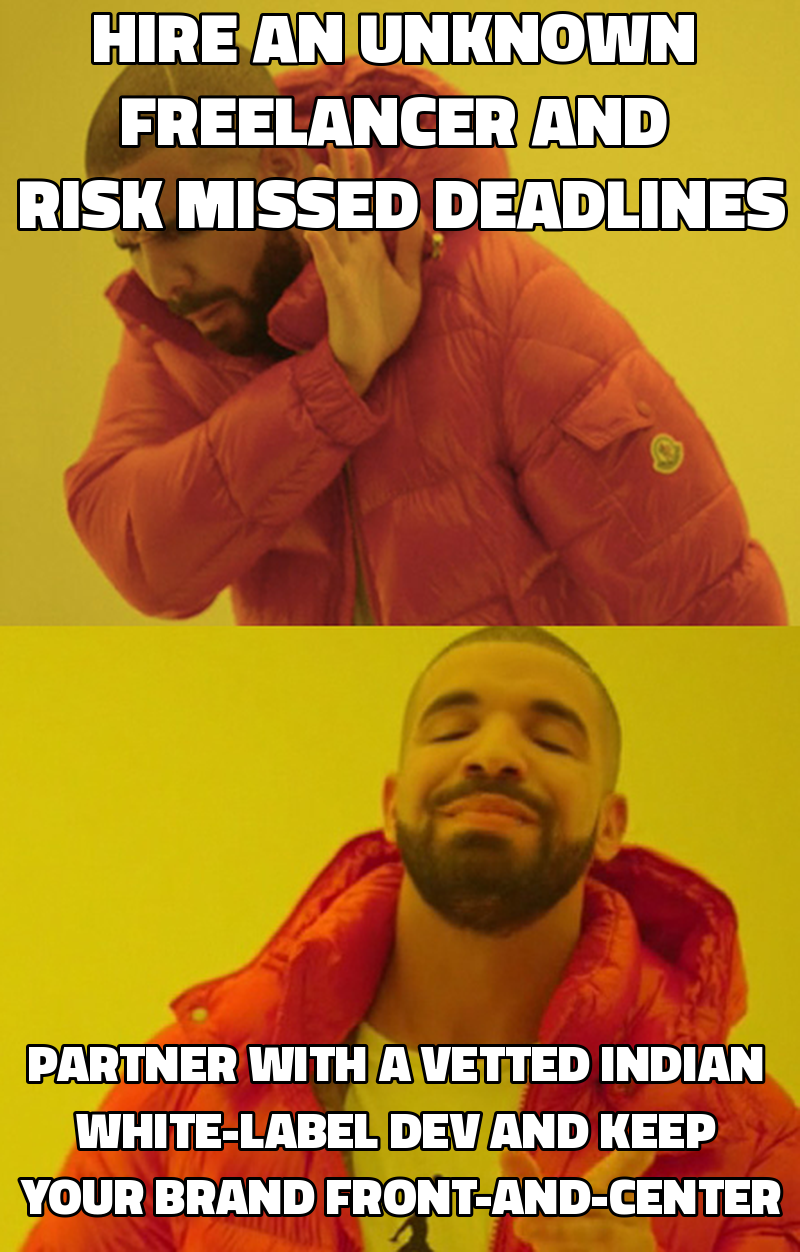
White-label web development agencies in India exist to let US marketing and SEO firms deliver custom builds without hiring engineers. The right partner offers a single accountable point of contact, transparent pricing, and a communication model that respects the 9-12 hour IST-US time gap while keeping your brand invisible to the client.
Key takeaways
- Pick partners that specialize in AI automation, voice, and custom back-ends – services no-code shops can’t handle.
- Verify a fixed-scope pilot with a clear turnaround (typically 2-4 weeks) before committing to larger projects.
- Choose a communication model that provides a dedicated Slack channel, weekly status calls, and a shared project dashboard.
- Expect Indian white-label rates 30-45% lower than US boutique dev shops, but factor in a 10-15% margin for reliability and IP protection.
- Legal safeguards (NDA, non-circumvent clause) are baseline; enforce reliability through performance SLAs, not contracts.
- Limit active partners to 5-7 agencies to maintain low concurrency and avoid the flaky-freelancer trap.
Why US agencies look to India for white-label development
US and UK agencies with 5-15 staff often lack in-house engineers but still receive client requests for custom SaaS tools, chatbot integrations, or voice assistants. Hiring a full-time developer in San Francisco or London can cost $150-200k per year, according to the Robert Half 2024 Salary Guide. By contrast, an experienced senior full-stack engineer in Bangalore commands $30-45k USD annually, according to a Stack Overflow 2023 developer survey. The cost differential enables agencies to keep a healthy margin while expanding service offerings.
Beyond price, India offers a deep talent pool in JavaScript, Python, and cloud-native architectures. Cities such as Bangalore, Hyderabad, and Pune host more than 2 million software engineers, per NASSCOM 2023 data. The large English-speaking workforce aligns with US agency expectations for clear documentation and client-facing communication.
Core selection criteria for an Indian white-label partner
| Criterion | What to look for | Why it matters |
|---|---|---|
| Domain expertise | Proven projects in AI automation, voice, custom back-ends | Agencies sell these high-margin services; a partner lacking them can’t deliver value |
| Delivery reliability | Minimum 95% on-time rate over the last 12 months (client-verified) | Missed deadlines damage agency reputation and client trust |
| Communication cadence | Dedicated Slack/Teams channel, weekly video sync, real-time dashboard | Keeps US agency in the loop despite the 9-12 hour time gap |
| Pricing transparency | Fixed-scope pilot cost disclosed, clear hourly or per-project rates, no hidden fees | Enables accurate quoting and protects margin |
| IP & confidentiality | Signed NDA, non-circumvent clause, code ownership transferred to agency | Prevents poaching and protects client data |
| Team size & scalability | 5-10 engineers with a single account manager | Guarantees low concurrency and personal accountability |
Communication models compared
| Model | Frequency | Tools | Pros | Cons |
|---|---|---|---|---|
| Synchronous video only | Daily 30-minute calls | Zoom, Google Meet | Real-time issue resolution | Hard to schedule across 9-12 hour gap |
| Asynchronous Slack + weekly sync | Continuous chat, weekly 45-minute call | Slack, ClickUp | Works with IST-US overlap, reduces meeting fatigue | Requires disciplined updates |
| Project dashboard + bi-weekly review | Dashboard updates, 30-minute call every 2 weeks | ClickUp, Jira, custom status page | Transparent progress, easy for multiple stakeholders | Slower feedback loop |
Cost structures you will encounter
| Structure | Typical range (USD) | When it fits best |
|---|---|---|
| Fixed-scope pilot | $1,500-$3,000 for a 2-4 week MVP | First engagement, risk-averse agencies |
| Per-project flat fee | $5,000-$20,000 depending on complexity | Predictable budgets, repeatable builds |
| Monthly retainer | $1,500-$2,500 for 15-20 hrs of escalation capacity | Ongoing overflow, steady pipeline |
| Hourly rate (rare) | $30-$55 per hour | Small bug fixes or ad-hoc tasks |
A typical US agency quoting a $8,000 custom dashboard can purchase the build for $4,500 from an Indian partner, retain a 55% margin, and still cover the agency’s overhead.
Red flags and disqualifiers
- The partner lists "development" as a public service on their website – they are likely a direct competitor, not a white-label provider.
- No clear point of contact; multiple engineers rotate without accountability.
- Absence of a signed NDA or non-circumvent clause in the initial proposal.
- Turnover rate above 30% in the past year (ask for employee tenure data).
- Promises "same-week delivery" without a defined turnaround band – this often leads to rushed, low-quality code.
Legal and IP safeguards
- NDA – Standard 2-year confidentiality agreement covering all project artefacts.
- Non-circumvent clause – Prevents the partner from approaching your clients directly for a defined period (usually 12 months).
- Code ownership transfer – Include a clause that all source code, designs, and documentation become the agency’s property upon payment.
- Service Level Agreement (SLA) – Define on-time delivery (e.g., 95% of milestones within 48 hours of agreed date) and quality metrics (e.g., <2% critical bugs after release).
Managing timezone overlap and workflow
India operates on IST (UTC+5:30). The typical US East Coast window (8 am-12 pm EST) overlaps with 6:30-10:30 pm IST, which is ideal for a daily hand-off. Schedule a brief end-of-day sync at 11 am EST to capture blockers and set priorities for the Indian team’s night shift. Use a shared Kanban board (ClickUp or Jira) with columns: Backlog, In-Progress, Review, Done. Tag each task with the agency’s brand name to keep the partner invisible to the client.
Top Indian cities and vetted firms for white-label work
| City | Notable firms (examples) | Specialties |
|---|---|---|
| Bangalore | Synthisia, CodeWave, VividLogic | AI automation, SaaS platforms, voice assistants |
| Hyderabad | CloudMinds, DevBridge, PixelPerfect | Cloud-native microservices, ERP integrations |
| Pune | TuringHive, BrightApps, NexaTech | Front-end React/Next.js, UI/UX, rapid prototyping |
| Chennai | SoftPulse, ApexCode, BlueOrbit | Backend Node.js, API gateways, data pipelines |
When evaluating, request a case study similar to RouteMate – a full-stack SaaS built end-to-end for an agency partner and delivered within 6 weeks.
Step-by-step onboarding process
- Pre-call qualification – Run the 10-second site test, confirm no in-house dev, and verify recent client case studies.
- Discovery call – Ask the three gate questions (volume, budget, live need). Record answers in a shared CRM.
- Pilot proposal – Define scope (e.g., a chatbot prototype), fixed price ($2,200), and turnaround (3 weeks). Include SLA clauses.
- Legal sign-off – NDA and non-circumvent signed via DocuSign.
- Kick-off meeting – Introduce the dedicated account manager, set up Slack channel, and share the ClickUp board.
- Mid-pilot review – Demo the prototype, gather agency feedback, adjust scope if needed.
- Pilot acceptance – Agency signs off, pays invoice, and decides on retainer or next project.
- Retainer onboarding – Allocate 15-20 hrs/month of escalation capacity, set monthly review cadence.
ROI example
Assume an agency wins a $12,000 client project for a custom lead-gen portal.
- Fixed-scope pilot cost: $3,500 (includes design, dev, QA).
- Remaining build cost: $5,000 (flat fee).
- Total spend on partner: $8,500.
- Agency margin: $3,500 (29%).
- Additional benefit: Ability to quote and win the project, preserving the client relationship and opening doors for future upsells.
Building trust beyond contracts
Reliability is proven through performance, not paperwork. Use these trust levers:
- Pilot success – Deliver the first build on time and with <2% critical bugs.
- Transparent dashboard – Real-time status updates reduce the “black box” feeling.
- Reference client – Provide a contact at a similar agency that has successfully used the partner.
- Escalation path – A 24-hour response SLA for blockers ensures the agency never feels stuck.
Frequently asked questions
How long does a typical pilot take?
A well-scoped pilot for a chatbot or simple web app usually finishes in 2-4 weeks. The timeline includes discovery, design mockups, development, QA, and a client demo. Agencies should budget a 3-week window to accommodate feedback cycles.
What is the average hourly rate for senior Indian developers?
Senior full-stack engineers in Bangalore charge $30-$45 per hour, according to the 2023 Stack Overflow survey. Junior engineers are $15-$25 per hour, but most white-label partners recommend senior staff for client-facing work to maintain quality.
Can I keep my brand completely invisible?
Yes. A reputable white-label partner signs a non-disclosure and non-circumvent agreement, delivers code under your repository, and never mentions their name in client communications. All deliverables are branded with your agency’s logo.
How do I handle IP ownership?
Include a clause in the contract that transfers all source code, designs, and documentation to the agency upon final payment. This is standard practice and protects you if the partner later works with a competitor.
What if the partner misses a deadline?
Define an SLA that specifies a penalty (e.g., 5% discount on the delayed milestone) and a remediation plan (additional resources at no extra cost). This creates accountability without needing legal enforcement.
Is a retainer worth it?
A retainer guarantees 15-20 hours of escalation capacity each month, smoothing out peak demand and reducing the need for ad-hoc pilots. For agencies with at least three builds per quarter, the retainer pays for itself by avoiding rushed pilots and missed revenue.
How do I evaluate cultural fit?
Ask for a short video introduction of the account manager, review their English proficiency, and check time-zone overlap willingness. A partner that schedules a daily 15-minute stand-up in EST-compatible hours shows commitment to your workflow.
Do I need a separate legal entity in India?
No. Most white-label partners operate as a limited company in India and invoice you directly in USD. Ensure they have a valid GST registration and can provide a tax invoice for your accounting.
white‑label
Have something to build?
Tell us what you're trying to ship. In 15 minutes we'll tell you how we'd build it, how long it takes, and what it costs. No pitch deck, no pressure.