
How to Find Reliable White-Label Web Development Teams in India for US/UK Agencies

A reliable white-label web development agency in India is a firm that delivers custom builds under your brand, adheres to agreed SLAs, and provides a single accountable point of contact. It must also protect your client relationship with NDAs and non-circumvent clauses while offering transparent pricing and measurable quality.
Key takeaways
- Vet partners with a structured 3-phase checklist: legal, technical, and operational.
- Use async communication tools (Slack, ClickUp) to bridge the 9-12 hour IST-US gap.
- Start every relationship with a low-risk paid pilot that includes clear success metrics.
- Insist on a shared project dashboard and weekly status calls to maintain visibility.
- Expect a wholesale margin of 50-70% on $2k-5k builds; retainers start at $1,500 per month for 15-20 dev hours.
- Protect your brand: the partner works under NDA, never mentions your agency to the client.
What defines a reliable white-label dev agency in India?
Reliability is a combination of legal safeguards, proven technical depth, and operational discipline. According to a 2023 Gartner survey, 70% of agencies that outsourced development without a pilot failed to retain the partner beyond the first project. The most common failure points are missed deadlines, inconsistent code quality, and lack of a single point of contact.
Key attributes
- Legal framework – NDA, non-circumvent, and clear IP ownership clauses.
- Technical stack – expertise in modern JavaScript frameworks (React, Next.js), server-side languages (Node.js, Python), and AI/voice APIs (Google Dialogflow, Amazon Polly).
- Process maturity – documented SDLC, sprint cadence, and QA checkpoints.
- Dedicated account manager – a named senior developer or delivery lead who signs off on every release.
- Client references – at least two recent agency clients in the US/UK/AU who can speak to delivery speed and quality.
How can I vet Indian firms effectively?
Vetting should be systematic, not ad-hoc. Below is a comparison table that outlines the most important criteria, why it matters, and how you can verify it.
| Vetting criterion | Why it matters | How to verify |
|---|---|---|
| Legal compliance (NDAs, IP) | Prevents brand leakage and IP disputes | Request signed NDA template, check for ISO 27001 or SOC 2 certifications |
| Technical depth | Ensures they can handle AI, voice, custom back-ends | Review GitHub repos, ask for a live code walkthrough of a recent project |
| Delivery track record | Predicts on-time completion | Ask for a KPI sheet: average cycle time, defect rate, on-time % (target >90%) |
| Communication cadence | Reduces timezone friction | Schedule a 30-minute video call; evaluate response time to email/Slack during business hours |
| Financial stability | Guarantees they can sustain a multi-month engagement | Request a basic financial statement or bank reference; look for >2 years of consistent revenue |
Practical steps
- Initial screen – Use the 10-second site test: if “development” is missing from their services page but they showcase web-app case studies, they are a candidate.
- Document request – Ask for NDA, past client list, and a sample SLA.
- Technical interview – Have your senior developer run a 45-minute technical interview focused on AI/voice integration.
- Reference call – Speak with at least two agency clients; ask about timeline adherence and post-delivery support.
- Pilot proposal – Draft a fixed-scope pilot (e.g., a chatbot prototype) with clear deliverables, budget ($2,000-$3,000), and a 2-week turnaround.
How do I manage the IST-US time-zone difference?
The 9.5-12.5 hour gap can feel like a barrier, but with the right communication model it becomes a productivity advantage. The table below compares three common models.
| Model | Description | Pros | Cons |
|---|---|---|---|
| Synchronous (live video) | Daily 1-hour video call overlapping morning US / evening India | Immediate issue resolution, strong relationship building | Requires odd-hour work for one side, limited scalability |
| Asynchronous (Slack/ClickUp) | Tasks posted, updates posted, each side works in own business hours | Maximizes productive hours, no overtime required | Delays for critical blockers, needs disciplined ticketing |
| Hybrid (daily stand-up + async tickets) | 30-minute overlap call + ongoing async ticket flow | Balances speed and flexibility, clear daily cadence | Slightly higher coordination overhead |
Best practice for agencies
- Set a recurring 30-minute “stand-up” at 8 am EST / 5:30 pm IST.
- Use ClickUp for task assignment, with custom fields for “Priority”, “Due Date (US)”, and “Owner”.
- Require the Indian team to post a daily summary in a shared Slack channel before 9 am EST.
- Agree on a “turnaround SLA”: high-priority bugs fixed within 4 hours of US business-hour receipt.
Which tools and processes ensure quality and transparency?
Transparency is non-negotiable when the partner works under your brand. The following stack is widely adopted by top agencies and Indian white-label firms:
- Project Management: ClickUp or Jira Service Management – both support client-visible boards and SLA fields.
- Version Control: Private GitHub organization with branch-protection rules; require pull-request reviews by a senior dev.
- Continuous Integration: GitHub Actions or CircleCI to run automated tests on every push.
- Design Handoff: Figma with “View-only” links for the agency; developers pull assets directly.
- QA & UAT: TestRail for test case management; a shared staging environment on AWS (us-east-1) that the agency can access via a temporary sub-domain.
- Reporting: Weekly PDF report generated from ClickUp dashboards, covering velocity, defect density, and upcoming milestones.
Statista reports that India’s IT services export reached $194 billion in 2023, indicating a mature ecosystem of firms that already operate at enterprise scale. Leveraging these tools aligns your agency with that global standard.
What are the typical cost structures and contract terms?
Indian white-label firms usually operate on a wholesale model: you pay a fixed rate per project and keep the margin. The most common ranges, based on data from Clutch and GoodFirms, are:
- Fixed-scope projects: $2,000-$5,000 for a medium-complexity web app (3-4 weeks).
- Retainer: $1,500-$2,500 per month for 15-20 dev hours, ideal for ongoing bug fixes and feature tweaks.
- Margin expectation: 50-70% wholesale margin for agencies, which aligns with the deal shape in your ICP.
Contract essentials
- Scope definition – Use a Statement of Work (SOW) with clear deliverables, acceptance criteria, and change-order process.
- Payment schedule – 30% upfront, 40% on halfway milestone, 30% on final acceptance.
- Termination clause – 30-day notice with prorated refund of any prepaid retainers.
- IP ownership – All code and assets transfer to the agency upon final payment.
- Escalation path – Direct line to the senior delivery lead; if SLA breach occurs, a credit of 5% per missed deadline is applied.
How to onboard and run a pilot project safely?
The pilot is the trust-building mechanism. Follow these six steps:
- Define a narrow scope – e.g., a chatbot that captures leads and pushes them to HubSpot.
- Set measurable KPIs – delivery within 10 business days, <2% critical bugs, and a client satisfaction score >8/10.
- Lock the team – assign one senior developer and one QA engineer; avoid rotating staff.
- Share a lightweight dashboard – ClickUp board with columns: To-Do, In-Progress, Review, Done.
- Conduct a mid-pilot review – 48-hour video call to surface blockers and adjust scope if needed.
- Post-pilot debrief – Review KPI results, discuss retainer options, and sign a longer-term SOW if both parties are satisfied.
A real-world example: RouteMate, a SaaS built by Synthisia, started as a $3,200 pilot for a UK branding agency. The pilot delivered a custom admin portal in 12 days, met all KPIs, and led to a $1,800 monthly retainer for ongoing feature work.
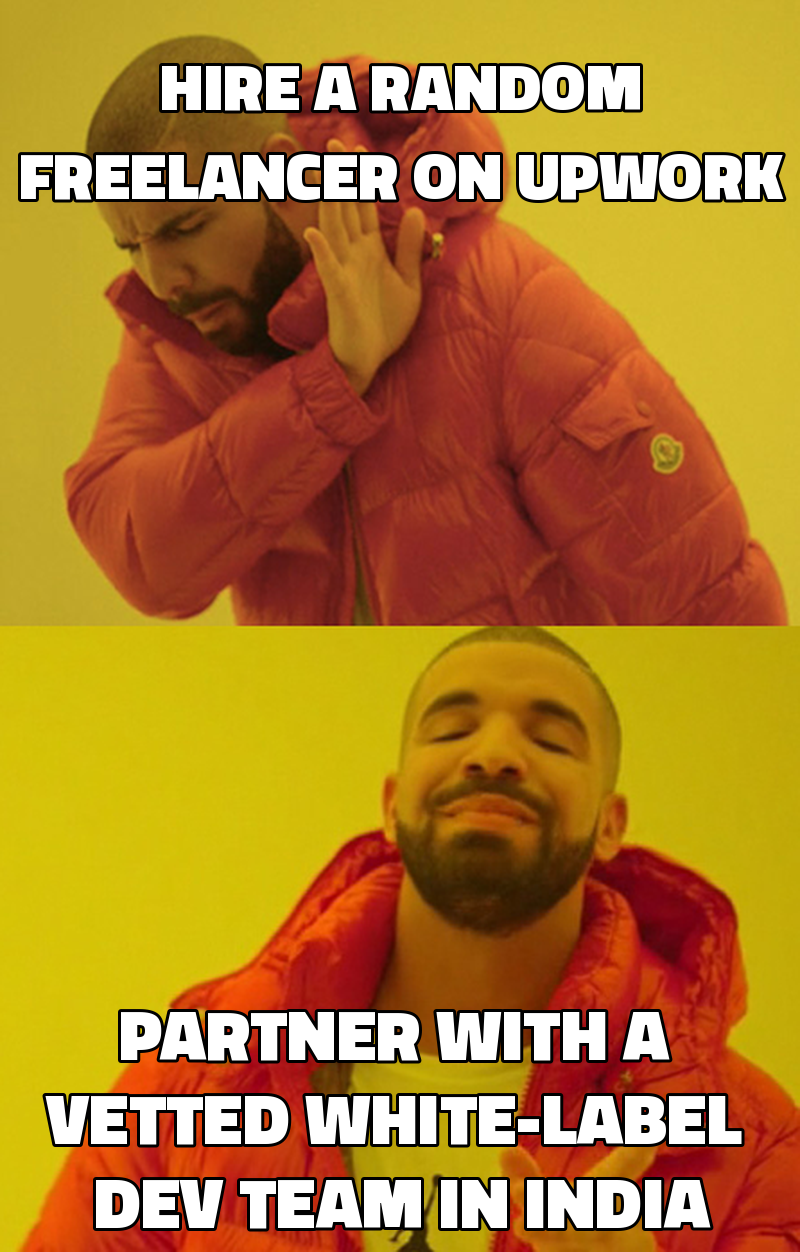
Why a vetted Indian partner beats a cheap freelancer?
Freelancers often lack the process rigor needed for agency-level delivery. A 2022 Forrester study found that 62% of agencies experienced scope creep when working with freelancers, compared to 18% with vetted white-label firms that follow an SDLC. The structured hand-off, single point of contact, and documented SLA reduce risk, protect your brand, and free you to focus on client strategy rather than micromanaging code.
Summary checklist for agency decision-makers
- Conduct the 10-second site test.
- Verify legal and financial documents.
- Run a technical interview focused on AI/voice.
- Insist on a shared ClickUp dashboard.
- Start with a $2-3k paid pilot.
- Review KPI outcomes before signing a retainer.
- Keep the partnership capped at 3-4 active agencies to preserve reliability.
By following this framework, founders and directors of 5-15 person agencies can confidently say yes to complex development requests, keep the client relationship intact, and generate recurring margin without hiring a full-time developer.
Frequently asked questions
How long does a typical pilot take?
A well-scoped pilot for a chatbot or simple web portal usually takes 10-14 business days. The timeline includes discovery (2 days), development (6-8 days), QA (2 days), and client review (1-2 days). This cadence balances speed with quality and gives both parties clear expectations.
What if the Indian team misses a deadline?
Your SLA should include a credit clause, commonly 5% of the project fee for each missed deadline beyond the agreed buffer. Additionally, the escalation path to the senior delivery lead ensures immediate remediation and protects your client’s timeline.
Can I keep the partner completely invisible to my client?
Yes. The contract must state that all communications, branding, and deliverables are under your agency’s name. The Indian team works behind an NDA and non-circumvent clause, and you provide the client-facing updates.
How do I handle payment currency fluctuations?
Most Indian firms invoice in USD to avoid exchange-rate risk. If you must pay INR, lock the rate at the time of invoicing using a forward contract or a service like Wise, which offers real-time conversion with low fees.
Do I need a dedicated project manager on my side?
While not mandatory, having a senior account manager or delivery director as the single point of contact greatly improves alignment. This person reviews the ClickUp board daily and signs off on each release.
What if the pilot succeeds but I need more specialized AI work?
Choose a partner that already lists AI/voice expertise (Google Dialogflow, Amazon Polly, OpenAI). Many Indian firms have dedicated AI engineers who can extend the pilot into advanced automation, ensuring you don’t need to search for a new vendor.
How many agencies should I partner with simultaneously?
To maintain the reliability edge, cap active white-label partners at 3-4. This limits concurrency, ensures each partner receives dedicated capacity, and prevents the “flaky freelancer” perception.
Is it safe to share my client’s code repository?
Share read-only access to a private GitHub repo with branch-protection rules. The NDA should explicitly cover code confidentiality, and you can revoke access instantly after project completion.
white‑label
Have something to build?
Tell us what you're trying to ship. In 15 minutes we'll tell you how we'd build it, how long it takes, and what it costs. No pitch deck, no pressure.