
How to Vet Indian White-Label Web Development Agencies for US Marketing Partners

A white-label web development agency in India is a firm that builds websites, web apps or custom integrations for another agency, which then sells the work under its own brand. It lets US/UK/AU marketing agencies expand their service catalog without hiring a full-time engineer.
Key takeaways
- Verify legal safeguards: NDA, non-circumvent clause and clear IP ownership.
- Prioritize agencies with proven AI, voice and custom-backend experience, not just generic WordPress.
- Use a paid pilot of $1,500-$2,000 to test delivery speed, communication and code quality.
- Red-flags include in-house dev listings, overly large staff, or a public partner logo that matches your gap.
- Aim for a wholesale margin of 50-70% on $2k-$5k projects and a retainer of $1,500 per month for ongoing escalation capacity.
- Track every prospect with the three-gate qualification framework: volume, budget and live need.
What is a white-label web development agency in India?
White-label agencies act as an invisible production line. The client agency retains the relationship, branding and margin, while the Indian partner writes code, configures servers and conducts QA. The model grew after the 2008 outsourcing boom and now accounts for roughly 30% of Indian IT service revenue, according to a 2022 Gartner report. For US-based marketing firms that lack developers, the model offers three core benefits: speed, expertise in niche technologies (AI automation, voice assistants, custom SaaS back-ends) and cost predictability.
Why US/UK/AU agencies look to India
- Talent depth – India produces over 1.5 million engineering graduates per year (Statista, 2023). Companies such as TCS and Infosys have built global delivery centers that spill over to boutique firms.
- Time-zone overlap – IST is 9.5-12.5 hours ahead of US Eastern, allowing overnight development and next-day review cycles. Australian agencies enjoy a 4-5 hour overlap, which is ideal for real-time stand-ups.
- Cost advantage without sacrificing quality – McKinsey notes that Indian software firms can deliver at 30-40% of US labor cost while maintaining comparable defect rates.
- Cultural alignment – English is an official language and many Indian firms adopt Agile ceremonies that mirror US agency practices.
The evaluation framework you can copy today
Below is a weighted checklist you can paste into a spreadsheet. Scores are on a 1-5 scale; multiply by the weight column to get a total out of 100. A score above 70 indicates a partner ready for a pilot.
| Criterion | Weight (%) | How to assess |
|---|---|---|
| Legal safeguards (NDA, non-circumvent) | 15 | Request signed documents, verify clause language. |
| Technical depth (AI, voice, custom APIs) | 20 | Review portfolio, ask for a demo of a recent automation. |
| Delivery reliability (on-time % past 12 months) | 15 | Ask for a KPI report or reference client. |
| Communication cadence (daily stand-up, Slack, video) | 10 | Test during the pilot; note response time. |
| Team size and specialization | 10 | Ensure 5-15 core staff, with at least one senior full-stack engineer. |
| Pricing transparency (fixed-scope rates) | 10 | Compare quoted rates to market benchmarks from Clutch. |
| Client overlap (US/UK/AU focus) | 10 | Verify they have existing US clients but not direct competition. |
| Cultural fit (English fluency, work hours) | 5 | Conduct a 30-minute video call. |
| Security posture (ISO 27001, SOC 2) | 5 | Request certification copy. |
Red-flag checklist (instant disqualifiers)
If any of the following appear, move on to the next prospect. This table is a quick screen before you invest a call.
| Red flag | Why it matters |
|---|---|
| Agency lists "development" as a service on its public site | No gap to fill; they already compete with you. |
| Displays a partner logo that is a direct competitor (e.g., another US agency) | Margin erosion and potential poaching. |
| Staff count > 20 with a dedicated dev team | Likely already has its own pipeline, reduces exclusivity. |
| Operates out of a low-cost offshore hub other than India (e.g., Philippines) while billing US clients | Margin compression, higher risk of sub-sub-contracting. |
| No recent case studies or social activity in the past 12 months | May be dormant or lacking live projects. |
| Offers only no-code solutions (Webflow, Wix) | Cannot handle AI or custom backend requests. |
| Provides only a "free first draft" without a scoped proposal | High risk of unpaid labor and brand dilution. |
How to run a low-risk pilot
- Scope a fixed-price micro-project – $1,500-$2,000, 2-3 weeks, single feature (e.g., a chatbot integration).
- Set clear success metrics – code repository access, daily stand-up minutes, defect count < 5.
- Use a shared project dashboard – a simple Google Sheet or Notion page works; avoid building a custom SaaS dashboard before you have paying partners.
- Document every hand-off – capture screenshots of code reviews, test reports and sign-off emails.
- Evaluate after delivery – if the pilot meets the 70+ score in the evaluation framework, move to a retainer agreement.
Pricing model that protects your margin
| Deal component | Typical range (USD) | Reasoning |
|---|---|---|
| Fixed-scope pilot | 1,500 – 2,500 | Covers onboarding, discovery and a tangible deliverable. |
| Ongoing project | 2,000 – 5,000 per build | Aligns with agency client budgets; allows 50-70% wholesale margin. |
| Monthly retainer | 1,500 – 2,500 | Guarantees 15-20 dev hours for escalation, reduces churn. |
| Minimum floor per invoice | 1,500 | Below this the delivery overhead outweighs profit. |
Real-world example: RouteMate partnership
Synthisia partnered with a Bangalore-based firm that specialized in voice-enabled SaaS platforms. The first pilot was a $1,800 AI-driven chatbot for a UK health-tech client. Delivery took 12 days, with daily video stand-ups and a shared GitHub repo. The agency kept the client relationship, marked up the cost to $3,200, and signed a $1,500/month retainer for future feature work. Within three months the partnership generated $12,000 in repeat revenue and eliminated the need for a costly in-house hire.
Common misconceptions that kill deals
- "Cheapest offshore is best" – Price-only competition leads to missed deadlines and low-quality code, which damages the agency’s brand.
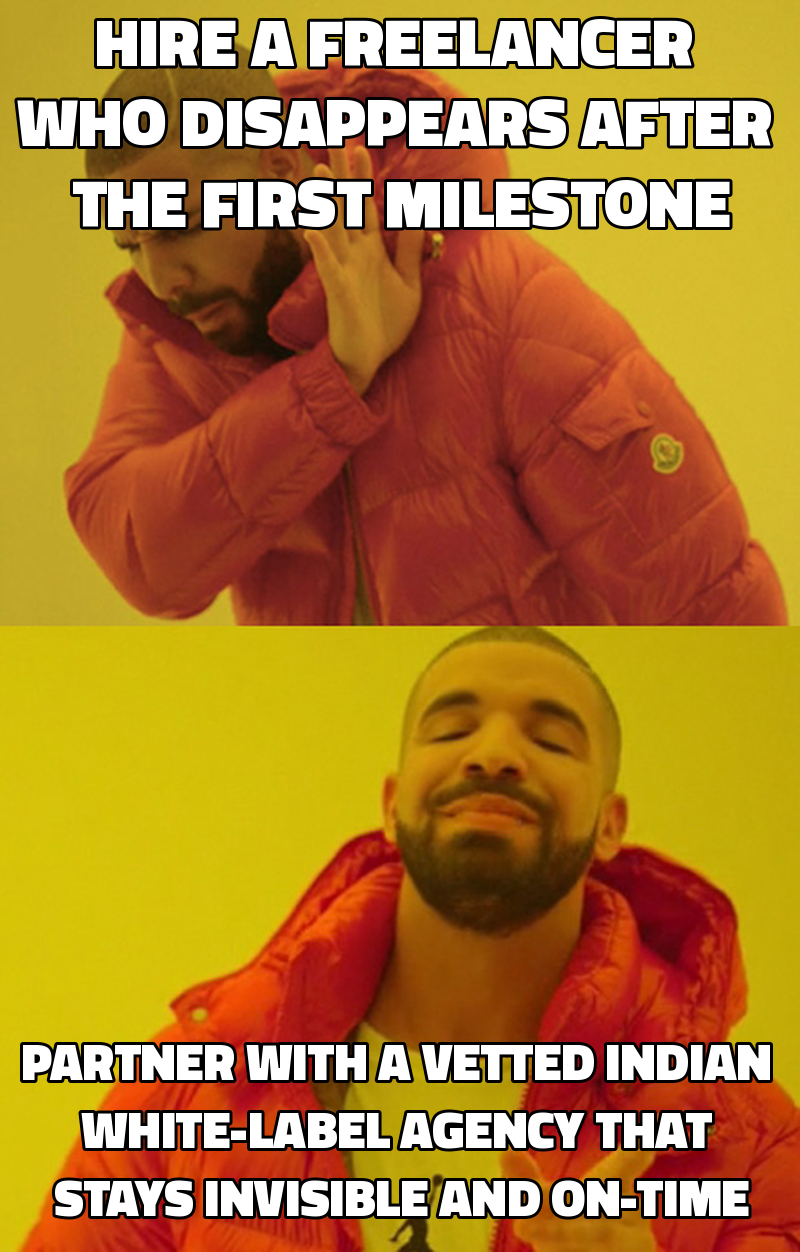
- "One-off freelancers are enough" – Freelancers lack the continuity, IP safeguards and capacity to handle recurring overflow.
- "NDA alone protects us" – Enforcement across borders is costly; the real protection is a proven delivery record and a paid pilot.
- "We can manage any timezone" – Without overlapping hours, async hand-offs create bottlenecks; choose partners that commit to at least 2-hour daily overlap.
Step-by-step outreach script for founders
- Subject line – "Scale your dev capacity without hiring – a $1,500 pilot"
- Opening – Reference a recent case study or a job post they published.
- Pain statement – "I see you’re turning away AI-automation projects because you don’t have a dev team."
- Value proposition – "We deliver custom AI back-ends under your brand, with a 48-hour turnaround guarantee."
- Social proof – Mention RouteMate or a similar success, include a short quote from a satisfied partner.
- Call to action – Propose a 15-minute call to discuss a scoped pilot.
The three-gate qualification you must run before a call
| Gate | Proxy check | Sample question | Pass condition |
|---|---|---|---|
| Volume | Number of active client projects visible | "How many client projects do you usually run at once, and how often does one need dev or automation you can't do in-house?" | Regular flow + recurring dev requests they currently turn away |
| Budget | Typical client spend on builds | "What budget range do your clients typically work in for a build?" | Clients regularly spend $2k-$5k, making a pilot financially trivial |
| Live need now | Recent dev job post or new big client win | "Do you have a project right now that needs dev or automation you can't deliver in-house?" | A current or imminent real project, not a future wish |
If a prospect passes all three, schedule the pilot. Two passes → nurture; one or none → drop.
How to protect your brand during the partnership
- Non-disclosure and non-circumvent – Include clauses that forbid the Indian firm from contacting your clients directly.
- White-label branding – Require all deliverables to be water-marked with your agency logo and to be delivered via your own repository.
- IP assignment – Ensure the contract states that all code, designs and documentation become your exclusive property upon payment.
- Escalation path – Designate a single point of contact on both sides; this reduces the “ghosting” risk seen with freelancers.
Frequently asked questions
How do I know an Indian agency can handle AI automation?
Ask for a live demo of a recent AI-driven project, request the tech stack (e.g., Python, TensorFlow, Dialogflow) and verify they have a senior data engineer on staff. According to a 2023 Clutch survey, agencies that list AI in their portfolio have a 68% on-time delivery rate.
What is a reasonable turnaround for a $3k web-app build?
A fixed-scope build of 3-4 core screens with backend integration typically takes 2-3 weeks when the partner commits to a daily 2-hour overlap. Anything shorter is a red flag for rushed quality.
Should I require ISO 27001 certification?
ISO 27001 is a strong indicator of security hygiene, but for most agency-to-agency work a SOC 2 Type II report or a documented security policy is sufficient. Choose the level that matches the sensitivity of the data you handle.
How do I avoid hidden subcontracting?
Include a clause that the partner must disclose any sub-sub-contractors and obtain your written approval. Conduct a spot check of the code repository to see if multiple unrelated usernames appear.
Can I start with a “free draft” to test quality?
A free draft often leads to unpaid engineering hours and devalues your service. Instead, offer a low-cost scoped prototype (one screen or one automation) that demonstrates competence without giving away the full deliverable.
What if the Indian firm’s time zone causes delays?
Negotiate a minimum of two overlapping hours per day, preferably early morning IST (which is evening US West). Use asynchronous tools like Loom videos for detailed hand-offs.
How many partners should I onboard at once?
Synthisia caps active partners at five to maintain reliability. Over-onboarding creates the flaky-freelancer perception you’re trying to replace.
Bottom line
Choosing the right Indian white-label web development agency is a disciplined process. By applying the weighted evaluation matrix, screening out red flags, running a paid pilot and locking in legal safeguards, US/UK/AU marketing agencies can confidently say yes to AI, voice and custom-backend projects without hiring a full-time engineer. The result is higher client retention, a predictable margin and a reputation for delivering cutting-edge technology under your own brand.
white‑label
Have something to build?
Tell us what you're trying to ship. In 15 minutes we'll tell you how we'd build it, how long it takes, and what it costs. No pitch deck, no pressure.