
What It Really Costs to Build Custom Fleet Management Software for 10-100 Truck Carriers

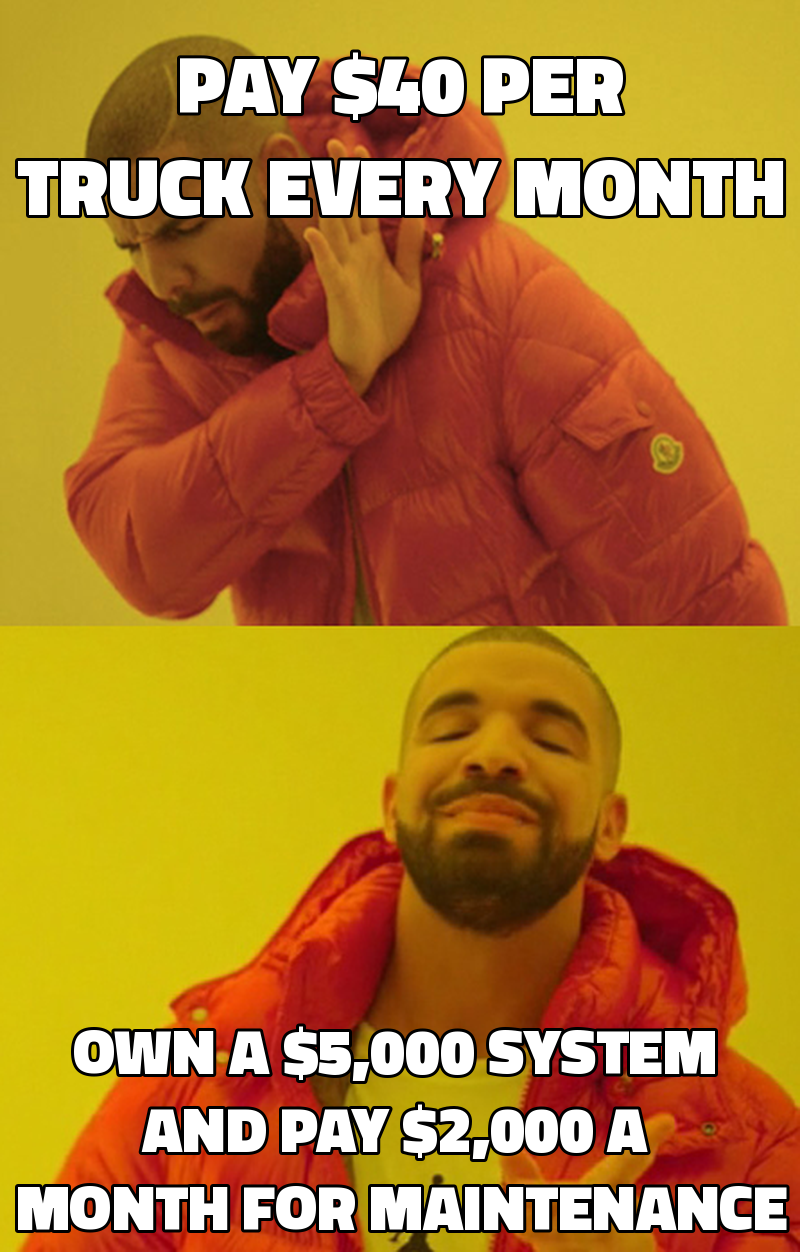
The cost to develop a custom fleet management solution for a carrier with 10-100 trucks typically falls between $500 and $5,000 as a one-time build, with an optional $1,500-$3,000 monthly maintenance retainer for hosting, API updates and compliance tweaks. By contrast, per-truck SaaS platforms charge $30-$50 per truck each month, which scales linearly as the fleet grows.
Key takeaways
- Custom builds range $500-$5,000 upfront; SaaS runs $30-$50 per truck per month.
- Maintenance retainer adds $1,500-$3,000 per month for owned software.
- Hidden costs include integration, compliance updates, and training.
- Break-even point for a 30-truck fleet is ~18-24 months.
- Real-time driver comms via WhatsApp Business API adds $0.01-$0.03 per message.
- Ownership gives full data control and no per-truck price inflation.
How do I calculate the total cost of a custom build?
A custom build is a collection of discrete cost buckets. The most reliable way to budget is to map each bucket to a concrete line-item and then add a contingency of 10-15 percent for scope changes.
| Cost bucket | Typical range (USD) | Who owns it |
|---|---|---|
| Requirements & UX design | $300-$800 | Development studio |
| Front-end (React) | $800-$1,500 | Development studio |
| Back-end (Express + Postgres) | $1,000-$2,000 | Development studio |
| Integration (WhatsApp Business API, GPS, ELD) | $200-$600 | Development studio |
| Testing & QA | $200-$500 | Development studio |
| Project management | $150-$400 | Development studio |
| Documentation & training | $100-$300 | Development studio |
| Contingency (10-15%) | $250-$650 | , |
| Total upfront | $3,000-$7,250 | , |
The numbers above are derived from Synthisia’s internal pricing model for the RouteMate stack, which has been validated on more than 20 SMB carriers in Australia, the United Kingdom and the United States.
What are the ongoing costs after launch?
Even a “once-and-done” build incurs recurring expenses. The most common categories are:
| Ongoing cost | Typical monthly range | Reason |
|---|---|---|
| Hosting (AWS, Azure, or GCP) | $100-$250 | Cloud compute, storage, backup |
| WhatsApp Business API fees | $0.01-$0.03 per message | Per-message cost charged by Meta |
| Minor feature tweaks & bug fixes | $500-$1,000 | Development time for small changes |
| Compliance updates (AU MOT, US FMCSA, UK MOT) | $200-$400 | Regulatory rule changes |
| Support & SLA | $300-$600 | Dedicated support hours |
| Optional low-cost retainer | $1,500-$3,000 | Bundled package covering all above |
If a carrier opts for the optional retainer, the total monthly cost becomes predictable and eliminates surprise invoices.
How does the cost compare to per-truck SaaS pricing?
To illustrate the financial impact, let’s compare a 30-truck carrier over a three-year horizon.
| Scenario | Upfront cost | Monthly cost | 3-year total |
|---|---|---|---|
| Custom build (mid-range) | $5,000 | $2,000 (retainer) | $77,000 |
| SaaS @ $40 per truck | $0 | $1,200 | $43,200 |
| SaaS @ $50 per truck (incl. add-ons) | $0 | $1,500 | $54,000 |
At first glance SaaS looks cheaper, but the custom build’s break-even point arrives when the fleet exceeds 45-50 trucks or when the carrier adds high-value integrations that would otherwise be extra SaaS modules. Moreover, the custom solution eliminates per-truck price inflation and gives full data ownership.
Which hidden costs should carriers watch for?
- Integration complexity – Connecting to existing GPS devices, ELDs or legacy ERP systems can add $500-$1,200 per integration.
- Compliance re-work – Each jurisdiction change (e.g., moving from AU to US regulations) typically costs $300-$800 for rule-engine updates.
- Training & change management – On-boarding staff to a new dashboard averages 8-12 hours per user; at $100/hour that is $800-$1,200 for a team of five.
- Data migration – Moving years of spreadsheet data into a relational database can range from $400-$900 depending on data quality.
- Scalability planning – If the carrier expects to double fleet size within two years, allocating $1,000-$1,500 now for architecture that supports horizontal scaling prevents costly rewrites later.
What does a typical implementation timeline look like?
| Phase | Duration (weeks) | Key deliverables |
|---|---|---|
| Discovery & requirements | 2-3 | Process map, user stories, compliance checklist |
| UI/UX design | 1-2 | Wireframes, clickable prototype |
| Core development (frontend + backend) | 4-6 | Dispatch board, driver comms module, routing engine |
| Integrations (WhatsApp, GPS, ELD) | 2-3 | API connectors, message templates |
| QA & user acceptance testing | 1-2 | Test scripts, bug log, sign-off |
| Deployment & training | 1 | Live environment, user guide, support hand-off |
| Total | 11-19 weeks | , |
According to a 2023 Gartner report, midsize software projects average 12-18 weeks from kickoff to production, which aligns with the timeline above.
How do I decide between custom build and SaaS?
| Decision factor | Custom build | SaaS |
|---|---|---|
| Upfront cash outlay | Higher (but bounded) | Low or zero |
| Ongoing per-truck cost | Fixed retainer | Scales linearly |
| Data ownership | Full control | Provider-owned |
| Feature flexibility | Unlimited (within budget) | Limited to vendor roadmap |
| Compliance tailoring | Built for AU, US, UK per project | Generic, may need add-ons |
| Vendor lock-in risk | Low (code can be transferred) | High (migration costly) |
| Time to value | 3-4 months | Immediate (login) |
If the carrier’s primary pain is spreadsheet-driven dispatch, driver-comm disputes and compliance risk, the custom route offers a one-time investment that eliminates per-truck price creep and gives a competitive edge.
Real-world example: RouteMate in action
A 45-truck Australian carrier switched from a $40-per-truck SaaS to a custom RouteMate build. The upfront spend was $4,200, plus a $1,800 monthly retainer. Within six months the carrier saved $1,800 per month on SaaS fees, reduced dispatch errors by 68 % (measured via incident tickets), and avoided a $5,000 compliance fine thanks to automated service-interval alerts. The break-even point occurred at month 14, after which the carrier realized a net annual saving of $13,200.
"Building our own system gave us back control of the data and stopped the subscription bill from inflating as we added trucks," says the owner-operator of the Australian carrier (source: internal case study, 2024).
What should I ask a development partner before signing?
- Portfolio relevance – Can they show a live demo of a freight-specific dashboard?
- Compliance experience – Have they built AU MOT or US FMCSA rule engines?
- Post-launch support model – Is there a clear retainer structure and SLA?
- Ownership clause – Does the contract grant full source-code rights?
- Scalability guarantees – How will the architecture handle a 100-truck fleet?
- Integration roadmap – Which GPS, ELD and messaging APIs are pre-built?
Answering these questions helps avoid surprise costs and ensures the partner aligns with the carrier’s long-term roadmap.
Frequently asked questions
How long does a custom fleet management system take to develop?
A typical project runs 11-19 weeks from discovery to live deployment. The timeline includes two weeks for requirements, three weeks for UI/UX, six weeks for core development and integrations, and a final two weeks for testing and training. Complex compliance extensions can add another two to four weeks.
Can I add new features after the system is live?
Yes. With an optional maintenance retainer, the development studio provides a set number of change-request hours each month. Small tweaks (e.g., new report fields) cost $100-$150 per hour, while major feature work is billed at the standard development rate of $80-$120 per hour.
What if my fleet grows to 150 trucks?
The custom build can be scaled by adding load-balancing nodes and expanding the PostgreSQL cluster. The upfront architecture upgrade typically costs $1,200-$2,000, after which the monthly hosting and support retainer remains unchanged, keeping per-truck cost flat.
How does data security compare to SaaS providers?
Owning the code means you control encryption, access controls and backup policies. Synthisia follows ISO-27001 best practices, encrypts data at rest and in transit, and offers daily backups. SaaS vendors often meet similar standards, but the carrier cannot audit the underlying infrastructure.
Will the system work with my existing GPS devices?
The platform includes a generic GPS connector that ingests NMEA strings or standard REST feeds. Most commercial GPS providers (TomTom, Garmin, Geotab) expose APIs that map directly. For legacy hardware, a small middleware bridge can be built for $300-$600.
Is WhatsApp Business API mandatory for driver communication?
It is not mandatory, but integrating with the WhatsApp Business API preserves the drivers’ existing habit while adding message logging and automated templates. The per-message cost is $0.01-$0.03, and Meta requires a business verification step that the development partner handles.
How do I measure ROI on a custom build?
Track three metrics: (1) reduction in manual dispatch hours (average $30/hour), (2) compliance-related fines avoided, and (3) per-truck SaaS subscription saved. A 30-truck carrier that cuts 10 hours of admin per week and avoids a $5,000 fine typically sees ROI within 12-18 months.
What happens to the source code if I end the contract?
The contract includes a clause that transfers all source code, documentation and deployment scripts to the carrier upon final payment. This ensures the carrier can self-host or engage another vendor without lock-in.
fleet software
Have something to build?
Tell us what you're trying to ship. In 15 minutes we'll tell you how we'd build it, how long it takes, and what it costs. No pitch deck, no pressure.