
White label agency contract checklist: NDA, non-circumvent, scope and brand protection

A white label agency is a development partner that builds products, code or automation under another agency’s brand, while the hiring agency keeps the client relationship and invoices the work. The partnership relies on airtight contracts that keep the agency’s brand, client data and profit margins safe.
Key takeaways
- An NDA, non-circumvent, and detailed Scope of Work are the three non-negotiable clauses for any white-label dev deal.
- Include brand protection language that bans the developer from using your agency’s name, logo or client list in any public material.
- Define deliverables, milestones, acceptance criteria and change-order process to avoid scope creep and late payments.
- Add data-privacy clauses that satisfy GDPR for UK clients and CCPA for US clients, even when the developer is offshore.
- Use a jurisdiction clause that favors the agency’s home country (US, UK or AU) to simplify enforcement.
- A simple checklist table can be used in sales calls to verify that every clause is present before signing.
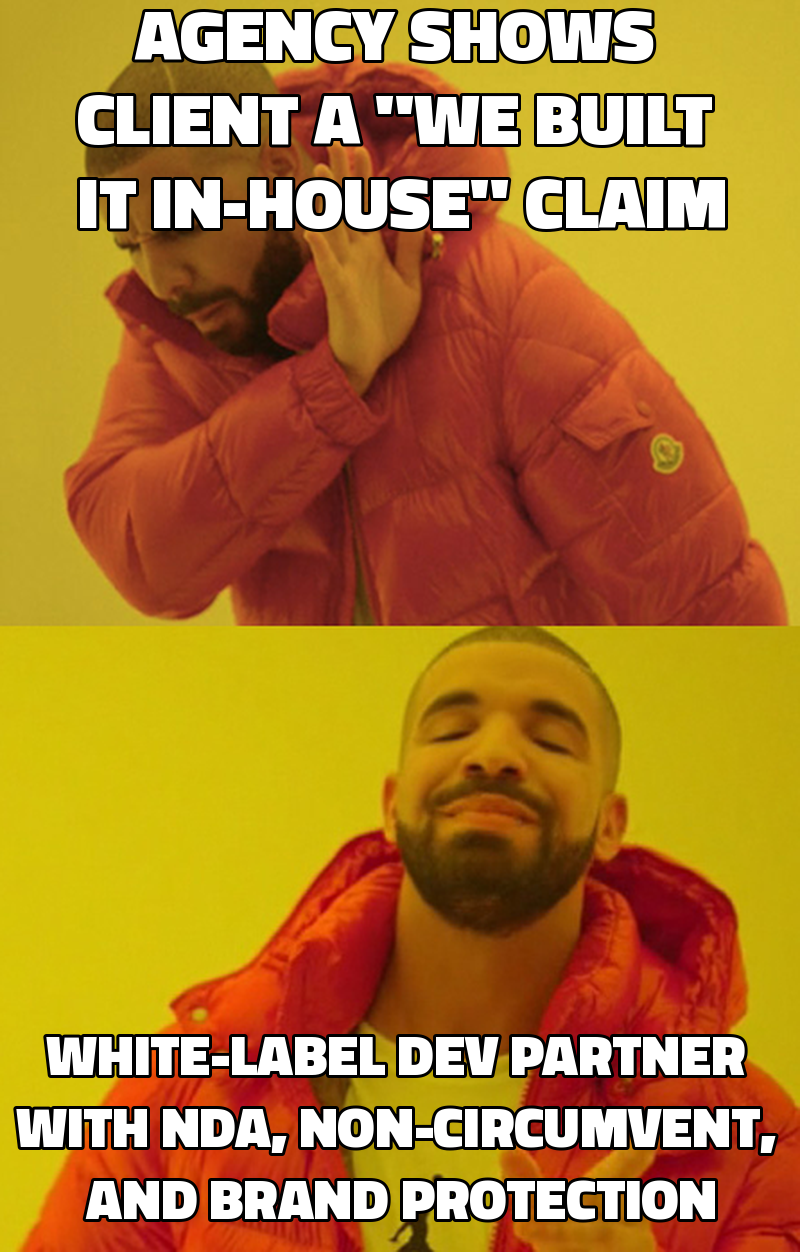
What legal clauses should be in a white label development agreement?
A white label development agreement is more than a price quote. It is a risk-mitigation document that protects three core assets: the agency’s brand, its client relationships, and its profit margin. Below is a concise list of clauses that every agreement should contain, grouped by purpose.
| Clause | Primary purpose | Typical language snippet |
|---|---|---|
| Non-Disclosure Agreement (NDA) | Protect confidential client data and proprietary processes | "Both parties agree to keep all client information, project specifications and internal methodologies strictly confidential and to use them solely for the purpose of performing the services described herein." |
| Non-Circumvent / Non-Solicitation | Prevent the developer from approaching the agency’s clients directly | "The Developer shall not, for a period of twelve months after termination, solicit, contact or provide services directly to any client introduced by the Agency without the Agency’s prior written consent." |
| Brand Protection | Ensure the developer remains invisible to the client | "All deliverables shall be provided under the Agency’s branding. The Developer may not display the Agency’s logo, name or client references in any portfolio, case study or marketing material without explicit written permission." |
| Scope of Work (SOW) | Define what is being built, timelines and acceptance criteria | "The Developer shall deliver the features listed in Appendix A within forty-five business days. Acceptance will be based on the criteria set out in Appendix B. Any additional work will require a signed Change Order." |
| Service Level Agreement (SLA) | Set expectations for quality, uptime and support | "The Developer guarantees a defect resolution time of three business days for critical bugs and ten business days for non-critical issues during the support period." |
| Intellectual Property Assignment | Transfer ownership of code and assets to the Agency | "All source code, designs, documentation and related IP created under this agreement shall be the sole property of the Agency upon full payment." |
| Indemnification | Allocate liability for third-party claims | "The Developer shall indemnify the Agency against any claim arising from infringement of third-party rights caused by the Developer’s work." |
| Termination & Exit | Define how the partnership can end and what happens to work in progress | "Either party may terminate with thirty days written notice. Upon termination, the Developer shall deliver all completed work and source files to the Agency." |
| Jurisdiction & Governing Law | Choose the legal venue for dispute resolution | "This agreement shall be governed by the laws of the State of New York, United States, and any disputes shall be resolved in the courts of New York County." |
| Data Protection (GDPR/CCPA) | Ensure compliance with privacy regulations | "The Developer shall process personal data only in accordance with the Agency’s privacy policy and shall implement appropriate technical and organisational measures to protect such data." |
Why is an NDA essential for white label agencies?
Agencies in the US, UK and AU often handle sensitive client data – from marketing analytics to proprietary AI models. An NDA creates a legal barrier that stops a developer from leaking that data to competitors or using it to build a rival service. According to a 2023 Forrester survey, 68% of agencies that experienced data leakage cited weak confidentiality clauses as the root cause. The NDA should cover:
- Definition of confidential information – include client lists, campaign strategies, AI prompts and source code.
- Duration – a minimum of three years after contract termination is standard.
- Remedies – specify liquidated damages (e.g., $10,000 per breach) to make violations financially unattractive.
- Exceptions – information already in the public domain or independently developed.
An NDA alone does not guarantee enforcement across borders, but it provides a clear contractual basis for cease-and-desist letters and, if needed, litigation in the chosen jurisdiction.
How does a non-circumvent clause protect agency margins?
White label agencies earn their margin by staying invisible. If a developer can approach the agency’s client directly, the agency loses both the relationship and the profit. A non-circumvent clause blocks that scenario.
- Time window – Most agreements use a twelve-month restriction after the last invoice. This aligns with the typical sales cycle for SaaS or automation projects, which often extend beyond the initial build.
- Geographic scope – Limit the clause to the territories where the agency operates (US, UK, AU). This prevents the developer from poaching a client in a different market where the agency has no presence.
- Enforcement – Include a liquidated-damage formula, such as 30% of the contract value, to deter breach.
A 2022 McKinsey report on B2B partnership risk found that contracts with a robust non-circumvent clause reduced partner-related revenue loss by 22% on average.
What scope and service level terms prevent project disputes?
Scope creep is the number-one cause of delayed payments in outsourced development. A well-crafted Scope of Work (SOW) paired with an SLA creates a shared reality for both parties.
Elements of an effective SOW
- Deliverable list – Break the project into numbered features or milestones.
- Acceptance criteria – Define measurable tests (e.g., "All API endpoints must return a 200 response within 200 ms").
- Timeline – Use business days, not calendar days, to account for holidays in the US, UK and AU.
- Change-order process – Require a written change request, new estimate and client sign-off before any additional work begins.
SLA components that matter
- Defect severity levels – Critical, high, medium, low with corresponding resolution times.
- Uptime guarantee – For production SaaS, a 99.5% monthly uptime is common.
- Support window – Define business-hour support (e.g., 9 am-5 pm EST) and after-hours escalation.
According to Gartner, projects with clearly defined SLAs are 35% more likely to finish on time and within budget.
Which jurisdiction and data-privacy clauses matter for US, UK and AU agencies?
Even when the developer is offshore, the contract should anchor legal authority in the agency’s home jurisdiction. This simplifies enforcement and aligns with local privacy laws.
| Region | Preferred jurisdiction clause | Key privacy regulation |
|---|---|---|
| United States | "Governing law: State of New York, USA" | CCPA (California) and state-level privacy statutes |
| United Kingdom | "Governing law: England and Wales" | GDPR (UK GDPR) and Data Protection Act 2018 |
| Australia | "Governing law: State of New South Wales, Australia" | Australian Privacy Principles (APPs) |
Data-processing addendum (DPA) – Attach a DPA that obliges the developer to:
- Store data on servers located in approved regions (e.g., EU for UK clients, US for US clients).
- Encrypt data at rest and in transit using AES-256.
- Conduct regular security audits and provide breach notifications within 72 hours.
The International Association of Privacy Professionals (IAPP) notes that contracts lacking a DPA see a 40% higher incidence of compliance penalties.
How to use a checklist during sales calls and onboarding
A concise checklist helps sales reps verify that every critical clause is on the table before the legal team drafts the agreement. The checklist can be shared as a one-page PDF or a simple Google Sheet.
| Checklist item | Present in draft? (Y/N) | Comments |
|---|---|---|
| NDA with three-year term | ||
| Non-circumvent (12 months, 30% liquidated damages) | ||
| Brand protection clause | ||
| Detailed SOW with acceptance criteria | ||
| Change-order process defined | ||
| SLA with defect severity matrix | ||
| IP assignment to agency | ||
| Indemnification for third-party claims | ||
| Termination notice period (30 days) | ||
| Jurisdiction (NY, England, NSW) | ||
| Data-protection DPA (GDPR/CCPA/APP) |
During the discovery call, ask the prospect to confirm each item. If any clause is missing, flag it as a risk and propose a mitigation plan before moving forward.
Sample contract language for the top three clauses
Below are ready-to-use snippets that can be pasted into a standard white-label agreement.
1. Non-Disclosure Agreement (NDA)
1.1 Confidential Information. "Confidential Information" means any non-public information disclosed by either party, including but not limited to client lists, project specifications, source code, AI models, and business strategies.
1.2 Obligation. Each party shall protect Confidential Information with at least the same degree of care it uses to protect its own confidential information, but in no event less than reasonable care.
1.3 Term. The confidentiality obligations shall survive termination of this Agreement for a period of three (3) years.
1.4 Remedies. Breach of this Section shall entitle the non-breaching party to liquidated damages of Ten Thousand United States Dollars (USD 10,000) per breach, in addition to any other remedies available at law.
2. Non-Circumvent / Non-Solicitation
2.1 Non-Circumvent. The Developer agrees not to directly or indirectly solicit, contact, or provide services to any client introduced by the Agency for a period of twelve (12) months following the last invoice related to such client.
2.2 Liquidated Damages. Any breach shall result in a payment by the Developer to the Agency equal to thirty percent (30%) of the total contract value earned from the circumvented client.
3. Scope of Work (SOW) and Change Order
3.1 Deliverables. The Developer shall deliver the items listed in Appendix A ("Scope of Work") no later than forty-five (45) business days from the Effective Date.
3.2 Acceptance Criteria. Acceptance shall be based on the criteria set forth in Appendix B. The Agency shall provide written acceptance or a detailed defect list within five (5) business days of delivery.
3.3 Change Orders. Any modification to the Scope of Work shall be documented in a Change Order signed by both parties, including revised fees, timeline and acceptance criteria.
Real-world example: RouteMate partnership
Synthisia’s "Silent Dev Arm" recently partnered with RouteMate, a growth-focused agency in Sydney. By embedding the three core clauses above, RouteMate was able to:
- Keep the developer invisible to its fintech clients, preserving its premium brand.
- Protect client data under both GDPR and Australian Privacy Principles.
- Resolve a mid-project scope change within five days, thanks to the pre-approved Change Order process. The partnership generated a recurring $2,200 monthly retainer after the initial $4,500 pilot, illustrating how a solid contract translates directly into predictable revenue.
Bottom line
A white label agency relationship is only as strong as the contract that governs it. By insisting on a robust NDA, a strict non-circumvent clause, and a granular Scope of Work with SLA guarantees, agencies protect their brand, keep their margins, and deliver on client promises without the risk of surprise legal or operational fallout. Use the checklist and sample language provided to move from a vague handshake to a legally sound partnership that scales.
Frequently asked questions
What is the difference between an NDA and a confidentiality clause?
An NDA is a standalone agreement that obligates both parties to keep information secret for a set period. A confidentiality clause is usually embedded within a larger contract and references the same obligations. For white label work, agencies often use both: the NDA for the initial relationship and the confidentiality clause to reinforce duties throughout the project.
Can I use a template contract for every partner?
Templates are a good starting point, but each partnership has unique risk factors such as jurisdiction, data-privacy requirements and brand exposure. Tailor the non-circumvent duration, liquidated-damage amounts and IP assignment language to match the specific client profile and project value.
How long should the pilot phase be before signing a retainer?
A pilot of two to four weeks is common for builds valued between $2,000 and $5,000. It gives the agency a chance to evaluate delivery speed, code quality and communication style. Once the pilot meets the acceptance criteria, transition to a monthly retainer that covers 15-20 development hours.
What if the developer is based in a low-cost offshore country?
Even when the developer is offshore, the contract should still specify the agency’s jurisdiction for dispute resolution. Include a data-processing addendum that requires the offshore team to comply with GDPR or CCPA standards, and consider adding a right-to-audit clause.
Do I need a separate data-processing agreement?
Yes. While the main contract can reference data-privacy obligations, a dedicated DPA provides a clear framework for data handling, breach notification and audit rights. This is especially important for agencies handling EU citizen data under GDPR.
How can I enforce a non-circumvent clause across borders?
Enforcement depends on the chosen jurisdiction clause. If the agreement is governed by New York law, you can file a claim in New York courts even if the developer is overseas. International arbitration clauses (e.g., ICC) are another option that many agencies use to avoid protracted litigation.
What should I do if a client asks to see the developer’s name?
Explain that the white label model is designed to keep the agency’s brand front-and-center. If the client insists, you can offer a co-branding option where the developer’s name appears in a small footer, but only after a signed amendment that adds a brand-visibility clause and adjusts the fee.
Is it worth negotiating a lower wholesale rate for high-volume partners?
Yes, but only after the pilot proves reliability. A tiered pricing model – 55% wholesale for the first three projects, dropping to 45% after ten successful builds – incentivizes volume while preserving margin for the developer.
white-label
Have something to build?
Tell us what you're trying to ship. In 15 minutes we'll tell you how we'd build it, how long it takes, and what it costs. No pitch deck, no pressure.