
Choosing the Right White-Label WordPress Partner for AI-Powered Sites

White-label WordPress development agencies provide agencies with a ready-made, behind-the-scenes team that builds custom AI-powered sites under the agency’s brand. They let you say yes to any client request for chatbots, voice assistants, or automated workflows without hiring a full-time engineer.
Key takeaways
- A white-label partner should sign an NDA, non-circumvent clause, and act invisibly to your client.
- AI automation capability separates a generic dev shop from a partner that can deliver chat-GPT-driven content, voice bots, and custom backend workflows.
- Look for fixed-scope pilot pricing (US$2 000-5 000) and a retainer model that protects your margin (50-70 % of the client bill).
- Turn-around bands (e.g., 2-3 weeks for a medium site) are more reliable than vague “fastest possible”.
- Verify the partner’s tech stack: WP Engine, Elementor Pro, Advanced Custom Fields, OpenAI API, LangChain, Zapier/Make, and server-side Node or Python for custom AI services.
- Use a shared project dashboard to keep the agency in the loop without exposing the dev team.
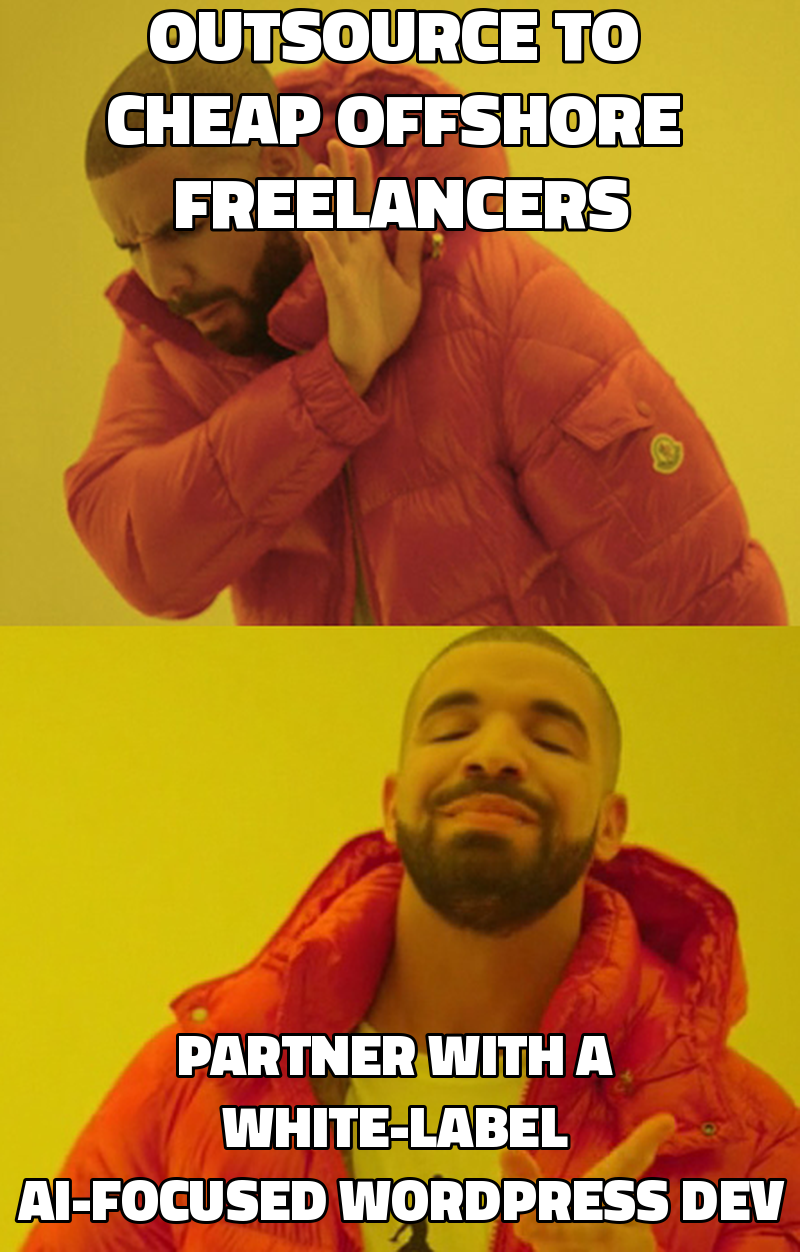
What is a white-label WordPress development agency?
A white-label WordPress development agency is a third-party studio that builds WordPress sites, plugins, and AI-driven features on behalf of another agency. The work is delivered under the hiring agency’s brand, with no credit given to the developer. The arrangement lets the agency keep the client relationship, margin, and brand positioning while outsourcing the technical heavy lifting.
According to the 2023 Clutch survey, 71 % of marketing agencies outsource at least one web-development project per quarter, and 42 % cite lack of in-house dev talent as the main blocker. For agencies that specialize in SEO, branding, or social media, the ability to add AI-enhanced sites expands service offerings without the overhead of hiring.
Why AI capabilities matter for modern agency sites
AI is no longer a novelty; it is a client expectation. A 2022 Gartner report notes that 65 % of SMBs plan to add AI chat or automation to their website within the next 12 months. Agencies that can’t deliver these features lose deals to competitors that can.
Typical AI use-cases on WordPress include:
- ChatGPT-style content generation for landing pages (via the OpenAI API).
- Voice-enabled navigation using Google Dialogflow or Amazon Lex.
- Automated lead routing with Zapier, Make, or custom webhook services.
- Dynamic personalization powered by LangChain or LlamaIndex that pulls data from a CRM in real time.
A partner that already has these integrations reduces project risk and shortens delivery time.
How to evaluate a white-label partner – 7 critical criteria
| Criterion | What to look for | Why it matters |
|---|---|---|
| AI expertise | Proven projects using OpenAI, Anthropic, or Cohere; demo of a chatbot or automation flow. | Guarantees they can meet the AI-heavy requests your clients demand. |
| Turn-around SLA | Fixed band (e.g., 10-15 business days for a 10-page site). | Sets client expectations and protects you from “fastest possible” promises. |
| NDA & non-circumvent | Signed NDA, clear clause preventing poaching of your clients. | Keeps your brand front-and-center and protects revenue. |
| Pricing transparency | Fixed-scope pilot cost, wholesale rate, retainer range. | Enables you to quote confidently and maintain margin. |
| Support model | Single point of contact, weekly status calls, shared dashboard. | Reduces friction and gives you visibility without exposing the dev team. |
| Capacity limits | Capped number of active agency partners (e.g., 12). | Ensures reliability – the core USP of Synthisia. |
| Compliance & security | GDPR-ready hosting, UK ICO compliance, regular security audits. | Protects client data and avoids legal headaches. |
How to score each partner
| Score | Description |
|---|---|
| 5 | Exceeds all criteria, provides live AI demo, and offers a 2-week pilot. |
| 4 | Meets all criteria, but AI demo is limited to a sandbox. |
| 3 | Meets most criteria, but turn-around SLA is vague. |
| 2 | Lacks AI expertise or clear pricing. |
| 1 | No NDA, no support model, or visible in-house dev team (gap already filled). |
Select partners with a minimum score of 4 to ensure they can handle AI automation without sacrificing reliability.
AI-focused tech stack you should expect from a partner
| Layer | Typical tools from a generic WordPress dev | Expected tools from an AI-focused white-label partner |
|---|---|---|
| Hosting | Shared cPanel, SiteGround | WP Engine or Kinsta with automatic backups and staging |
| Page builder | Elementor Free | Elementor Pro + Advanced Custom Fields (ACF) for dynamic fields |
| AI integration | Basic plugin (e.g., WP Chatbot) | OpenAI API, Anthropic Claude, LangChain, custom serverless functions on Vercel |
| Automation | Zapier basic zaps | Make advanced scenarios, custom webhooks, and event-driven micro-services |
| Voice | None or third-party widget | Google Dialogflow CX or Amazon Lex with WordPress bridge |
| Testing & CI | Manual QA | Cypress automated tests, GitHub Actions for CI/CD |
| Security | Wordfence | Sucuri, regular vulnerability scans, GDPR-ready cookie consent manager |
If a partner cannot demonstrate at least three items from the right-hand column, they likely lack the depth needed for AI-heavy builds.
Pricing models and profit margins you can target
Most agencies prefer a wholesale-rate model where the partner invoices the agency at 50-70 % of the client’s bill. For example, a client pays US$4 000 for a custom AI-enhanced site; the agency pays the partner US$2 200 (55 %). The remaining US$1 800 covers project management, branding, and margin.
A typical deal shape looks like this:
- Pilot project: Fixed scope US$2 500-5 000, 2-3 weeks delivery, includes one AI feature (e.g., chatbot).
- Retainer: US$1 500-2 000 per month for up to 20 hours of ongoing development, bug fixes, and new AI automations.
- Minimum floor: US$1 500 per project to ensure the partner’s overhead is covered.
According to a 2024 PwC report, agency margins on outsourced development average 45-55 %, so staying within the 50-70 % wholesale range keeps you competitive while preserving profitability.
Onboarding a reliable partner – best practices
- Run a paid pilot – a small, fixed-scope project that includes at least one AI component. Use the pilot to assess communication, quality, and turn-around.
- Set up a shared dashboard – a simple Notion or ClickUp board where the agency can view status, milestones, and deliverable links. Avoid building a custom SaaS dashboard before you have paying partners.
- Define escalation paths – a clear point of contact on the dev side (e.g., “Senior Delivery Lead – John Doe”) and a backup contact.
- Document NDA & non-circumvent – store signed agreements in a secure folder and reference them in every project kickoff.
- Create a hand-off checklist – include design assets, brand guidelines, AI prompt libraries, and compliance requirements.
- Schedule a post-pilot review – discuss what went well, any missed AI features, and agree on retainer terms.
Common pitfalls and how to avoid them
- Choosing the cheapest partner – Low cost often means limited AI expertise and high turnover. Prioritize depth over price.
- Vague delivery promises – “Fastest possible” leads to missed deadlines. Insist on a concrete SLA.
- No single point of contact – Multiple dev contacts cause miscommunication. Require one accountable lead.
- Missing compliance checks – If the partner’s hosting is not GDPR-ready, you risk fines. Verify data-processing agreements.
- Over-onboarding – Accepting too many agencies dilutes reliability. Keep the active partner count under 12.
Frequently asked questions
How do I know if a white-label partner can handle AI automation?
Ask for a live demo of a recent AI feature (e.g., a ChatGPT-powered FAQ or voice navigation). Verify the stack (OpenAI API, LangChain) and request references from agencies that have used the same capability.
What turnaround time is realistic for a custom AI-enhanced WordPress site?
A well-structured pilot of 8-10 pages with one AI integration typically takes 10-15 business days. Larger projects (15-20 pages, multiple automations) should be scoped at 3-4 weeks.
Will my clients ever see the white-label developer’s branding?
No. The partner works under a strict NDA and non-circumvent clause, delivering all code, assets, and documentation directly to you. Your agency’s brand remains the only public face.
How should I price AI-powered builds to stay competitive?
Quote the client based on value (e.g., increased lead capture, reduced support tickets) rather than cost. Use the wholesale model: client price = partner cost ÷ 0.55 + margin. Most agencies price between US$3 000-6 000 for a mid-size AI site.
What if the partner misses a deadline?
Include a penalty clause in the service agreement (e.g., 5 % discount per day delayed beyond the SLA). This protects you and incentivizes the partner to meet commitments.
Do I need to worry about data privacy when using AI APIs?
Yes. Ensure the partner uses EU-standard contractual clauses for OpenAI or Anthropic data processing, and that any personal data is anonymized before being sent to the API. A GDPR-ready hosting environment is mandatory for EU clients.
Can I start with a one-off project and later move to a retainer?
Absolutely. The pilot is designed to build trust. After a successful delivery, negotiate a retainer that covers ongoing tweaks, new AI features, and priority support.
How many agencies should I partner with at once?
Limit to 8-12 active partners. This keeps your partner’s capacity high, ensures fast turn-around, and prevents the “flaky freelancer” reputation you’re trying to avoid.
white‑label
Have something to build?
Tell us what you're trying to ship. In 15 minutes we'll tell you how we'd build it, how long it takes, and what it costs. No pitch deck, no pressure.