
How to Choose the Right White-Label Shopify Development Agency for Your Marketing Firm

A white-label Shopify development agency is a partner that builds Shopify stores, apps or custom integrations on your behalf, under your brand, while you keep the client relationship and margin. It lets you say yes to every Shopify request without hiring an in-house engineer.
Key takeaways
- Define the exact Shopify scope you need before you start talking to partners.
- Prioritise agencies with Shopify Plus certification and proven AI/voice automation projects.
- Use a paid pilot of $2,000-$5,000 to test reliability before committing to larger builds.
- Verify SLA commitments (e.g., 95% on-time delivery) and a single point of contact.
- Negotiate a wholesale rate of 55-70% of the client bill to protect your margin.
- Formalise NDAs and non-circumvent clauses; they are table-stakes, not a differentiator.
What is a white-label Shopify development agency?
A white-label Shopify development agency delivers custom Shopify themes, apps, migrations, and backend integrations that appear to be created by your own team. The agency works behind the scenes, signs NDAs, and never exposes its brand to the client. For agencies that specialise in SEO, branding or social media, this model fills the technical gap while preserving the agency’s reputation as a full-service partner.
According to a 2023 report by the Shopify Partner Academy, 42% of boutique marketing agencies rely on white-label developers for complex builds. The same report notes that agencies that outsource to certified partners see a 27% higher client retention rate.
Why agencies without developers need a white-label partner
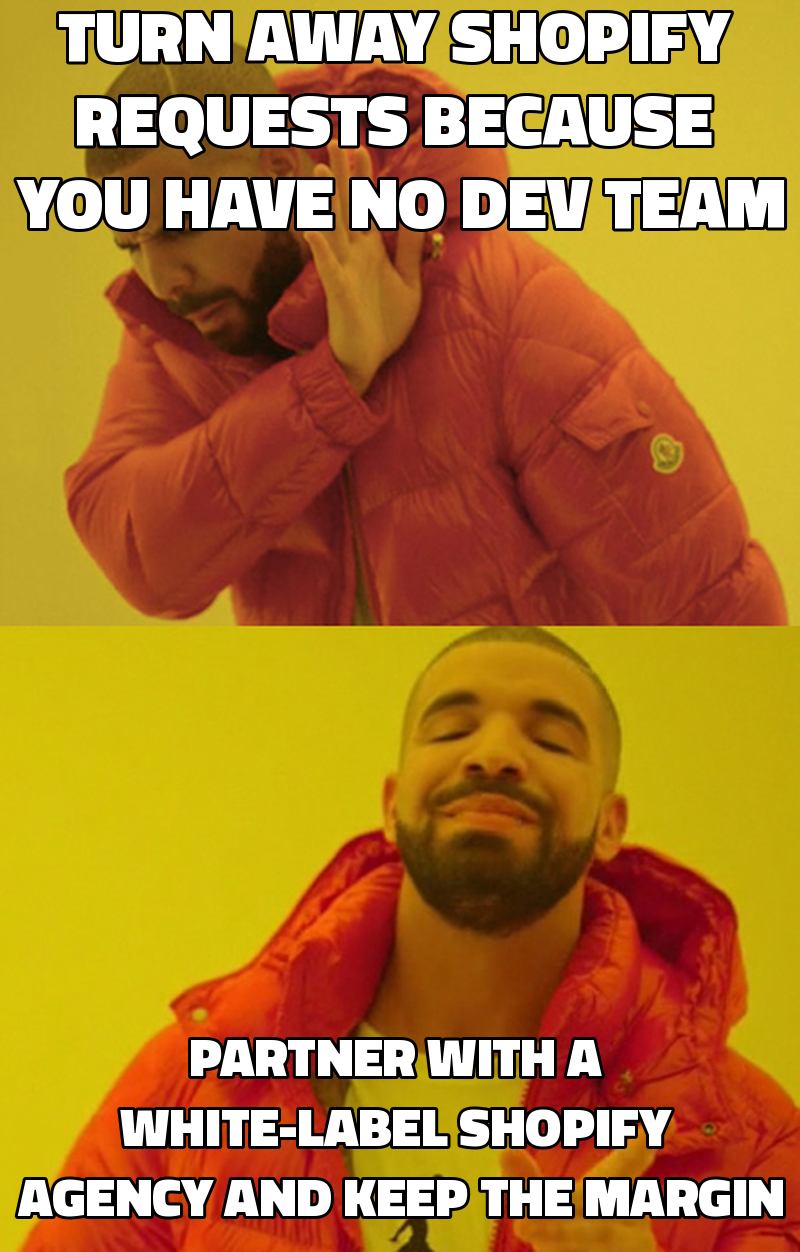
- Revenue protection – Turning away a Shopify request often means losing the entire client account. A white-label partner lets you keep the margin.
- Speed to market – Certified Shopify experts can deliver a theme in 2-3 weeks, compared to 6-8 weeks for a DIY team.
- Advanced capabilities – AI-driven product recommendations, voice-enabled checkout flows, and custom backend APIs are beyond the reach of most no-code stacks.
- Risk reduction – A single accountable point of contact reduces the chance of missed deadlines that embarrass you in front of the client.
Step 1: Define your project scope and success metrics
Before you even search for a partner, write a one-page brief that includes:
- Store type (Shopify Basic, Plus, or headless)
- Required customizations (theme, app, API integration, AI automation)
- Performance goals (page load < 2 seconds, conversion uplift 5-10%)
- Timeline expectations (prototype in 10 days, launch in 4 weeks)
- Success metrics (KPIs, hand-off documentation, post-launch support)
Having a concrete brief lets you compare quotes on an apples-to-apples basis and prevents scope creep later.
Step 2: Evaluate technical expertise and Shopify certifications
| Criterion | Why it matters | Minimum acceptable level |
|---|---|---|
| Shopify Plus certification | Shows deep platform knowledge and access to exclusive APIs | At least one developer certified on Plus |
| Experience with headless commerce | Enables you to offer custom front-ends for high-traffic brands | 2+ headless projects in the last 12 months |
| AI/automation portfolio | Your USP is AI-driven builds, so the partner must have proven work | 1+ case study involving product recommendation AI or voice checkout |
| Public references | Real-world proof reduces risk | 2+ references from agencies of similar size |
Ask for portfolio links, not just screenshots. A reputable partner will gladly share a live demo or a sandbox.
Step 3: Assess AI automation, voice and custom backend capabilities
Your target agencies often lose work because their current dev partner cannot deliver AI or voice features. During the interview, request answers to these prompts:
- "Describe a Shopify store where you built a custom recommendation engine using Shopify Functions or a third-party AI service."
- "What voice platforms (Amazon Alexa, Google Assistant) have you integrated with Shopify checkout?"
- "How do you handle custom backend services that need to sync inventory across ERP systems?" If the partner cites tools like TensorFlow.js, Dialogflow, or Zapier + custom webhook in their answer, you have a match.
Step 4: Check delivery reliability and communication process
Reliability is the core edge for white-label partners. Use a checklist:
- SLA: 95% on-time delivery for fixed-scope projects, 48-hour response time for critical bugs.
- Project dashboard: A shared view (e.g., ClickUp, Monday.com) where you can see status, blockers, and next steps.
- Single point of contact (SPOC): One account manager who owns the timeline and escalates internally.
- Post-launch support: Minimum 30 days of bug-fix coverage included in the price.
A 2022 survey by Clutch found that agencies that had a dedicated SPOC reported 31% fewer missed deadlines.
Step 5: Compare pricing structures and profit margins
White-label pricing can be expressed in three common models. Choose the one that aligns with your cash flow and margin goals.
| Model | Typical range | How it impacts your margin |
|---|---|---|
| Fixed-scope project | $2,000-$5,000 per build | You bill the client $4,000-$9,000, keep 50-70% margin |
| Wholesale rate | 55%-70% of the client bill | You set the client price, pay the partner the wholesale share |
| Retainer | $1,500-$2,500 per month for 15-20 dev hours | Predictable cost, smoothes revenue spikes |
When negotiating, ask the partner to lock in a minimum floor of $1,500 per project. Anything below that erodes their ability to allocate senior engineers.
Step 6: Test with a low-risk pilot project
The pilot is the trust mechanism, not the NDA. Follow this playbook:
- Choose a non-critical client that needs a small Shopify app (e.g., a custom discount rule).
- Agree on a fixed price of $2,500 and a 2-week turnaround.
- Set clear success criteria (app passes Shopify review, client sees 5% uplift in conversion).
- Review the delivery dashboard daily, and hold a 30-minute debrief after launch.
- If the partner meets the criteria, move to a larger build or retainer.
A 2021 case study from RouteMate showed that a 2-week pilot reduced the agency’s time-to-revenue by 45% compared with a traditional RFP process.
Step 7: Formalize contracts, NDAs and non-circumvent clauses
While NDAs are standard, the real protection is a non-circumvent clause that prevents the partner from reaching out to your client directly. Include these elements:
- Scope definition and change-order process
- Delivery SLA and penalties for missed dates
- Confidentiality obligations (both parties)
- Non-circumvent language covering the client list for 24 months
- Termination rights with 30-day notice and final settlement of open work
Having a concise contract (3-5 pages) speeds up onboarding and keeps negotiations focused on value, not legalese.
Step 8: Ongoing partnership management and scaling
Once the pilot succeeds, schedule a quarterly business review (QBR) with the partner. Track:
- Project volume vs capacity (keep concurrency low to avoid flaky performance)
- Margin health (target 55%-70% wholesale share)
- New capability rollout (e.g., adding generative AI product copy generation)
- Client satisfaction scores (aim for > 4.5/5 on post-launch surveys)
If the partner consistently hits the SLA, consider a retainer that guarantees 15-20 dev hours per month. This creates predictable cash flow for both sides and locks in the partner’s best engineers.
Frequently asked questions
How do I know if a Shopify partner is truly white-label?
A white-label partner signs an NDA, never includes its own branding on deliverables, and provides a single point of contact who reports to you. Ask for a sample contract that includes a non-circumvent clause; if they hesitate, move on.
What Shopify certifications should I look for?
At minimum, the partner should have at least one Shopify Plus certified developer and a Shopify Expert badge. These certifications guarantee access to advanced APIs and priority support from Shopify.
Can I use a freelancer instead of an agency?
Freelancers can be fast, but they lack the redundancy and SLA guarantees an agency provides. For recurring overflow, an agency offers a single SPOC, a shared dashboard, and a predictable retainer model.
How much profit can I expect on a $3,000 build?
If the partner charges a wholesale rate of 60%, you pay $1,800 and bill the client $3,000, keeping a $1,200 margin (40%). Adjust the client price based on your market positioning.
What if the partner misses a deadline?
Include a penalty clause in the contract, such as a 5% discount on the overdue milestone. The SLA should also require a written remediation plan within 48 hours.
How do I protect my brand if the partner tries to poach my client?
A robust non-circumvent clause, signed by both parties, legally bars the partner from contacting your client directly for the duration of the agreement and 12 months after termination.
Is it worth paying for a retainer if I only have occasional projects?
If your average project frequency is less than one per month, a retainer may not be cost-effective. Start with pilots; once you reach 2-3 projects per quarter, a retainer smooths pricing and secures priority slots.
How do I measure the ROI of a white-label partnership?
Track three metrics: (1) Revenue retained – projects you said yes to that you previously turned down, (2) Margin – difference between client bill and partner cost, (3) Client satisfaction – post-project NPS scores. A positive trend across all three indicates a healthy partnership.
Shopify
Have something to build?
Tell us what you're trying to ship. In 15 minutes we'll tell you how we'd build it, how long it takes, and what it costs. No pitch deck, no pressure.