
How to Choose a White-Label App Development Partner for Your Agency

White-label app development company is a partner that builds custom mobile or web applications under your agency’s brand, while you retain the client relationship and margin. It lets you say yes to build requests without hiring full-time engineers, and it protects your brand by keeping the developer invisible.
Key takeaways
- Pick a partner whose primary stack (React Native, Flutter, or native) matches the platforms your clients need.
- Verify SOC 2, ISO 27001, or GDPR compliance before any code leaves the partner’s environment.
- Insist on a single, dedicated project manager and a shared status dashboard to avoid “ghost” freelancers.
- NDA, non-circumvent, and IP ownership clauses must be signed, tracked, and reviewed each quarter.
- Run a low-risk paid pilot (2-4 weeks, $1,500-$3,000) before committing to a retainer.
- Expect a wholesale margin of 50-70 % on $2k-$5k builds to keep your agency profitable.
What is a white-label app development company?
A white-label app development company creates software that is delivered to the client under the agency’s name. The agency remains the point of contact, invoices the client, and keeps the margin. The developer works behind the scenes, often signing NDAs and non-circumvent agreements that prevent them from poaching the agency’s clients. This model is common in the US, UK, and Australia where agencies charge USD-based rates and need reliable, timezone-compatible partners.
Why agencies without developers need a vetted partner
Agencies of 5-15 people frequently run into three pain points:
- Lost revenue – they turn away projects that require custom back-ends, AI automation, or voice integration.
- Brand risk – clients may notice a “built by X” badge and question the agency’s expertise.
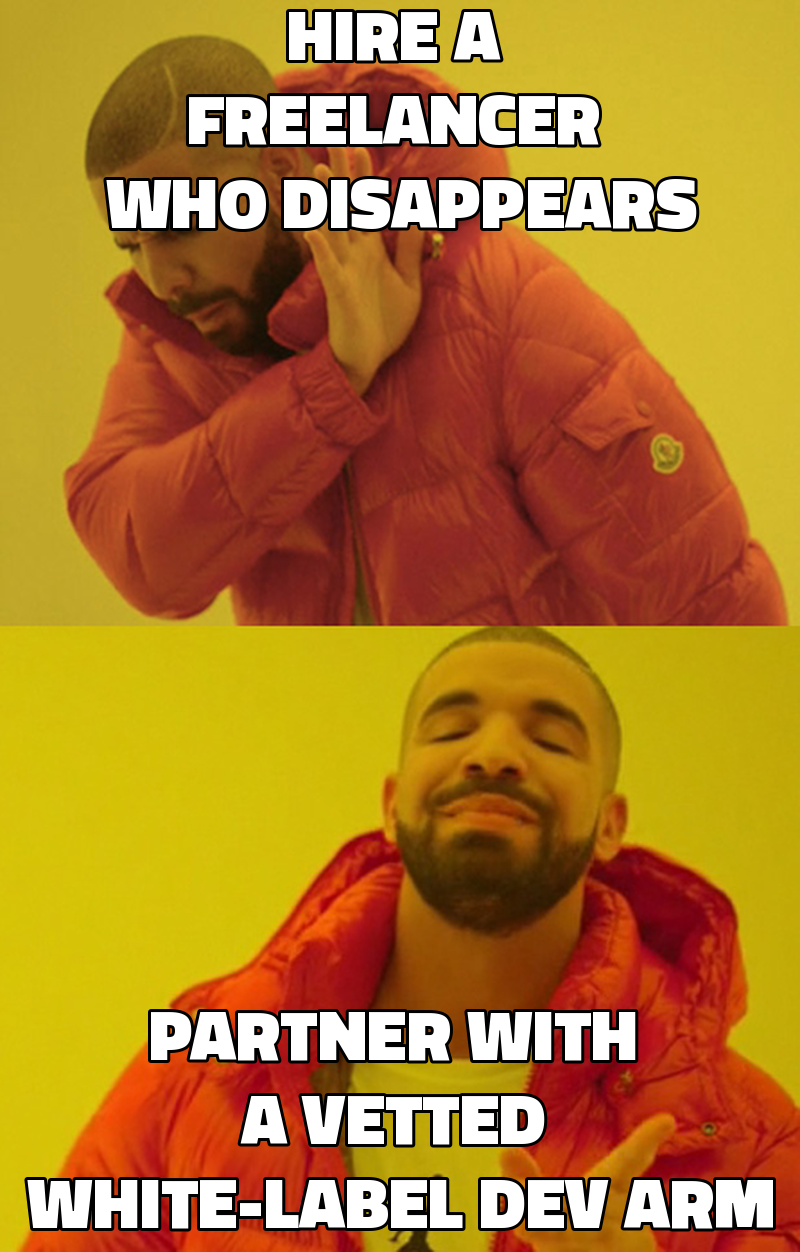
- Operational chaos – freelancers disappear, miss deadlines, or deliver low-quality code that embarrasses the agency. A vetted white-label partner eliminates these risks by providing a single accountable point of contact, proven security certifications, and a transparent technology stack.
Criteria to evaluate a white-label partner
1. Technology stack alignment
Your partner’s stack must support the platforms and features your clients demand. Below is a quick comparison of the most common stacks for agency projects.
| Stack | Primary use case | Pros | Cons |
|---|---|---|---|
| React Native | Cross-platform mobile (iOS & Android) | Re-uses web React code, large talent pool, fast updates | Slightly larger app size, occasional native module gaps |
| Flutter | Cross-platform mobile with high UI fidelity | Single codebase, excellent performance, growing community | Still maturing for complex native integrations |
| Native iOS (Swift) / Android (Kotlin) | Platform-specific apps that need deep OS integration | Best performance, full access to OS APIs | Higher cost, separate codebases |
| Progressive Web App (PWA) | Light-weight web-first experiences | No app store approval, instant updates | Limited offline capability, not ideal for heavy media |
When you match the stack to the client’s requirement, you reduce scope creep and keep delivery timelines predictable. According to a 2023 Gartner report, 62 % of agencies that adopted a single cross-platform stack saw a 15 % reduction in average development time.
2. Security and compliance
Agencies handling SMB data must ensure the partner complies with industry standards. Look for:
- SOC 2 Type II certification (covers data security, availability, processing integrity).
- ISO 27001 for information security management.
- GDPR compliance if any EU data is processed.
- Regular penetration testing reports (at least annually). A 2022 Statista survey found that 48 % of SMBs terminate contracts after a single security breach, underscoring the financial impact of a weak partner.
3. Communication and project management
Effective communication prevents the “ghost freelancer” syndrome. Verify that the partner offers:
- A dedicated project manager who is the sole liaison for your agency.
- A shared dashboard (e.g., Jira, ClickUp, or a custom status page) that updates in real time.
- Weekly sync calls aligned with US/UK/AU business hours.
- Clear escalation paths for bugs or scope changes. According to a 2024 Clutch study, agencies that used a single point of contact reduced average issue resolution time from 5 days to 2 days.
4. NDA, non-circumvent, and IP ownership practices
Legal safeguards are table-stakes, not differentiators, but they must be enforced:
| Clause | What to look for | Why it matters |
|---|---|---|
| NDA | Signed by all engineers, limited to 3-year term, includes breach penalties | Prevents accidental client exposure |
| Non-circumvent | Explicitly bars the partner from contacting your clients directly for 12 months | Protects your margin |
| IP Assignment | All code and assets transferred to your agency upon project completion | Guarantees you can re-sell or modify later |
Make sure the partner stores signed agreements in a document management system (e.g., DocuSign, HelloSign) and provides a quarterly audit of compliance.
Running a low-risk pilot
A pilot validates capability without draining resources. Follow this framework:
- Scope a fixed-price, fixed-timeline deliverable (e.g., a simple chatbot or a data-visualisation dashboard). Target $1,500-$3,000.
- Define success metrics – functional demo, code repository access, and a post-pilot review meeting.
- Set a turnaround band – for a $2k scope, aim for 10-14 business days.
- Document every hand-off – use a shared Confluence page or Notion workspace.
- Evaluate – if the partner meets the metrics, move to a retainer; if not, disengage.
A pilot also gives you a concrete case study to show future prospects, reinforcing trust.
Pricing models and margin expectations
Typical white-label arrangements in the US/UK/AU market follow a wholesale-to-retail spread:
- Project-based: Partner charges $2k-$5k wholesale; agency invoices $4k-$7k, keeping a 50-70 % margin.
- Retainer: $1,500-$2,500 per month for 15-20 dev hours, covering ongoing bug fixes, feature tweaks, and rapid prototypes.
- Minimum floor: $1,500 per project; anything below erodes profitability because of overhead (contract management, QA, NDA tracking). According to McKinsey, agencies that maintain a 60 % average margin on white-label services outperform peers by 12 % in annual revenue growth.
Common pitfalls and red flags
| Red flag | Indicator |
|---|---|
| No security certifications | Only generic “We follow best practices” claim |
| Multiple dev teams listed on their site | Likely a shop, not a white-label partner |
| No dedicated PM | You’ll juggle many contacts, leading to delays |
| “Free first deliverable” without scope | Risk of unpaid engineering hours |
| Turnaround promises like “fastest possible” | No measurable SLA, potential scope creep |
If you encounter any of these, ask for proof (certificates, org chart, SLA docs) before proceeding.
Comparison tables for quick reference
Technology stack suitability matrix
| Client need | Recommended stack | Agency skill overlap | Typical delivery time |
|---|---|---|---|
| Simple data entry app | PWA (React) | Most agencies already use React | 2-3 weeks |
| High-performance mobile game | Native (Swift/Kotlin) | Requires specialist devs | 6-8 weeks |
| AI-driven chatbot | Flutter + TensorFlow Lite | Agency can sell AI value | 3-4 weeks |
| Voice-enabled assistant | React Native + native modules | Agency can market voice UX | 4-5 weeks |
NDA & IP checklist
| Item | Must-have clause | Sample language |
|---|---|---|
| NDA term | 3-year enforceable period | "The Receiving Party shall keep Confidential Information secret for three years." |
| Non-circumvent | 12-month client protection | "The Provider will not solicit or contract with any client introduced by the Agency for twelve months." |
| IP transfer | Full assignment on delivery | "All source code, designs, and documentation shall become exclusive property of the Agency upon payment." |
| Audit rights | Quarterly compliance review | "The Agency may request proof of SOC 2 compliance every quarter." |
Putting it all together: a step-by-step vetting checklist
- Identify the stack your typical client requests (use the matrix above).
- Collect security evidence – request SOC 2 Type II report, ISO 27001 certificate, and latest pen-test summary.
- Confirm communication model – schedule a demo of their dashboard and meet the dedicated PM.
- Review legal documents – NDA, non-circumvent, IP assignment; ensure they are signed in a verifiable system.
- Run a pilot – scope a $2k project, set a 10-day SLA, and evaluate against success metrics.
- Negotiate margin – aim for 55-65 % wholesale spread; lock in a minimum $1,500 floor.
- Onboard – add the partner to your internal vendor list, set up shared Slack channel, and document the SLA in your agency’s playbook.
Following this process lets you say “yes” to more build requests, keep the client relationship intact, and protect your brand from exposure.
Frequently asked questions
How long does a typical white-label mobile app project take?
For a $2k-$5k scope, most partners deliver in 10-14 business days if the requirements are well defined. Complex native builds can extend to 6-8 weeks, but the partner should provide a clear timeline up front.
Do I need to sign a separate NDA for each project?
A master NDA covering all engagements is sufficient if it includes a clause for project-specific addenda. This reduces paperwork and speeds up kickoff.
What if the partner breaches the non-circumvent clause?
Include a breach penalty (e.g., 2× the project fee) and a right to terminate the agreement with immediate effect. Enforceability improves when the clause is signed by a corporate officer.
Can I charge my client a higher price than the partner’s wholesale rate?
Yes. The typical agency markup is 50-70 % to cover project management, QA, and brand positioning. Ensure the final price remains competitive in your market.
How do I protect client data during development?
Require the partner to use encrypted storage (AES-256), enforce role-based access, and run regular vulnerability scans. Ask for a data-processing agreement if GDPR applies.
Is it worth paying for a partner that offers a “free first deliverable”?
Generally no. A free draft often leads to unpaid engineering hours and devalues your service. Offer a low-cost prototype instead, then move to a paid pilot.
What if the partner’s time zone doesn’t overlap with mine?
Choose a partner with at least 4-6 hour overlap with US/UK/AU business hours. Many Australian-based firms provide that window and can handle async hand-offs.
How many partners should I work with?
Start with one capped partner to prove reliability. Once you have a proven process, you can add a second partner for overflow, but keep concurrency low to avoid the flaky-freelancer trap.
white‑label
Have something to build?
Tell us what you're trying to ship. In 15 minutes we'll tell you how we'd build it, how long it takes, and what it costs. No pitch deck, no pressure.