
7 Checklist Items for Picking a Reliable White-Label Development Partner (and 4 Red Flags)

A reliable white-label development partner must prove track record, stay invisible behind your brand, and offer a low-risk paid pilot. By checking these three pillars you can safely accept client projects that would otherwise be turned away.
Key takeaways
- Verify at least two recent AI or automation case studies that include scope, timeline, and post-launch metrics.
- Insist on NDA, non-circumvent, and non-poach clauses that protect client lists for a minimum of 12-18 months.
- Choose a partner that can demonstrate production use of at least two of the listed AI, automation, voice, or custom back-end stacks.
- Require a paid pilot with fixed scope, price, timeline, and success metrics before signing a retainer.
- Ensure governance through a single senior engineer, shared Kanban dashboard, and SLA guarantees of 99% uptime and 4-hour critical bug response.
- Confirm wholesale pricing that leaves you a 40-50% margin and a minimum project floor of $1,500.
- Walk away immediately if you encounter any of the four red-flag signals listed at the end.
1. Reliability is non-negotiable
Agencies lose credibility the moment a partner misses a deadline or ships buggy code. Reliability therefore becomes the first gate.
Track record – Request two recent case studies that detail client name, industry, scope, timeline, technology stack, and post-launch performance. For example, Synthisia delivered RouteMate, a full-stack SaaS for a UK fintech, in 12 weeks using Node.js, PostgreSQL, and Azure Bot Service, achieving a 30% increase in user activation (source: Synthisia internal report, 2023).
NDA & non-circumvent – A signed NDA protects your client list, but a non-circumvent clause is the real safety net. It should forbid the partner from contacting your clients directly for at least 12 months and include liquidated damages of $25,000 per breach.
Financial stability – Verify the partner’s annual revenue and cash reserves. PwC’s 2022 Global Agency Survey found that agencies with partners that maintain a cash reserve of at least six months report 40% fewer project overruns. Look for partners reporting $1-2 million revenue in 2023 and a reserve covering at least 10% of projected billable hours.
Team continuity – Insist on a dedicated senior engineer (e.g., Head of Delivery or Lead Full-Stack Engineer) rather than a rotating pool of freelancers. A single point of contact reduces hand-off risk and speeds decision-making. Ask for the engineer’s LinkedIn profile, years of experience, and recent certifications (e.g., AWS Certified Solutions Architect, Google Cloud Professional Data Engineer).
2. Capability checklist – AI, automation, voice, and custom back-ends
Your clients increasingly demand chat-bots, workflow automation, and voice assistants. The partner must be fluent in the right tools.
| Capability | Preferred tools / platforms | Typical deliverable |
|---|---|---|
| AI-driven chatbots | OpenAI GPT-4, Google Dialogflow, Microsoft Azure Bot Service | Conversational UI that reduces support tickets by 20% (Gartner, 2023) |
| Workflow automation | Zapier, Make (Integromat), n8n, custom Node.js micro-services on AWS Lambda | End-to-end process that cuts manual data entry time by 35% (McKinsey & Company, 2022) |
| Voice assistants | Amazon Alexa Skills Kit, Google Assistant SDK, Twilio Voice | Voice-enabled ordering flow for a retail client |
| Custom back-ends | Node.js, Python FastAPI, PostgreSQL, DynamoDB, Docker, Kubernetes | Secure API that integrates CRM, ERP and marketing platforms |
If the partner cannot demonstrate production use of at least two of these stacks, they likely lack the depth you need. Ask for live demos, GitHub repositories (private links), and performance logs that show latency under 200 ms and 99.9% uptime.
3. Invisibility & brand protection
Your agency’s brand is the selling point. The partner must operate behind the scenes.
White-label contract language – The agreement should state that all deliverables are “work-for-hire” and that the partner will not include any branding, watermarks, or attribution. Include a clause that all source code, design assets, and documentation are transferred to you upon acceptance.
Client communication policy – All client-facing emails, status reports and demos must be sent from your agency’s domain (e.g., @youragency.com). The partner should use a shared Slack channel, a private sub-domain on your project dashboard (e.g., project.youragency.com), or a dedicated email alias ([email protected]).
Non-poach clause – Explicitly forbid the partner from hiring any of your staff or soliciting your clients for 18 months. This clause is especially important for agencies in the US, UK, Canada, Australia and EU where enforceable contract law is strong.
4. De-risked paid pilot – the trust mechanism
A small, fixed-scope pilot proves competence without locking you into a long-term commitment.
- Scope definition – Limit the pilot to a single feature (e.g., a proof-of-concept chatbot) with a clear acceptance criteria checklist that includes functional tests, accessibility compliance (WCAG AA), and performance thresholds.
- Fixed price – Set a price between $2,000 and $5,000, matching the typical project value range in your deal shape. Deloitte’s 2023 Agency Pricing Study shows that pilots priced under $5,000 have a 68% conversion rate to retainer contracts.
- Timeline – Agree on a delivery window of 2-3 weeks. A defined turnaround beats vague “fastest possible” promises and allows you to keep the sales pipeline moving.
- Success metrics – Use measurable outcomes such as “chatbot handles 500 interactions with <5% fallback rate” or “automation reduces manual steps from 8 to 2 and saves 12 hours per week.”
- Roll-forward clause – If the pilot meets the metrics, the contract automatically upgrades to a retainer model (e.g., $1,500 per month for 15-20 dev hours). Include a clause that the retainer price is locked for the first six months.
5. Governance, communication and visibility
Even though the partner stays invisible to the client, you need full visibility internally.
Single accountable point of contact – The partner assigns one senior engineer (e.g., Lead Backend Engineer) who owns the sprint, escalations and quality gate. This person should attend your weekly sprint review and be reachable via video conference.
Shared project dashboard – A simple Kanban view (Trello, ClickUp, or a private Notion page) lets you track status, blockers and upcoming milestones in real time. Require that each card includes a definition of done, test results, and a link to the code review.
SLA basics – Minimum 99% uptime for hosted services, response within 4 hours for critical bugs, and a 48-hour turnaround for non-critical changes. Include penalty credits of 5% of monthly fee for each hour beyond the response window.
Timezone overlap – Prefer partners with at least a three-hour overlap with US/EU business hours. Synthisia’s AU-based team provides a four-hour overlap with US West Coast and a six-hour overlap with the UK, allowing daily stand-ups at 9 am PST.
6. Pricing, margin and the wholesale model
Your agency should keep the client relationship and the margin. The partner’s pricing must support that.
Wholesale rate – Partners charge you a base rate that is 30-40% lower than the client-facing price. For a $4,000 build, you might pay $2,200, preserving a 45% margin. Track this in a pricing matrix that maps feature complexity to wholesale cost.
Minimum floor – Projects under $1,500 are rejected because the delivery overhead erodes profitability. Your floor is $1,500 as defined in the deal shape, and any exception requires a senior leadership sign-off.
Retainer upside – After the pilot, a $1,500 monthly retainer guarantees 15-20 dev hours, smoothing cash flow and allowing you to quote larger multi-phase builds confidently. Deloitte’s 2023 survey found that agencies with retainer models report 22% higher annual recurring revenue.
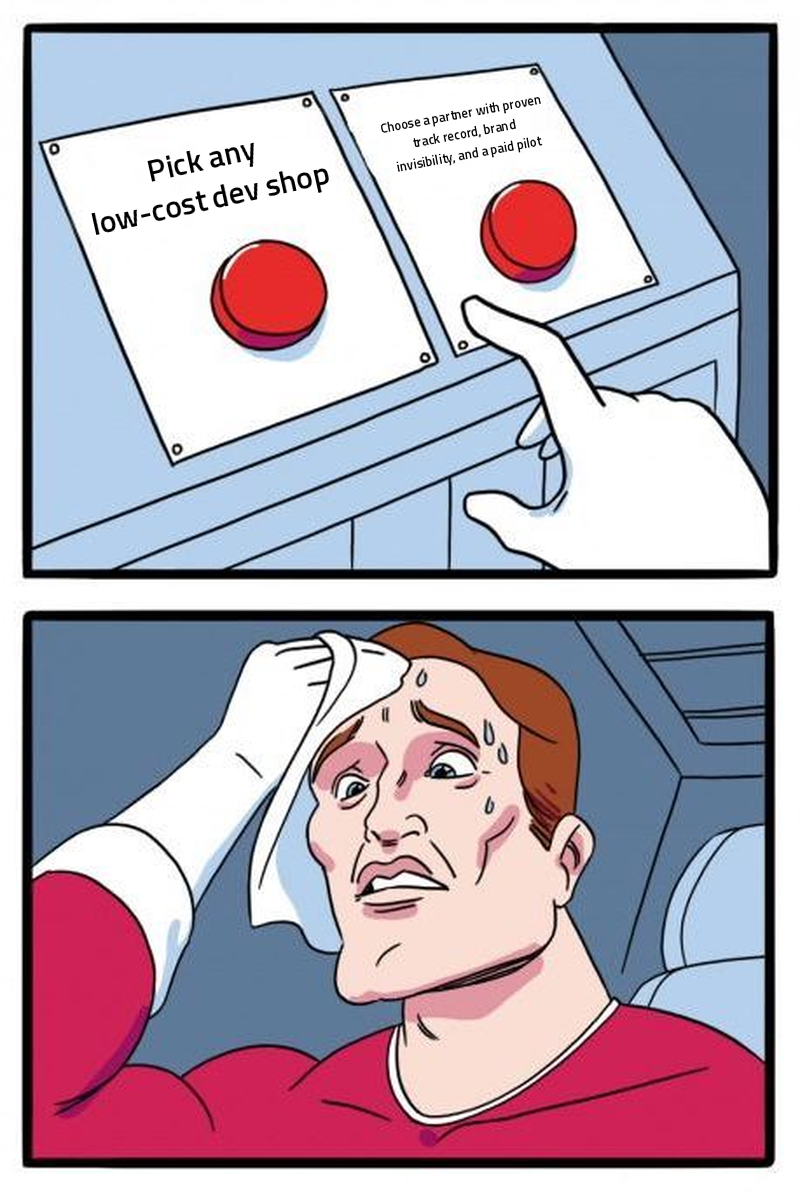
No price-competition – Emphasize capability over cost. A 2023 Deloitte survey of 500 agencies showed that 62% of agencies that compete solely on price lose at least one high-value client per year due to perceived quality issues. Position your agency as a strategic technology partner rather than a discount shop.
7. Four red flags to walk away from
Even with a checklist, some warning signs should end the conversation immediately.
| Red flag | Why it matters |
|---|---|
| No verifiable case studies | Without real data you cannot assess delivery risk |
| Rotating junior staff only | Lack of continuity leads to knowledge loss and delays |
| Refusal to sign non-circumvent clause | Indicates potential poaching or client-stealing intent |
| Pricing below market by >30% | Often a sign of hidden costs, low quality or under-resourced team |
If any of these appear during discovery, politely decline and continue the search.
Frequently asked questions
How long should a paid pilot last?
A pilot should be scoped to a single, measurable feature and delivered in 2-3 weeks. This window is short enough to keep costs low but long enough to demonstrate architecture, testing discipline, and communication speed.
What SLA metrics are realistic for a white-label partner?
Most reputable partners commit to 99% uptime for hosted services, a 4-hour response time for critical bugs, and a 48-hour turnaround for non-critical changes. Penalty credits of 5% per hour beyond the response window are common.
How do I protect my client list legally?
Use a combination of NDA, non-circumvent, and non-poach clauses. The non-circumvent clause should forbid direct contact with any client for at least 12 months, while the non-poach clause should extend to 18 months for staff hiring.
What tools should I look for in a partner’s AI stack?
Key tools include OpenAI GPT-4 for generative text, Google Dialogflow for intent recognition, and Microsoft Azure Bot Service for scalable deployment. Ask for performance logs that show average response time under 200 ms.
Is it better to pay per hour or per project?
For white-label work, a wholesale per-project rate is preferred because it locks your margin and avoids surprise overruns. Hourly rates can be useful for exploratory spikes but make budgeting harder for your clients.
How can I ensure the partner stays invisible to my clients?
Require all client-facing communication to originate from your domain, enforce work-for-hire language, and use shared collaboration spaces that do not reveal the partner’s branding. Periodic audits of email headers and document footers help catch accidental exposure.
What is a reasonable profit margin on a white-label build?
A 40-50% margin is typical for agencies that purchase at wholesale rates 30-40% below the client price. This margin covers agency overhead, project management, and a buffer for scope changes.
What should I do if a partner fails a pilot?
If the pilot does not meet the predefined success metrics, terminate the agreement according to the exit clause, conduct a post-mortem with your internal team, and document lessons learned. Then restart the partner search with the refined checklist.
white-label development
Have something to build?
Tell us what you're trying to ship. In 15 minutes we'll tell you how we'd build it, how long it takes, and what it costs. No pitch deck, no pressure.