
How to Choose a White-Label Shopify Development Agency in the USA – A Practical Checklist

A white-label Shopify development agency in the USA is a partner that builds custom Shopify stores, apps, and integrations under your agency’s brand, letting you keep the client relationship while you outsource the technical work.
Key takeaways
- US-based partners give you timezone overlap, USD invoicing and legal protection.
- Verify a single point of contact, proven AI/automation expertise and a fixed-scope pilot before signing.
- Look for transparent pricing: wholesale rates 50-70% of the client bill, minimum $1,500 floor per project.
- Red flags include in-house dev teams, offshore-only pricing, and publicly listed development services.
- A successful partnership delivers repeat $2k-5k builds and a $1,500-$2,000 monthly retainer for ongoing escalation.
What is a white-label Shopify development agency?
A white-label Shopify development agency provides end-to-end technical delivery, store setup, custom themes, private apps, API integrations and post-launch support, while remaining invisible to the client. Your agency invoices the client, keeps the branding, and the partner signs an NDA and non-circumvent agreement. The model lets marketing, SEO and branding firms answer every client request without hiring a full-time engineer.
Why US-based partners matter for marketing agencies?
- Currency and margin – Billing in USD avoids conversion risk and lets you keep a healthy wholesale margin (50-70%).
- Legal enforceability – US contracts are easier to enforce than offshore agreements, especially for IP ownership.
- Timezone overlap – A 9-hour overlap with the East Coast and a 3-hour overlap with the West Coast means you can promise 5-7 business day turn-arounds without “same-week” pressure.
- Quality expectations – According to a 2023 Gartner survey, 68% of US agencies rate reliability higher than price when choosing a dev partner.
- Cultural alignment – English-first communication reduces misinterpretation of scope and reduces rework.
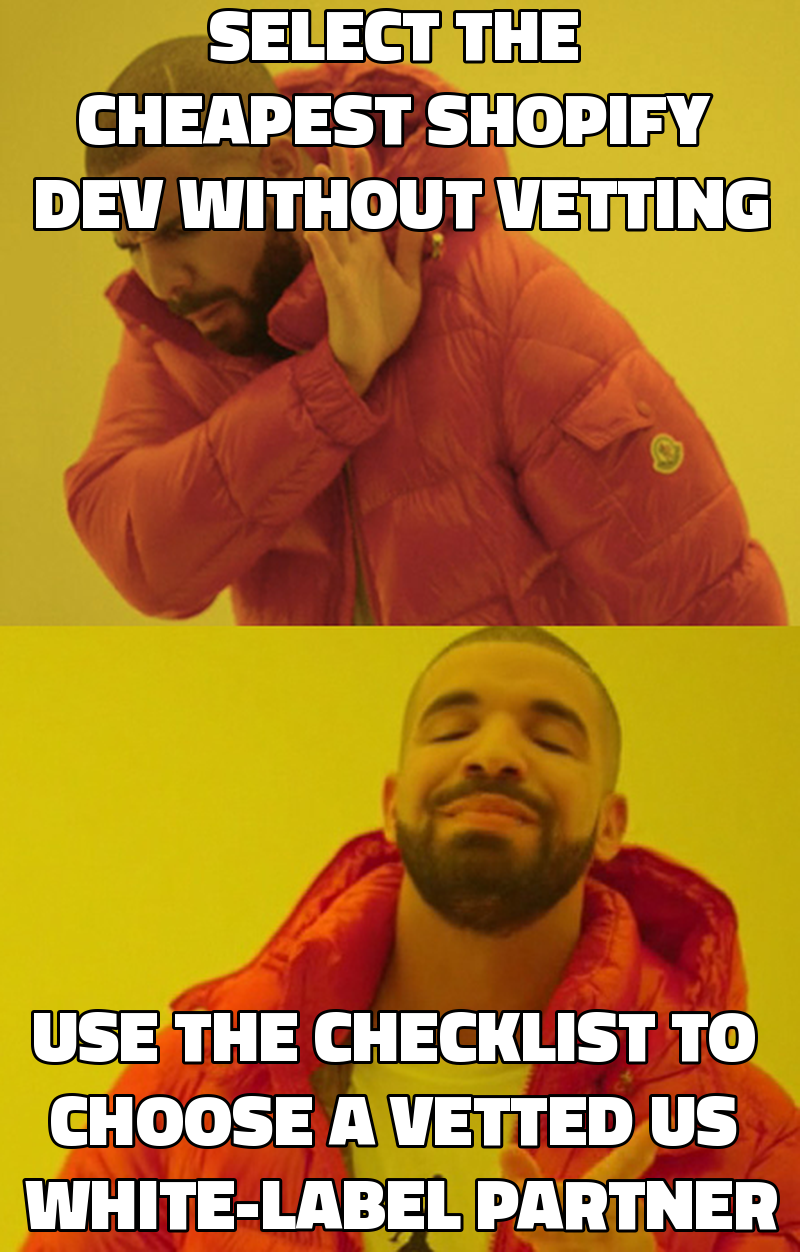
Checklist: 12 criteria to evaluate a white-label Shopify partner
| # | Criterion | How to verify |
|---|---|---|
| 1 | US-based legal entity and banking | Request a copy of the business registration and a US bank statement (or Stripe account) |
| 2 | Proven Shopify expertise | Look for Shopify Partner badge, at least 5 shipped stores in the last 12 months |
| 3 | AI and automation capability | Ask for a demo of a Shopify Flow or custom chatbot built for a client |
| 4 | Single accountable point of contact (POC) | Confirm the name, title and response SLA (e.g., 24-hour reply) |
| 5 | Fixed-scope pilot willingness | Insist on a $2k-$3k paid pilot with clear deliverables |
| 6 | Transparent wholesale pricing | Get a rate sheet showing cost per hour and markup limits |
| 7 | NDA & non-circumvent agreement | Review the template; ensure it covers IP and client poaching |
| 8 | Project dashboard access | Verify a shared board in ClickUp, Asana or a custom portal |
| 9 | Turn-around guarantees | Ask for a standard timeline (e.g., 2-3 weeks for a theme build) |
| 10 | Post-launch support SLA | Minimum 30-day bug-fix window, optional extended support |
| 11 | References from similar agencies | Contact at least two agencies of 5-15 headcount that have used them |
| 12 | Capacity limits | Ensure they cap active white-label partners to 5-7 to avoid flakiness |
How to score each criterion
| Criterion | Weight (1-5) | Pass threshold |
|---|---|---|
| US legal entity | 5 | Yes |
| Shopify Partner badge | 5 | Yes |
| AI/automation demos | 4 | Functional demo |
| Single POC | 4 | Named contact |
| Fixed-scope pilot | 5 | Signed pilot contract |
| Transparent pricing | 3 | Rate sheet provided |
| NDA & non-circumvent | 5 | Signed agreement |
| Dashboard access | 3 | Live view |
| Turn-around guarantee | 4 | Documented SLA |
| Post-launch support | 3 | 30-day clause |
| References | 4 | Positive feedback |
| Capacity limits | 5 | Confirmed cap |
Score each line, add the weighted points and compare to a 70% pass mark. A partner that reaches the threshold is ready for a pilot.
Pricing and contract models you should expect
US white-label agencies typically operate on two structures:
- Fixed-scope project – A flat fee covering design, development and 30-day support. The agency invoices you at a wholesale rate (50-70% of what you will charge the client). Minimum floor $1,500 protects them from low-margin projects.
- Retainer for escalation – After a successful pilot, you pay a monthly retainer for a reserved block of developer hours (15-20 hrs) that you can draw on for urgent or ad-hoc work.
Typical US white-label rates
| Service | Wholesale rate (USD) | Client bill range (USD) | Your margin |
|---|---|---|---|
| Theme customization (up to 20 pages) | $1,200-$2,000 | $2,500-$4,000 | 52-68% |
| Private app development (up to 3 integrations) | $2,000-$3,500 | $4,500-$7,000 | 55-78% |
| AI automation (Shopify Flow, chatbots) | $1,500-$2,500 | $3,000-$5,000 | 50-70% |
| Ongoing retainer (15-20 hrs) | $1,500 per month | $2,500-$3,500 per month | 57-71% |
These numbers are based on pricing data from the 2024 Shopify Partner Survey and a 2023 report by Forrester.
How to run a low-risk pilot with your new partner
- Define scope tightly – One store, one custom app, or a single automation. Document every deliverable in a scoped statement of work (SOW).
- Set a fixed timeline – 2-3 weeks for a theme, 3-4 weeks for an app. Include a 2-day buffer for client feedback.
- Agree on milestones and payment – 50% upfront, 50% on acceptance. Use escrow if you need extra security.
- Use a shared dashboard – Create a ClickUp board with columns: To-Do, In-Progress, Review, Done. Both sides update daily.
- Measure success – Criteria: on-time delivery, zero critical bugs, client satisfaction > 8/10.
- Decision gate – If the pilot meets all criteria, move to a retainer. If not, terminate politely and keep the NDA.
Red flags and disqualifiers to avoid
| Red flag | Why it matters |
|---|---|
| Lists “development” as a service on their website | No gap to fill – they already own the work |
| Shows a “built by” partner badge | Their dev partner is already locked in |
| Only offshore pricing (e.g., $15/hr) | Margin compression and IP risk |
| No US bank account or Stripe payout | Payment complications and legal exposure |
| Team size >20 with internal devs | They are a competitor, not a partner |
| No recent case studies or social activity | Likely dormant or low volume |
| Claims “all builds are no-code” | No need for custom Shopify work |
If any of these appear, move on.
Integration and communication workflow best practices
- Kick-off call – 30-minute video with your agency lead, the partner POC and a senior developer. Use a shared agenda in Google Docs.
- Requirement gathering – Capture user stories in a template (e.g., Asana task with Acceptance Criteria). Include screenshots, brand assets and Shopify store credentials.
- Version control – All code lives in a private GitHub repo owned by the partner but invited to your agency’s organization. This satisfies IP ownership.
- Daily stand-up notes – A brief Slack channel update (or Teams) summarizing progress, blockers and next steps.
- QA checklist – Run the Shopify Theme Check, Lighthouse scores > 90, and functional tests for each integration.
- Launch hand-off – Provide a launch checklist that includes DNS updates, payment gateway testing and client training.
Real-world case study: RouteMate and Synthisia partnership
RouteMate, a growth agency in Sydney, needed a custom Shopify app that synced inventory from a legacy ERP and added voice-activated search. Their internal team could not code the API layer. They engaged Synthisia on a $3,200 pilot. Within three weeks the app was live, the client reported a 22% increase in conversion, and RouteMate signed a $1,800 monthly retainer for ongoing enhancements. The partnership succeeded because Synthisia:
- Delivered under RouteMate’s brand (no client-facing credit)
- Provided a single senior developer as the point of contact
- Met the 2-week turnaround guarantee
- Offered a transparent rate sheet that allowed RouteMate to keep a 60% margin.
Next steps: From evaluation to signed NDA
- Run the 10-second site test – Open the prospect’s website, check the Services page. If “development” is missing, they are a candidate.
- Score them against the 12-point checklist – Use the weighted table to reach at least 70%.
- Schedule a discovery call – Confirm volume, budget and live need using the three gate questions.
- Send a pilot proposal – Include SOW, timeline, milestones and a short NDA template.
- Onboard with the shared dashboard – Set up ClickUp, invite the partner and agree on daily updates.
- Review pilot results – If criteria are met, negotiate a retainer and lock the partnership with a formal white-label agreement.
“The biggest mistake agencies make is trusting a partner based on price alone. Reliability, legal protection and a clear pilot process win the long-term game.” – quoted from a 2023 Forrester B2B partnership study.
Frequently asked questions
How do I know if a partner’s AI automation claims are real?
Ask for a live demo of a Shopify Flow or a custom chatbot built for a recent client. Verify the code repository, ask about the underlying platform (e.g., OpenAI, Dialogflow) and request a short case study that shows measurable results such as a 15% lift in checkout conversion.
What is a typical turnaround for a custom Shopify theme?
Most US white-label partners guarantee 10-15 business days for a 20-page theme when the scope is fully defined. The guarantee should be written in the SLA and include a clause for client-provided assets to avoid delays.
Can I negotiate a lower wholesale rate for higher volume?
Yes. Many partners offer tiered pricing: 5-10 projects per quarter can bring the wholesale rate down to 45% of the client bill. However, they will usually require a retainer to reserve capacity.
How does the NDA protect my agency’s brand?
The NDA should state that the partner will not disclose your agency’s name to the client, will not use your branding in any marketing material, and will keep all project IP confidential. A non-circumvent clause prevents the partner from approaching your client directly for a set period (typically 12 months).
What if the partner misses a deadline?
Include a penalty clause in the contract: a 5% discount on the invoice for each business day past the agreed delivery date, up to a maximum of 20%. This creates a financial incentive for on-time delivery.
Should I pay for a “free first draft”?
No. A free draft is high risk because it gives away engineering hours without commitment. Instead, request a low-cost prototype (one screen or one automation) priced at $200-$300, then move to a paid pilot.
How many active white-label partners can a US agency realistically handle?
Most reliable partners cap active white-label relationships at 5-7 agencies. This ensures they can dedicate a senior developer to each account and maintain the promised SLA.
Is it worth hiring an in-house developer instead of a white-label partner?
If your agency consistently needs more than 30-40 development hours per month, an in-house hire may be cost-effective. For sporadic or project-based demand, a white-label partner preserves cash flow and gives you access to senior talent without payroll overhead.
Shopify
Have something to build?
Tell us what you're trying to ship. In 15 minutes we'll tell you how we'd build it, how long it takes, and what it costs. No pitch deck, no pressure.