
How to Choose a White-Label Development Agency in the USA

White-label development agencies let marketing firms sell custom software, AI automation or voice solutions under their own brand while you stay invisible to the client. Choose a partner that delivers on time, protects your brand and offers a clear pilot path, and you can start saying yes to every build request.
Key takeaways
- Look for proven AI and automation expertise, not just generic web dev.
- Verify a single accountable point of contact with a shipped reference like RouteMate.
- Start with a fixed-scope paid pilot before committing to a retainer.
- Insist on NDA, non-circumvent clause and a wholesale margin of 50-70%.
- Red flags include in-house engineers, listed dev services or offshore-only pricing.
- Use a shared project dashboard to keep visibility without building a full SaaS.
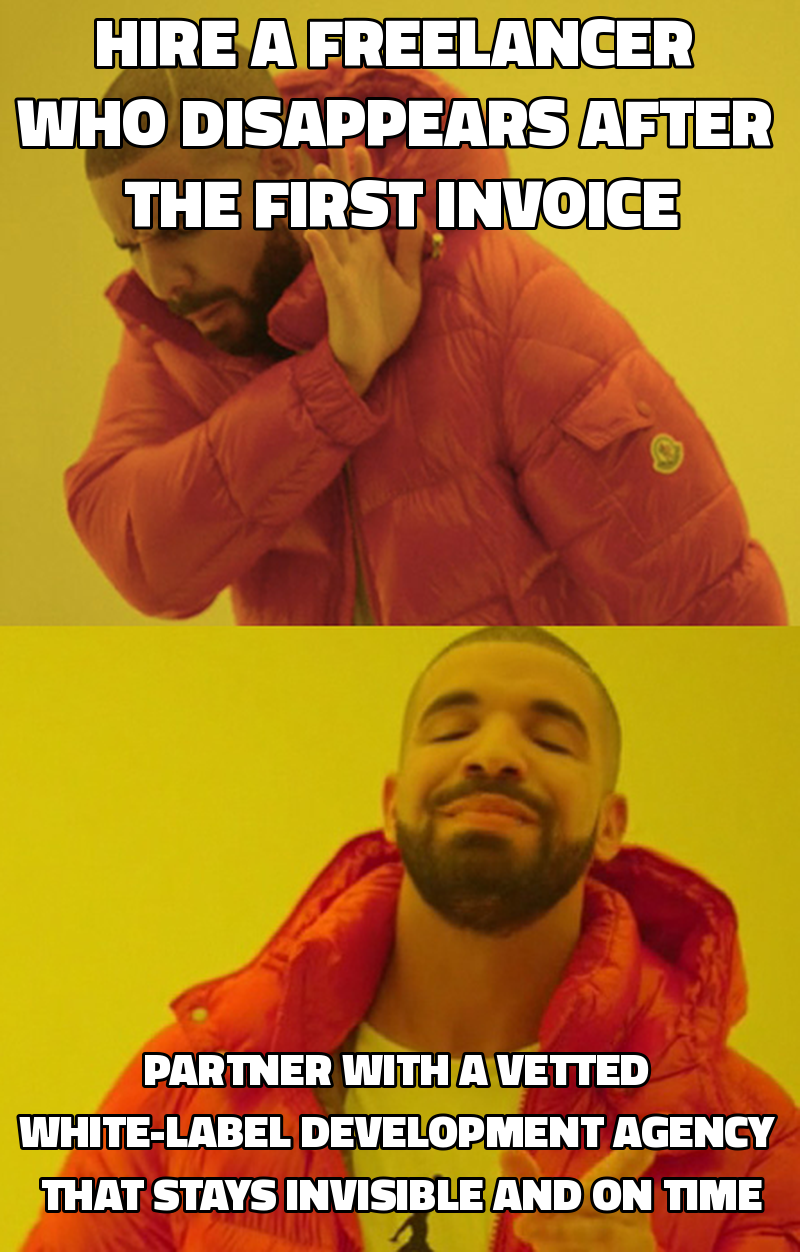
What is a white-label development agency and why do US agencies need one?
A white-label development agency builds custom software, AI bots, voice assistants or backend integrations that the hiring agency resells as its own service. The hiring agency keeps the client relationship, the margin and the brand identity, while the dev partner works behind the scenes. For agencies in the United States, United Kingdom or Australia that have 5-15 staff and no engineers, this model solves three core problems: lost revenue from turn-away projects, inability to quote confidently, and the risk of brand dilution when outsourcing to unknown freelancers.
According to a 2023 Gartner survey, 62% of small marketing firms cite "lack of technical capacity" as the top barrier to offering AI-driven solutions. By partnering with a specialist white-label agency, they can close that gap without the overhead of hiring a full-time developer.
How do I assess the credibility of a potential white-label partner?
| Evaluation Area | What to Look For | Why It Matters |
|---|---|---|
| Portfolio & References | At least three recent SaaS or automation projects, preferably with a public case study. Look for a live product like RouteMate that demonstrates end-to-end delivery. | Shows ability to ship production-grade code, not just prototypes. |
| Technical Stack | Proficiency in Node.js, Python, React, AWS Lambda, Google Dialogflow, Zapier or Make.com. | Guarantees they can handle AI, voice and custom backend work that no-code tools cannot. |
| Client Confidentiality | Signed NDA and non-circumvent clause, plus a documented process for brand masking. | Protects your agency’s reputation and prevents poaching. |
| Delivery Model | Single point of contact, sprint-based status updates, and a shared dashboard (e.g., ClickUp or Monday.com). | Reduces friction and gives you real-time visibility. |
| Financial Terms | Wholesale rate that leaves you 50-70% margin on $2k-5k projects, minimum floor $1,500 per project. | Ensures the partnership is profitable at scale. |
When you find a partner that checks most rows, schedule a discovery call that focuses on their process rather than price. Ask for a short demo of their project dashboard and request a copy of a recent NDA template.
Which criteria matter most for agencies without in-house developers?
- AI and automation expertise – Agencies are increasingly asked for chatbots, predictive analytics and voice assistants. A partner that lists OpenAI, LangChain, or Google Vertex AI as core competencies is a must.
- Turn-key branding compliance – The partner must be willing to sign a brand-masking agreement and deliver all UI assets in the agency’s style guide.
- Fixed-scope pricing – Variable hourly rates create surprise costs. Look for a clear scope-of-work document with a fixed price range ($500-$5,000) and defined delivery days.
- Geographic and timezone alignment – Partners located in the US, Canada or Eastern Europe provide a 4-8 hour overlap with US agencies, avoiding the 12+ hour gap that leads to missed deadlines.
- Support bandwidth – Low concurrency models (e.g., max 3 active agency partners) ensure the partner is not a flaky freelancer.
How do I evaluate pricing and contract terms for US-based white-label work?
The contract should be a wholesale agreement where the agency invoices the client at a marked-up rate and pays you a wholesale fee. Key clauses:
- Wholesale rate: 50-70% of the client invoice, matching the deal_shape values.
- Minimum floor: $1,500 per project to cover delivery overhead.
- Retainer option: $1,500-$2,500 per month for 15-20 dev hours once the pilot succeeds.
- Scope change policy: Any addition beyond the original scope triggers a change order at a pre-agreed hourly rate.
- Termination: 30-day notice with a prorated refund of any prepaid retainer.
For reference, Clutch’s 2022 report on US development agencies shows the median hourly rate for senior full-stack engineers at $150-$200. A wholesale margin of 55% on a $3,000 project leaves the agency with a healthy $1,350 profit while the partner receives $1,650 for the work.
What red flags indicate a partner is not a good fit?
| Red Flag | Explanation |
|---|---|
| Lists "development" as a service on their website | The agency already offers dev services and likely has no capacity to be invisible. |
| Shows a "built by" credit linking to another dev shop | Their partnership slot is already taken; you would be a third-wheel. |
| Only offshore rates quoted in INR or PHP | No wholesale margin for US agencies and higher risk of quality issues. |
| No public case studies or recent social activity (12+ months) | May be dormant or not delivering. |
| Claims "fastest delivery possible" without a turnaround band | Sets unbounded expectations that can burn you. |
| Team size >20 with an internal dev department | They are a competitor, not a partner. |
If any of these appear during the qualification gate, politely decline and move to the next prospect.
How to run a low-risk pilot before committing?
| Pilot Element | Recommended Approach |
|---|---|
| Scope | One small feature (e.g., a chatbot prototype or a data-export API) capped at 20-30 development hours. |
| Pricing | Fixed fee of $1,000-$1,500, payable up front. |
| Timeline | 2-3 weeks from kickoff to demo. |
| Success Metrics | Delivery on time, code quality (GitHub PR approvals), and client satisfaction score ≥4/5. |
| Next Step | If metrics are met, transition to a retainer or larger fixed-scope project. |
During the pilot, use a shared dashboard (ClickUp, Asana or Monday.com) with columns for "To Do", "In Progress", "Review" and "Done". This gives your agency visibility without requiring the partner to build a custom SaaS portal.
Which tools and platforms should the partner be proficient in?
- Backend: Node.js, Python (FastAPI), Ruby on Rails – these cover most API and automation needs.
- Frontend: React, Vue.js, Tailwind CSS – for custom client-facing portals.
- AI/ML: OpenAI GPT-4, Google Vertex AI, LangChain – essential for chatbots and content automation.
- Voice: Amazon Alexa Skills Kit, Google Dialogflow CX – for voice assistants.
- Integrations: Zapier, Make.com, Workato – to connect SaaS tools quickly.
- Cloud: AWS (Lambda, RDS), Google Cloud (Cloud Functions, Firestore) – for scalable hosting.
- Version Control: GitHub with protected branches and code review policies.
- Project Management: ClickUp or Monday.com with client-visible boards.
A partner that lists at least five of these in their tech stack and can provide recent GitHub commit samples passes the technical competency gate.
How to structure the ongoing relationship for repeat flow?
- Onboard with a pilot – Use the pilot as a trust mechanism, not an NDA enforcement.
- Define a retainer – After a successful pilot, sign a 6-month retainer at $1,500-$2,500 per month covering 15-20 dev hours.
- Set capacity limits – Cap active agency partners at three to maintain low concurrency and high reliability.
- Quarterly business reviews – Review volume, margin, and upcoming pipeline; adjust pricing tiers if needed.
- Escalation path – Assign a senior engineer as the escalation point for any critical bugs; response SLA of 24 hours.
- Brand masking checklist – Ensure every deliverable is re-branded (logo, color palette, copy) before hand-off.
By following this structure, agencies can consistently say yes to AI-driven projects, keep the client relationship intact, and maintain a 60% average margin on $3k-$5k builds.
Frequently asked questions
How long does a typical white-label project take?
A fixed-scope project of $2k-$5k usually completes in 2-4 weeks, depending on complexity. The partner should provide a delivery band in the proposal and stick to it.
Do I need to sign a non-disclosure agreement?
Yes. An NDA protects both parties and is considered table-stakes. It should cover confidentiality, brand masking and a non-circumvent clause.
Can I resell the partner’s work under my own pricing?
Absolutely. The wholesale model lets you set your own client price, as long as you maintain the agreed margin range of 50-70%.
What if the partner misses a deadline?
Include a SLA clause that triggers a discount or credit for missed milestones. Most reputable partners will offer a 5% credit per delayed week.
How do I handle support after launch?
Negotiate a support add-on in the retainer: 5-10 hours per month for bug fixes and minor enhancements. Anything beyond that can be billed as change orders.
Is it safe to work with an offshore partner?
Offshore rates can be attractive, but they often break the wholesale margin and increase brand risk. For US agencies, a partner in the US, Canada or Eastern Europe provides better alignment and legal recourse.
What if I already have a dev partner?
If your current partner cannot deliver AI, voice or custom backend work, you can position the white-label agency as a specialist overflow resource. Use the wedge qualifier question to surface that gap.
How many agencies should I partner with at once?
Start with one or two to validate the model. The deal_shape recommends capping active partners at three to keep delivery reliability high.
white‑label
Have something to build?
Tell us what you're trying to ship. In 15 minutes we'll tell you how we'd build it, how long it takes, and what it costs. No pitch deck, no pressure.