
How to Choose a US White-Label Shopify Development Partner: Checklist for Agencies

A white-label Shopify development agency in the USA is a partner that builds custom Shopify stores, apps, and integrations under your agency’s brand while you retain the client relationship. It lets you say yes to every client request without hiring full-time engineers, and it keeps the work invisible to the client.
Key takeaways
- Verify the partner’s Shopify-certified expertise and proven AI/automation track record.
- Insist on a written SLA that defines response times, bug-fix windows, and escalation paths.
- Confirm strict NDA and non-circumvent clauses to protect brand confidentiality.
- Test the partnership with a low-risk, fixed-scope pilot before committing to a retainer.
- Prefer agencies that operate in US/UK/AU time zones for realistic turn-around expectations.
- Look for a single point of contact who owns delivery from kickoff to launch.
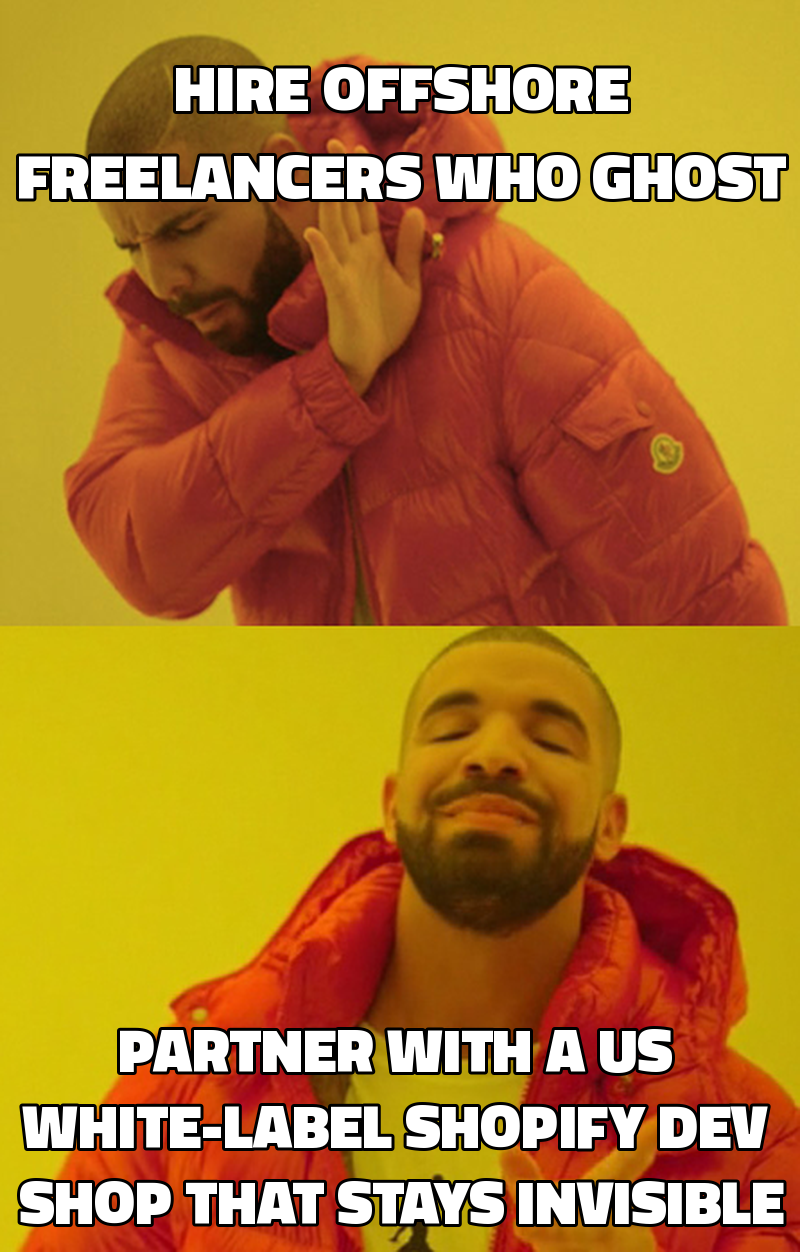
What exactly does a white-label Shopify development agency do?
A white-label Shopify partner takes the technical work that your agency cannot perform in-house – custom theme development, Shopify Plus migrations, private app creation, headless integrations, AI-driven personalization, voice commerce, and complex automation – and delivers it as if it were built by your own team. The client never sees the partner’s name; invoices, project updates, and final assets are branded with your agency’s identity. This model protects your client-facing reputation while expanding your service catalogue.
Why US-based partners matter for US/UK/AU agencies
- Currency alignment – Billing in USD avoids exchange-rate risk and matches your client’s payment expectations.
- Time-zone overlap – US-based teams provide at least 4-6 hours of overlap with US agencies and a reasonable 2-3 hour overlap with UK/AU agencies, reducing the “same-week” delivery myth.
- Legal enforceability – US courts enforce NDAs and non-circumvent clauses more reliably than offshore jurisdictions, according to a 2022 survey by the International Association of Contract Administrators.
- Cultural fit – Shared business etiquette and language reduce miscommunication, a factor highlighted in a 2023 Gartner study on agency-developer collaborations.
Checklist: Technical Stack Evaluation
| Criterion | What to Look For | Why It Matters |
|---|---|---|
| Shopify certification | Partner should have at least two Shopify Plus Certified Developers. | Guarantees deep platform knowledge and access to Shopify’s private APIs. |
| AI/automation expertise | Proven projects using OpenAI, Google Vertex AI, or custom Python/Ruby automation scripts. | Enables you to sell chat-bots, recommendation engines, and voice commerce without building the expertise yourself. |
| Headless capability | Experience with Hydrogen, Remix, or Next.js for headless Shopify stores. | Future-proofs client sites and opens higher-margin projects. |
| Integration stack | Pre-built connectors for ERP (NetSuite, SAP), CRM (HubSpot, Salesforce), and marketing tools (Klaviyo, Mailchimp). | Reduces custom coding time and improves project predictability. |
| Testing & CI/CD | Use of Jest, Cypress, and automated deployment pipelines (GitHub Actions, CircleCI). | Improves quality, lowers bug-fix costs, and speeds up delivery. |
How to verify: Request a portfolio that includes a link to a live Shopify Plus store, a case study describing AI-driven upsell logic, and a short video of their CI/CD pipeline.
Checklist: Service Level Agreement (SLA) Requirements
| SLA Element | Minimum Acceptable Level | Typical Industry Benchmark |
|---|---|---|
| Response time (critical issue) | 2 business hours | 1-4 hours per Shopify Partner Program data (2023). |
| Bug-fix turnaround (high priority) | 24-48 hours | 24-72 hours across top US dev shops (Clutch survey, 2022). |
| Feature delivery (fixed-scope) | 10-15 business days for $2-5k project | 12-18 days average for Shopify custom themes (Shopify Partner Report, 2023). |
| Communication cadence | Weekly status call + real-time Slack channel | Standard practice for white-label partners (Forrester, 2022). |
| Escalation path | Direct line to senior technical lead within 4 hours of issue | Recommended by the International Association of Outsourcing Professionals. |
Red flags: No written SLA, vague “we’ll respond ASAP,” or reliance on email only.
Checklist: Brand Confidentiality & Legal Safeguards
- NDA with mutual non-disclosure – Must cover all project artifacts, source code, and client data. Look for a clause that survives termination for at least two years.
- Non-circumvent clause – Prevents the partner from contacting your client directly for a defined period (usually 12 months).
- White-label branding clause – Explicit language that the partner will not place its logo on deliverables, invoices, or communications.
- IP ownership statement – All intellectual property created belongs to your agency (or your client, as you direct).
- Data protection compliance – GDPR for UK clients, CCPA for US clients, and Australian Privacy Principles for AU clients. Verify that the partner can sign a Data Processing Addendum (DPA).
How to enforce: Store signed agreements in a shared, version-controlled repository (e.g., GitHub private repo) and reference the document ID in every project brief.
How to run a low-risk pilot
- Scope a single, bounded feature – e.g., a custom product recommendation widget using OpenAI’s API.
- Set a fixed price – $2,500–$4,000, with a clear definition of “done.”
- Define success metrics – delivery within 10 business days, zero critical bugs, and client sign-off.
- Include a post-pilot review – 30-minute debrief covering timeline adherence, communication quality, and any hidden costs.
- Decision point – If the pilot meets all criteria, move to a retainer (e.g., $1,500/month for 15-20 dev hours). If not, politely terminate.
Real-world example: RouteMate’s partnership model
Synthisia’s “Silent Dev Arm” uses the exact checklist above. A UK-based branding agency needed a voice-enabled Shopify store for a fashion client. Synthisia delivered a headless store with Amazon Alexa integration in 12 days, met the 2-hour critical response SLA, and kept all branding under the agency’s name. The agency then signed a $1,800/month retainer for ongoing feature work, turning a one-off project into a recurring revenue stream.
Comparing US white-label partners vs offshore freelancers
| Factor | US White-Label Partner | Offshore Freelancer |
|---|---|---|
| Legal enforceability | Strong US contract law, easy to enforce NDAs | Limited recourse, jurisdictional challenges |
| Time-zone overlap | 4-6 hours with US agencies, 2-3 hours with UK/AU | Often 12+ hour lag, causing delays |
| Quality consistency | Certified developers, documented processes | Variable skill levels, no standard QA |
| SLA guarantees | Formal SLAs with penalties | Usually informal, no penalties |
| Pricing model | Wholesale rate + retainer, predictable cost | Low hourly rate but hidden overtime and re-work |
Bottom line: The higher upfront cost of a US partner is offset by reduced risk, faster turn-around, and the ability to keep your brand front-and-center.
Steps to onboard the right partner
- Run the 10-second site test – Confirm the agency does not list development as a service.
- Qualify with the three-gate framework – Volume, budget, and live need now.
- Score the partner against the checklist – Use a simple spreadsheet to tally pass/fail for each criterion.
- Negotiate pilot terms – Fixed scope, price, SLA, and confidentiality.
- Set up shared tools – Project dashboard (e.g., ClickUp or Asana), shared Slack channel, and GitHub repo with protected branches.
- Kick-off meeting – Introduce the single point of contact, review timeline, and confirm communication cadence.
- Monitor and iterate – After the pilot, assess KPI adherence and decide on retainer.
Common pitfalls and how to avoid them
- Choosing the cheapest partner – Low price often means missing SLAs, no NDA, and high turnover. Stick to partners that meet the minimum SLA thresholds.
- Skipping the pilot – Jumping straight to a retainer without proof of delivery leads to surprise delays and hidden costs.
- Relying on verbal agreements – Always have written contracts; verbal promises are not enforceable.
- Over-loading a single partner – Cap the number of active agency partners (Synthisia caps at 12) to maintain reliability.
- Ignoring data compliance – Failing to secure a DPA can result in fines under GDPR or CCPA.
Frequently asked questions
How long does a typical white-label Shopify build take?
A fixed-scope custom theme or app usually ships in 10-15 business days for a $2,000-$5,000 project, provided the scope is clearly defined and assets are supplied up front. Larger headless or AI-driven projects may require 4-6 weeks.
What certifications should I look for?
At minimum, the partner should have two Shopify Plus Certified Developers and documented experience with AI platforms such as OpenAI, Google Vertex AI, or Azure Cognitive Services.
Can I keep my client’s data secure?
Yes, if the partner signs a Data Processing Addendum and follows GDPR, CCPA, and Australian Privacy Principles. Ask for evidence of SOC 2 Type II compliance for added assurance.
How is pricing structured?
Most US white-label partners work on a wholesale rate (50-70% of the agency’s bill) plus a monthly retainer for ongoing support. Fixed-scope pilots range from $2,500 to $5,000.
What if the partner misses an SLA?
A solid SLA includes penalty clauses, such as service credits or a discount on the next month’s retainer. Make sure this is written into the contract.
Do I need a technical champion on my side?
Having a Head of Delivery or Operations Director as the internal champion speeds up decision-making and ensures the partner’s work aligns with client expectations.
Is it possible to scale beyond one partner?
Yes, but only after you have proven reliability with a single partner. Over-onboarding creates the flaky-freelancer problem you’re trying to avoid.
How do I protect my brand from being exposed?
Enforce a white-label branding clause, use a generic email domain for all communications, and never share the partner’s logo on client-facing assets.
Shopify
Have something to build?
Tell us what you're trying to ship. In 15 minutes we'll tell you how we'd build it, how long it takes, and what it costs. No pitch deck, no pressure.