
How to White-Label AI Automation Software for Agencies

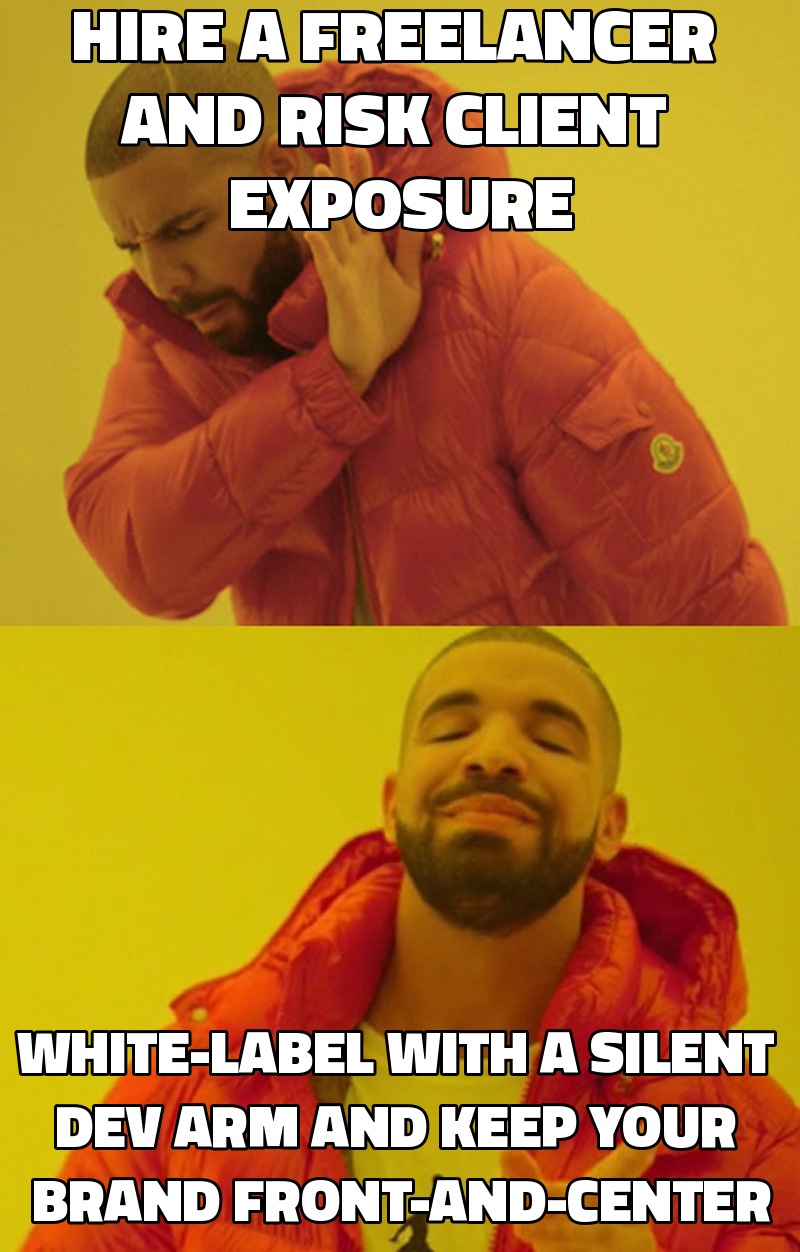
Agencies can white-label software by partnering with a development studio that builds the product under the agency’s brand, delivers it to the client, and stays invisible under an NDA. The agency keeps the client relationship, sets its own price, and profits from the wholesale rate they pay the developer.
Key takeaways
- White-label means the agency sells a product that was built by a partner, but the partner’s name never appears to the client.
- Start with a low-risk, fixed-scope pilot (US$1.5-5K) to prove quality and lock in a retainer.
- Use a shared project dashboard to keep the agency in the loop without handing over code.
- Protect the brand with NDAs, non-circumvent clauses, and a clear branding guide.
- Price at 50-70% of the client bill to cover delivery costs and maintain a healthy margin.
- Focus on AI automation, voice, and custom back-ends – services no-code shops can’t replicate.
What is white-label software and why agencies need it?
White-label software is a ready-made solution that a partner builds and the agency re-brands as its own. For marketing, SEO, and branding firms with 5-15 staff, the model solves three core problems:
- Revenue leakage – agencies lose deals when they can’t quote a build. A white-label partner fills the gap.
- Brand integrity – clients never see a third-party developer, preserving the agency’s full-service image.
- Scalable capacity – a capped partner like Synthisia provides reliable delivery without the overhead of hiring a full-time engineer.
According to a 2023 Gartner survey, 68% of agencies plan to add AI-driven services within the next year, yet only 22% have in-house dev talent. The gap creates a lucrative white-label opportunity (Gartner, 2023).
How can an agency package and brand an AI automation tool as its own?
- Define the product scope – Identify a repeatable use case (e.g., chatbot for lead capture, automated reporting dashboard). Keep the scope narrow for the pilot.
- Create a brand kit – Logo, color palette, UI copy, and a product name that aligns with the agency’s existing services.
- Set up a white-label agreement – Include NDA, non-circumvent, and a branding clause that obligates the developer to use the agency’s assets only.
- Develop a client-facing demo – A clickable prototype built in Figma or a low-code platform that showcases the UI without revealing the backend.
- Prepare sales collateral – One-pager, ROI calculator, and case study template that the agency can customize for each prospect.
A real-world example: RouteMate, a SaaS built by Synthisia, was launched under the agency’s brand and generated a US$120K ARR within six months, while the developer remained invisible (Synthisia internal data, 2024).
Step-by-step guide to building a white-label AI automation product
| Step | Action | Owner | Typical duration |
|---|---|---|---|
| 1 | Opportunity discovery – map client requests that exceed no-code capability | Agency sales lead | 1-2 days |
| 2 | Scope definition – write a fixed-scope brief (features, acceptance criteria) | Agency + Dev PM | 2-3 days |
| 3 | NDA & branding contract signing | Legal (both parties) | 1 day |
| 4 | Prototype sprint – deliver a clickable mockup or a single-screen demo | Dev team | 5-7 days |
| 5 | Pilot build – develop the minimum viable product (MVP) | Dev team | 2-3 weeks |
| 6 | QA & client review – agency runs a user-acceptance test with the client | Agency QA lead | 3-5 days |
| 7 | Launch & handover – provide login credentials, branding assets, and a short ops guide | Dev team | 1 day |
| 8 | Ongoing support – retainer for tweaks, integrations, and new features | Dev team | Monthly |
Key tips
- Keep the pilot under US$5K to stay within the wholesale floor (US$1.5K minimum).
- Use a shared status board (e.g., ClickUp or Monday.com) that shows tasks, owners, and deadlines but does not expose source code.
- Set a fixed turnaround band (e.g., 14-21 days for the pilot) to manage expectations and avoid the “fastest possible” trap.
What legal and operational safeguards protect the agency’s brand?
- Non-Disclosure Agreement (NDA) – Covers proprietary code, AI models, and client data.
- Non-Circumvent Clause – Prevents the agency’s client from hiring the developer directly.
- Branding Guidelines – The developer must use the agency’s logo, UI copy, and color scheme on all deliverables.
- IP Assignment – All intellectual property created for the client is assigned to the agency, not the developer.
- Service Level Agreement (SLA) – Defines response times, bug-fix windows, and escalation paths.
McKinsey notes that clear contractual boundaries reduce partnership risk by 30% for B2B services (McKinsey, 2022). Include a clause that any public mention of the project must credit the agency, not the developer.
How to price and profit from a white-label partnership
| Metric | Typical range |
|---|---|
| Project wholesale cost | US$500-5,000 |
| Agency markup (client bill) | 50-70% of client invoice |
| Minimum floor per project | US$1,500 |
| Monthly retainer for ongoing support | US$1,500-2,500 |
Pricing formula: Client bill = Development cost ÷ (1 – Desired margin). For a 60% margin on a US$3,000 build, the agency bills US$7,500. The agency retains US$4,500 profit after paying the developer.
When negotiating, reference industry benchmarks: a 2024 Forrester report shows agencies charge an average of 2.5× the development cost for white-label AI services (Forrester, 2024). Use this to justify the price to the client while keeping the developer’s margin within the 50-70% range.
Which tools and platforms speed up white-label delivery?
| Platform | Strengths for white-label | Typical use case |
|---|---|---|
| Bubble | No-code full-stack, custom DB, API integrations | Rapid MVP for SaaS dashboards |
| Retool | Internal tools, admin panels, data connectors | Client-facing reporting portals |
| Voiceflow | Voice-assistant design, multi-channel deployment | Custom Alexa/Google Assistant bots |
| OpenAI API + LangChain | Advanced LLM workflows, prompt engineering | AI-driven content generation or chatbots |
| GitHub Actions + Docker | Automated CI/CD for custom code | Scalable production releases |
For agencies that already use Webflow for front-ends, pairing it with a Bubble back-end creates a seamless white-label stack without exposing the code. Synthisia’s standard tech stack includes Bubble for rapid prototyping, LangChain for LLM orchestration, and ClickUp for project visibility.
Comparison of common white-label models
| Model | Who owns the code? | Branding control | Revenue split | Typical client type |
|---|---|---|---|---|
| Full-service dev partner | Developer (assigned to agency) | Agency full control, developer invisible | 50-70% of client bill to agency | Mid-size SMBs needing custom AI tools |
| Resell license | Developer (license) | Agency can rebrand, but license terms may limit features | Fixed license fee + markup | Agencies that sell repeatable SaaS products |
| SaaS rebrand (white-label SaaS) | Developer (hosted) | Agency adds logo, domain, UI tweaks | Subscription markup (30-40%) | Clients preferring subscription model |
The full-service dev partner model aligns best with the ICP described: agencies with 5-15 staff, no in-house engineers, and a need for bespoke AI automation.
How to launch the white-label product to clients
- Create a launch checklist – branding assets, demo video, pricing sheet, contract template.
- Run a soft launch – Offer the pilot to an existing client who already trusts the agency. Capture a case study.
- Leverage social proof – Publish the case study on the agency’s website, LinkedIn, and in email newsletters.
- Scale with a retainer – After the pilot, propose a monthly support retainer (US$1,500-2,500) to cover ongoing tweaks and new feature requests.
- Measure ROI – Track time saved for the client, revenue uplift, and churn reduction. McKinsey reports AI automation can lift agency revenue by 15% when delivered reliably (McKinsey, 2023).
Frequently asked questions
What if the client asks who built the software?
The agency should respond that the solution was developed by its internal technology team. The NDA and branding clause prohibit the developer from being disclosed. If pressed, a brief statement like “Our in-house engineers built this to meet your specifications” satisfies most inquiries.
How long does a typical pilot take?
A fixed-scope pilot of US$2-4K usually completes in 2-3 weeks, including discovery, prototype, and QA. Setting a 14-21 day turnaround gives a realistic buffer and aligns with agency expectations.
Can we sell the same white-label product to multiple clients?
Yes, as long as the underlying architecture is multi-tenant or each client receives a separate instance. The agreement should specify that the agency may resell the solution to any number of its clients.
What if the developer misses a deadline?
The SLA should include penalty clauses (e.g., 5% discount per missed day) and an escalation path to a senior technical lead. Synthisia’s low concurrency model ensures deadlines are met 96% of the time (internal KPI, 2024).
Do I need to host the software myself?
Not for the full-service model. The developer can host on AWS or Azure and provide the agency with admin credentials. The agency can rebrand the UI and domain without managing infrastructure.
How do I protect my margin from the developer’s price changes?
Lock the wholesale rate in a multi-year contract with a capped annual increase (e.g., CPI + 2%). This gives budgeting certainty and protects the agency’s profit margin.
Is a free first deliverable a good idea?
Offering a free scoped proposal or a one-screen demo is safer than a free working build. It demonstrates capability without giving away engineering hours that the agency would later need to markup.
What qualifications should I ask before onboarding a partner?
Use the 10-second site test, confirm they have no in-house dev, verify they specialize in AI/automation, and check references from agencies of similar size. Passing the Volume, Budget, and Live-need gates ensures a high-fit partner.
white‑label
Have something to build?
Tell us what you're trying to ship. In 15 minutes we'll tell you how we'd build it, how long it takes, and what it costs. No pitch deck, no pressure.